Showing:

Annotations
Attributes
Diagrams
Instances
Model
Properties
Source
Used by
Element diggs:ResistivityReadingType / diggs:electrodeSpacing
Namespace http://diggsml.org/schemas/3
Annotations
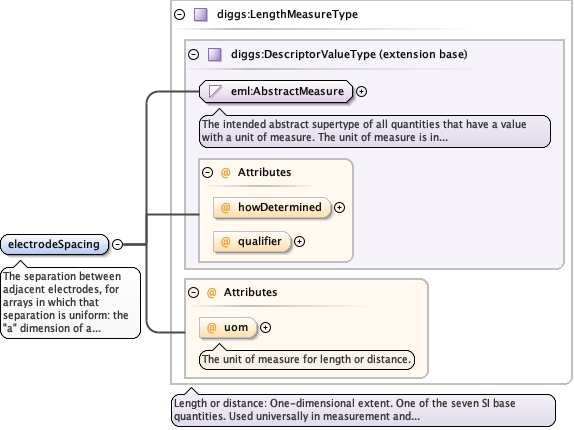
The separation between adjacent electrodes, for arrays in which
that separation is uniform: the "a" dimension of a Wenner array,
and the probe spacing of a Wenner probe applied to a concrete
surface.
Diagram
DiagramEmlAllObjects_xsd_Simple_Type_eml_AbstractMeasure.tmp#AbstractMeasureMeasureTypes_xsd_Complex_Type_diggs_DescriptorValueType.tmp#DescriptorValueType_howDeterminedMeasureTypes_xsd_Complex_Type_diggs_DescriptorValueType.tmp#DescriptorValueType_qualifierMeasureTypes_xsd_Complex_Type_diggs_DescriptorValueType.tmp#DescriptorValueTypeMeasureTypes_xsd_Complex_Type_diggs_LengthMeasureType.tmp#LengthMeasureType_uomMeasureTypes_xsd_Complex_Type_diggs_LengthMeasureType.tmp#LengthMeasureType
Type diggs:LengthMeasureType
Type hierarchy
Properties
content complex
Attributes
QName Type Use Annotation
howDetermined diggs:DescriptorMethodEnumType optional
qualifier diggs:QualifierEnumExtType optional
uom diggs:LengthUomEnumType optional
The unit of measure for length or distance.
Source
<element name="electrodeSpacing" type="diggs:LengthMeasureType">
  <annotation>
    <documentation>The separation between adjacent electrodes, for arrays in which that separation is uniform: the "a" dimension of a Wenner array, and the probe spacing of a Wenner probe applied to a concrete surface.</documentation>
  </annotation>
</element>
Element diggs:ResistivityReadingType / diggs:currentElectrodeSeparation
Namespace http://diggsml.org/schemas/3
Annotations
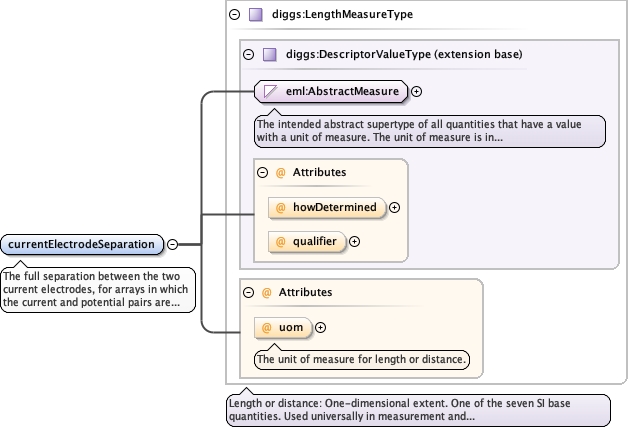
The full separation between the two current electrodes, for
arrays in which the current and potential pairs are
separated differently, principally Schlumberger. It is not
the half-separation against which sounding curves are
conventionally plotted.
Diagram
DiagramEmlAllObjects_xsd_Simple_Type_eml_AbstractMeasure.tmp#AbstractMeasureMeasureTypes_xsd_Complex_Type_diggs_DescriptorValueType.tmp#DescriptorValueType_howDeterminedMeasureTypes_xsd_Complex_Type_diggs_DescriptorValueType.tmp#DescriptorValueType_qualifierMeasureTypes_xsd_Complex_Type_diggs_DescriptorValueType.tmp#DescriptorValueTypeMeasureTypes_xsd_Complex_Type_diggs_LengthMeasureType.tmp#LengthMeasureType_uomMeasureTypes_xsd_Complex_Type_diggs_LengthMeasureType.tmp#LengthMeasureType
Type diggs:LengthMeasureType
Type hierarchy
Properties
content complex
Attributes
QName Type Use Annotation
howDetermined diggs:DescriptorMethodEnumType optional
qualifier diggs:QualifierEnumExtType optional
uom diggs:LengthUomEnumType optional
The unit of measure for length or distance.
Source
<element name="currentElectrodeSeparation" type="diggs:LengthMeasureType">
  <annotation>
    <documentation>The full separation between the two current electrodes, for arrays in which the current and potential pairs are separated differently, principally Schlumberger. It is not the half-separation against which sounding curves are conventionally plotted.</documentation>
  </annotation>
</element>
Element diggs:ResistivityReadingType / diggs:potentialElectrodeSeparation
Namespace http://diggsml.org/schemas/3
Annotations
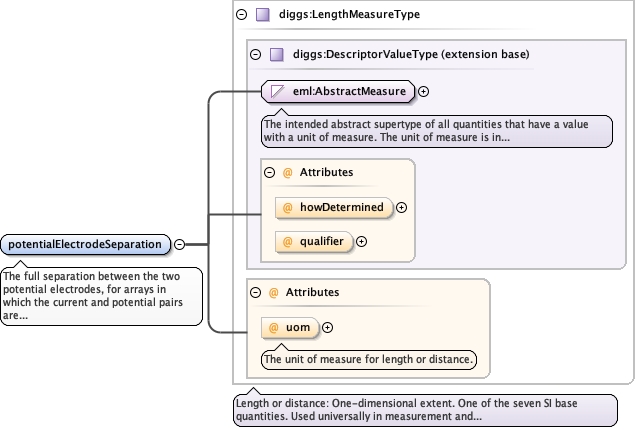
The full separation between the two potential electrodes,
for arrays in which the current and potential pairs are
separated differently, principally Schlumberger. It follows
the same convention as
diggs:ResistivityReadingType/currentElectrodeSeparation.
Diagram
DiagramEmlAllObjects_xsd_Simple_Type_eml_AbstractMeasure.tmp#AbstractMeasureMeasureTypes_xsd_Complex_Type_diggs_DescriptorValueType.tmp#DescriptorValueType_howDeterminedMeasureTypes_xsd_Complex_Type_diggs_DescriptorValueType.tmp#DescriptorValueType_qualifierMeasureTypes_xsd_Complex_Type_diggs_DescriptorValueType.tmp#DescriptorValueTypeMeasureTypes_xsd_Complex_Type_diggs_LengthMeasureType.tmp#LengthMeasureType_uomMeasureTypes_xsd_Complex_Type_diggs_LengthMeasureType.tmp#LengthMeasureType
Type diggs:LengthMeasureType
Type hierarchy
Properties
content complex
Attributes
QName Type Use Annotation
howDetermined diggs:DescriptorMethodEnumType optional
qualifier diggs:QualifierEnumExtType optional
uom diggs:LengthUomEnumType optional
The unit of measure for length or distance.
Source
<element name="potentialElectrodeSeparation" type="diggs:LengthMeasureType">
  <annotation>
    <documentation>The full separation between the two potential electrodes, for arrays in which the current and potential pairs are separated differently, principally Schlumberger. It follows the same convention as diggs:ResistivityReadingType/currentElectrodeSeparation.</documentation>
  </annotation>
</element>
Element diggs:ResistivityReadingType / diggs:dipoleLength
Namespace http://diggsml.org/schemas/3
Annotations
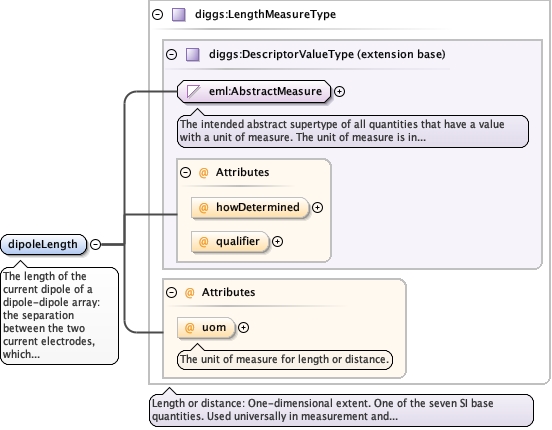
The length of the current dipole of a dipole-dipole array:
the separation between the two current electrodes, which
equals the separation between the two potential electrodes
(the "a" spacing in the n-a dipole-dipole notation).
Diagram
DiagramEmlAllObjects_xsd_Simple_Type_eml_AbstractMeasure.tmp#AbstractMeasureMeasureTypes_xsd_Complex_Type_diggs_DescriptorValueType.tmp#DescriptorValueType_howDeterminedMeasureTypes_xsd_Complex_Type_diggs_DescriptorValueType.tmp#DescriptorValueType_qualifierMeasureTypes_xsd_Complex_Type_diggs_DescriptorValueType.tmp#DescriptorValueTypeMeasureTypes_xsd_Complex_Type_diggs_LengthMeasureType.tmp#LengthMeasureType_uomMeasureTypes_xsd_Complex_Type_diggs_LengthMeasureType.tmp#LengthMeasureType
Type diggs:LengthMeasureType
Type hierarchy
Properties
content complex
Attributes
QName Type Use Annotation
howDetermined diggs:DescriptorMethodEnumType optional
qualifier diggs:QualifierEnumExtType optional
uom diggs:LengthUomEnumType optional
The unit of measure for length or distance.
Source
<element name="dipoleLength" type="diggs:LengthMeasureType">
  <annotation>
    <documentation>The length of the current dipole of a dipole-dipole array: the separation between the two current electrodes, which equals the separation between the two potential electrodes (the "a" spacing in the n-a dipole-dipole notation).</documentation>
  </annotation>
</element>
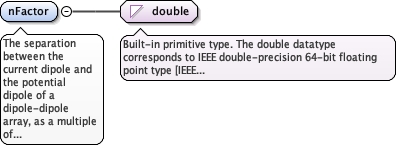
Element diggs:ResistivityReadingType / diggs:nFactor
Namespace http://diggsml.org/schemas/3
Annotations
The separation between the current dipole and the potential
dipole of a dipole-dipole array, as a multiple of
diggs:ResistivityReadingType/dipoleLength (the "n" in the
n-a notation) rather than as a length. The multiplier is
what a survey steps from one reading to the next at a fixed
dipole length.
Diagram
Diagram
Type double
Properties
content simple
Source
<element name="nFactor" type="double">
  <annotation>
    <documentation>The separation between the current dipole and the potential dipole of a dipole-dipole array, as a multiple of diggs:ResistivityReadingType/dipoleLength (the "n" in the n-a notation) rather than as a length. The multiplier is what a survey steps from one reading to the next at a fixed dipole length.</documentation>
  </annotation>
</element>
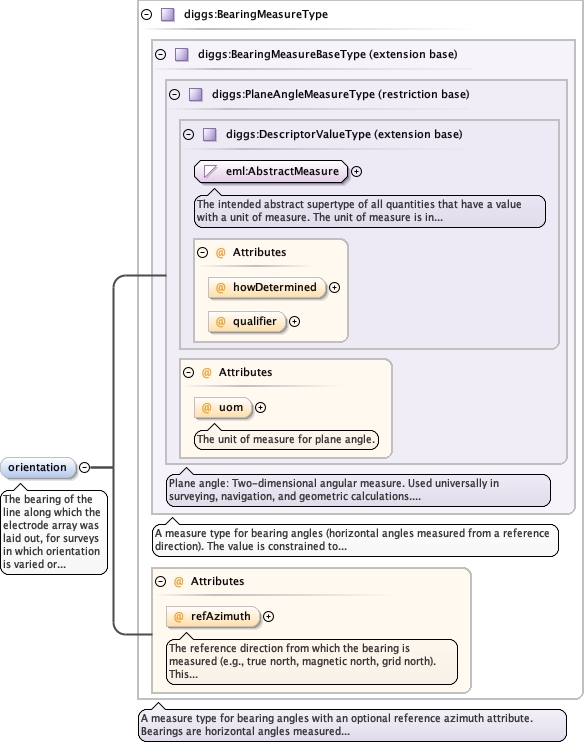
Element diggs:ResistivityReadingType / diggs:orientation
Namespace http://diggsml.org/schemas/3
Annotations
The bearing of the line along which the electrode array was laid
out, for surveys in which orientation is varied or otherwise
significant. An array line has no direction, so give the one of its
two opposed bearings that falls between 0 and 180 degrees. The
reference direction is carried by the refAzimuth attribute of the
measure.
Diagram
DiagramEmlAllObjects_xsd_Simple_Type_eml_AbstractMeasure.tmp#AbstractMeasureMeasureTypes_xsd_Complex_Type_diggs_DescriptorValueType.tmp#DescriptorValueType_howDeterminedMeasureTypes_xsd_Complex_Type_diggs_DescriptorValueType.tmp#DescriptorValueType_qualifierMeasureTypes_xsd_Complex_Type_diggs_DescriptorValueType.tmp#DescriptorValueTypeMeasureTypes_xsd_Complex_Type_diggs_PlaneAngleMeasureType.tmp#PlaneAngleMeasureType_uomMeasureTypes_xsd_Complex_Type_diggs_PlaneAngleMeasureType.tmp#PlaneAngleMeasureTypeMeasureTypes_xsd_Complex_Type_diggs_BearingMeasureBaseType.tmp#BearingMeasureBaseTypeMeasureTypes_xsd_Complex_Type_diggs_BearingMeasureType.tmp#BearingMeasureType_refAzimuthMeasureTypes_xsd_Complex_Type_diggs_BearingMeasureType.tmp#BearingMeasureType
Type diggs:BearingMeasureType
Type hierarchy
Properties
content complex
minOccurs 0
Attributes
QName Type Use Annotation
howDetermined diggs:DescriptorMethodEnumType optional
qualifier diggs:QualifierEnumExtType optional
refAzimuth diggs:AziRefEnumType optional
The reference direction from which the bearing is measured (e.g., true north, magnetic north, grid north). This attribute specifies the azimuth reference system used.
uom diggs:PlaneAngleUomEnumType optional
The unit of measure for plane angle.
Source
<element minOccurs="0" name="orientation" type="diggs:BearingMeasureType">
  <annotation>
    <documentation>The bearing of the line along which the electrode array was laid out, for surveys in which orientation is varied or otherwise significant. An array line has no direction, so give the one of its two opposed bearings that falls between 0 and 180 degrees. The reference direction is carried by the refAzimuth attribute of the measure.</documentation>
  </annotation>
</element>
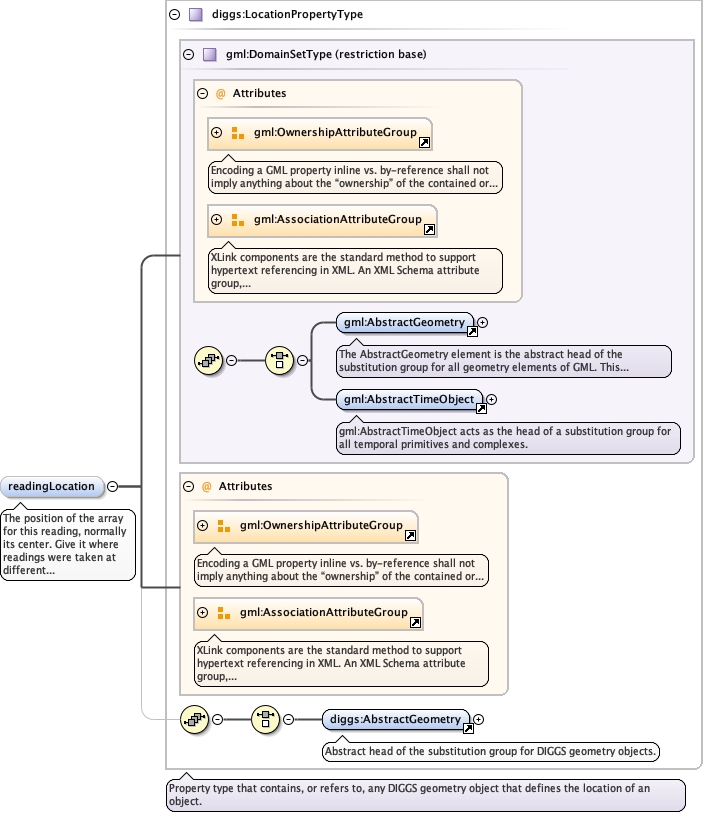
Element diggs:ResistivityReadingType / diggs:readingLocation
Namespace http://diggsml.org/schemas/3
Annotations
The position of the array for this reading, normally its center.
Give it where readings were taken at different positions,
principally constant separation traversing and successive points on
a structure. Where every reading shares one position, the sampling
feature the test was performed at carries it.
Diagram
Diagramgml3_2Profile_diggs_xsd_Attribute_Group_gml_OwnershipAttributeGroup.tmp#OwnershipAttributeGroupgml3_2Profile_diggs_xsd_Attribute_Group_gml_AssociationAttributeGroup.tmp#AssociationAttributeGroupgml3_2Profile_diggs_xsd_Element_gml_AbstractGeometry.tmp#AbstractGeometrygml3_2Profile_diggs_xsd_Element_gml_AbstractTimeObject.tmp#AbstractTimeObjectgml3_2Profile_diggs_xsd_Complex_Type_gml_DomainSetType.tmp#DomainSetTypegml3_2Profile_diggs_xsd_Attribute_Group_gml_OwnershipAttributeGroup.tmp#OwnershipAttributeGroupgml3_2Profile_diggs_xsd_Attribute_Group_gml_AssociationAttributeGroup.tmp#AssociationAttributeGroupCore_xsd_Element_diggs_AbstractGeometry.tmp#http___diggsml.org_schemas_3_AbstractGeometryCommon_xsd_Complex_Type_diggs_LocationPropertyType.tmp#LocationPropertyType
Type diggs:LocationPropertyType
Type hierarchy
Properties
content complex
minOccurs 0
Model
Children diggs:AbstractGeometry
Instance
<diggs:readingLocation owns="false" xlink:href="" nilReason="" xmlns:diggs="http://diggsml.org/schemas/3">
  <diggs:AbstractGeometry axisLabels="" gml:id="" srsDimension="" srsName="" uomLabels="">{1,1}</diggs:AbstractGeometry>
</diggs:readingLocation>
Attributes
QName Type Default Use
nilReason gml:NilReasonType optional
owns boolean false optional
xlink:href anyURI optional
Source
<element minOccurs="0" name="readingLocation" type="diggs:LocationPropertyType">
  <annotation>
    <documentation>The position of the array for this reading, normally its center. Give it where readings were taken at different positions, principally constant separation traversing and successive points on a structure. Where every reading shares one position, the sampling feature the test was performed at carries it.</documentation>
  </annotation>
</element>
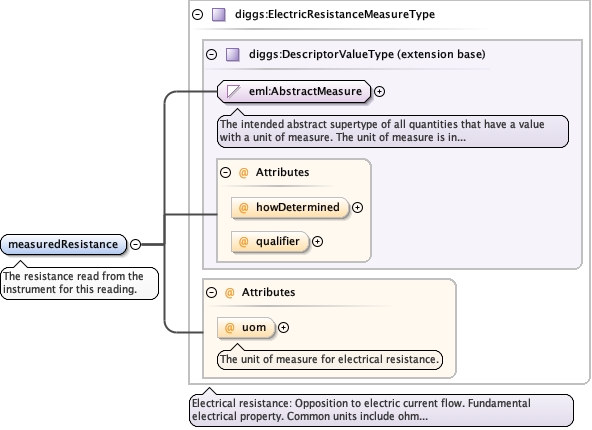
Element diggs:ResistivityReadingType / diggs:measuredResistance
Namespace http://diggsml.org/schemas/3
Annotations
The resistance read from the instrument for this reading.
Diagram
DiagramEmlAllObjects_xsd_Simple_Type_eml_AbstractMeasure.tmp#AbstractMeasureMeasureTypes_xsd_Complex_Type_diggs_DescriptorValueType.tmp#DescriptorValueType_howDeterminedMeasureTypes_xsd_Complex_Type_diggs_DescriptorValueType.tmp#DescriptorValueType_qualifierMeasureTypes_xsd_Complex_Type_diggs_DescriptorValueType.tmp#DescriptorValueTypeMeasureTypes_xsd_Complex_Type_diggs_ElectricResistanceMeasureType.tmp#ElectricResistanceMeasureType_uomMeasureTypes_xsd_Complex_Type_diggs_ElectricResistanceMeasureType.tmp#ElectricResistanceMeasureType
Type diggs:ElectricResistanceMeasureType
Type hierarchy
Properties
content complex
minOccurs 1
Attributes
QName Type Use Annotation
howDetermined diggs:DescriptorMethodEnumType optional
qualifier diggs:QualifierEnumExtType optional
uom diggs:ElectricResistanceUomEnumType optional
The unit of measure for electrical resistance.
Source
<element minOccurs="1" name="measuredResistance" type="diggs:ElectricResistanceMeasureType">
  <annotation>
    <documentation>The resistance read from the instrument for this reading.</documentation>
  </annotation>
</element>
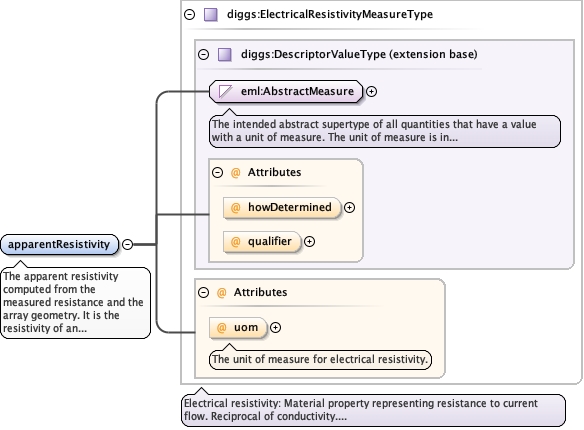
Element diggs:ResistivityReadingType / diggs:apparentResistivity
Namespace http://diggsml.org/schemas/3
Annotations
The apparent resistivity computed from the measured resistance and
the array geometry. It is the resistivity of an equivalent
homogeneous medium; where the ground is layered or anisotropic it is
not the resistivity of any one layer.
Diagram
DiagramEmlAllObjects_xsd_Simple_Type_eml_AbstractMeasure.tmp#AbstractMeasureMeasureTypes_xsd_Complex_Type_diggs_DescriptorValueType.tmp#DescriptorValueType_howDeterminedMeasureTypes_xsd_Complex_Type_diggs_DescriptorValueType.tmp#DescriptorValueType_qualifierMeasureTypes_xsd_Complex_Type_diggs_DescriptorValueType.tmp#DescriptorValueTypeMeasureTypes_xsd_Complex_Type_diggs_ElectricalResistivityMeasureType.tmp#ElectricalResistivityMeasureType_uomMeasureTypes_xsd_Complex_Type_diggs_ElectricalResistivityMeasureType.tmp#ElectricalResistivityMeasureType
Type diggs:ElectricalResistivityMeasureType
Type hierarchy
Properties
content complex
minOccurs 1
Attributes
QName Type Use Annotation
howDetermined diggs:DescriptorMethodEnumType optional
qualifier diggs:QualifierEnumExtType optional
uom diggs:ElectricalResistivityUomEnumType optional
The unit of measure for electrical resistivity.
Source
<element minOccurs="1" name="apparentResistivity" type="diggs:ElectricalResistivityMeasureType">
  <annotation>
    <documentation>The apparent resistivity computed from the measured resistance and the array geometry. It is the resistivity of an equivalent homogeneous medium; where the ground is layered or anisotropic it is not the resistivity of any one layer.</documentation>
  </annotation>
</element>
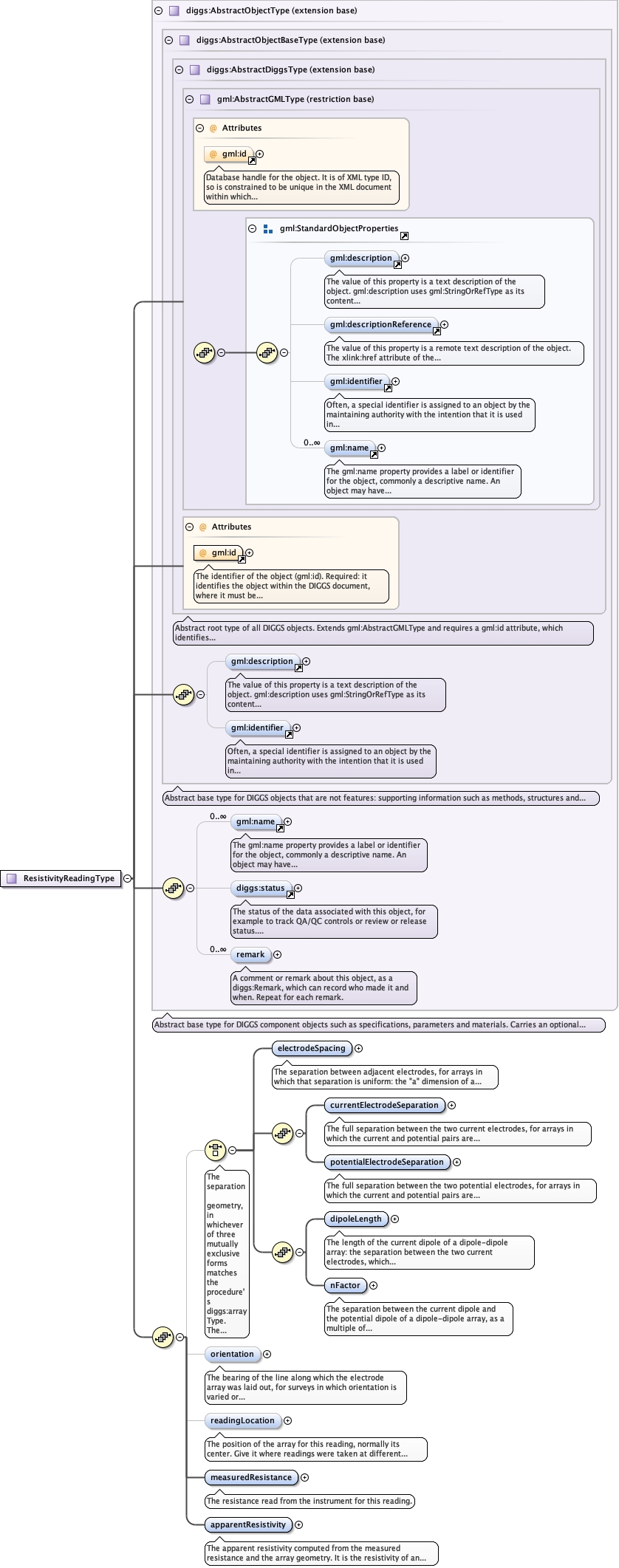
Complex Type diggs:ResistivityReadingType
Namespace http://diggsml.org/schemas/3
Diagram
Diagramgml3_2Profile_diggs_xsd_Attribute_gml_id.tmp#idgml3_2Profile_diggs_xsd_Element_gml_description.tmp#descriptiongml3_2Profile_diggs_xsd_Element_gml_descriptionReference.tmp#descriptionReferencegml3_2Profile_diggs_xsd_Element_gml_identifier.tmp#identifiergml3_2Profile_diggs_xsd_Element_gml_name.tmp#namegml3_2Profile_diggs_xsd_Element_Group_gml_StandardObjectProperties.tmp#StandardObjectPropertiesgml3_2Profile_diggs_xsd_Complex_Type_gml_AbstractGMLType.tmp#AbstractGMLTypegml3_2Profile_diggs_xsd_Attribute_gml_id.tmp#idAbstractTypes_xsd_Complex_Type_diggs_AbstractDiggsType.tmp#AbstractDiggsTypegml3_2Profile_diggs_xsd_Element_gml_description.tmp#descriptiongml3_2Profile_diggs_xsd_Element_gml_identifier.tmp#identifierAbstractTypes_xsd_Complex_Type_diggs_AbstractObjectBaseType.tmp#AbstractObjectBaseTypegml3_2Profile_diggs_xsd_Element_gml_name.tmp#nameCommon_xsd_Element_diggs_status.tmp#statusAbstractTypes_xsd_Complex_Type_diggs_AbstractObjectType.tmp#AbstractObjectType_remarkAbstractTypes_xsd_Complex_Type_diggs_AbstractObjectType.tmp#AbstractObjectTypeExtProcedures_xsd_Complex_Type_diggs_ResistivityReadingType.tmp#ResistivityReadingType_electrodeSpacingExtProcedures_xsd_Complex_Type_diggs_ResistivityReadingType.tmp#ResistivityReadingType_currentElectrodeSeparationExtProcedures_xsd_Complex_Type_diggs_ResistivityReadingType.tmp#ResistivityReadingType_potentialElectrodeSeparationExtProcedures_xsd_Complex_Type_diggs_ResistivityReadingType.tmp#ResistivityReadingType_dipoleLengthExtProcedures_xsd_Complex_Type_diggs_ResistivityReadingType.tmp#ResistivityReadingType_nFactorExtProcedures_xsd_Complex_Type_diggs_ResistivityReadingType.tmp#ResistivityReadingType_orientationExtProcedures_xsd_Complex_Type_diggs_ResistivityReadingType.tmp#ResistivityReadingType_readingLocationExtProcedures_xsd_Complex_Type_diggs_ResistivityReadingType.tmp#ResistivityReadingType_measuredResistanceExtProcedures_xsd_Complex_Type_diggs_ResistivityReadingType.tmp#ResistivityReadingType_apparentResistivity
Type extension of diggs:AbstractObjectType
Type hierarchy
Used by
Model
Children diggs:apparentResistivity, diggs:currentElectrodeSeparation, diggs:dipoleLength, diggs:electrodeSpacing, diggs:measuredResistance, diggs:nFactor, diggs:orientation, diggs:potentialElectrodeSeparation, diggs:readingLocation, diggs:remark, diggs:status, gml:description, gml:identifier, gml:name
Attributes
QName Type Use Annotation
gml:id ID required
Database handle for the object. It is of XML type ID, so is constrained to be
unique in the XML document within which it occurs. An external identifier for the object in
the form of a URI may be constructed using standard XML and XPointer methods. This is done
by concatenating the URI for the document, a fragment separator, and the value of the id
attribute.
Source
<complexType name="ResistivityReadingType">
  <complexContent>
    <extension base="diggs:AbstractObjectType">
      <sequence>
        <choice minOccurs="0">
          <annotation>
            <documentation>The separation geometry, in whichever of three mutually exclusive forms matches the procedure's diggs:arrayType. The three forms are never combined on one reading - a Wenner array's single uniform spacing, a Schlumberger array's independently stated current and potential pair separations, and a dipole-dipole array's dipole length and separation multiplier describe the same underlying idea (how far apart the electrodes are) in three shapes that do not share a common representation, which is why this is a choice rather than three independently optional siblings.</documentation>
          </annotation>
          <element name="electrodeSpacing" type="diggs:LengthMeasureType">
            <annotation>
              <documentation>The separation between adjacent electrodes, for arrays in which that separation is uniform: the "a" dimension of a Wenner array, and the probe spacing of a Wenner probe applied to a concrete surface.</documentation>
            </annotation>
          </element>
          <sequence>
            <element name="currentElectrodeSeparation" type="diggs:LengthMeasureType">
              <annotation>
                <documentation>The full separation between the two current electrodes, for arrays in which the current and potential pairs are separated differently, principally Schlumberger. It is not the half-separation against which sounding curves are conventionally plotted.</documentation>
              </annotation>
            </element>
            <element name="potentialElectrodeSeparation" type="diggs:LengthMeasureType">
              <annotation>
                <documentation>The full separation between the two potential electrodes, for arrays in which the current and potential pairs are separated differently, principally Schlumberger. It follows the same convention as diggs:ResistivityReadingType/currentElectrodeSeparation.</documentation>
              </annotation>
            </element>
          </sequence>
          <sequence>
            <element name="dipoleLength" type="diggs:LengthMeasureType">
              <annotation>
                <documentation>The length of the current dipole of a dipole-dipole array: the separation between the two current electrodes, which equals the separation between the two potential electrodes (the "a" spacing in the n-a dipole-dipole notation).</documentation>
              </annotation>
            </element>
            <element name="nFactor" type="double">
              <annotation>
                <documentation>The separation between the current dipole and the potential dipole of a dipole-dipole array, as a multiple of diggs:ResistivityReadingType/dipoleLength (the "n" in the n-a notation) rather than as a length. The multiplier is what a survey steps from one reading to the next at a fixed dipole length.</documentation>
              </annotation>
            </element>
          </sequence>
        </choice>
        <element minOccurs="0" name="orientation" type="diggs:BearingMeasureType">
          <annotation>
            <documentation>The bearing of the line along which the electrode array was laid out, for surveys in which orientation is varied or otherwise significant. An array line has no direction, so give the one of its two opposed bearings that falls between 0 and 180 degrees. The reference direction is carried by the refAzimuth attribute of the measure.</documentation>
          </annotation>
        </element>
        <element minOccurs="0" name="readingLocation" type="diggs:LocationPropertyType">
          <annotation>
            <documentation>The position of the array for this reading, normally its center. Give it where readings were taken at different positions, principally constant separation traversing and successive points on a structure. Where every reading shares one position, the sampling feature the test was performed at carries it.</documentation>
          </annotation>
        </element>
        <element minOccurs="1" name="measuredResistance" type="diggs:ElectricResistanceMeasureType">
          <annotation>
            <documentation>The resistance read from the instrument for this reading.</documentation>
          </annotation>
        </element>
        <element minOccurs="1" name="apparentResistivity" type="diggs:ElectricalResistivityMeasureType">
          <annotation>
            <documentation>The apparent resistivity computed from the measured resistance and the array geometry. It is the resistivity of an equivalent homogeneous medium; where the ground is layered or anisotropic it is not the resistivity of any one layer.</documentation>
          </annotation>
        </element>
      </sequence>
    </extension>
  </complexContent>
</complexType>