Showing:

Annotations
Attributes
Diagrams
Model
Properties
Source
Used by
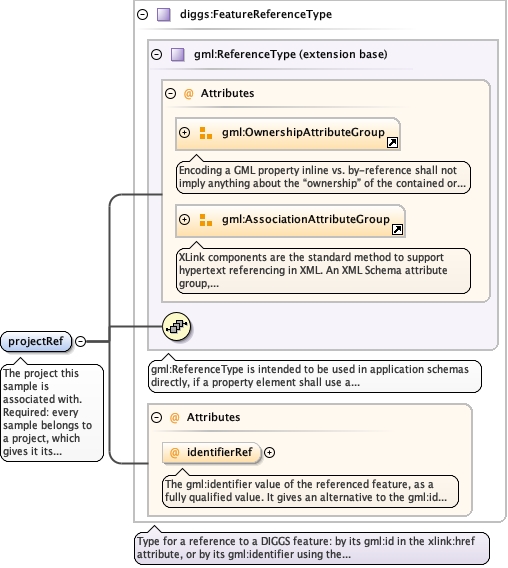
Element diggs:AbstractSampleType / diggs:projectRef
Namespace http://diggsml.org/schemas/3
Annotations
The project this sample is associated with. Required: every sample
belongs to a project, which gives it its organizational and
geographical context.
Diagram
Diagramgml3_2Profile_diggs_xsd_Attribute_Group_gml_OwnershipAttributeGroup.tmp#OwnershipAttributeGroupgml3_2Profile_diggs_xsd_Attribute_Group_gml_AssociationAttributeGroup.tmp#AssociationAttributeGroupgml3_2Profile_diggs_xsd_Complex_Type_gml_ReferenceType.tmp#ReferenceTypeCommon_xsd_Complex_Type_diggs_FeatureReferenceType.tmp#FeatureReferenceType_identifierRefCommon_xsd_Complex_Type_diggs_FeatureReferenceType.tmp#FeatureReferenceType
Type diggs:FeatureReferenceType
Type hierarchy
Properties
content complex
minOccurs 1
Model
Attributes
QName Type Default Use Annotation
identifierRef diggs:IdentifierReferenceType optional
The gml:identifier value of the referenced feature, as a fully qualified
value. It gives an alternative to the gml:id in xlink:href for finding
the referenced feature, mainly to reference a feature by a globally
unique identifier and where naming conflicts occur with gml:id when
accessing data in external files.
nilReason gml:NilReasonType optional
owns boolean false optional
xlink:href anyURI optional
Source
<element name="projectRef" type="diggs:FeatureReferenceType" minOccurs="1">
  <annotation>
    <documentation>The project this sample is associated with. Required: every sample belongs to a project, which gives it its organizational and geographical context.</documentation>
  </annotation>
</element>
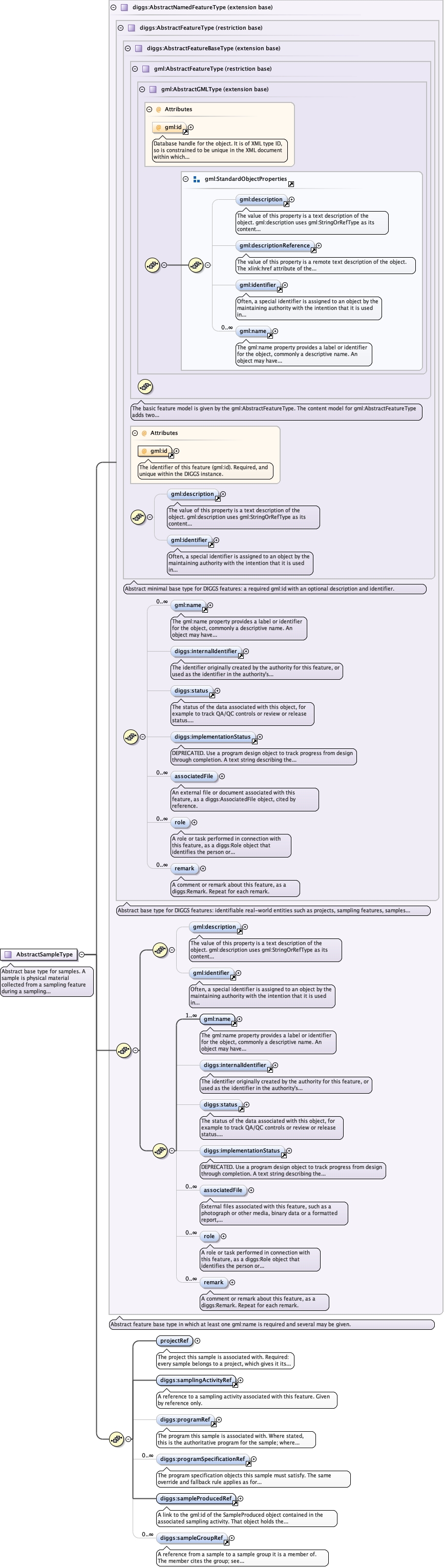
Complex Type diggs:AbstractSampleType
Namespace http://diggsml.org/schemas/3
Annotations
Abstract base type for samples. A sample is physical material collected from a
sampling feature during a sampling activity, or made by aggregating other samples.
Samples link field investigations (sampling features) to laboratory testing
(specimens and material tests), and record their collection location, parent
sampling feature, collection method and physical characteristics. A sample can be
subdivided into specimens for laboratory testing or aggregated from several source
samples.
Diagram
Diagramgml3_2Profile_diggs_xsd_Attribute_gml_id.tmp#idgml3_2Profile_diggs_xsd_Element_gml_description.tmp#descriptiongml3_2Profile_diggs_xsd_Element_gml_descriptionReference.tmp#descriptionReferencegml3_2Profile_diggs_xsd_Element_gml_identifier.tmp#identifiergml3_2Profile_diggs_xsd_Element_gml_name.tmp#namegml3_2Profile_diggs_xsd_Element_Group_gml_StandardObjectProperties.tmp#StandardObjectPropertiesgml3_2Profile_diggs_xsd_Complex_Type_gml_AbstractGMLType.tmp#AbstractGMLTypegml3_2Profile_diggs_xsd_Complex_Type_gml_AbstractFeatureType.tmp#AbstractFeatureTypegml3_2Profile_diggs_xsd_Attribute_gml_id.tmp#idgml3_2Profile_diggs_xsd_Element_gml_description.tmp#descriptiongml3_2Profile_diggs_xsd_Element_gml_identifier.tmp#identifierAbstractTypes_xsd_Complex_Type_diggs_AbstractFeatureBaseType.tmp#AbstractFeatureBaseTypegml3_2Profile_diggs_xsd_Element_gml_name.tmp#nameCommon_xsd_Element_diggs_internalIdentifier.tmp#internalIdentifierCommon_xsd_Element_diggs_status.tmp#statusCommon_xsd_Element_diggs_implementationStatus.tmp#implementationStatusAbstractTypes_xsd_Complex_Type_diggs_AbstractFeatureType.tmp#http___diggsml.org_schemas_3_AbstractFeatureType_associatedFileAbstractTypes_xsd_Complex_Type_diggs_AbstractFeatureType.tmp#http___diggsml.org_schemas_3_AbstractFeatureType_roleAbstractTypes_xsd_Complex_Type_diggs_AbstractFeatureType.tmp#http___diggsml.org_schemas_3_AbstractFeatureType_remarkAbstractTypes_xsd_Complex_Type_diggs_AbstractFeatureType.tmp#http___diggsml.org_schemas_3_AbstractFeatureTypegml3_2Profile_diggs_xsd_Element_gml_description.tmp#descriptiongml3_2Profile_diggs_xsd_Element_gml_identifier.tmp#identifiergml3_2Profile_diggs_xsd_Element_gml_name.tmp#nameCommon_xsd_Element_diggs_internalIdentifier.tmp#internalIdentifierCommon_xsd_Element_diggs_status.tmp#statusCommon_xsd_Element_diggs_implementationStatus.tmp#implementationStatusAbstractTypes_xsd_Complex_Type_diggs_AbstractNamedFeatureType.tmp#AbstractNamedFeatureType_associatedFileAbstractTypes_xsd_Complex_Type_diggs_AbstractNamedFeatureType.tmp#AbstractNamedFeatureType_roleAbstractTypes_xsd_Complex_Type_diggs_AbstractNamedFeatureType.tmp#AbstractNamedFeatureType_remarkAbstractTypes_xsd_Complex_Type_diggs_AbstractNamedFeatureType.tmp#AbstractNamedFeatureTypeAbstractTypes_xsd_Complex_Type_diggs_AbstractSampleType.tmp#AbstractSampleType_projectRefCommon_xsd_Element_diggs_samplingActivityRef.tmp#samplingActivityRefCommon_xsd_Element_diggs_programRef.tmp#programRefCommon_xsd_Element_diggs_programSpecificationRef.tmp#programSpecificationRefCommon_xsd_Element_diggs_sampleProducedRef.tmp#sampleProducedRefCommon_xsd_Element_diggs_sampleGroupRef.tmp#sampleGroupRef
Type extension of diggs:AbstractNamedFeatureType
Type hierarchy
Properties
abstract true
Used by
Model
Children diggs:associatedFile, diggs:implementationStatus, diggs:internalIdentifier, diggs:programRef, diggs:programSpecificationRef, diggs:projectRef, diggs:remark, diggs:role, diggs:sampleGroupRef, diggs:sampleProducedRef, diggs:samplingActivityRef, diggs:status, gml:description, gml:identifier, gml:name
Attributes
QName Type Use Annotation
gml:id ID required
Database handle for the object. It is of XML type ID, so is constrained to be
unique in the XML document within which it occurs. An external identifier for the object in
the form of a URI may be constructed using standard XML and XPointer methods. This is done
by concatenating the URI for the document, a fragment separator, and the value of the id
attribute.
Source
<complexType name="AbstractSampleType" abstract="true">
  <annotation>
    <documentation>Abstract base type for samples. A sample is physical material collected from a sampling feature during a sampling activity, or made by aggregating other samples. Samples link field investigations (sampling features) to laboratory testing (specimens and material tests), and record their collection location, parent sampling feature, collection method and physical characteristics. A sample can be subdivided into specimens for laboratory testing or aggregated from several source samples.</documentation>
  </annotation>
  <complexContent>
    <extension base="diggs:AbstractNamedFeatureType">
      <sequence>
        <element name="projectRef" type="diggs:FeatureReferenceType" minOccurs="1">
          <annotation>
            <documentation>The project this sample is associated with. Required: every sample belongs to a project, which gives it its organizational and geographical context.</documentation>
          </annotation>
        </element>
        <element ref="diggs:samplingActivityRef"/>
        <element minOccurs="0" ref="diggs:programRef">
          <annotation>
            <documentation>The program this sample is associated with. Where stated, this is the authoritative program for the sample; where absent, the program is that of the sampling activity, reached through samplingActivityRef. State it only where the program of the sample genuinely differs from that of its sampling activity, for example a sample re-tested under a later, separate testing program.</documentation>
          </annotation>
        </element>
        <element minOccurs="0" maxOccurs="unbounded" ref="diggs:programSpecificationRef">
          <annotation>
            <documentation>The program specification objects this sample must satisfy. The same override and fallback rule applies as for programRef.</documentation>
          </annotation>
        </element>
        <element ref="diggs:sampleProducedRef"/>
        <element minOccurs="0" maxOccurs="unbounded" ref="diggs:sampleGroupRef"/>
      </sequence>
    </extension>
  </complexContent>
</complexType>