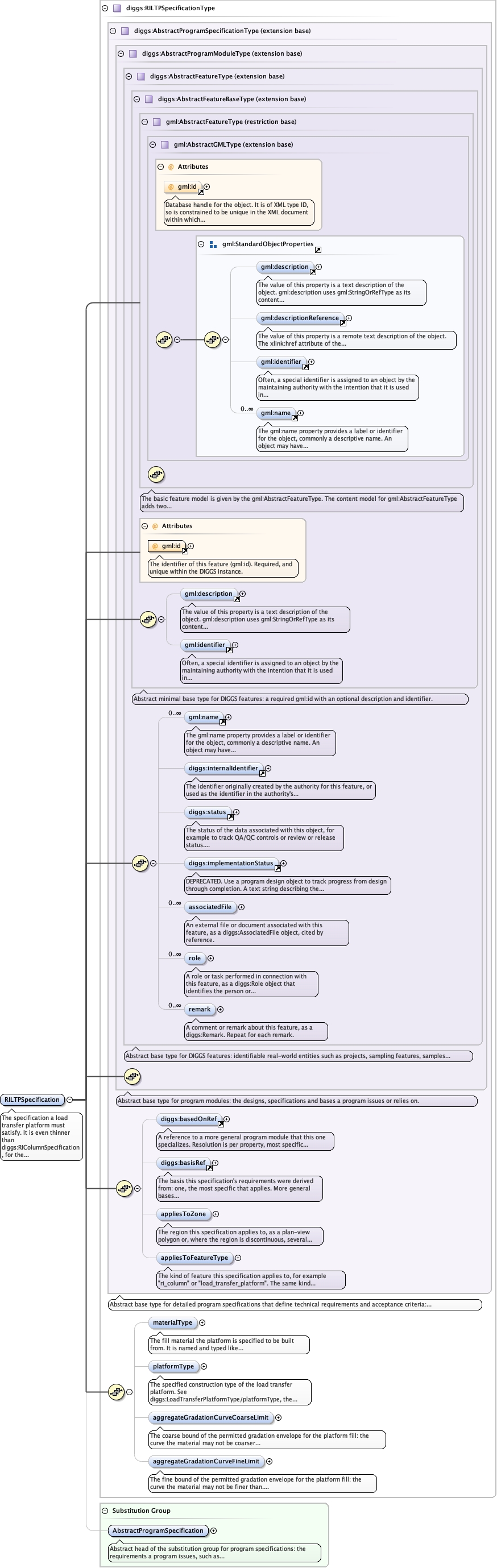
The specification a load transfer platform must satisfy. It is even thinner thandiggs:RIColumnSpecification, for the same reason: platform requirements areoverwhelmingly limits (minimum thickness, target relative compaction, permittedsettlement), and each limit is an acceptance criterion declared as a sibling underthe specification slot of the program, citing this object through basedOnRef. Thefill gradation envelope is carried here and target compaction is not: targetrelative compaction is a single limit with an operator, so it is an acceptancecriterion, whereas a gradation envelope is a pair of curves and cannot be anoperator and limit. The curve pair reuses the shape of diggs:GroutSpecificationType.The shape of the envelope is provisional pending review by the subject matterexpert.
Database handle for the object. It is of XML type ID, so is constrained to beunique in the XML document within which it occurs. An external identifier for the object inthe form of a URI may be constructed using standard XML and XPointer methods. This is doneby concatenating the URI for the document, a fragment separator, and the value of the idattribute.
Source
<element name="RILTPSpecification" type="diggs:RILTPSpecificationType" substitutionGroup="diggs:AbstractProgramSpecification"><annotation><documentation>The specification a load transfer platform must satisfy. It is even thinner than diggs:RIColumnSpecification, for the same reason: platform requirements are overwhelmingly limits (minimum thickness, target relative compaction, permitted settlement), and each limit is an acceptance criterion declared as a sibling under the specification slot of the program, citing this object through basedOnRef. The fill gradation envelope is carried here and target compaction is not: target relative compaction is a single limit with an operator, so it is an acceptance criterion, whereas a gradation envelope is a pair of curves and cannot be an operator and limit. The curve pair reuses the shape of diggs:GroutSpecificationType. The shape of the envelope is provisional pending review by the subject matter expert.</documentation></annotation></element>