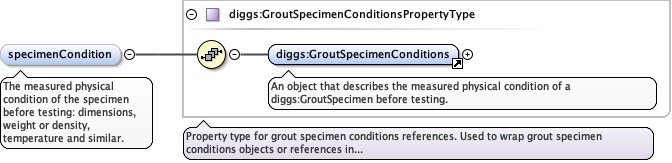
<element minOccurs="0" name="specimenCondition" type="diggs:GroutSpecimenConditionsPropertyType"><annotation><documentation>The measured physical condition of the specimen before testing: dimensions, weight or density, temperature and similar.</documentation></annotation></element>
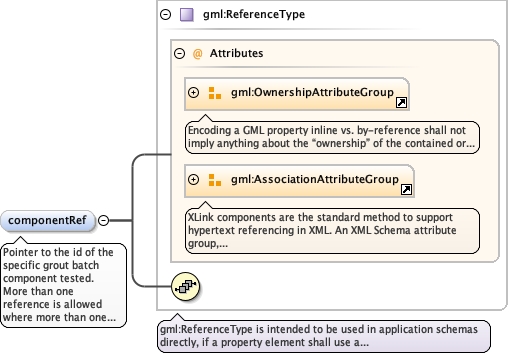
Pointer to the id of the specific grout batch componenttested. More than one reference is allowed where more than onecomponent of a specific type is included together in the specimentested. In this case each componentRef will point to the componentsused.
<element maxOccurs="unbounded" minOccurs="0" name="componentRef" type="gml:ReferenceType"><annotation><appinfo>diggs:Admixture or diggs:Binder or diggs:Cement or diggs:Chemical or diggs:Filler</appinfo><documentation>Pointer to the id of the specific grout batch component tested. More than one reference is allowed where more than one component of a specific type is included together in the specimen tested. In this case each componentRef will point to the components used.</documentation></annotation></element>
Where the specimen is a single component of a grout mixrather than the mix itself, the type of component tested: Admixture,Binder, Cement, Chemical or Filler (see the component objects ofdiggs:GroutBatch), or Other: followed by a description.
<element minOccurs="0" name="componentType" type="diggs:GroutComponentTypeType"><annotation><documentation>Where the specimen is a single component of a grout mix rather than the mix itself, the type of component tested: Admixture, Binder, Cement, Chemical or Filler (see the component objects of diggs:GroutBatch), or Other: followed by a description.</documentation></annotation></element>
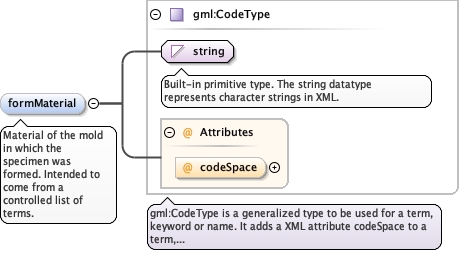
<element minOccurs="0" name="formMaterial" type="gml:CodeType"><annotation><documentation>Material of the mold in which the specimen was formed. Intended to come from a controlled list of terms.</documentation></annotation></element>
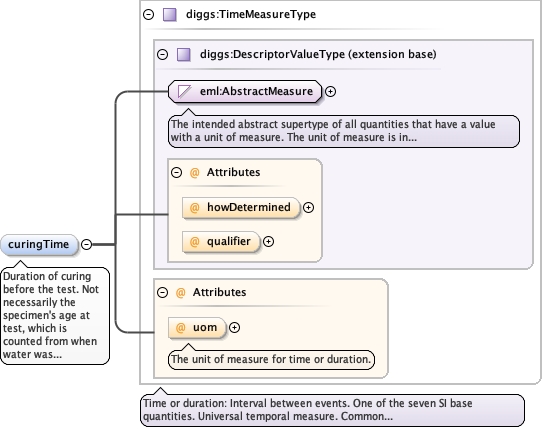
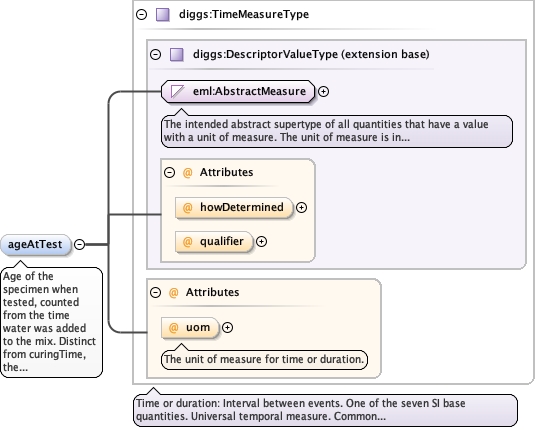
<element minOccurs="0" name="curingTime" type="diggs:TimeMeasureType"><annotation><documentation>Duration of curing before the test. Not necessarily the specimen's age at test, which is counted from when water was added to the mix.</documentation></annotation></element>
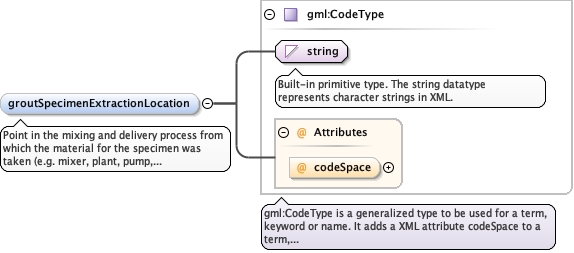
Point in the mixing and delivery process from which thematerial for the specimen was taken (e.g. mixer, plant, pump, riser).Intended to come from a controlled list of terms.
<element minOccurs="0" name="groutSpecimenExtractionLocation" type="gml:CodeType"><annotation><documentation>Point in the mixing and delivery process from which the material for the specimen was taken (e.g. mixer, plant, pump, riser). Intended to come from a controlled list of terms.</documentation></annotation></element>
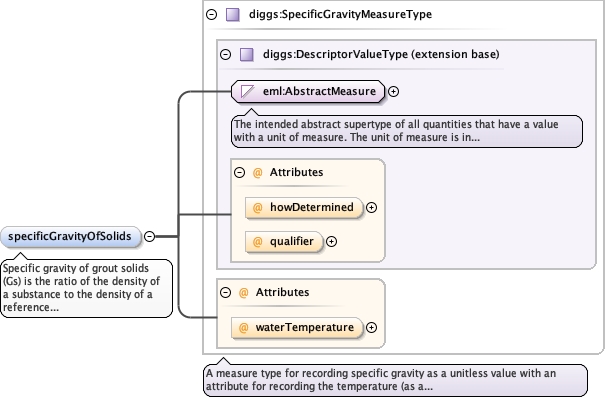
Specific gravity of grout solids (Gs) is the ratio of thedensity of a substance to the density of a reference substance,usually water at 4 deg C; equivalently, it is the ratio of the massof a substance to the mass of a reference substance for the samegiven volume.
<element minOccurs="0" name="specificGravityOfSolids" type="diggs:SpecificGravityMeasureType"><annotation><documentation>Specific gravity of grout solids (Gs) is the ratio of the density of a substance to the density of a reference substance, usually water at 4 deg C; equivalently, it is the ratio of the mass of a substance to the mass of a reference substance for the same given volume.</documentation></annotation></element>
<element minOccurs="0" name="ageAtTest" type="diggs:TimeMeasureType"><annotation><documentation>Age of the specimen when tested, counted from the time water was added to the mix. Distinct from curingTime, the duration of curing.</documentation></annotation></element>
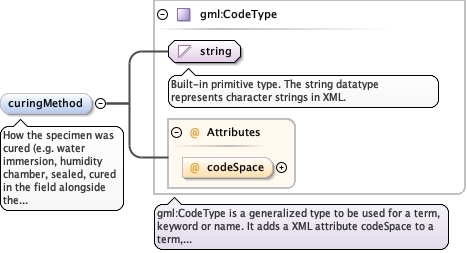
How the specimen was cured (e.g. water immersion,humidity chamber, sealed, cured in the field alongside thestructure). More than one may be given where the curing changedduring the curing period. Intended to come from a controlled list ofterms.
<element maxOccurs="unbounded" minOccurs="0" name="curingMethod" type="gml:CodeType"><annotation><documentation>How the specimen was cured (e.g. water immersion, humidity chamber, sealed, cured in the field alongside the structure). More than one may be given where the curing changed during the curing period. Intended to come from a controlled list of terms.</documentation></annotation></element>
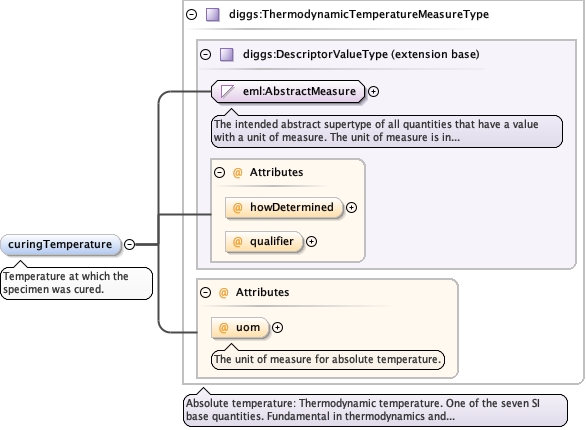
<element minOccurs="0" name="curingTemperature" type="diggs:ThermodynamicTemperatureMeasureType"><annotation><documentation>Temperature at which the specimen was cured.</documentation></annotation></element>
<element minOccurs="0" name="specimenOrigin" type="diggs:SpecimenOriginEnumExtType"><annotation><documentation>How the specimen was made: molded from fresh material, cast in place in the structure, cored from hardened material, or sawed.</documentation></annotation></element>
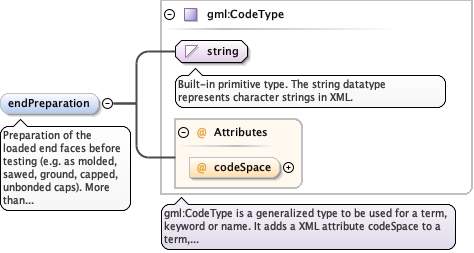
Preparation of the loaded end faces before testing (e.g.as molded, sawed, ground, capped, unbonded caps). More than one maybe given where the ends were prepared in more than one way.Intended to come from a controlled list of terms.
<element maxOccurs="unbounded" minOccurs="0" name="endPreparation" type="gml:CodeType"><annotation><documentation>Preparation of the loaded end faces before testing (e.g. as molded, sawed, ground, capped, unbonded caps). More than one may be given where the ends were prepared in more than one way. Intended to come from a controlled list of terms.</documentation></annotation></element>
Database handle for the object. It is of XML type ID, so is constrained to beunique in the XML document within which it occurs. An external identifier for the object inthe form of a URI may be constructed using standard XML and XPointer methods. This is doneby concatenating the URI for the document, a fragment separator, and the value of the idattribute.
Source
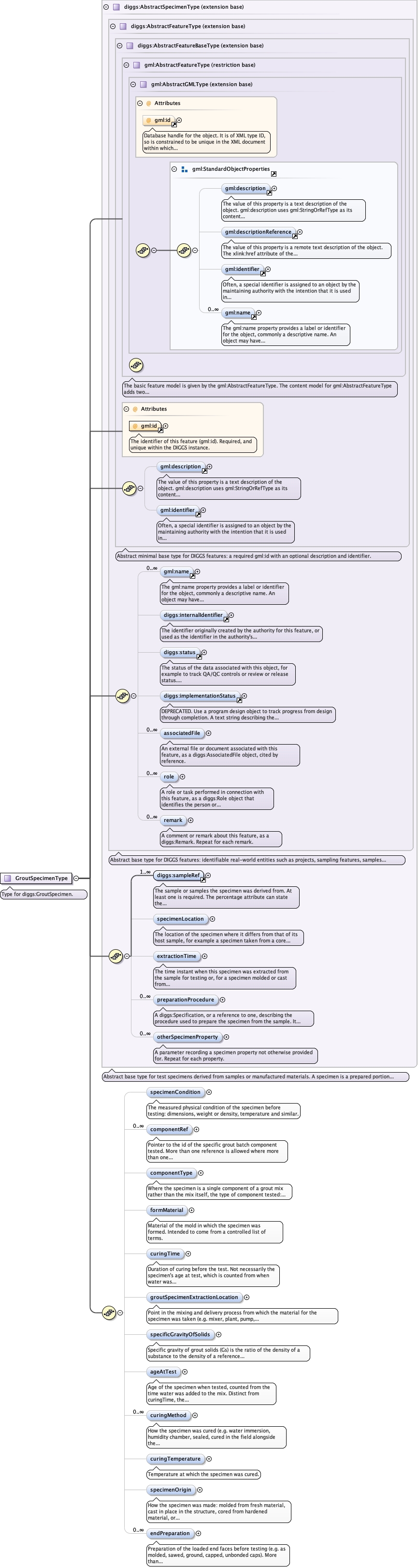
<complexType name="GroutSpecimenType"><annotation><documentation>Type for diggs:GroutSpecimen.</documentation></annotation><complexContent><extension base="diggs:AbstractSpecimenType"><sequence><element minOccurs="0" name="specimenCondition" type="diggs:GroutSpecimenConditionsPropertyType"><annotation><documentation>The measured physical condition of the specimen before testing: dimensions, weight or density, temperature and similar.</documentation></annotation></element><element maxOccurs="unbounded" minOccurs="0" name="componentRef" type="gml:ReferenceType"><annotation><appinfo>diggs:Admixture or diggs:Binder or diggs:Cement or diggs:Chemical or diggs:Filler</appinfo><documentation>Pointer to the id of the specific grout batch component tested. More than one reference is allowed where more than one component of a specific type is included together in the specimen tested. In this case each componentRef will point to the components used.</documentation></annotation></element><element minOccurs="0" name="componentType" type="diggs:GroutComponentTypeType"><annotation><documentation>Where the specimen is a single component of a grout mix rather than the mix itself, the type of component tested: Admixture, Binder, Cement, Chemical or Filler (see the component objects of diggs:GroutBatch), or Other: followed by a description.</documentation></annotation></element><element minOccurs="0" name="formMaterial" type="gml:CodeType"><annotation><documentation>Material of the mold in which the specimen was formed. Intended to come from a controlled list of terms.</documentation></annotation></element><element minOccurs="0" name="curingTime" type="diggs:TimeMeasureType"><annotation><documentation>Duration of curing before the test. Not necessarily the specimen's age at test, which is counted from when water was added to the mix.</documentation></annotation></element><element minOccurs="0" name="groutSpecimenExtractionLocation" type="gml:CodeType"><annotation><documentation>Point in the mixing and delivery process from which the material for the specimen was taken (e.g. mixer, plant, pump, riser). Intended to come from a controlled list of terms.</documentation></annotation></element><element minOccurs="0" name="specificGravityOfSolids" type="diggs:SpecificGravityMeasureType"><annotation><documentation>Specific gravity of grout solids (Gs) is the ratio of the density of a substance to the density of a reference substance, usually water at 4 deg C; equivalently, it is the ratio of the mass of a substance to the mass of a reference substance for the same given volume.</documentation></annotation></element><element minOccurs="0" name="ageAtTest" type="diggs:TimeMeasureType"><annotation><documentation>Age of the specimen when tested, counted from the time water was added to the mix. Distinct from curingTime, the duration of curing.</documentation></annotation></element><element maxOccurs="unbounded" minOccurs="0" name="curingMethod" type="gml:CodeType"><annotation><documentation>How the specimen was cured (e.g. water immersion, humidity chamber, sealed, cured in the field alongside the structure). More than one may be given where the curing changed during the curing period. Intended to come from a controlled list of terms.</documentation></annotation></element><element minOccurs="0" name="curingTemperature" type="diggs:ThermodynamicTemperatureMeasureType"><annotation><documentation>Temperature at which the specimen was cured.</documentation></annotation></element><element minOccurs="0" name="specimenOrigin" type="diggs:SpecimenOriginEnumExtType"><annotation><documentation>How the specimen was made: molded from fresh material, cast in place in the structure, cored from hardened material, or sawed.</documentation></annotation></element><element maxOccurs="unbounded" minOccurs="0" name="endPreparation" type="gml:CodeType"><annotation><documentation>Preparation of the loaded end faces before testing (e.g. as molded, sawed, ground, capped, unbonded caps). More than one may be given where the ends were prepared in more than one way. Intended to come from a controlled list of terms.</documentation></annotation></element></sequence></extension></complexContent></complexType>