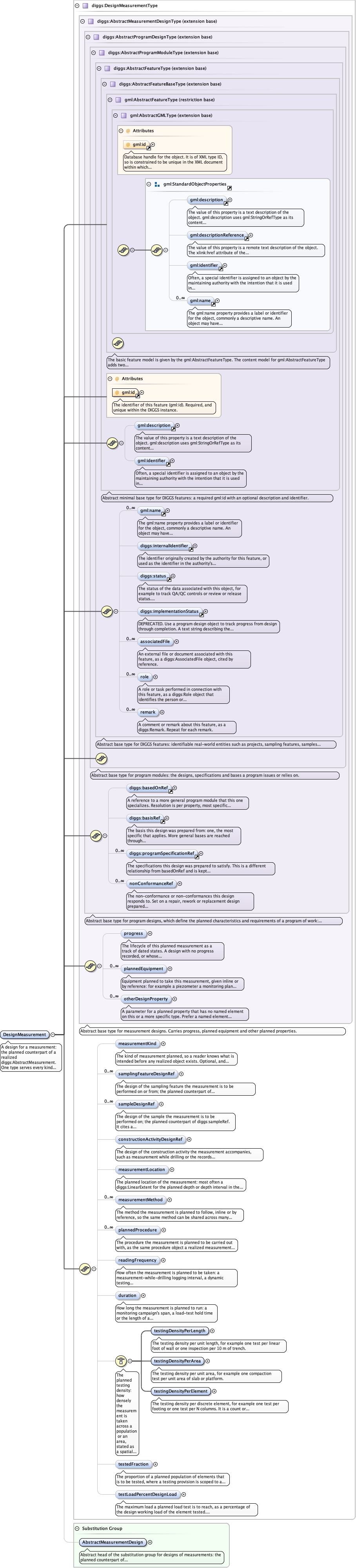
Namespace http://diggsml.org/schemas/3
Annotations
A design for a measurement: the planned counterpart of a realized
diggs:AbstractMeasurement. One type serves every kind of measurement, whether an
in-situ test, a laboratory test on a sample, a monitoring campaign, a measurement
taken while drilling or a geophysical survey, because what is plannable (what it is
done on, where, by what method, how often, how densely, for how long) is common to
all of them. A realized measurement cites its design through programDesignRef.
Diagram
Type diggs:DesignMeasurementType
Type hierarchy
Properties
Substitution Group Affiliation
Model
gml:description{0,1} ,
gml:identifier{0,1} ,
gml:name* ,
diggs:internalIdentifier{0,1} ,
diggs:status{0,1} ,
diggs:implementationStatus{0,1} ,
diggs:associatedFile* ,
diggs:role* ,
diggs:remark* ,
diggs:basedOnRef{0,1} ,
diggs:basisRef{0,1} ,
diggs:programSpecificationRef* ,
diggs:nonConformanceRef* ,
diggs:progress{0,1} ,
diggs:plannedEquipment* ,
diggs:otherDesignProperty* ,
diggs:measurementKind{0,1} ,
diggs:samplingFeatureDesignRef* ,
diggs:sampleDesignRef* ,
diggs:constructionActivityDesignRef{0,1} ,
diggs:measurementLocation{0,1} ,
diggs:measurementMethod* ,
diggs:plannedProcedure* ,
diggs:readingFrequency{0,1} ,
diggs:duration{0,1} , (
diggs:testingDensityPerLength |
diggs:testingDensityPerArea |
diggs:testingDensityPerElement ) ,
diggs:testedFraction{0,1} ,
diggs:testLoadPercentDesignLoad{0,1}
Children diggs:associatedFile diggs:basedOnRef diggs:basisRef diggs:constructionActivityDesignRef diggs:duration diggs:implementationStatus diggs:internalIdentifier diggs:measurementKind diggs:measurementLocation diggs:measurementMethod diggs:nonConformanceRef diggs:otherDesignProperty diggs:plannedEquipment diggs:plannedProcedure diggs:programSpecificationRef diggs:progress diggs:readingFrequency diggs:remark diggs:role diggs:sampleDesignRef diggs:samplingFeatureDesignRef diggs:status diggs:testLoadPercentDesignLoad diggs:testedFraction diggs:testingDensityPerArea diggs:testingDensityPerElement diggs:testingDensityPerLength gml:description gml:identifier gml:name
Instance
<diggs:DesignMeasurement gml:id= "" xmlns:diggs= "http://diggsml.org/schemas/3" xmlns:gml= "http://www.opengis.net/gml/3.2" >
<gml:description xlink:href= "" nilReason= "" > {0,1} </gml:description>
<gml:identifier codeSpace= "" > {0,1} </gml:identifier>
<gml:name codeSpace= "" > {0,unbounded} </gml:name>
<diggs:internalIdentifier codeSpace= "" > {0,1} </diggs:internalIdentifier>
<diggs:status codeSpace= "" > {0,1} </diggs:status>
<diggs:implementationStatus codeSpace= "" > {0,1} </diggs:implementationStatus>
<diggs:associatedFile xlink:href= "" nilReason= "" owns= "false" > {0,unbounded} </diggs:associatedFile>
<diggs:role > {0,unbounded} </diggs:role>
<diggs:remark > {0,unbounded} </diggs:remark>
<diggs:basedOnRef xlink:href= "" identifierRef= "" nilReason= "" owns= "false" > {0,1} </diggs:basedOnRef>
<diggs:basisRef xlink:href= "" identifierRef= "" nilReason= "" owns= "false" > {0,1} </diggs:basisRef>
<diggs:programSpecificationRef xlink:href= "" identifierRef= "" nilReason= "" owns= "false" > {0,unbounded} </diggs:programSpecificationRef>
<diggs:nonConformanceRef xlink:href= "" identifierRef= "" nilReason= "" owns= "false" > {0,unbounded} </diggs:nonConformanceRef>
<diggs:progress > {0,1} </diggs:progress>
<diggs:plannedEquipment xlink:href= "" nilReason= "" owns= "false" > {0,unbounded} </diggs:plannedEquipment>
<diggs:otherDesignProperty > {0,unbounded} </diggs:otherDesignProperty>
<diggs:measurementKind codeSpace= "" > {0,1} </diggs:measurementKind>
<diggs:samplingFeatureDesignRef xlink:href= "" identifierRef= "" nilReason= "" owns= "false" > {0,unbounded} </diggs:samplingFeatureDesignRef>
<diggs:sampleDesignRef xlink:href= "" identifierRef= "" nilReason= "" owns= "false" percentage= "" > {0,unbounded} </diggs:sampleDesignRef>
<diggs:constructionActivityDesignRef xlink:href= "" identifierRef= "" nilReason= "" owns= "false" > {0,1} </diggs:constructionActivityDesignRef>
<diggs:measurementLocation owns= "false" xlink:href= "" nilReason= "" > {0,1} </diggs:measurementLocation>
<diggs:measurementMethod xlink:href= "" nilReason= "" owns= "false" > {0,unbounded} </diggs:measurementMethod>
<diggs:plannedProcedure xlink:href= "" nilReason= "" owns= "false" > {0,unbounded} </diggs:plannedProcedure>
<diggs:readingFrequency howDetermined= "" qualifier= "" uom= "" > {0,1} </diggs:readingFrequency>
<diggs:duration howDetermined= "" qualifier= "" uom= "" > {0,1} </diggs:duration>
<diggs:testingDensityPerLength howDetermined= "" qualifier= "" uom= "" > {1,1} </diggs:testingDensityPerLength>
<diggs:testingDensityPerArea howDetermined= "" qualifier= "" uom= "" > {1,1} </diggs:testingDensityPerArea>
<diggs:testingDensityPerElement howDetermined= "" qualifier= "" uom= "" > {1,1} </diggs:testingDensityPerElement>
<diggs:testedFraction howDetermined= "" qualifier= "" uom= "" > {0,1} </diggs:testedFraction>
<diggs:testLoadPercentDesignLoad howDetermined= "" qualifier= "" uom= "" > {0,1} </diggs:testLoadPercentDesignLoad>
</diggs:DesignMeasurement>
Attributes
QName
Type
Use
Annotation
gml:id ID required
Database handle for the object. It is of XML type ID, so is constrained to be
unique in the XML document within which it occurs. An external identifier for the object in
the form of a URI may be constructed using standard XML and XPointer methods. This is done
by concatenating the URI for the document, a fragment separator, and the value of the id
attribute.
Source
<element name= "DesignMeasurement" type= "diggs:DesignMeasurementType" substitutionGroup= "diggs:AbstractMeasurementDesign" >
<annotation >
<documentation > A design for a measurement: the planned counterpart of a realized diggs:AbstractMeasurement. One type serves every kind of measurement, whether an in-situ test, a laboratory test on a sample, a monitoring campaign, a measurement taken while drilling or a geophysical survey, because what is plannable (what it is done on, where, by what method, how often, how densely, for how long) is common to all of them. A realized measurement cites its design through programDesignRef. </documentation>
</annotation>
</element>