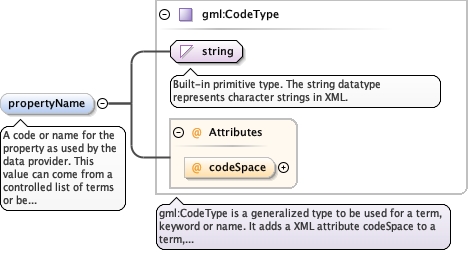
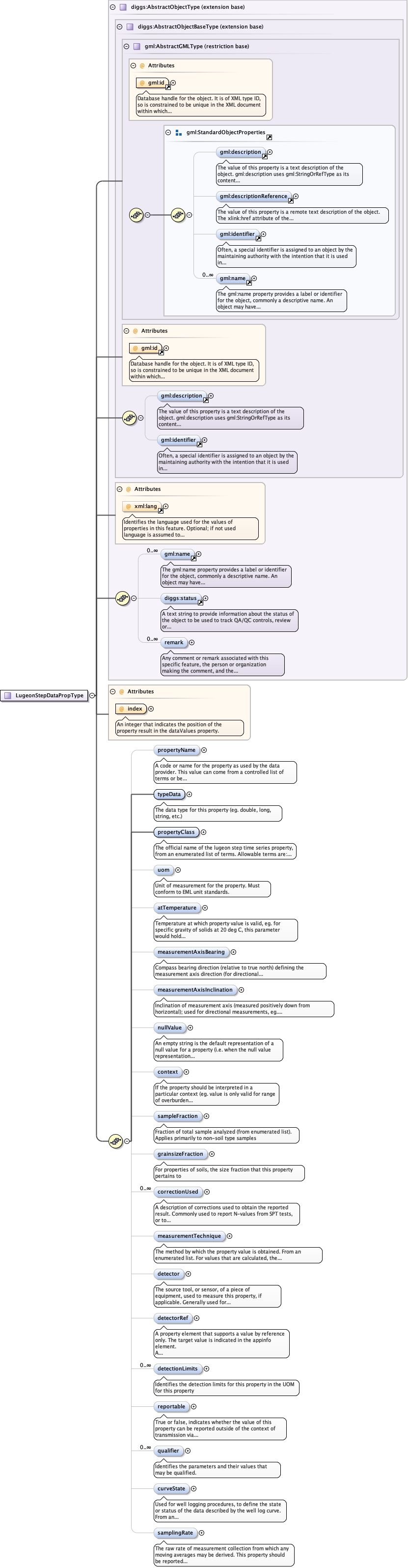
A code or name for the property as used by the dataprovider. This value can come from a controlled list of terms or bean uncontrolled text string. The value would be commonly used tolabel a column of a log sheet or provide other local meaning to theproperty. The value of mnemonic should be unique for all of theproperties included in the dataValue block transmitted as part ofthis measurement.
<element maxOccurs="1" minOccurs="0" name="propertyName" type="gml:CodeType"><annotation><documentation>A code or name for the property as used by the data provider. This value can come from a controlled list of terms or be an uncontrolled text string. The value would be commonly used to label a column of a log sheet or provide other local meaning to the property. The value of mnemonic should be unique for all of the properties included in the dataValue block transmitted as part of this measurement.</documentation></annotation></element>
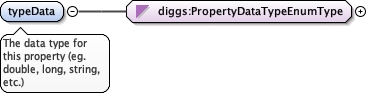
<element maxOccurs="1" minOccurs="1" name="typeData" type="diggs:PropertyDataTypeEnumType"><annotation><documentation>The data type for this property (eg. double, long, string, etc.)</documentation></annotation></element>
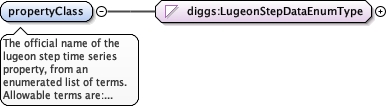
The official name of the lugeon step time seriesproperty, from an enumerated list of terms. Allowable terms are:elapsed_time flow_rate flow_volume gauge_pressuretransducer_pressure
<element maxOccurs="1" minOccurs="1" name="propertyClass" type="diggs:LugeonStepDataEnumType"><annotation><documentation>The official name of the lugeon step time series property, from an enumerated list of terms. Allowable terms are: elapsed_time flow_rate flow_volume gauge_pressure transducer_pressure</documentation></annotation></element>
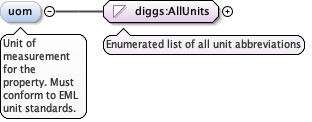
<element maxOccurs="1" minOccurs="0" name="uom" type="diggs:AllUnits"><annotation><documentation>Unit of measurement for the property. Must conform to EML unit standards.</documentation></annotation></element>
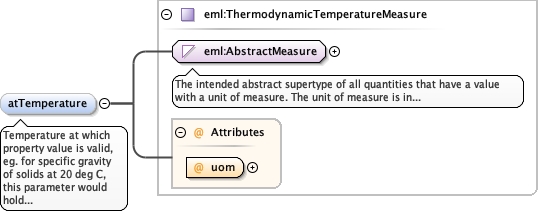
<element maxOccurs="1" minOccurs="0" name="atTemperature" type="eml:ThermodynamicTemperatureMeasure"><annotation><documentation>Temperature at which property value is valid, eg. for specific gravity of solids at 20 deg C, this parameter would hold the temperature value</documentation></annotation></element>
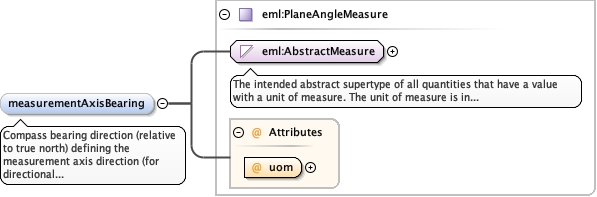
Compass bearing direction (relative to true north)defining the measurement axis direction (for directionalmeasurements, eg. component of an extensometer, accelerometer,etc.)
<element minOccurs="0" name="measurementAxisBearing" type="eml:PlaneAngleMeasure"><annotation><documentation>Compass bearing direction (relative to true north) defining the measurement axis direction (for directional measurements, eg. component of an extensometer, accelerometer, etc.)</documentation></annotation></element>
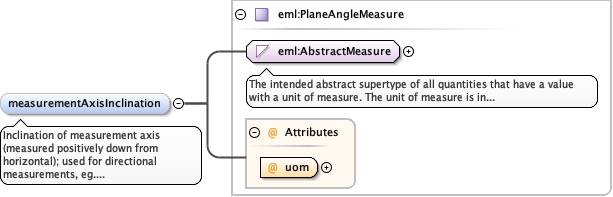
<element minOccurs="0" name="measurementAxisInclination" type="eml:PlaneAngleMeasure"><annotation><documentation>Inclination of measurement axis (measured positively down from horizontal); used for directional measurements, eg. extensometer, accelerometer, etc.</documentation></annotation></element>
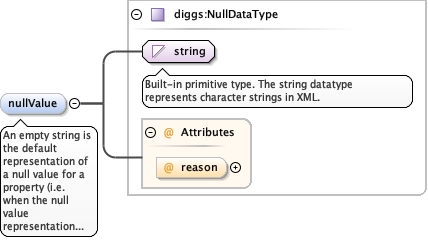
An empty string is the default representation of a nullvalue for a property (i.e. when the null value representation is notexplicitly defined). This value defines a value to be interpreted asnull for this property in the dataValues block. The reason attributecan be used to define the reason for the null value, (eg. witheld).This can be customized with an other: qualifier (eg. other:belowdetection limit) or reference a URI for a more completedefinition.
<element maxOccurs="1" minOccurs="0" name="nullValue" type="diggs:NullDataType"><annotation><documentation>An empty string is the default representation of a null value for a property (i.e. when the null value representation is not explicitly defined). This value defines a value to be interpreted as null for this property in the dataValues block. The reason attribute can be used to define the reason for the null value, (eg. witheld). This can be customized with an other: qualifier (eg. other:below detection limit) or reference a URI for a more complete definition.</documentation></annotation></element>
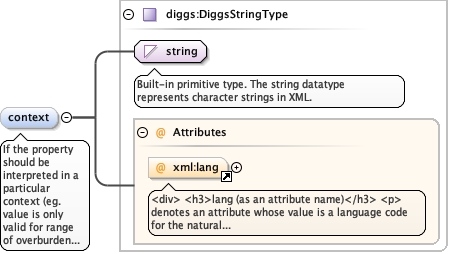
If the property should be interpreted in a particularcontext (eg. value is only valid for range of overburden pressures,etc.), then the context of the property is describedhere.
<div><h3>lang (as an attribute name)</h3><p>denotes an attribute whose value is a language code for the natural language of the content of any element; its value is inherited. This name is reserved by virtue of its definition in the XML specification.</p></div><div><h4>Notes</h4><p>Attempting to install the relevant ISO 2- and 3-letter codes as the enumerated possible values is probably never going to be a realistic possibility.</p><p>See BCP 47 at<a href="http://www.rfc-editor.org/rfc/bcp/bcp47.txt">http://www.rfc-editor.org/rfc/bcp/bcp47.txt</a>and the IANA language subtag registry at<a href="http://www.iana.org/assignments/language-subtag-registry">http://www.iana.org/assignments/language-subtag-registry</a>for further information.</p><p>The union allows for the 'un-declaration' of xml:lang with the empty string.</p></div>
Source
<element minOccurs="0" name="context" type="diggs:DiggsStringType"><annotation><documentation>If the property should be interpreted in a particular context (eg. value is only valid for range of overburden pressures, etc.), then the context of the property is described here.</documentation></annotation></element>
<element minOccurs="0" name="sampleFraction" type="diggs:SampleFractionEnumType"><annotation><documentation>Fraction of total sample analyzed (from enumerated list). Applies primarily to non-soil type samples</documentation></annotation></element>
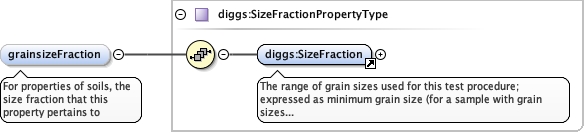
<element minOccurs="0" name="grainsizeFraction" type="diggs:SizeFractionPropertyType"><annotation><documentation>For properties of soils, the size fraction that this property pertains to</documentation></annotation></element>
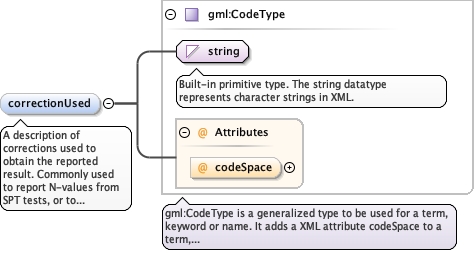
A description of corrections used to obtain the reportedresult. Commonly used to report N-values from SPT tests, or todescribe any other adjustments made to the reported data. Can comefrom a controlled list.
<element maxOccurs="unbounded" minOccurs="0" name="correctionUsed" type="gml:CodeType"><annotation><documentation>A description of corrections used to obtain the reported result. Commonly used to report N-values from SPT tests, or to describe any other adjustments made to the reported data. Can come from a controlled list.</documentation></annotation></element>
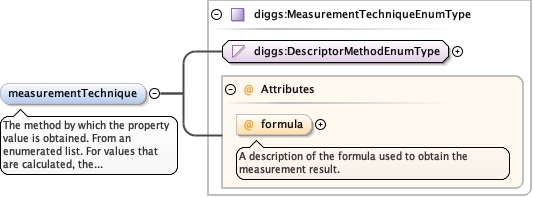
The method by which the property value is obtained. Froman enumerated list. For values that are calculated, the formulaattribute allows for a formula to be included, adescription/reference to the formula used to calculate te value, ordetails of any moving average. The samplingRate attribute describesthe raw rate of measurement collection from which any movingaverages may be derived.
A description of the formula used to obtain the measurementresult.
Source
<element minOccurs="0" name="measurementTechnique" type="diggs:MeasurementTechniqueEnumType"><annotation><documentation>The method by which the property value is obtained. From an enumerated list. For values that are calculated, the formula attribute allows for a formula to be included, a description/reference to the formula used to calculate te value, or details of any moving average. The samplingRate attribute describes the raw rate of measurement collection from which any moving averages may be derived.</documentation></annotation></element>
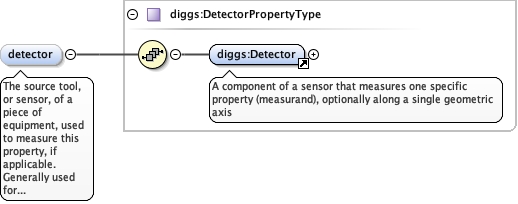
The source tool, or sensor, of a piece of equipment, usedto measure this property, if applicable. Generally used for welllog,downhole logging procedures, or monitoringequipment.
<element maxOccurs="1" minOccurs="0" name="detector" type="diggs:DetectorPropertyType"><annotation><documentation>The source tool, or sensor, of a piece of equipment, used to measure this property, if applicable. Generally used for well log,downhole logging procedures, or monitoring equipment.</documentation></annotation></element>
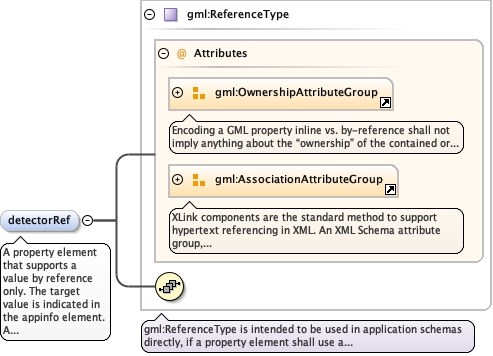
A property element that supports a value by referenceonly. The target value is indicated in the appinfoelement.
A reference to the source tool, or sensor, of a piece ofequipment, used to measure this property, if applicable. Generallyused for well log,downhole logging procedures, or monitoringequipment.
The 'actuate' attribute is used to communicate the desired timing of traversal from the starting resource to the ending resource; it's value should be treated as follows:onLoad - traverse to the ending resource immediately on loading the starting resource onRequest - traverse from the starting resource to the ending resource only on a post-loading event triggered for this purpose other - behavior is unconstrained; examine other markup in link for hints none - behavior is unconstrained
The 'show' attribute is used to communicate the desired presentation of the ending resource on traversal from the starting resource; it's value should be treated as follows: new - load ending resource in a new window, frame, pane, or other presentation contextreplace - load the resource in the same window, frame, pane, or other presentation contextembed - load ending resource in place of the presentation of the starting resourceother - behavior is unconstrained; examine other markup in the link for hints none - behavior is unconstrained
<element maxOccurs="1" minOccurs="0" name="detectorRef" type="gml:ReferenceType"><annotation><appinfo source="urn:x-gml:targetElement">diggs:Equipment</appinfo><documentation>A property element that supports a value by reference only. The target value is indicated in the appinfo element.</documentation><documentation>A reference to the source tool, or sensor, of a piece of equipment, used to measure this property, if applicable. Generally used for well log,downhole logging procedures, or monitoring equipment.</documentation></annotation></element>
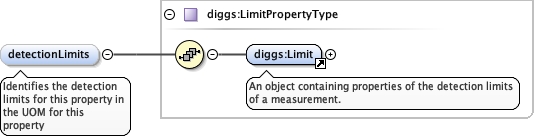
<element maxOccurs="unbounded" minOccurs="0" name="detectionLimits" type="diggs:LimitPropertyType"><annotation><documentation>Identifies the detection limits for this property in the UOM for this property</documentation></annotation></element>
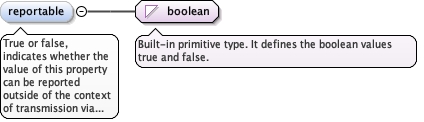
True or false, indicates whether the value of thisproperty can be reported outside of the context of transmission viaan xml instance.
Diagram
Type
boolean
Properties
content
simple
minOccurs
0
maxOccurs
1
default
true
Source
<element default="true" maxOccurs="1" minOccurs="0" name="reportable" type="boolean"><annotation><documentation>True or false, indicates whether the value of this property can be reported outside of the context of transmission via an xml instance.</documentation></annotation></element>
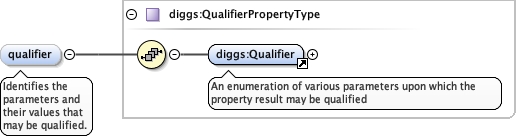
<element maxOccurs="unbounded" minOccurs="0" name="qualifier" type="diggs:QualifierPropertyType"><annotation><documentation>Identifies the parameters and their values that may be qualified.</documentation></annotation></element>
Sensor data is recorded into downhole memory of a tool, rather than transmitting in "real time" to surface.
enumeration
processed
Results of calculations based on measurements
enumeration
real time
Measurements at the actual time.
Source
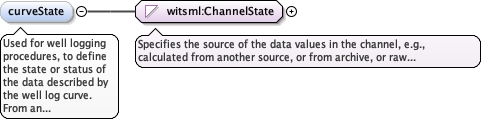
<element maxOccurs="1" minOccurs="0" name="curveState" type="witsml:ChannelState"><annotation><documentation>Used for well logging procedures, to define the state or status of the data described by the well log curve. From an enumerated list.</documentation></annotation></element>
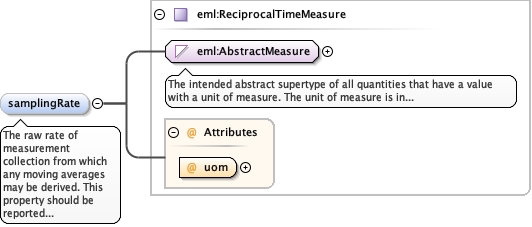
The raw rate of measurement collection from which anymoving averages may be derived. This property should be reported ifthe value of the measurementTechnique property is movingaverage.
<element maxOccurs="1" minOccurs="0" name="samplingRate" type="eml:ReciprocalTimeMeasure"><annotation><documentation>The raw rate of measurement collection from which any moving averages may be derived. This property should be reported if the value of the measurementTechnique property is moving average.</documentation></annotation></element>
Database handle for the object. It is of XML type ID, so is constrained to beunique in the XML document within which it occurs. An external identifier for the object inthe form of a URI may be constructed using standard XML and XPointer methods. This is doneby concatenating the URI for the document, a fragment separator, and the value of the idattribute.
<div><h3>lang (as an attribute name)</h3><p>denotes an attribute whose value is a language code for the natural language of the content of any element; its value is inherited. This name is reserved by virtue of its definition in the XML specification.</p></div><div><h4>Notes</h4><p>Attempting to install the relevant ISO 2- and 3-letter codes as the enumerated possible values is probably never going to be a realistic possibility.</p><p>See BCP 47 at<a href="http://www.rfc-editor.org/rfc/bcp/bcp47.txt">http://www.rfc-editor.org/rfc/bcp/bcp47.txt</a>and the IANA language subtag registry at<a href="http://www.iana.org/assignments/language-subtag-registry">http://www.iana.org/assignments/language-subtag-registry</a>for further information.</p><p>The union allows for the 'un-declaration' of xml:lang with the empty string.</p></div>
Source
<complexType name="LugeonStepDataPropType"><complexContent><extension base="diggs:AbstractObjectType"><sequence><element maxOccurs="1" minOccurs="0" name="propertyName" type="gml:CodeType"><annotation><documentation>A code or name for the property as used by the data provider. This value can come from a controlled list of terms or be an uncontrolled text string. The value would be commonly used to label a column of a log sheet or provide other local meaning to the property. The value of mnemonic should be unique for all of the properties included in the dataValue block transmitted as part of this measurement.</documentation></annotation></element><element maxOccurs="1" minOccurs="1" name="typeData" type="diggs:PropertyDataTypeEnumType"><annotation><documentation>The data type for this property (eg. double, long, string, etc.)</documentation></annotation></element><element maxOccurs="1" minOccurs="1" name="propertyClass" type="diggs:LugeonStepDataEnumType"><annotation><documentation>The official name of the lugeon step time series property, from an enumerated list of terms. Allowable terms are: elapsed_time flow_rate flow_volume gauge_pressure transducer_pressure</documentation></annotation></element><element maxOccurs="1" minOccurs="0" name="uom" type="diggs:AllUnits"><annotation><documentation>Unit of measurement for the property. Must conform to EML unit standards.</documentation></annotation></element><element maxOccurs="1" minOccurs="0" name="atTemperature" type="eml:ThermodynamicTemperatureMeasure"><annotation><documentation>Temperature at which property value is valid, eg. for specific gravity of solids at 20 deg C, this parameter would hold the temperature value</documentation></annotation></element><element minOccurs="0" name="measurementAxisBearing" type="eml:PlaneAngleMeasure"><annotation><documentation>Compass bearing direction (relative to true north) defining the measurement axis direction (for directional measurements, eg. component of an extensometer, accelerometer, etc.)</documentation></annotation></element><element minOccurs="0" name="measurementAxisInclination" type="eml:PlaneAngleMeasure"><annotation><documentation>Inclination of measurement axis (measured positively down from horizontal); used for directional measurements, eg. extensometer, accelerometer, etc.</documentation></annotation></element><element maxOccurs="1" minOccurs="0" name="nullValue" type="diggs:NullDataType"><annotation><documentation>An empty string is the default representation of a null value for a property (i.e. when the null value representation is not explicitly defined). This value defines a value to be interpreted as null for this property in the dataValues block. The reason attribute can be used to define the reason for the null value, (eg. witheld). This can be customized with an other: qualifier (eg. other:below detection limit) or reference a URI for a more complete definition.</documentation></annotation></element><element minOccurs="0" name="context" type="diggs:DiggsStringType"><annotation><documentation>If the property should be interpreted in a particular context (eg. value is only valid for range of overburden pressures, etc.), then the context of the property is described here.</documentation></annotation></element><element minOccurs="0" name="sampleFraction" type="diggs:SampleFractionEnumType"><annotation><documentation>Fraction of total sample analyzed (from enumerated list). Applies primarily to non-soil type samples</documentation></annotation></element><element minOccurs="0" name="grainsizeFraction" type="diggs:SizeFractionPropertyType"><annotation><documentation>For properties of soils, the size fraction that this property pertains to</documentation></annotation></element><element maxOccurs="unbounded" minOccurs="0" name="correctionUsed" type="gml:CodeType"><annotation><documentation>A description of corrections used to obtain the reported result. Commonly used to report N-values from SPT tests, or to describe any other adjustments made to the reported data. Can come from a controlled list.</documentation></annotation></element><element minOccurs="0" name="measurementTechnique" type="diggs:MeasurementTechniqueEnumType"><annotation><documentation>The method by which the property value is obtained. From an enumerated list. For values that are calculated, the formula attribute allows for a formula to be included, a description/reference to the formula used to calculate te value, or details of any moving average. The samplingRate attribute describes the raw rate of measurement collection from which any moving averages may be derived.</documentation></annotation></element><element maxOccurs="1" minOccurs="0" name="detector" type="diggs:DetectorPropertyType"><annotation><documentation>The source tool, or sensor, of a piece of equipment, used to measure this property, if applicable. Generally used for well log,downhole logging procedures, or monitoring equipment.</documentation></annotation></element><element maxOccurs="1" minOccurs="0" name="detectorRef" type="gml:ReferenceType"><annotation><appinfo source="urn:x-gml:targetElement">diggs:Equipment</appinfo><documentation>A property element that supports a value by reference only. The target value is indicated in the appinfo element.</documentation><documentation>A reference to the source tool, or sensor, of a piece of equipment, used to measure this property, if applicable. Generally used for well log,downhole logging procedures, or monitoring equipment.</documentation></annotation></element><element maxOccurs="unbounded" minOccurs="0" name="detectionLimits" type="diggs:LimitPropertyType"><annotation><documentation>Identifies the detection limits for this property in the UOM for this property</documentation></annotation></element><element default="true" maxOccurs="1" minOccurs="0" name="reportable" type="boolean"><annotation><documentation>True or false, indicates whether the value of this property can be reported outside of the context of transmission via an xml instance.</documentation></annotation></element><element maxOccurs="unbounded" minOccurs="0" name="qualifier" type="diggs:QualifierPropertyType"><annotation><documentation>Identifies the parameters and their values that may be qualified.</documentation></annotation></element><element maxOccurs="1" minOccurs="0" name="curveState" type="witsml:ChannelState"><annotation><documentation>Used for well logging procedures, to define the state or status of the data described by the well log curve. From an enumerated list.</documentation></annotation></element><element maxOccurs="1" minOccurs="0" name="samplingRate" type="eml:ReciprocalTimeMeasure"><annotation><documentation>The raw rate of measurement collection from which any moving averages may be derived. This property should be reported if the value of the measurementTechnique property is moving average.</documentation></annotation></element></sequence><attribute name="index" type="positiveInteger" use="required"><annotation><documentation>An integer that indicates the position of the property result in the dataValues property.</documentation></annotation></attribute></extension></complexContent></complexType>
<attribute name="index" type="positiveInteger" use="required"><annotation><documentation>An integer that indicates the position of the property result in the dataValues property.</documentation></annotation></attribute>