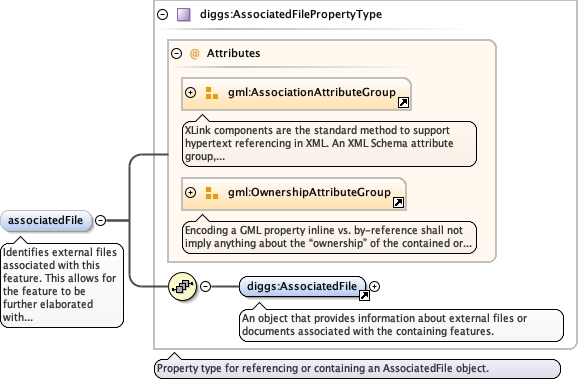
Identifies external files associated with thisfeature. This allows for the feature to be further elaboratedwith information that cannot be represented by ASCII text, suchas a photograph or other media, binary data, or a formattedreport.
The 'actuate' attribute is used to communicate the desired timing of traversal from the starting resource to the ending resource; it's value should be treated as follows:onLoad - traverse to the ending resource immediately on loading the starting resource onRequest - traverse from the starting resource to the ending resource only on a post-loading event triggered for this purpose other - behavior is unconstrained; examine other markup in link for hints none - behavior is unconstrained
The 'show' attribute is used to communicate the desired presentation of the ending resource on traversal from the starting resource; it's value should be treated as follows: new - load ending resource in a new window, frame, pane, or other presentation contextreplace - load the resource in the same window, frame, pane, or other presentation contextembed - load ending resource in place of the presentation of the starting resourceother - behavior is unconstrained; examine other markup in the link for hints none - behavior is unconstrained
<element maxOccurs="unbounded" minOccurs="0" name="associatedFile" type="diggs:AssociatedFilePropertyType"><annotation><documentation>Identifies external files associated with this feature. This allows for the feature to be further elaborated with information that cannot be represented by ASCII text, such as a photograph or other media, binary data, or a formatted report.</documentation></annotation></element>
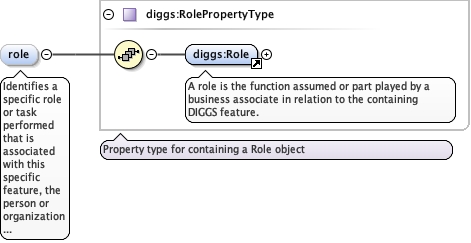
Identifies a specific role or task performed that isassociated with this specific feature, the person ororganization that performed the role, and associated time frame,if applicable.
<element maxOccurs="unbounded" minOccurs="0" name="role" type="diggs:RolePropertyType"><annotation><documentation>Identifies a specific role or task performed that is associated with this specific feature, the person or organization that performed the role, and associated time frame, if applicable.</documentation></annotation></element>
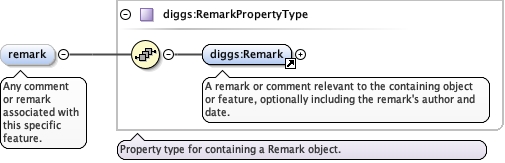
<element maxOccurs="unbounded" minOccurs="0" name="remark" type="diggs:RemarkPropertyType"><annotation><documentation>Any comment or remark associated with this specific feature.</documentation></annotation></element>
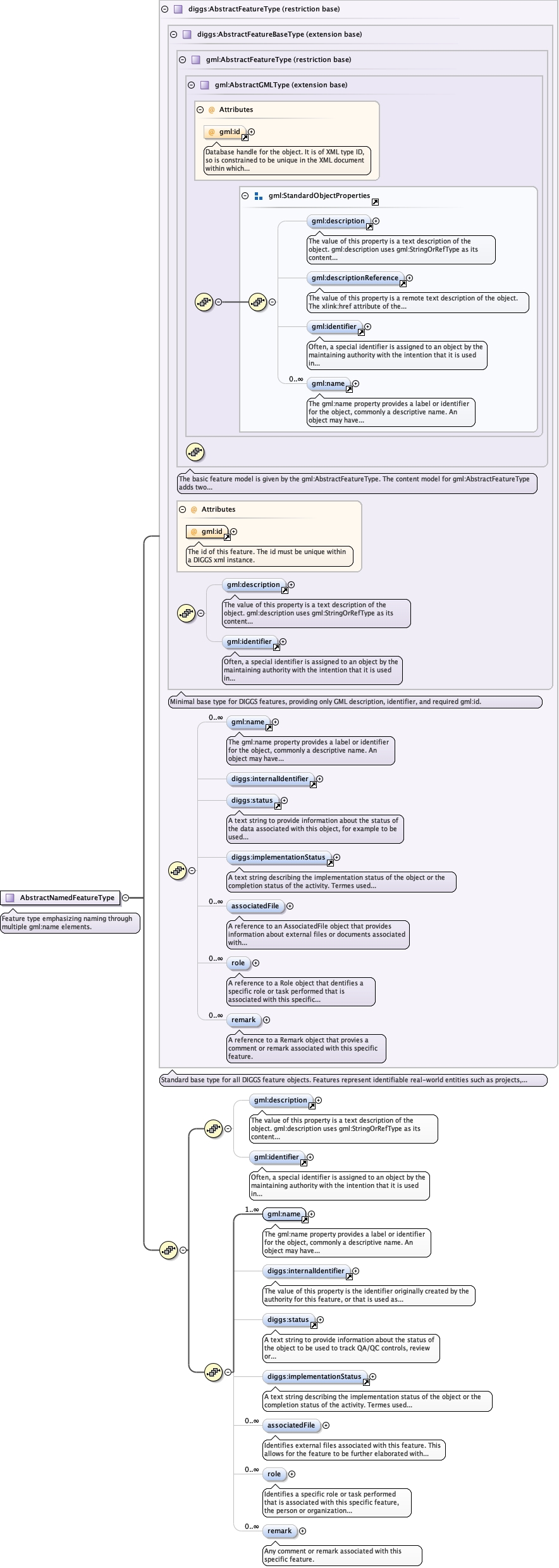
Complex Type diggs:AbstractNamedFeatureType
Namespace
http://diggsml.org/schemas/3
Annotations
Feature type emphasizing naming through multiple gml:name elements.
Database handle for the object. It is of XML type ID, so is constrained to beunique in the XML document within which it occurs. An external identifier for the object inthe form of a URI may be constructed using standard XML and XPointer methods. This is doneby concatenating the URI for the document, a fragment separator, and the value of the idattribute.
Source
<complexType name="AbstractNamedFeatureType" abstract="true"><annotation><documentation>Feature type emphasizing naming through multiple gml:name elements.</documentation></annotation><complexContent><restriction base="diggs:AbstractFeatureType"><sequence><sequence><element minOccurs="0" ref="gml:description"/><element minOccurs="0" ref="gml:identifier"/></sequence><sequence><element maxOccurs="unbounded" minOccurs="1" ref="gml:name"/><element minOccurs="0" ref="diggs:internalIdentifier"><annotation><documentation>The value of this property is the identifier originally created by the authority for this feature, or that is used as the identifier in the authority's internal data management system. There is no assumption as to the unique scope or persistence of this identifier. In cases where the original or internal identifier does not meet the semantic requirements for gml:id or gml:identifier, the internal identifier may be included in this property in order for the originating authority to "map back" the identifier to an internal data management system. The codeSpace attribute must be populated to identify the authority that uses the internalIdentifier value.</documentation></annotation></element><element minOccurs="0" ref="diggs:status"><annotation><documentation>A text string to provide information about the status of the object to be used to track QA/QC controls, review or release status, etc. The values used are intended to come from a controlled list of terms maintained by an organization.</documentation></annotation></element><element minOccurs="0" ref="diggs:implementationStatus"/><element maxOccurs="unbounded" minOccurs="0" name="associatedFile" type="diggs:AssociatedFilePropertyType"><annotation><documentation>Identifies external files associated with this feature. This allows for the feature to be further elaborated with information that cannot be represented by ASCII text, such as a photograph or other media, binary data, or a formatted report.</documentation></annotation></element><element maxOccurs="unbounded" minOccurs="0" name="role" type="diggs:RolePropertyType"><annotation><documentation>Identifies a specific role or task performed that is associated with this specific feature, the person or organization that performed the role, and associated time frame, if applicable.</documentation></annotation></element><element maxOccurs="unbounded" minOccurs="0" name="remark" type="diggs:RemarkPropertyType"><annotation><documentation>Any comment or remark associated with this specific feature.</documentation></annotation></element></sequence></sequence></restriction></complexContent></complexType>