Showing:

Annotations
Attributes
Diagrams
Instances
Model
Properties
Source
Used by
Element diggs:AbstractNamedRoleObjectType / diggs:role
Namespace http://diggsml.org/schemas/3
Annotations
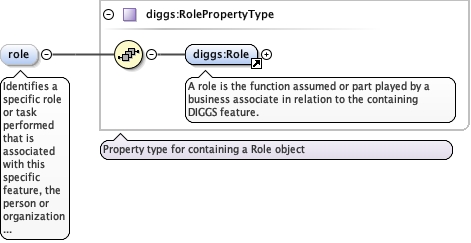
Identifies a specific role or task performed that is
associated with this specific feature, the person or
organization that performed the role, and associated time frame,
if applicable.
Diagram
DiagramCommon_xsd_Element_diggs_Role.tmp#http___diggsml.org_schemas_3_RoleCommon_xsd_Complex_Type_diggs_RolePropertyType.tmp#RolePropertyType
Type diggs:RolePropertyType
Properties
content complex
minOccurs 0
maxOccurs unbounded
Model
Children diggs:Role
Instance
<diggs:role xmlns:diggs="http://diggsml.org/schemas/3">
  <diggs:Role owns="false">{1,1}</diggs:Role>
</diggs:role>
Source
<element maxOccurs="unbounded" minOccurs="0" name="role" type="diggs:RolePropertyType">
  <annotation>
    <documentation>Identifies a specific role or task performed that is associated with this specific feature, the person or organization that performed the role, and associated time frame, if applicable.</documentation>
  </annotation>
</element>
Element diggs:AbstractNamedRoleObjectType / diggs:remark
Namespace http://diggsml.org/schemas/3
Annotations
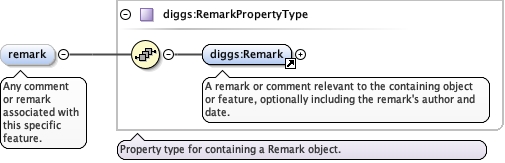
Any comment or remark associated with this specific
feature.
Diagram
DiagramCommon_xsd_Element_diggs_Remark.tmp#RemarkCommon_xsd_Complex_Type_diggs_RemarkPropertyType.tmp#RemarkPropertyType
Type diggs:RemarkPropertyType
Properties
content complex
minOccurs 0
maxOccurs unbounded
Model
Children diggs:Remark
Instance
<diggs:remark xmlns:diggs="http://diggsml.org/schemas/3">
  <diggs:Remark owns="false">{1,1}</diggs:Remark>
</diggs:remark>
Source
<element maxOccurs="unbounded" minOccurs="0" name="remark" type="diggs:RemarkPropertyType">
  <annotation>
    <documentation>Any comment or remark associated with this specific feature.</documentation>
  </annotation>
</element>
Complex Type diggs:AbstractNamedRoleObjectType
Namespace http://diggsml.org/schemas/3
Annotations
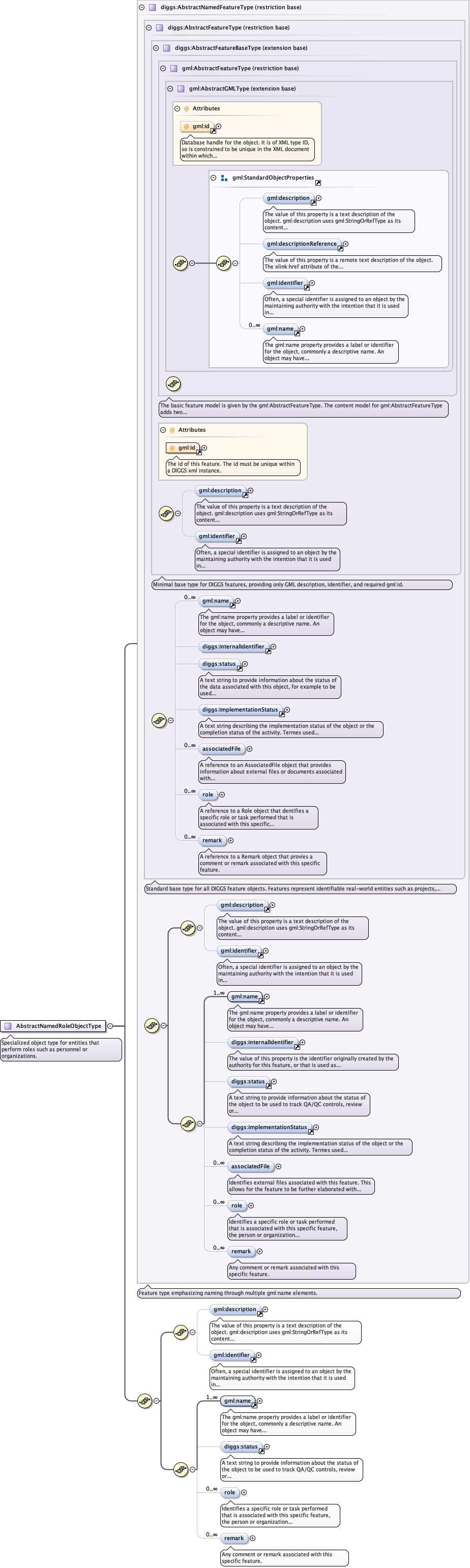
Specialized object type for entities that perform roles such as personnel or organizations.
Diagram
Diagramgml3_2Profile_diggs_xsd_Attribute_gml_id.tmp#idgml3_2Profile_diggs_xsd_Element_gml_description.tmp#descriptiongml3_2Profile_diggs_xsd_Element_gml_descriptionReference.tmp#descriptionReferencegml3_2Profile_diggs_xsd_Element_gml_identifier.tmp#identifiergml3_2Profile_diggs_xsd_Element_gml_name.tmp#namegml3_2Profile_diggs_xsd_Element_Group_gml_StandardObjectProperties.tmp#StandardObjectPropertiesgml3_2Profile_diggs_xsd_Complex_Type_gml_AbstractGMLType.tmp#AbstractGMLTypegml3_2Profile_diggs_xsd_Complex_Type_gml_AbstractFeatureType.tmp#AbstractFeatureTypegml3_2Profile_diggs_xsd_Attribute_gml_id.tmp#idgml3_2Profile_diggs_xsd_Element_gml_description.tmp#descriptiongml3_2Profile_diggs_xsd_Element_gml_identifier.tmp#identifierAbstractTypes_xsd_Complex_Type_diggs_AbstractFeatureBaseType.tmp#AbstractFeatureBaseTypegml3_2Profile_diggs_xsd_Element_gml_name.tmp#nameCommon_xsd_Element_diggs_internalIdentifier.tmp#internalIdentifierCommon_xsd_Element_diggs_status.tmp#statusCommon_xsd_Element_diggs_implementationStatus.tmp#implementationStatusAbstractTypes_xsd_Complex_Type_diggs_AbstractFeatureType.tmp#http___diggsml.org_schemas_3_AbstractFeatureType_associatedFileAbstractTypes_xsd_Complex_Type_diggs_AbstractFeatureType.tmp#http___diggsml.org_schemas_3_AbstractFeatureType_roleAbstractTypes_xsd_Complex_Type_diggs_AbstractFeatureType.tmp#http___diggsml.org_schemas_3_AbstractFeatureType_remarkAbstractTypes_xsd_Complex_Type_diggs_AbstractFeatureType.tmp#http___diggsml.org_schemas_3_AbstractFeatureTypegml3_2Profile_diggs_xsd_Element_gml_description.tmp#descriptiongml3_2Profile_diggs_xsd_Element_gml_identifier.tmp#identifiergml3_2Profile_diggs_xsd_Element_gml_name.tmp#nameCommon_xsd_Element_diggs_internalIdentifier.tmp#internalIdentifierCommon_xsd_Element_diggs_status.tmp#statusCommon_xsd_Element_diggs_implementationStatus.tmp#implementationStatusAbstractTypes_xsd_Complex_Type_diggs_AbstractNamedFeatureType.tmp#AbstractNamedFeatureType_associatedFileAbstractTypes_xsd_Complex_Type_diggs_AbstractNamedFeatureType.tmp#AbstractNamedFeatureType_roleAbstractTypes_xsd_Complex_Type_diggs_AbstractNamedFeatureType.tmp#AbstractNamedFeatureType_remarkAbstractTypes_xsd_Complex_Type_diggs_AbstractNamedFeatureType.tmp#AbstractNamedFeatureTypegml3_2Profile_diggs_xsd_Element_gml_description.tmp#descriptiongml3_2Profile_diggs_xsd_Element_gml_identifier.tmp#identifiergml3_2Profile_diggs_xsd_Element_gml_name.tmp#nameCommon_xsd_Element_diggs_status.tmp#statusAbstractTypes_xsd_Complex_Type_diggs_AbstractNamedRoleObjectType.tmp#AbstractNamedRoleObjectType_roleAbstractTypes_xsd_Complex_Type_diggs_AbstractNamedRoleObjectType.tmp#AbstractNamedRoleObjectType_remark
Type restriction of diggs:AbstractNamedFeatureType
Type hierarchy
Used by
Model
Children diggs:remark, diggs:role, diggs:status, gml:description, gml:identifier, gml:name
Attributes
QName Type Use Annotation
gml:id ID required
Database handle for the object. It is of XML type ID, so is constrained to be
unique in the XML document within which it occurs. An external identifier for the object in
the form of a URI may be constructed using standard XML and XPointer methods. This is done
by concatenating the URI for the document, a fragment separator, and the value of the id
attribute.
Source
<complexType name="AbstractNamedRoleObjectType">
  <annotation>
    <documentation>Specialized object type for entities that perform roles such as personnel or organizations.</documentation>
  </annotation>
  <complexContent>
    <restriction base="diggs:AbstractNamedFeatureType">
      <sequence>
        <sequence>
          <element minOccurs="0" ref="gml:description"/>
          <element minOccurs="0" ref="gml:identifier"/>
        </sequence>
        <sequence>
          <element maxOccurs="unbounded" minOccurs="1" ref="gml:name"/>
          <element minOccurs="0" ref="diggs:status">
            <annotation>
              <documentation>A text string to provide information about the status of the object to be used to track QA/QC controls, review or release status, etc. The values used are intended to come from a controlled list of terms maintained by an organization.</documentation>
            </annotation>
          </element>
          <element maxOccurs="unbounded" minOccurs="0" name="role" type="diggs:RolePropertyType">
            <annotation>
              <documentation>Identifies a specific role or task performed that is associated with this specific feature, the person or organization that performed the role, and associated time frame, if applicable.</documentation>
            </annotation>
          </element>
          <element maxOccurs="unbounded" minOccurs="0" name="remark" type="diggs:RemarkPropertyType">
            <annotation>
              <documentation>Any comment or remark associated with this specific feature.</documentation>
            </annotation>
          </element>
        </sequence>
      </sequence>
    </restriction>
  </complexContent>
</complexType>