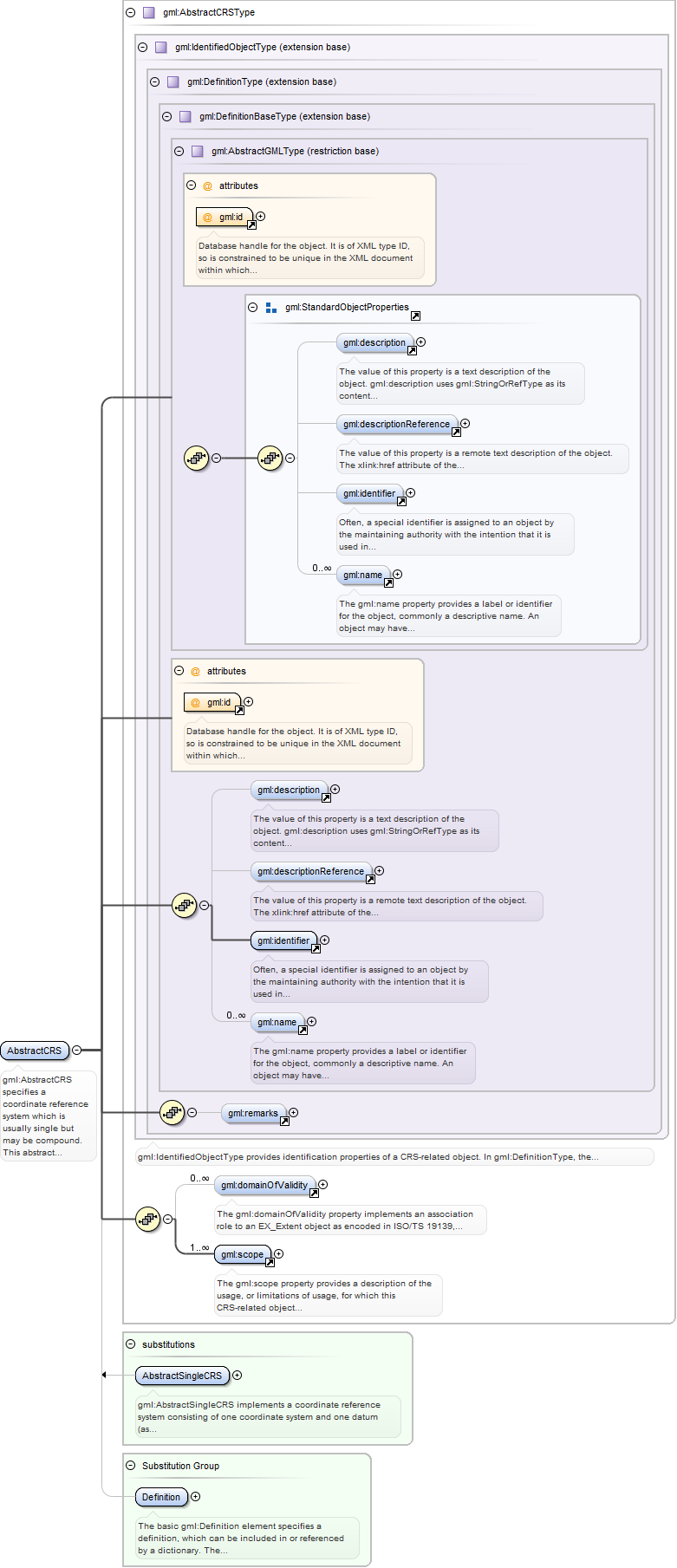
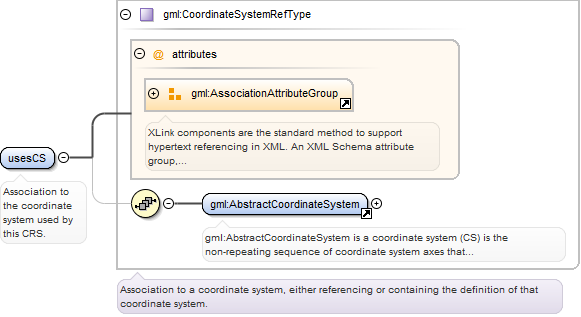
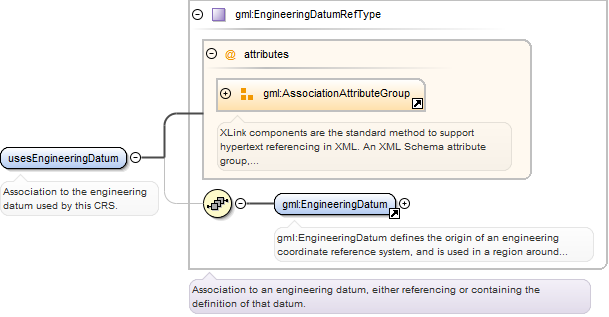
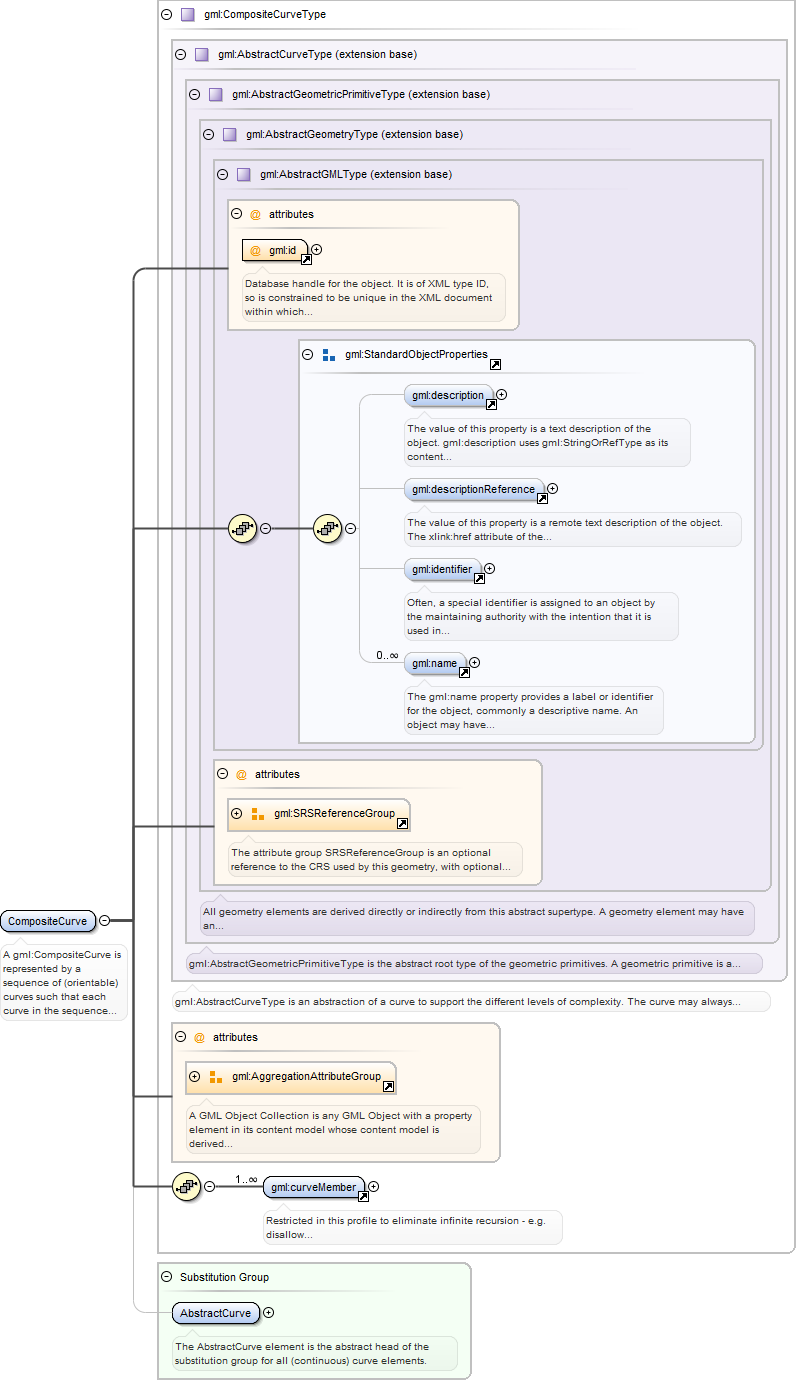
Showing:

Annotations
Attributes
Diagrams
Facets
Instances
Properties
Source
Used by
Imported schema gml3.2Profile_diggs.xsd
Namespace http://www.opengis.net/gml/3.2
Annotations
GML Subset schema for
,PointPropertyType,CodeType,EngineeringDatum,CoordinateSystemAxis,CurvePropertyType,AbstractGML,AbstractFeature,MultiGeometryPropertyType,MultiPointPropertyType,AssociationAttributeGroup,ReferenceType,EngineeringDatumType,CoordinateSystemAxisType,AbstractGMLType,AbstractFeatureCollectionType,AbstractFeatureType,
written by gmlSubset.xslt.
Date 2012-06-29. Further valid restrictions made to this GML 3.2 profile for
DIGGS V2.0.a by David S. Burggraf (DSB), Galdos Systems. (look for changes following comments
with the text: 'DSB: restricted from profile'). All profile restrictions were validated in
accordance with GML 3.2 rules (ISO TC 211 19136 (2007), clauses 2.3 and 20). In particular,
the DIGGS schemas continue to validate against the full set of GML schemas (tested by
replacing all gml profile imports with the complete GML schema document wrapper,
gml.xsd)
Properties
attribute form default: unqualified
element form default: qualified
version: 3.2.1
Schema location file:/C:/GaldosOffline/DIGGS_Offline - GMLProfile/Diggs2.0.a/Schemas/gml3.2Profile_diggs.xsd
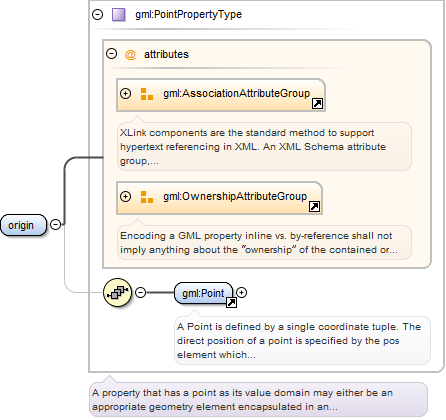
Element gml:Point
Namespace http://www.opengis.net/gml/3.2
Annotations
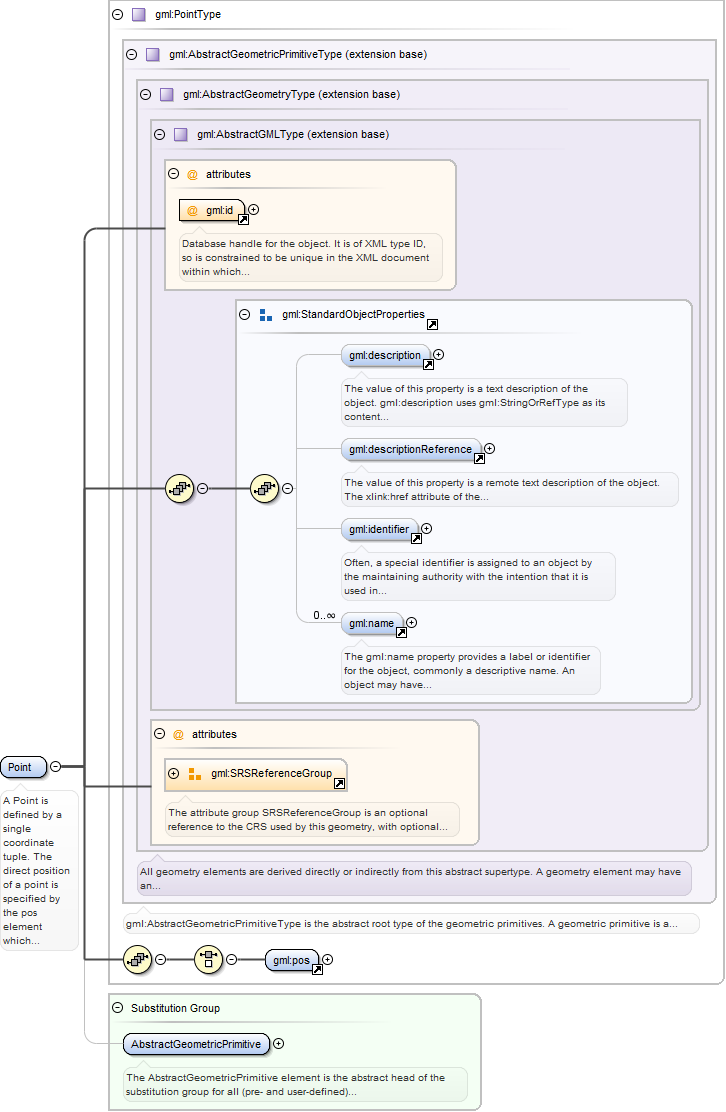
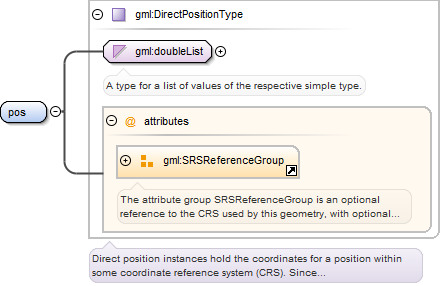
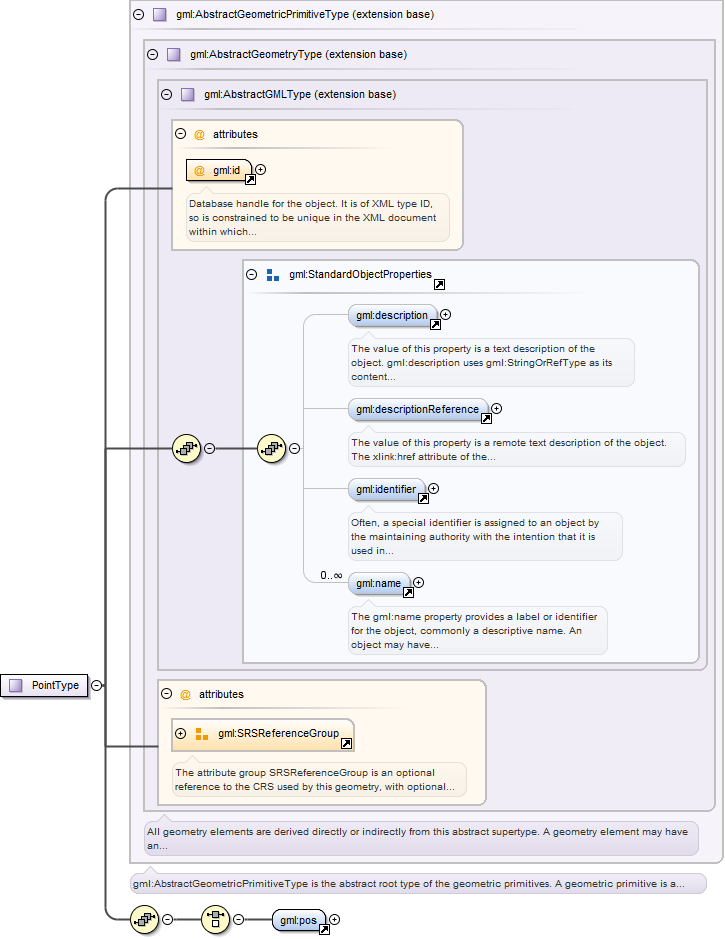
A Point is defined by a single coordinate tuple. The direct position of a point
is specified by the pos element which is of type DirectPositionType.
Diagram
Diagram 3_2.tmp#id 3_2.tmp#description 3_2.tmp#descriptionReference 3_2.tmp#identifier 3_2.tmp#name 3_2.tmp#StandardObjectProperties 3_2.tmp#AbstractGMLType 3_2.tmp#SRSReferenceGroup 3_2.tmp#AbstractGeometryType 3_2.tmp#AbstractGeometricPrimitiveType 3_2.tmp#pos 3_2.tmp#PointType 3_2.tmp#AbstractGeometricPrimitive
Type gml:PointType
Type hierarchy
Properties
content: complex
Substitution Group Affiliation
Used by
Model gml:description{0,1} , gml:descriptionReference{0,1} , gml:identifier{0,1} , gml:name* , (gml:pos)
Children gml:description, gml:descriptionReference, gml:identifier, gml:name, gml:pos
Instance
<gml:Point axisLabels="" gml:id="" srsDimension="" srsName="" uomLabels="" xmlns:gml="http://www.opengis.net/gml/3.2">
  <gml:description xlink:href="" nilReason="" xlink:title="">{0,1}</gml:description>
  <gml:descriptionReference xlink:href="" nilReason="" owns="false" xlink:title="">{0,1}</gml:descriptionReference>
  <gml:identifier codeSpace="">{0,1}</gml:identifier>
  <gml:name codeSpace="">{0,unbounded}</gml:name>
  <gml:pos axisLabels="" srsDimension="" srsName="" uomLabels="">{1,1}</gml:pos>
</gml:Point>
Attributes
QName Type Fixed Default Use Annotation
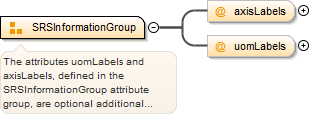
axisLabels gml:NCNameList optional
gml:id ID required
Database handle for the object. It is of XML type ID, so is constrained to be
unique in the XML document within which it occurs. An external identifier for the object in
the form of a URI may be constructed using standard XML and XPointer methods. This is done
by concatenating the URI for the document, a fragment separator, and the value of the id
attribute.
srsDimension positiveInteger optional
srsName anyURI optional
uomLabels gml:NCNameList optional
Source
<element name="Point" type="gml:PointType" substitutionGroup="gml:AbstractGeometricPrimitive">
  <annotation>
    <documentation>A Point is defined by a single coordinate tuple. The direct position of a point is specified by the pos element which is of type DirectPositionType.</documentation>
  </annotation>
</element>
Schema location file:/C:/GaldosOffline/DIGGS_Offline - GMLProfile/Diggs2.0.a/Schemas/gml3.2Profile_diggs.xsd
Element gml:description
Namespace http://www.opengis.net/gml/3.2
Annotations
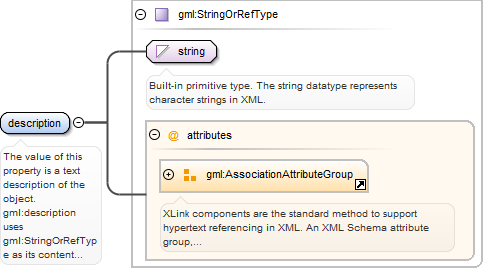
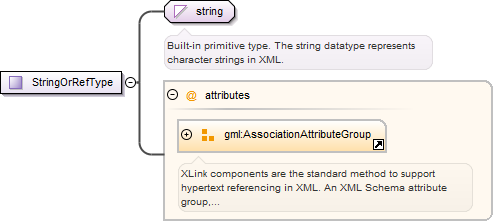
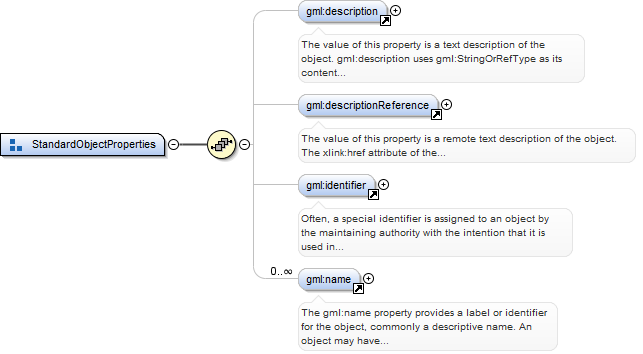
The value of this property is a text description of the object. gml:description
uses gml:StringOrRefType as its content model, so it may contain a simple text string
content, or carry a reference to an external description. The use of gml:description to
reference an external description has been deprecated and replaced by the
gml:descriptionReference property.
Diagram
Diagram 3_2.tmp#AssociationAttributeGroup 3_2.tmp#StringOrRefType
Type gml:StringOrRefType
Properties
content: complex
Used by
Element Group gml:StandardObjectProperties
Complex Types diggs:AbstractBoreholeInsituTestType, diggs:AbstractCurveType, diggs:AbstractEventType, diggs:AbstractFeatureBaseType, diggs:AbstractFeatureType, diggs:AbstractGeometricAggregateType, diggs:AbstractGeometricPrimitiveType, diggs:AbstractGeometryType, diggs:AbstractGroupType, diggs:AbstractInsituTestType, diggs:AbstractInvestigationTargetType, diggs:AbstractLaboratoryTestType, diggs:AbstractLayerType, diggs:AbstractLinearSamplingFeatureType, diggs:AbstractMeasurementType, diggs:AbstractMetaDataType, diggs:AbstractMonitoringProcessType, diggs:AbstractNamedFeatureType, diggs:AbstractNamedLayerType, diggs:AbstractNamedObjectType, diggs:AbstractObjectBaseType, diggs:AbstractObjectType, diggs:AbstractPlanarSamplingFeatureType, diggs:AbstractPointSamplingFeatureType, diggs:AbstractSamplingFeatureType, diggs:AbstractSurfaceType, diggs:AbstractTestProcedureType, diggs:AddressType, diggs:AssociatedFileType, diggs:BackfillLayerType, diggs:BackfillType, diggs:BlockSampleDetailType, diggs:BoreholeDiameterType, diggs:BoreholeEventType, diggs:BoreholeType, diggs:BoundaryType, diggs:BusinessAssociateType, diggs:CalibrationType, diggs:CasingType, diggs:ChainOfCustodyEventType, diggs:ChiselingType, diggs:ColorLayerType, diggs:ColorType, diggs:ComponentLayerType, diggs:ComponentLithologyType, diggs:ComponentType, diggs:ConstituentType, diggs:ConstructionMethodType, diggs:ContractType, diggs:CylindricalSampleDetailType, diggs:DelayEventType, diggs:DescriptivePropertyType, diggs:DetectionLimitType, diggs:DetectorType, diggs:DiscontinuityLayerType, diggs:EnvironmentType, diggs:EquipmentType, diggs:FaceType, diggs:FlushType, diggs:FractureDescriptionType, diggs:FractureSpacingType, diggs:GroundType, diggs:GroupGroupType, diggs:LayerSystemType, diggs:LineStringType, diggs:LinearSpatialReferenceSystemType, diggs:LithologyLayerType, diggs:LithologyType, diggs:MeasureOrStringType, diggs:MonitoringResultType, diggs:MonitoringTimeType, diggs:MonitoringType, diggs:MultiCurveType, diggs:OrientationLayerType, diggs:OrientationType, diggs:OtherLayerType, diggs:ParameterType, diggs:ParticleDensityType, diggs:ParticleSizeDistributionType, diggs:ParticleSizeType, diggs:PlanarLayerRepresentationType, diggs:PointType, diggs:PolygonType, diggs:PostStrikeReadingType, diggs:ProjectGroupType, diggs:ProjectType, diggs:PropertyLayerType, diggs:PropertyType, diggs:SampleGroupType, diggs:SamplePreparationType, diggs:SampleProducedType, diggs:SampleType, diggs:SamplingActivityType, diggs:SamplingFeatureGroupType, diggs:SensorType, diggs:SimpleMultiPointType, diggs:SoftwareApplicationType, diggs:SpecificationType, diggs:StationType, diggs:StratigraphyLayerType, diggs:TestType, diggs:TimeIntervalType, diggs:TransectType, diggs:TrenchWallType, diggs:TrialPitEventType, diggs:TrialPitType, diggs:ValueAtTimeType, diggs:VectorLinearSpatialReferenceSystemType, diggs:WaterStrikeType, diggs:WellEventType, diggs:WellOpeningType, diggs:WellType, diggs_env:ChemicalAnalysisType, diggs_env:FiltrationType, diggs_env:PurgeType, diggs_env:SpectralAnalysisType, diggs_env:TICResultType, diggs_env:WaterLevelReadingType, diggs_geo:AggregateAbrasionValueTestType, diggs_geo:AggregateCrushingValueTestType, diggs_geo:AggregateImpactValueTestType, diggs_geo:AggregateLosAngelesAbrasionTestType, diggs_geo:AggregateSlakeDurabilityTestType, diggs_geo:AggregateSoundnessTestType, diggs_geo:AggregateTenPercentFinesTestType, diggs_geo:AtterbergLimitsTestType, diggs_geo:CationExchangeTestType, diggs_geo:ChalkCrushingValueTestType, diggs_geo:CompactionTestTrialsType, diggs_geo:CompactionTestType, diggs_geo:CompressiveStrengthTestType, diggs_geo:ConsolidationTestTrialsType, diggs_geo:ConsolidationTestType, diggs_geo:DirectShearTestTrialsType, diggs_geo:DirectShearTestType, diggs_geo:DriveSetType, diggs_geo:DrivenPenetrationTestType, diggs_geo:FlatDilatometerTestType, diggs_geo:FrostSusceptibilityTestType, diggs_geo:GradingType, diggs_geo:HandVaneTestType, diggs_geo:InsituCBRTestType, diggs_geo:InsituPermeabilityTestType, diggs_geo:InsituVaneTestType, diggs_geo:LabCBRTestTrialsType, diggs_geo:LabCBRTestType, diggs_geo:LabPermeabilityTestType, diggs_geo:LabVelocityTestType, diggs_geo:LinearShrinkageTestType, diggs_geo:MCVTestTrialsType, diggs_geo:MCVTestType, diggs_geo:ParticleSizeTestType, diggs_geo:PointLoadTestType, diggs_geo:PorePressureElementType, diggs_geo:PorewaterPressureMeasureType, diggs_geo:PressuremeterTestTrialsType, diggs_geo:PressuremeterTestType, diggs_geo:PumpingTestTrialsType, diggs_geo:PumpingTestType, diggs_geo:RedoxTestType, diggs_geo:RelativeDensityTestType, diggs_geo:RockPorosityDensityTestType, diggs_geo:SchmidtReboundHardnessTestType, diggs_geo:StaticConePenetrationTestType, diggs_geo:SuctionTestType, diggs_geo:WirelineLogType, glr:LinearSRSType, glrov:VectorOffsetLinearSRSType, gml:AbstractCRSType, gml:AbstractCoordinateSystemType, gml:AbstractDatumType, gml:AffineCSType, gml:CartesianCSType, gml:CoordinateSystemAxisType, gml:CylindricalCSType, gml:DefinitionBaseType, gml:DefinitionType, gml:EngineeringCRSType, gml:EngineeringDatumType, gml:IdentifiedObjectType, gml:LinearCSType, gml:PolarCSType, gml:SphericalCSType, gml:UserDefinedCSType
Attributes
QName Type Fixed Default Use Annotation
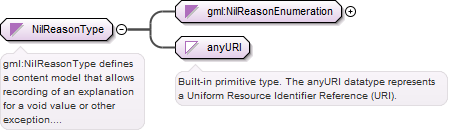
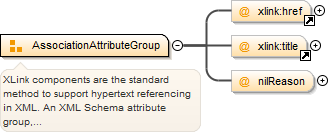
nilReason gml:NilReasonType optional
xlink:href xlink:hrefType optional
xlink:title xlink:titleAttrType optional
Source
<element name="description" type="gml:StringOrRefType">
  <annotation>
    <documentation>The value of this property is a text description of the object. gml:description uses gml:StringOrRefType as its content model, so it may contain a simple text string content, or carry a reference to an external description. The use of gml:description to reference an external description has been deprecated and replaced by the gml:descriptionReference property.</documentation>
  </annotation>
</element>
Schema location file:/C:/GaldosOffline/DIGGS_Offline - GMLProfile/Diggs2.0.a/Schemas/gml3.2Profile_diggs.xsd
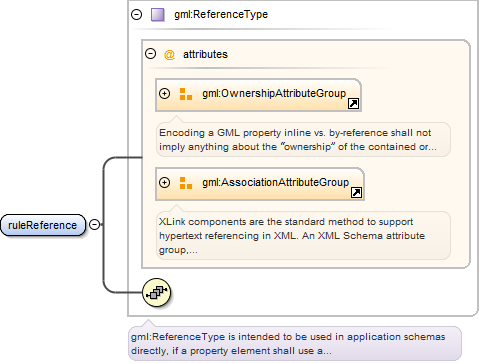
Element gml:descriptionReference
Namespace http://www.opengis.net/gml/3.2
Annotations
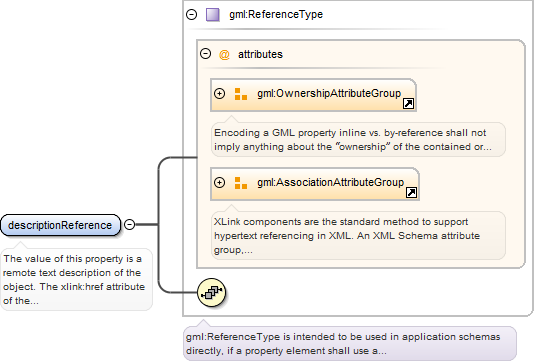
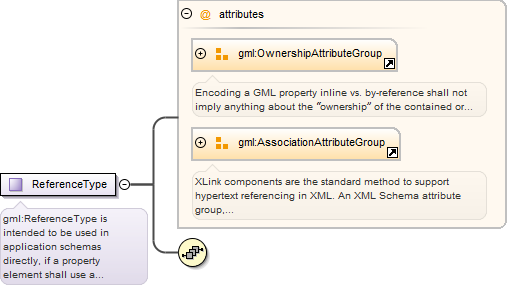
The value of this property is a remote text description of the object. The
xlink:href attribute of the gml:descriptionReference property references the external
description.
Diagram
Diagram 3_2.tmp#OwnershipAttributeGroup 3_2.tmp#AssociationAttributeGroup 3_2.tmp#ReferenceType
Type gml:ReferenceType
Properties
content: complex
Used by
Model
Attributes
QName Type Fixed Default Use Annotation
nilReason gml:NilReasonType optional
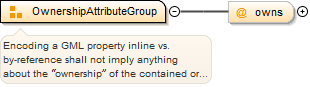
owns boolean false optional
xlink:href xlink:hrefType optional
xlink:title xlink:titleAttrType optional
Source
<element name="descriptionReference" type="gml:ReferenceType">
  <annotation>
    <documentation>The value of this property is a remote text description of the object. The xlink:href attribute of the gml:descriptionReference property references the external description.</documentation>
  </annotation>
</element>
Schema location file:/C:/GaldosOffline/DIGGS_Offline - GMLProfile/Diggs2.0.a/Schemas/gml3.2Profile_diggs.xsd
Element gml:identifier
Namespace http://www.opengis.net/gml/3.2
Annotations
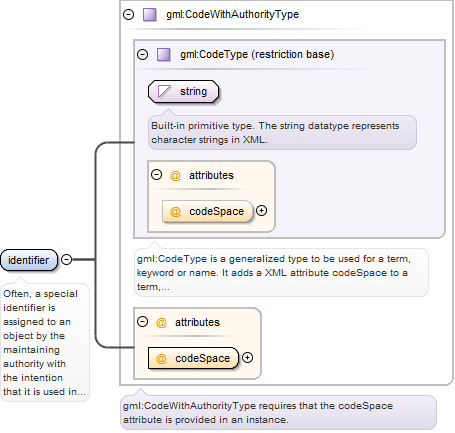
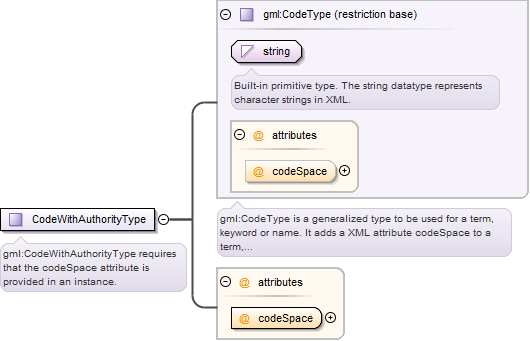
Often, a special identifier is assigned to an object by the maintaining
authority with the intention that it is used in references to the object For such cases, the
codeSpace shall be provided. That identifier is usually unique either globally or within an
application domain. gml:identifier is a pre-defined property for such
identifiers.
Diagram
Diagram NO_NAMESPACE.tmp#CodeType_codeSpace 3_2.tmp#CodeType NO_NAMESPACE.tmp#CodeWithAuthorityType_codeSpace 3_2.tmp#CodeWithAuthorityType
Type gml:CodeWithAuthorityType
Type hierarchy
Properties
content: complex
Used by
Attributes
QName Type Fixed Default Use Annotation
codeSpace anyURI required
Source
<element name="identifier" type="gml:CodeWithAuthorityType">
  <annotation>
    <documentation>Often, a special identifier is assigned to an object by the maintaining authority with the intention that it is used in references to the object For such cases, the codeSpace shall be provided. That identifier is usually unique either globally or within an application domain. gml:identifier is a pre-defined property for such identifiers.</documentation>
  </annotation>
</element>
Schema location file:/C:/GaldosOffline/DIGGS_Offline - GMLProfile/Diggs2.0.a/Schemas/gml3.2Profile_diggs.xsd
Element gml:name
Namespace http://www.opengis.net/gml/3.2
Annotations
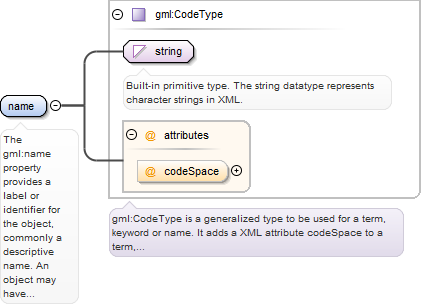
The gml:name property provides a label or identifier for the object, commonly a
descriptive name. An object may have several names, typically assigned by different
authorities. gml:name uses the gml:CodeType content model. The authority for a name is
indicated by the value of its (optional) codeSpace attribute. The name may or may not be
unique, as determined by the rules of the organization responsible for the codeSpace. In
common usage there will be one name per authority, so a processing application may select
the name from its preferred codeSpace.
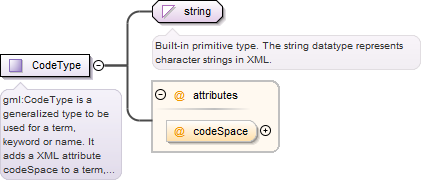
Diagram
Diagram NO_NAMESPACE.tmp#CodeType_codeSpace 3_2.tmp#CodeType
Type gml:CodeType
Properties
content: complex
Used by
Attributes
QName Type Fixed Default Use Annotation
codeSpace anyURI optional
Source
<element name="name" type="gml:CodeType">
  <annotation>
    <documentation>The gml:name property provides a label or identifier for the object, commonly a descriptive name. An object may have several names, typically assigned by different authorities. gml:name uses the gml:CodeType content model. The authority for a name is indicated by the value of its (optional) codeSpace attribute. The name may or may not be unique, as determined by the rules of the organization responsible for the codeSpace. In common usage there will be one name per authority, so a processing application may select the name from its preferred codeSpace.</documentation>
  </annotation>
</element>
Schema location file:/C:/GaldosOffline/DIGGS_Offline - GMLProfile/Diggs2.0.a/Schemas/gml3.2Profile_diggs.xsd
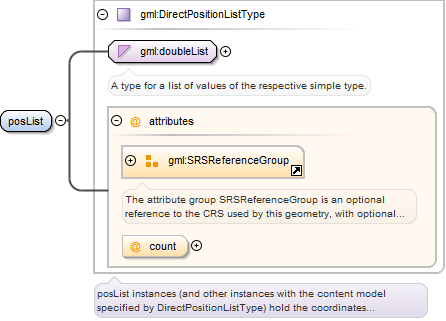
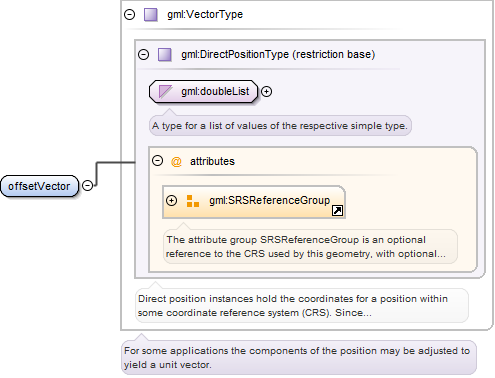
Element gml:pos
Namespace http://www.opengis.net/gml/3.2
Diagram
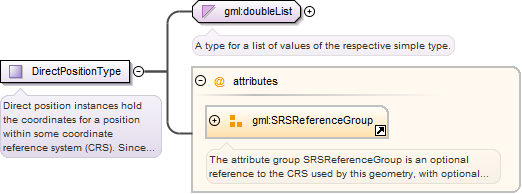
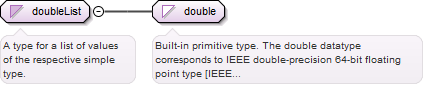
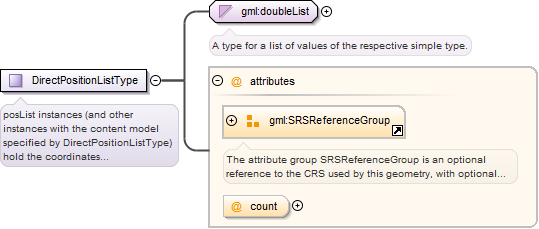
Diagram 3_2.tmp#doubleList 3_2.tmp#SRSReferenceGroup 3_2.tmp#DirectPositionType
Type gml:DirectPositionType
Type hierarchy
Properties
content: complex
Used by
Attributes
QName Type Fixed Default Use Annotation
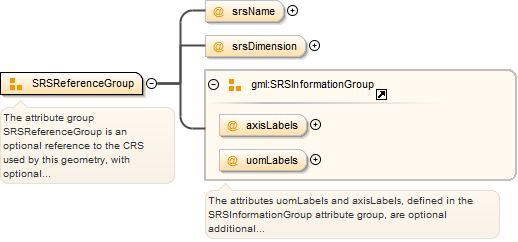
axisLabels gml:NCNameList optional
srsDimension positiveInteger optional
srsName anyURI optional
uomLabels gml:NCNameList optional
Source
<element name="pos" type="gml:DirectPositionType"/>
Schema location file:/C:/GaldosOffline/DIGGS_Offline - GMLProfile/Diggs2.0.a/Schemas/gml3.2Profile_diggs.xsd
Element gml:AbstractGeometricPrimitive
Namespace http://www.opengis.net/gml/3.2
Annotations
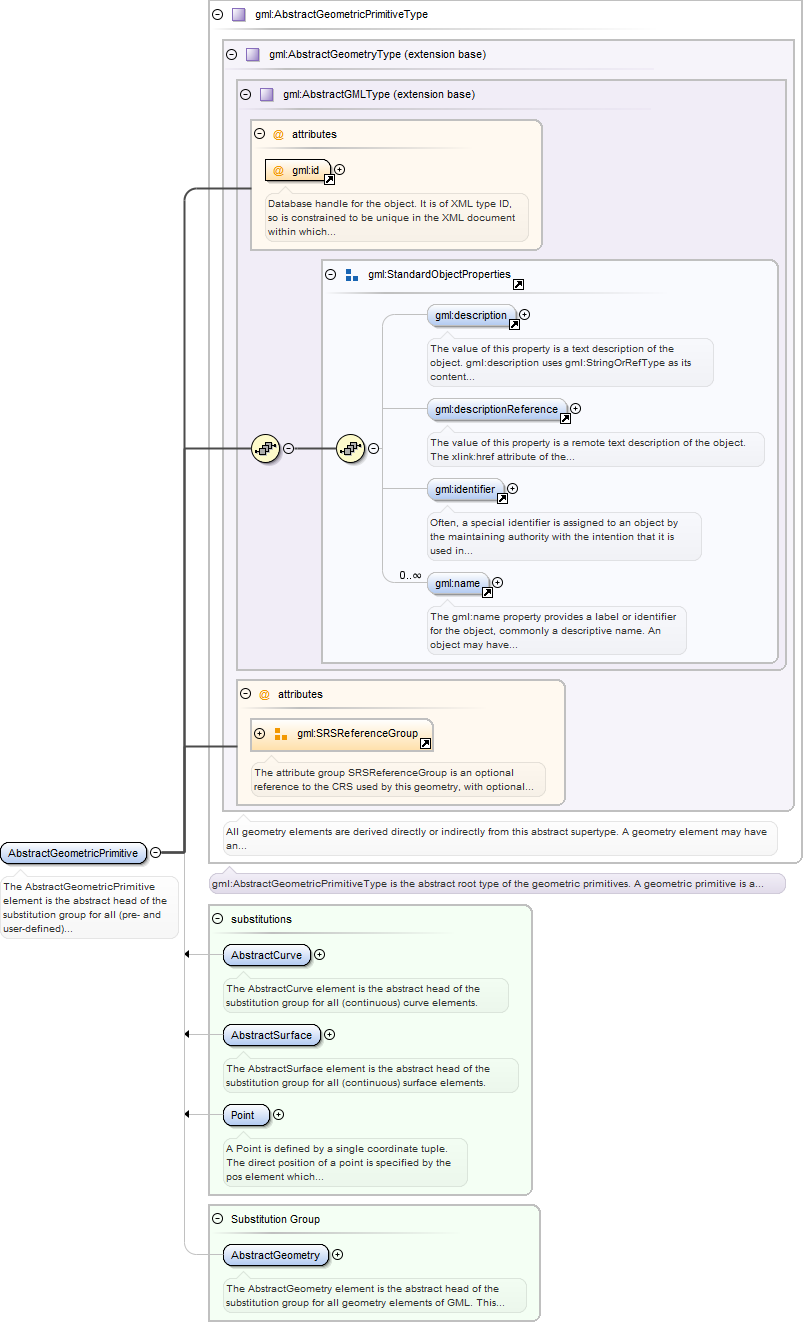
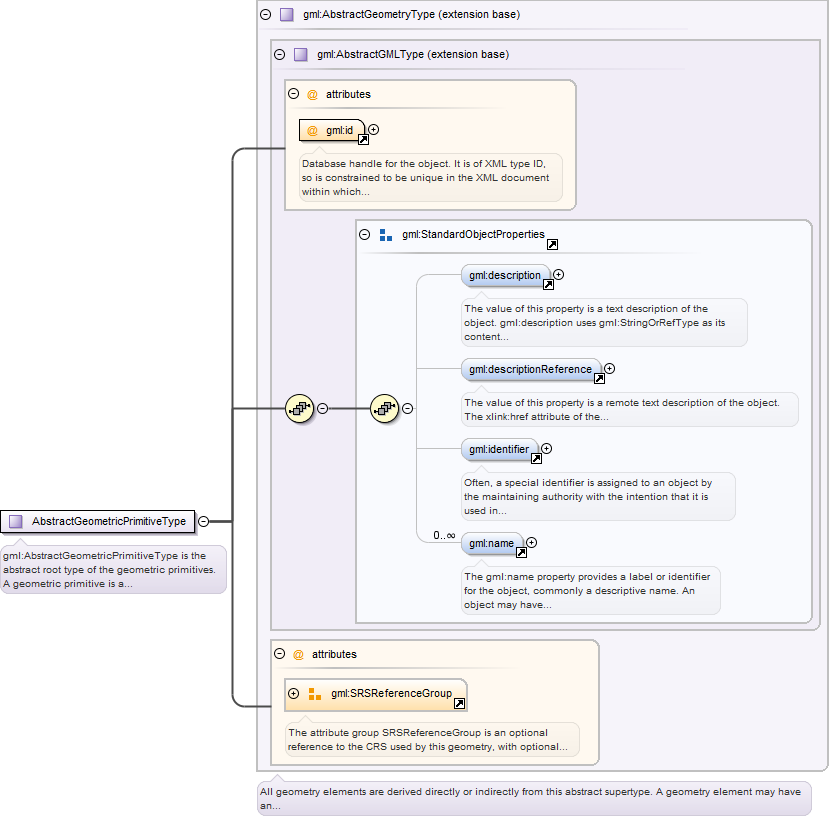
The AbstractGeometricPrimitive element is the abstract head of the substitution
group for all (pre- and user-defined) geometric primitives.
Diagram
Diagram 3_2.tmp#id 3_2.tmp#description 3_2.tmp#descriptionReference 3_2.tmp#identifier 3_2.tmp#name 3_2.tmp#StandardObjectProperties 3_2.tmp#AbstractGMLType 3_2.tmp#SRSReferenceGroup 3_2.tmp#AbstractGeometryType 3_2.tmp#AbstractGeometricPrimitiveType 3_2.tmp#AbstractCurve 3_2.tmp#AbstractSurface 3_2.tmp#Point 3_2.tmp#AbstractGeometry
Type gml:AbstractGeometricPrimitiveType
Type hierarchy
Properties
content: complex
abstract: true
Substitution Group
Substitution Group Affiliation
Model gml:description{0,1} , gml:descriptionReference{0,1} , gml:identifier{0,1} , gml:name*
Children gml:description, gml:descriptionReference, gml:identifier, gml:name
Instance
<gml:AbstractGeometricPrimitive axisLabels="" gml:id="" srsDimension="" srsName="" uomLabels="" xmlns:gml="http://www.opengis.net/gml/3.2">
  <gml:description xlink:href="" nilReason="" xlink:title="">{0,1}</gml:description>
  <gml:descriptionReference xlink:href="" nilReason="" owns="false" xlink:title="">{0,1}</gml:descriptionReference>
  <gml:identifier codeSpace="">{0,1}</gml:identifier>
  <gml:name codeSpace="">{0,unbounded}</gml:name>
</gml:AbstractGeometricPrimitive>
Attributes
QName Type Fixed Default Use Annotation
axisLabels gml:NCNameList optional
gml:id ID required
Database handle for the object. It is of XML type ID, so is constrained to be
unique in the XML document within which it occurs. An external identifier for the object in
the form of a URI may be constructed using standard XML and XPointer methods. This is done
by concatenating the URI for the document, a fragment separator, and the value of the id
attribute.
srsDimension positiveInteger optional
srsName anyURI optional
uomLabels gml:NCNameList optional
Source
<element name="AbstractGeometricPrimitive" type="gml:AbstractGeometricPrimitiveType" abstract="true" substitutionGroup="gml:AbstractGeometry">
  <annotation>
    <documentation>The AbstractGeometricPrimitive element is the abstract head of the substitution group for all (pre- and user-defined) geometric primitives.</documentation>
  </annotation>
</element>
Schema location file:/C:/GaldosOffline/DIGGS_Offline - GMLProfile/Diggs2.0.a/Schemas/gml3.2Profile_diggs.xsd
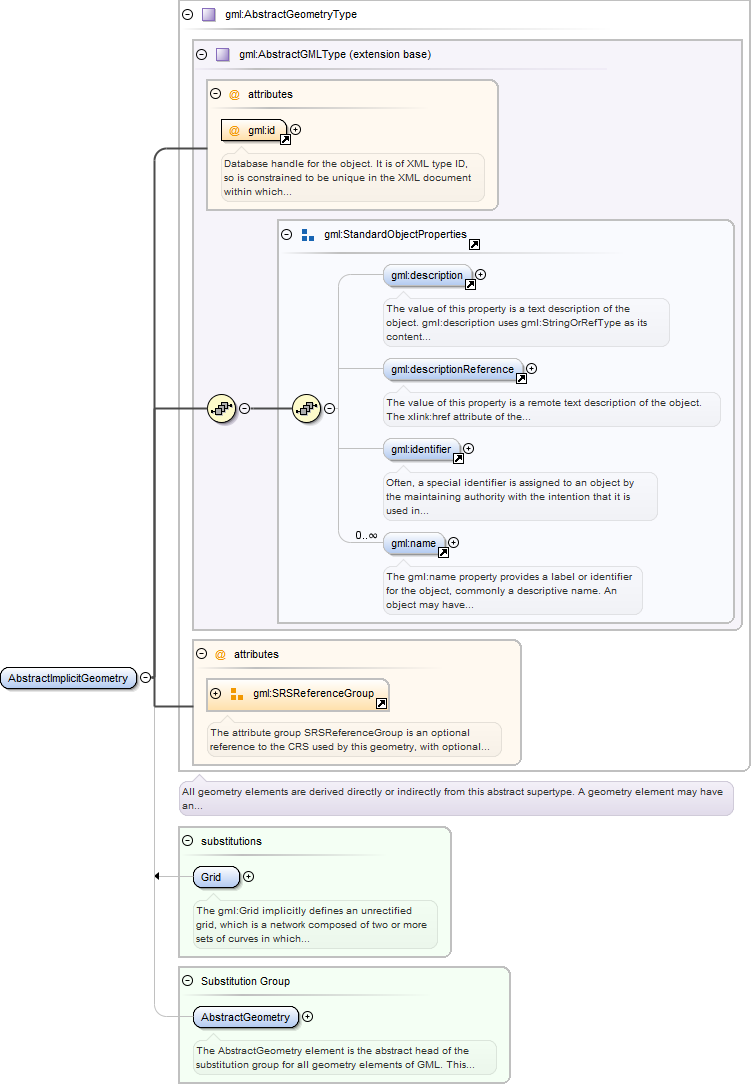
Element gml:AbstractGeometry
Namespace http://www.opengis.net/gml/3.2
Annotations
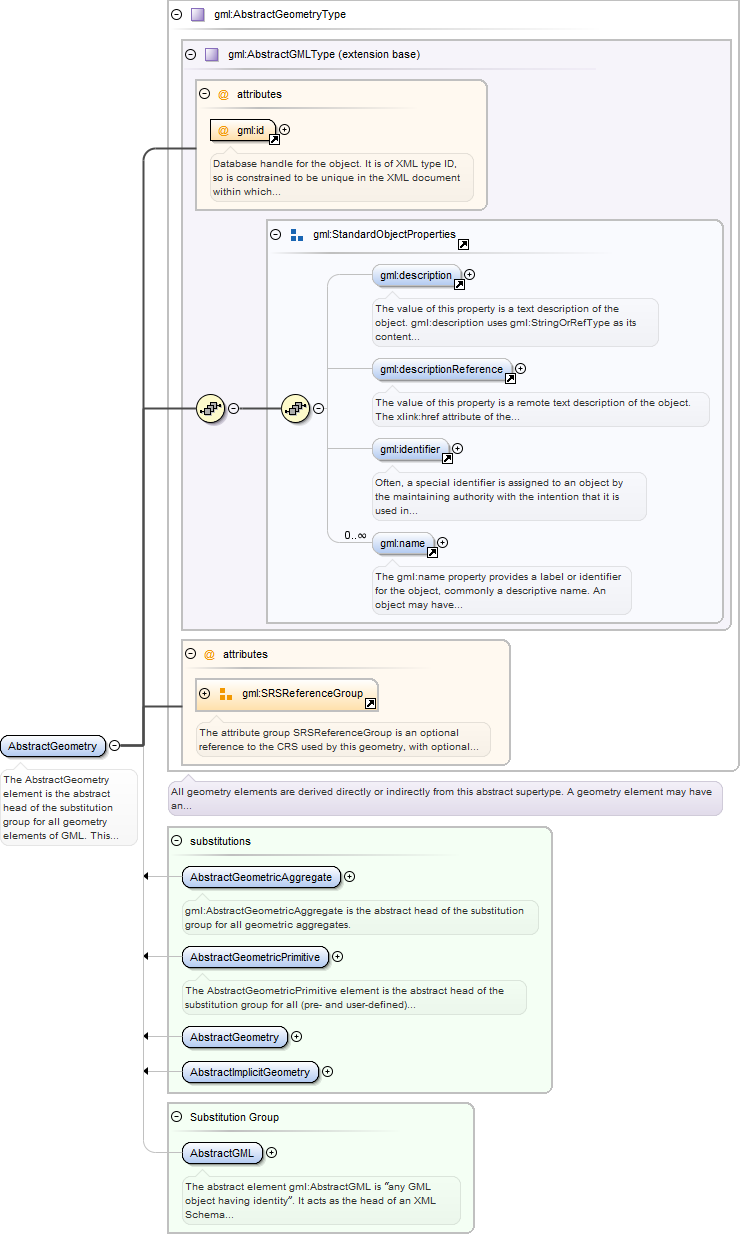
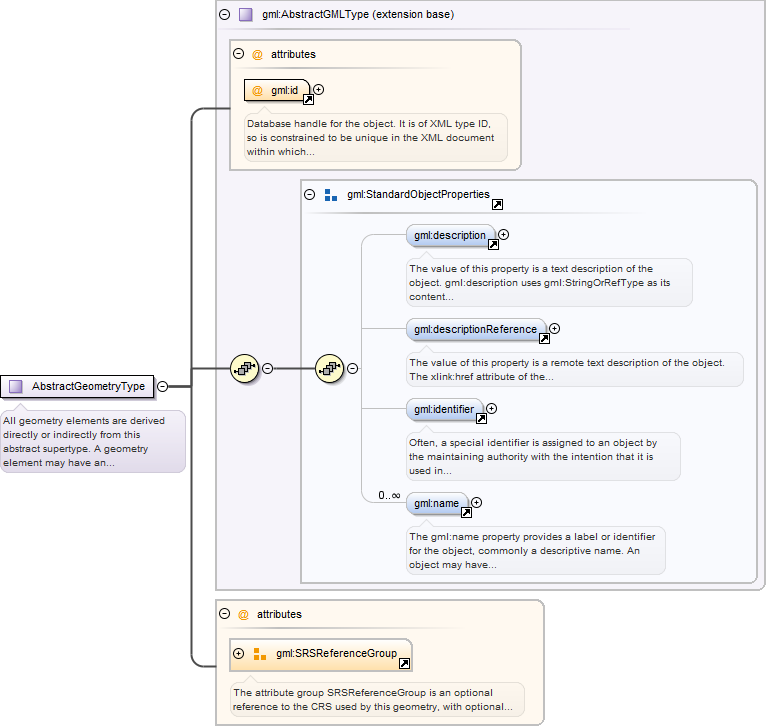
The AbstractGeometry element is the abstract head of the substitution group for
all geometry elements of GML. This includes pre-defined and user-defined geometry elements.
Any geometry element shall be a direct or indirect extension/restriction of
AbstractGeometryType and shall be directly or indirectly in the substitution group of
AbstractGeometry.
Diagram
Diagram 3_2.tmp#id 3_2.tmp#description 3_2.tmp#descriptionReference 3_2.tmp#identifier 3_2.tmp#name 3_2.tmp#StandardObjectProperties 3_2.tmp#AbstractGMLType 3_2.tmp#SRSReferenceGroup 3_2.tmp#AbstractGeometryType 3_2.tmp#AbstractGeometricAggregate 3_2.tmp#AbstractGeometricPrimitive 2_0_a.tmp#http___schemas.diggsml.com_2.0.a_AbstractGeometry 3_2.tmp#AbstractImplicitGeometry 3_2.tmp#AbstractGML
Type gml:AbstractGeometryType
Type hierarchy
Properties
content: complex
abstract: true
Substitution Group
Substitution Group Affiliation
Used by
Model gml:description{0,1} , gml:descriptionReference{0,1} , gml:identifier{0,1} , gml:name*
Children gml:description, gml:descriptionReference, gml:identifier, gml:name
Instance
<gml:AbstractGeometry axisLabels="" gml:id="" srsDimension="" srsName="" uomLabels="" xmlns:gml="http://www.opengis.net/gml/3.2">
  <gml:description xlink:href="" nilReason="" xlink:title="">{0,1}</gml:description>
  <gml:descriptionReference xlink:href="" nilReason="" owns="false" xlink:title="">{0,1}</gml:descriptionReference>
  <gml:identifier codeSpace="">{0,1}</gml:identifier>
  <gml:name codeSpace="">{0,unbounded}</gml:name>
</gml:AbstractGeometry>
Attributes
QName Type Fixed Default Use Annotation
axisLabels gml:NCNameList optional
gml:id ID required
Database handle for the object. It is of XML type ID, so is constrained to be
unique in the XML document within which it occurs. An external identifier for the object in
the form of a URI may be constructed using standard XML and XPointer methods. This is done
by concatenating the URI for the document, a fragment separator, and the value of the id
attribute.
srsDimension positiveInteger optional
srsName anyURI optional
uomLabels gml:NCNameList optional
Source
<element name="AbstractGeometry" type="gml:AbstractGeometryType" abstract="true" substitutionGroup="gml:AbstractGML">
  <annotation>
    <documentation>The AbstractGeometry element is the abstract head of the substitution group for all geometry elements of GML. This includes pre-defined and user-defined geometry elements. Any geometry element shall be a direct or indirect extension/restriction of AbstractGeometryType and shall be directly or indirectly in the substitution group of AbstractGeometry.</documentation>
  </annotation>
</element>
Schema location file:/C:/GaldosOffline/DIGGS_Offline - GMLProfile/Diggs2.0.a/Schemas/gml3.2Profile_diggs.xsd
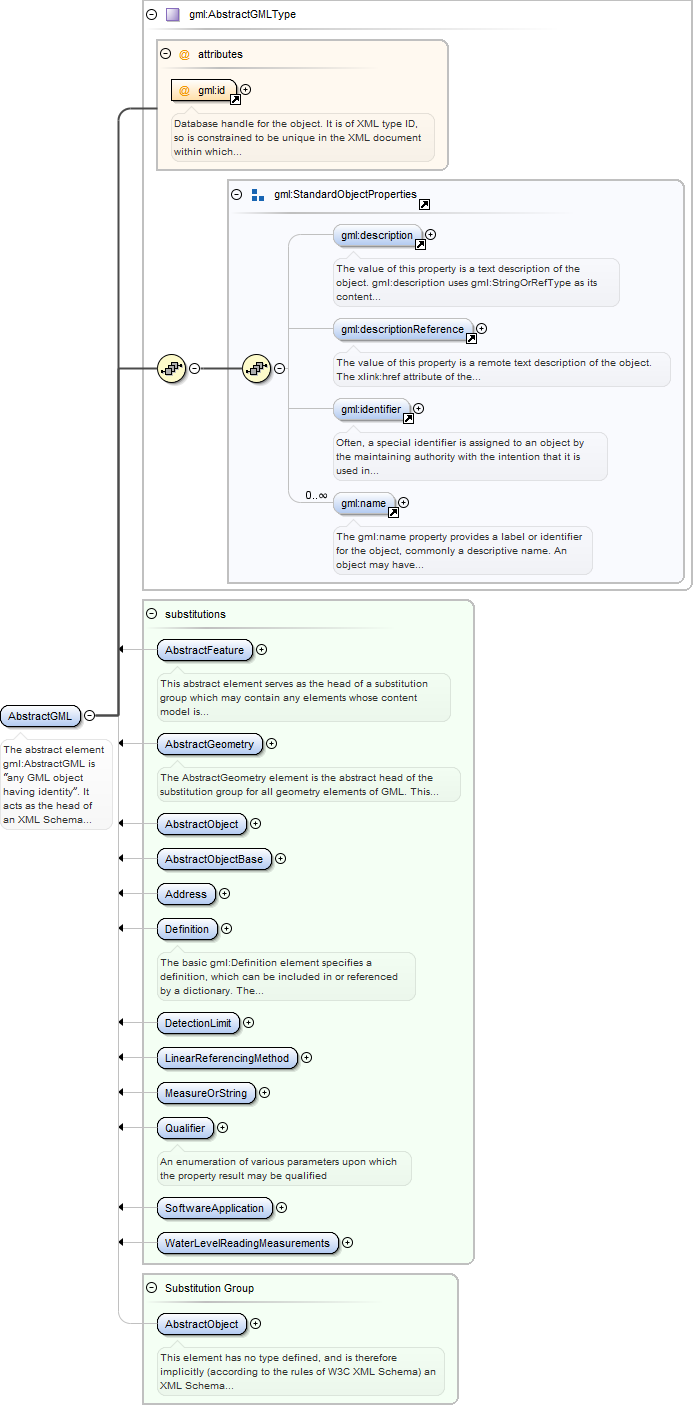
Element gml:AbstractGML
Namespace http://www.opengis.net/gml/3.2
Annotations
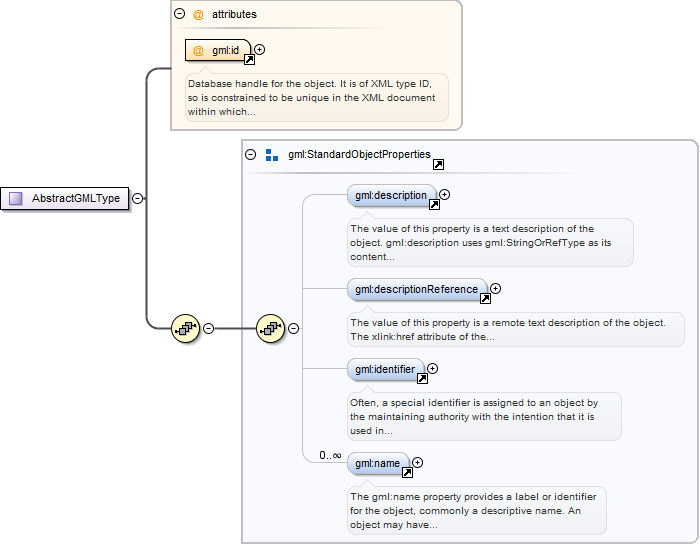
The abstract element gml:AbstractGML is “any GML object having identity”. It
acts as the head of an XML Schema substitution group, which may include any element which is
a GML feature, or other object, with identity. This is used as a variable in content models
in GML core and application schemas. It is effectively an abstract superclass for all GML
objects.
Diagram
Diagram 3_2.tmp#id 3_2.tmp#description 3_2.tmp#descriptionReference 3_2.tmp#identifier 3_2.tmp#name 3_2.tmp#StandardObjectProperties 3_2.tmp#AbstractGMLType 3_2.tmp#AbstractFeature 3_2.tmp#AbstractGeometry 2_0_a.tmp#http___schemas.diggsml.com_2.0.a_AbstractObject 2_0_a.tmp#AbstractObjectBase 2_0_a.tmp#Address 3_2.tmp#Definition 2_0_a.tmp#DetectionLimit lr.tmp#LinearReferencingMethod 2_0_a.tmp#MeasureOrString 2_0_a.tmp#Qualifier 2_0_a.tmp#SoftwareApplication environmental.tmp#WaterLevelReadingMeasurements 3_2.tmp#AbstractObject
Type gml:AbstractGMLType
Properties
content: complex
abstract: true
Substitution Group
Substitution Group Affiliation
Model gml:description{0,1} , gml:descriptionReference{0,1} , gml:identifier{0,1} , gml:name*
Children gml:description, gml:descriptionReference, gml:identifier, gml:name
Instance
<gml:AbstractGML gml:id="" xmlns:gml="http://www.opengis.net/gml/3.2">
  <gml:description xlink:href="" nilReason="" xlink:title="">{0,1}</gml:description>
  <gml:descriptionReference xlink:href="" nilReason="" owns="false" xlink:title="">{0,1}</gml:descriptionReference>
  <gml:identifier codeSpace="">{0,1}</gml:identifier>
  <gml:name codeSpace="">{0,unbounded}</gml:name>
</gml:AbstractGML>
Attributes
QName Type Fixed Default Use Annotation
gml:id ID required
Database handle for the object. It is of XML type ID, so is constrained to be
unique in the XML document within which it occurs. An external identifier for the object in
the form of a URI may be constructed using standard XML and XPointer methods. This is done
by concatenating the URI for the document, a fragment separator, and the value of the id
attribute.
Source
<element name="AbstractGML" type="gml:AbstractGMLType" abstract="true" substitutionGroup="gml:AbstractObject">
  <annotation>
    <documentation>The abstract element gml:AbstractGML is “any GML object having identity”. It acts as the head of an XML Schema substitution group, which may include any element which is a GML feature, or other object, with identity. This is used as a variable in content models in GML core and application schemas. It is effectively an abstract superclass for all GML objects.</documentation>
  </annotation>
</element>
Schema location file:/C:/GaldosOffline/DIGGS_Offline - GMLProfile/Diggs2.0.a/Schemas/gml3.2Profile_diggs.xsd
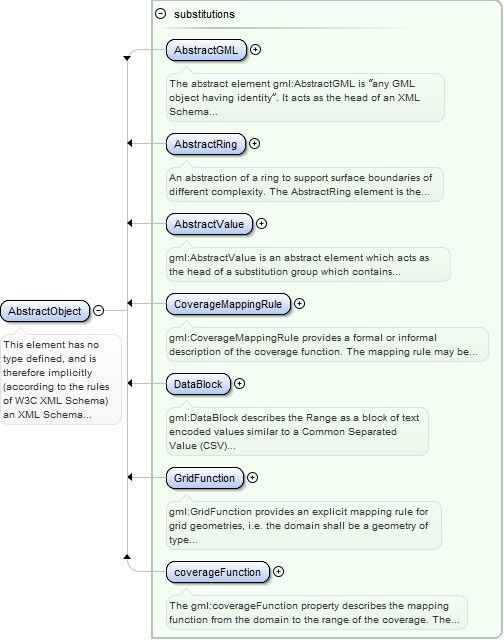
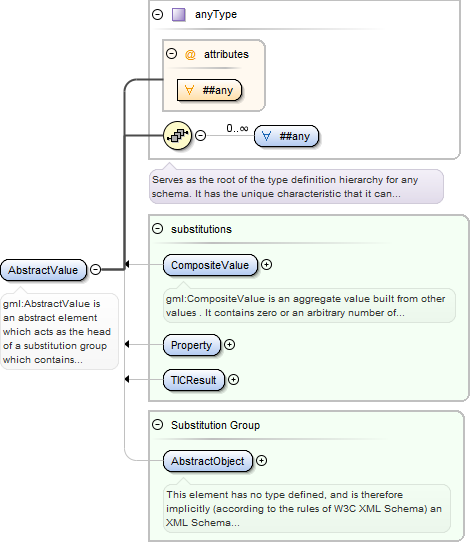
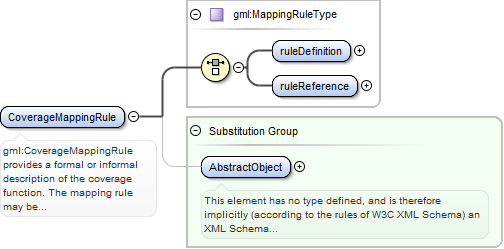
Element gml:AbstractObject
Namespace http://www.opengis.net/gml/3.2
Annotations
This element has no type defined, and is therefore implicitly (according to the
rules of W3C XML Schema) an XML Schema anyType. It is used as the head of an XML Schema
substitution group which unifies complex content and certain simple content elements used
for datatypes in GML, including the gml:AbstractGML substitution group.
Diagram
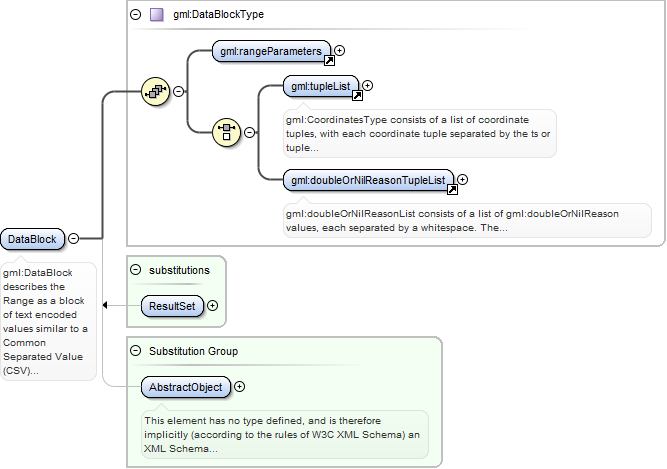
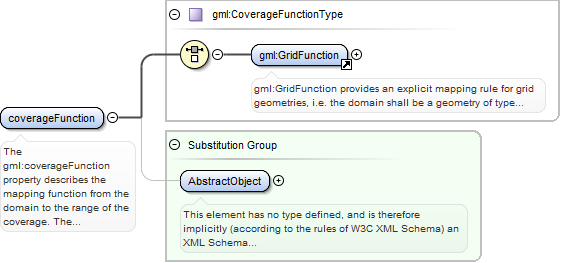
Diagram 3_2.tmp#AbstractGML 3_2.tmp#AbstractRing 3_2.tmp#AbstractValue 3_2.tmp#CoverageMappingRule 3_2.tmp#DataBlock 3_2.tmp#GridFunction 3_2.tmp#coverageFunction
Properties
abstract: true
Substitution Group
Source
<element name="AbstractObject" abstract="true">
  <annotation>
    <documentation>This element has no type defined, and is therefore implicitly (according to the rules of W3C XML Schema) an XML Schema anyType. It is used as the head of an XML Schema substitution group which unifies complex content and certain simple content elements used for datatypes in GML, including the gml:AbstractGML substitution group.</documentation>
  </annotation>
</element>
Schema location file:/C:/GaldosOffline/DIGGS_Offline - GMLProfile/Diggs2.0.a/Schemas/gml3.2Profile_diggs.xsd
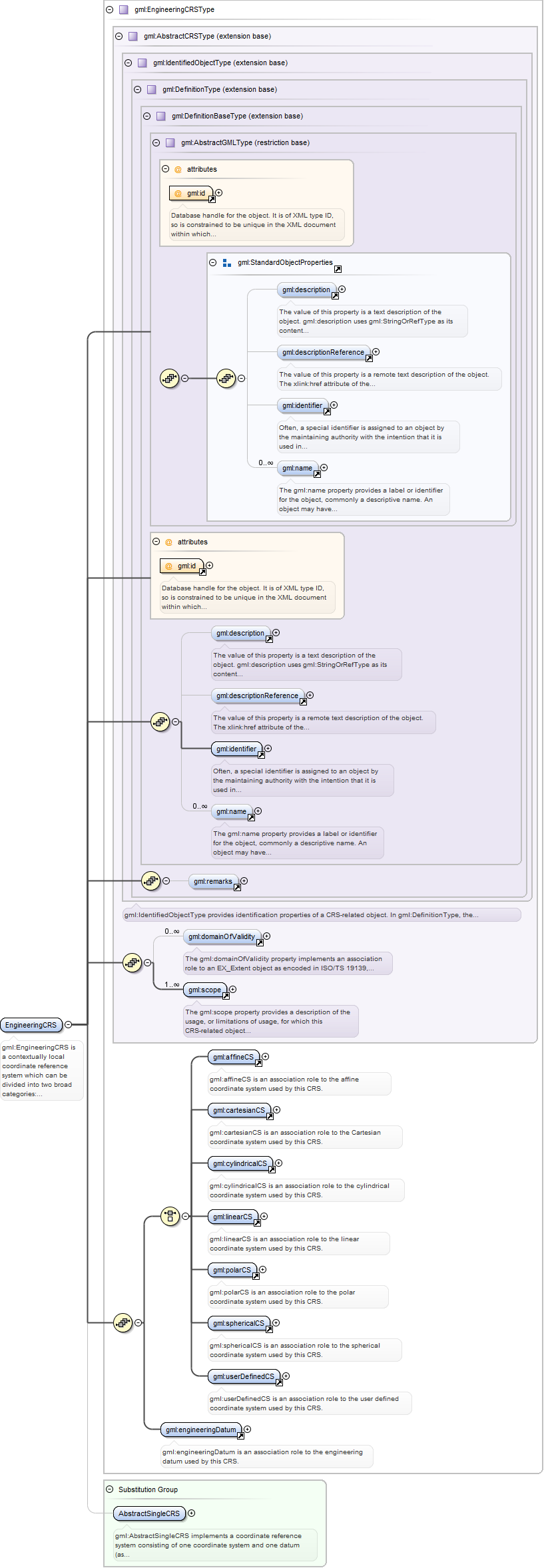
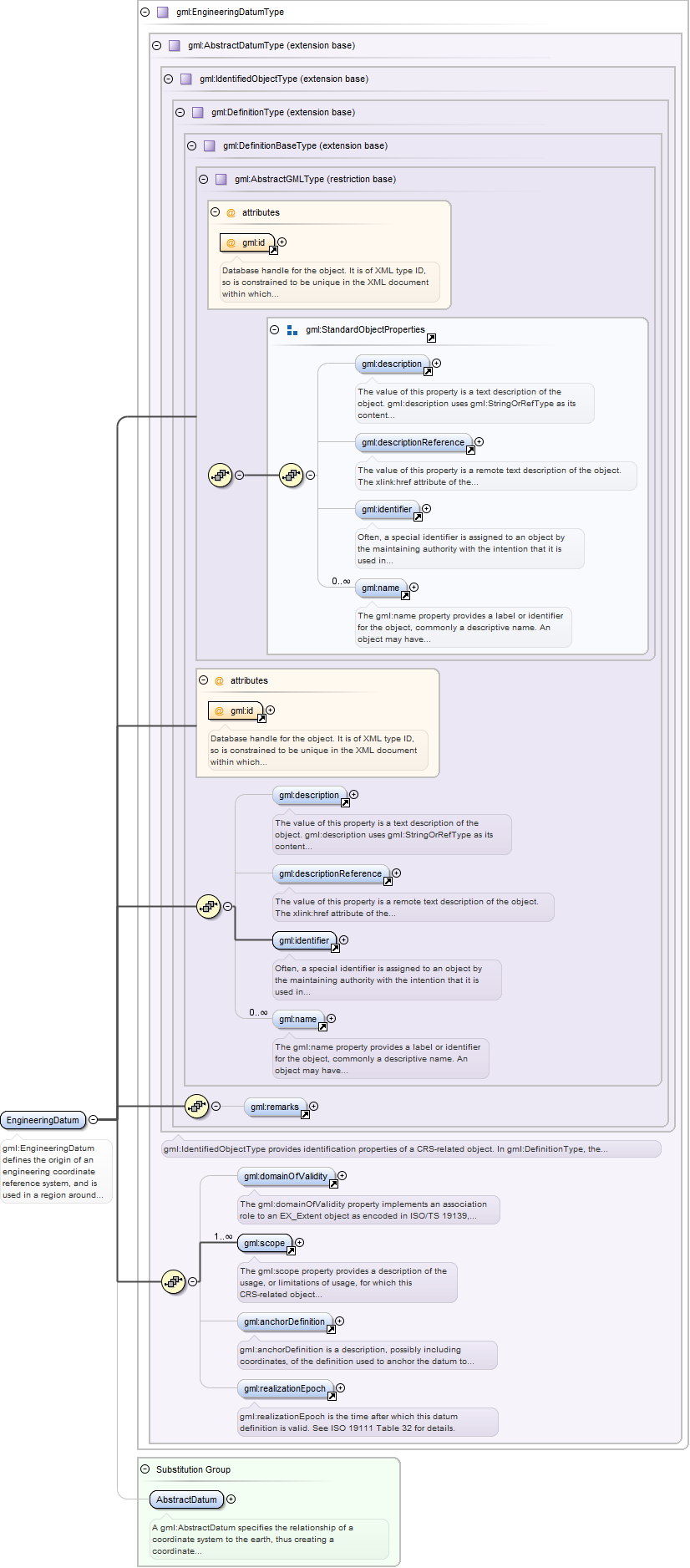
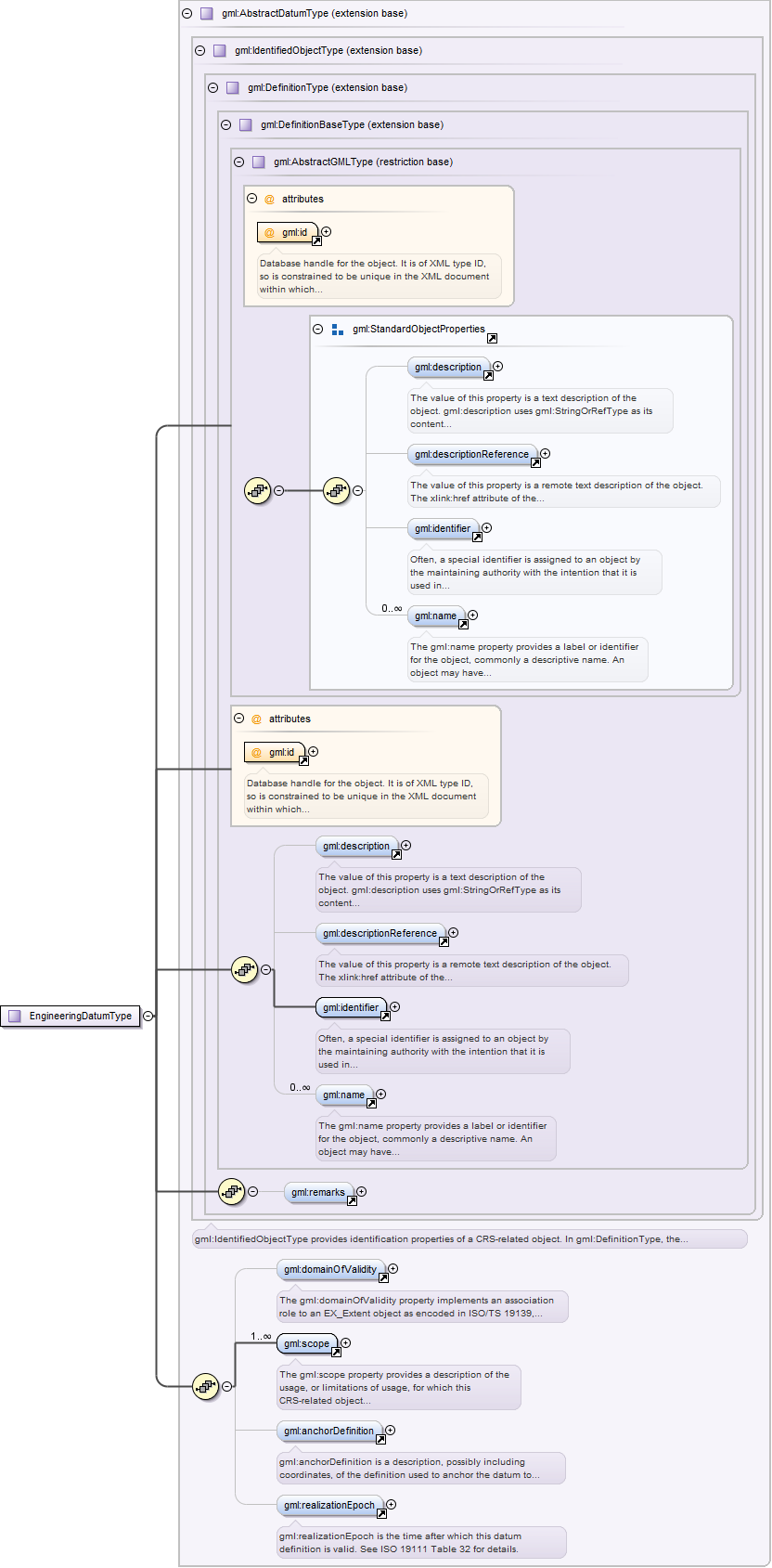
Element gml:EngineeringDatum
Namespace http://www.opengis.net/gml/3.2
Annotations
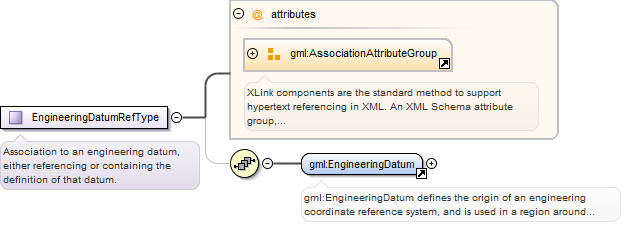
gml:EngineeringDatum defines the origin of an engineering coordinate reference
system, and is used in a region around that origin. This origin may be fixed with respect to
the earth (such as a defined point at a construction site), or be a defined point on a
moving vehicle (such as on a ship or satellite).
Diagram
Diagram 3_2.tmp#id 3_2.tmp#description 3_2.tmp#descriptionReference 3_2.tmp#identifier 3_2.tmp#name 3_2.tmp#StandardObjectProperties 3_2.tmp#AbstractGMLType 3_2.tmp#id 3_2.tmp#description 3_2.tmp#descriptionReference 3_2.tmp#identifier 3_2.tmp#name 3_2.tmp#DefinitionBaseType 3_2.tmp#remarks 3_2.tmp#DefinitionType 3_2.tmp#IdentifiedObjectType 3_2.tmp#domainOfValidity 3_2.tmp#scope 3_2.tmp#anchorDefinition 3_2.tmp#realizationEpoch 3_2.tmp#AbstractDatumType 3_2.tmp#EngineeringDatumType 3_2.tmp#AbstractDatum
Type gml:EngineeringDatumType
Type hierarchy
Properties
content: complex
Substitution Group Affiliation
Used by
Model gml:description{0,1} , gml:descriptionReference{0,1} , gml:identifier , gml:name* , gml:remarks{0,1} , gml:domainOfValidity{0,1} , gml:scope+ , gml:anchorDefinition{0,1} , gml:realizationEpoch{0,1}
Children gml:anchorDefinition, gml:description, gml:descriptionReference, gml:domainOfValidity, gml:identifier, gml:name, gml:realizationEpoch, gml:remarks, gml:scope
Instance
<gml:EngineeringDatum gml:id="" xmlns:gml="http://www.opengis.net/gml/3.2">
  <gml:description xlink:href="" nilReason="" xlink:title="">{0,1}</gml:description>
  <gml:descriptionReference xlink:href="" nilReason="" owns="false" xlink:title="">{0,1}</gml:descriptionReference>
  <gml:identifier codeSpace="">{1,1}</gml:identifier>
  <gml:name codeSpace="">{0,unbounded}</gml:name>
  <gml:remarks>{0,1}</gml:remarks>
  <gml:domainOfValidity xlink:href="" nilReason="" xlink:title="">{0,1}</gml:domainOfValidity>
  <gml:scope>{1,unbounded}</gml:scope>
  <gml:anchorDefinition codeSpace="">{0,1}</gml:anchorDefinition>
  <gml:realizationEpoch>{0,1}</gml:realizationEpoch>
</gml:EngineeringDatum>
Attributes
QName Type Fixed Default Use Annotation
gml:id ID required
Database handle for the object. It is of XML type ID, so is constrained to be
unique in the XML document within which it occurs. An external identifier for the object in
the form of a URI may be constructed using standard XML and XPointer methods. This is done
by concatenating the URI for the document, a fragment separator, and the value of the id
attribute.
Source
<element name="EngineeringDatum" type="gml:EngineeringDatumType" substitutionGroup="gml:AbstractDatum">
  <annotation>
    <documentation>gml:EngineeringDatum defines the origin of an engineering coordinate reference system, and is used in a region around that origin. This origin may be fixed with respect to the earth (such as a defined point at a construction site), or be a defined point on a moving vehicle (such as on a ship or satellite).</documentation>
  </annotation>
</element>
Schema location file:/C:/GaldosOffline/DIGGS_Offline - GMLProfile/Diggs2.0.a/Schemas/gml3.2Profile_diggs.xsd
Element gml:remarks
Namespace http://www.opengis.net/gml/3.2
Diagram
Diagram
Type string
Properties
content: simple
Used by
Source
<element name="remarks" type="string"/>
Schema location file:/C:/GaldosOffline/DIGGS_Offline - GMLProfile/Diggs2.0.a/Schemas/gml3.2Profile_diggs.xsd
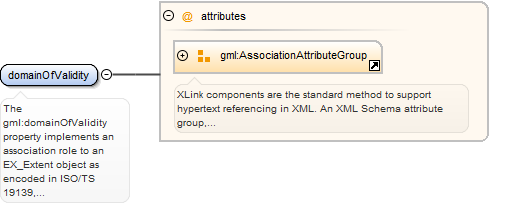
Element gml:domainOfValidity
Namespace http://www.opengis.net/gml/3.2
Annotations
The gml:domainOfValidity property implements an association role to an
EX_Extent object as encoded in ISO/TS 19139, either referencing or containing the definition
of that extent.
Diagram
Diagram 3_2.tmp#AssociationAttributeGroup
Properties
content: complex
Used by
Attributes
QName Type Fixed Default Use Annotation
nilReason gml:NilReasonType optional
xlink:href xlink:hrefType optional
xlink:title xlink:titleAttrType optional
Source
<element name="domainOfValidity">
  <annotation>
    <documentation>The gml:domainOfValidity property implements an association role to an EX_Extent object as encoded in ISO/TS 19139, either referencing or containing the definition of that extent.</documentation>
  </annotation>
  <complexType>
    <!--DSB: restricted from profile
			<sequence minOccurs="0">
				<element ref="gmd:EX_Extent"/>
			</sequence>
-->
    <attributeGroup ref="gml:AssociationAttributeGroup"/>
  </complexType>
</element>
Schema location file:/C:/GaldosOffline/DIGGS_Offline - GMLProfile/Diggs2.0.a/Schemas/gml3.2Profile_diggs.xsd
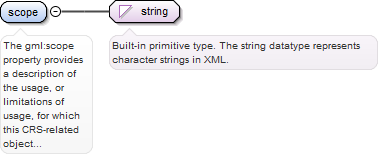
Element gml:scope
Namespace http://www.opengis.net/gml/3.2
Annotations
The gml:scope property provides a description of the usage, or limitations of
usage, for which this CRS-related object is valid. If unknown, enter "not
known".
Diagram
Diagram
Type string
Properties
content: simple
Used by
Source
<element name="scope" type="string">
  <annotation>
    <documentation>The gml:scope property provides a description of the usage, or limitations of usage, for which this CRS-related object is valid. If unknown, enter "not known".</documentation>
  </annotation>
</element>
Schema location file:/C:/GaldosOffline/DIGGS_Offline - GMLProfile/Diggs2.0.a/Schemas/gml3.2Profile_diggs.xsd
Element gml:anchorDefinition
Namespace http://www.opengis.net/gml/3.2
Annotations
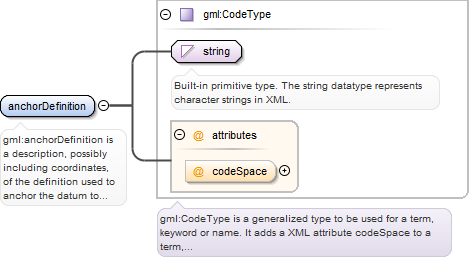
gml:anchorDefinition is a description, possibly including coordinates, of the
definition used to anchor the datum to the Earth. Also known as the "origin", especially for
engineering and image datums. The codeSpace attribute may be used to reference a source of
more detailed on this point or surface, or on a set of such descriptions. - For a geodetic
datum, this point is also known as the fundamental point, which is traditionally the point
where the relationship between geoid and ellipsoid is defined. In some cases, the
"fundamental point" may consist of a number of points. In those cases, the parameters
defining the geoid/ellipsoid relationship have been averaged for these points, and the
averages adopted as the datum definition. - For an engineering datum, the anchor definition
may be a physical point, or it may be a point with defined coordinates in another CRS.may -
For an image datum, the anchor definition is usually either the centre of the image or the
corner of the image. - For a temporal datum, this attribute is not defined. Instead of the
anchor definition, a temporal datum carries a separate time origin of type
DateTime.
Diagram
Diagram NO_NAMESPACE.tmp#CodeType_codeSpace 3_2.tmp#CodeType
Type gml:CodeType
Properties
content: complex
Used by
Attributes
QName Type Fixed Default Use Annotation
codeSpace anyURI optional
Source
<element name="anchorDefinition" type="gml:CodeType">
  <annotation>
    <documentation>gml:anchorDefinition is a description, possibly including coordinates, of the definition used to anchor the datum to the Earth. Also known as the "origin", especially for engineering and image datums. The codeSpace attribute may be used to reference a source of more detailed on this point or surface, or on a set of such descriptions. - For a geodetic datum, this point is also known as the fundamental point, which is traditionally the point where the relationship between geoid and ellipsoid is defined. In some cases, the "fundamental point" may consist of a number of points. In those cases, the parameters defining the geoid/ellipsoid relationship have been averaged for these points, and the averages adopted as the datum definition. - For an engineering datum, the anchor definition may be a physical point, or it may be a point with defined coordinates in another CRS.may - For an image datum, the anchor definition is usually either the centre of the image or the corner of the image. - For a temporal datum, this attribute is not defined. Instead of the anchor definition, a temporal datum carries a separate time origin of type DateTime.</documentation>
  </annotation>
</element>
Schema location file:/C:/GaldosOffline/DIGGS_Offline - GMLProfile/Diggs2.0.a/Schemas/gml3.2Profile_diggs.xsd
Element gml:realizationEpoch
Namespace http://www.opengis.net/gml/3.2
Annotations
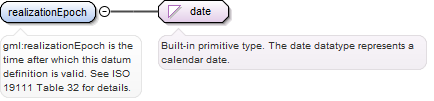
gml:realizationEpoch is the time after which this datum definition is valid.
See ISO 19111 Table 32 for details.
Diagram
Diagram
Type witsml:date
Properties
content: simple
Used by
Source
<element name="realizationEpoch" type="date">
  <annotation>
    <documentation>gml:realizationEpoch is the time after which this datum definition is valid. See ISO 19111 Table 32 for details.</documentation>
  </annotation>
</element>
Schema location file:/C:/GaldosOffline/DIGGS_Offline - GMLProfile/Diggs2.0.a/Schemas/gml3.2Profile_diggs.xsd
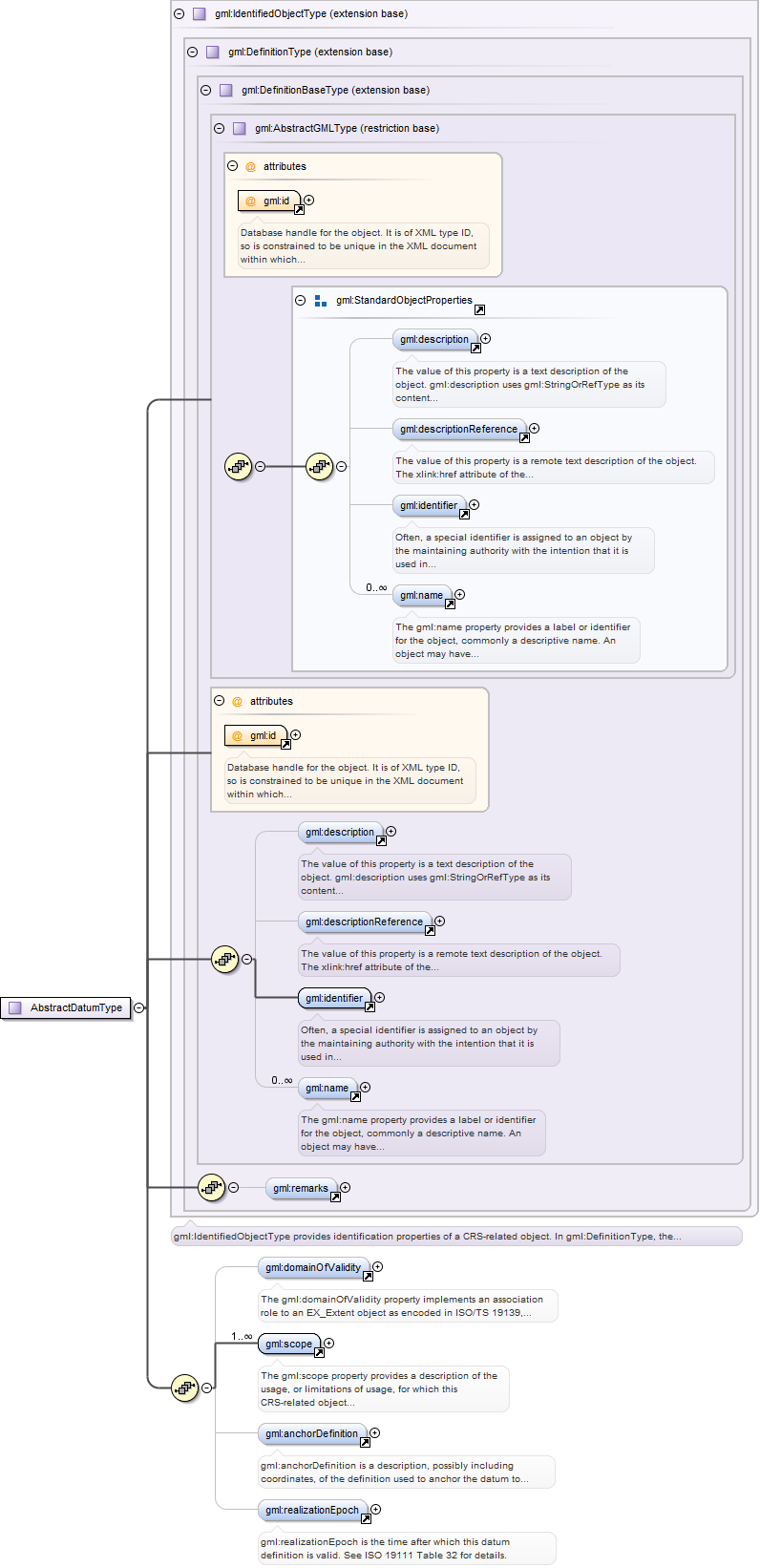
Element gml:AbstractDatum
Namespace http://www.opengis.net/gml/3.2
Annotations
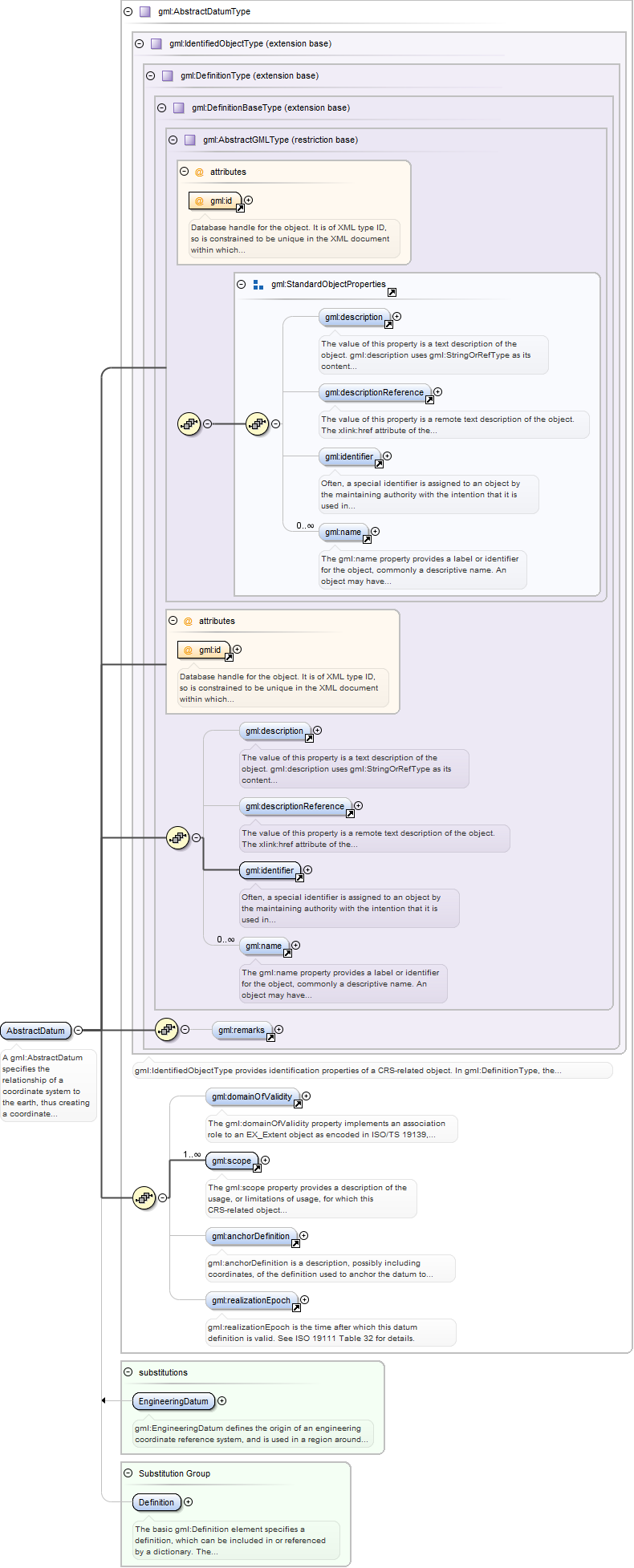
A gml:AbstractDatum specifies the relationship of a coordinate system to the
earth, thus creating a coordinate reference system. A datum uses a parameter or set of
parameters that determine the location of the origin of the coordinate reference system.
Each datum subtype may be associated with only specific types of coordinate systems. This
abstract complex type shall not be used, extended, or restricted, in a GML Application
Schema, to define a concrete subtype with a meaning equivalent to a concrete subtype
specified in this document.
Diagram
Diagram 3_2.tmp#id 3_2.tmp#description 3_2.tmp#descriptionReference 3_2.tmp#identifier 3_2.tmp#name 3_2.tmp#StandardObjectProperties 3_2.tmp#AbstractGMLType 3_2.tmp#id 3_2.tmp#description 3_2.tmp#descriptionReference 3_2.tmp#identifier 3_2.tmp#name 3_2.tmp#DefinitionBaseType 3_2.tmp#remarks 3_2.tmp#DefinitionType 3_2.tmp#IdentifiedObjectType 3_2.tmp#domainOfValidity 3_2.tmp#scope 3_2.tmp#anchorDefinition 3_2.tmp#realizationEpoch 3_2.tmp#AbstractDatumType 3_2.tmp#EngineeringDatum 3_2.tmp#Definition
Type gml:AbstractDatumType
Type hierarchy
Properties
content: complex
abstract: true
Substitution Group
Substitution Group Affiliation
Model gml:description{0,1} , gml:descriptionReference{0,1} , gml:identifier , gml:name* , gml:remarks{0,1} , gml:domainOfValidity{0,1} , gml:scope+ , gml:anchorDefinition{0,1} , gml:realizationEpoch{0,1}
Children gml:anchorDefinition, gml:description, gml:descriptionReference, gml:domainOfValidity, gml:identifier, gml:name, gml:realizationEpoch, gml:remarks, gml:scope
Instance
<gml:AbstractDatum gml:id="" xmlns:gml="http://www.opengis.net/gml/3.2">
  <gml:description xlink:href="" nilReason="" xlink:title="">{0,1}</gml:description>
  <gml:descriptionReference xlink:href="" nilReason="" owns="false" xlink:title="">{0,1}</gml:descriptionReference>
  <gml:identifier codeSpace="">{1,1}</gml:identifier>
  <gml:name codeSpace="">{0,unbounded}</gml:name>
  <gml:remarks>{0,1}</gml:remarks>
  <gml:domainOfValidity xlink:href="" nilReason="" xlink:title="">{0,1}</gml:domainOfValidity>
  <gml:scope>{1,unbounded}</gml:scope>
  <gml:anchorDefinition codeSpace="">{0,1}</gml:anchorDefinition>
  <gml:realizationEpoch>{0,1}</gml:realizationEpoch>
</gml:AbstractDatum>
Attributes
QName Type Fixed Default Use Annotation
gml:id ID required
Database handle for the object. It is of XML type ID, so is constrained to be
unique in the XML document within which it occurs. An external identifier for the object in
the form of a URI may be constructed using standard XML and XPointer methods. This is done
by concatenating the URI for the document, a fragment separator, and the value of the id
attribute.
Source
<element name="AbstractDatum" type="gml:AbstractDatumType" abstract="true" substitutionGroup="gml:Definition">
  <annotation>
    <documentation>A gml:AbstractDatum specifies the relationship of a coordinate system to the earth, thus creating a coordinate reference system. A datum uses a parameter or set of parameters that determine the location of the origin of the coordinate reference system. Each datum subtype may be associated with only specific types of coordinate systems. This abstract complex type shall not be used, extended, or restricted, in a GML Application Schema, to define a concrete subtype with a meaning equivalent to a concrete subtype specified in this document.</documentation>
  </annotation>
</element>
Schema location file:/C:/GaldosOffline/DIGGS_Offline - GMLProfile/Diggs2.0.a/Schemas/gml3.2Profile_diggs.xsd
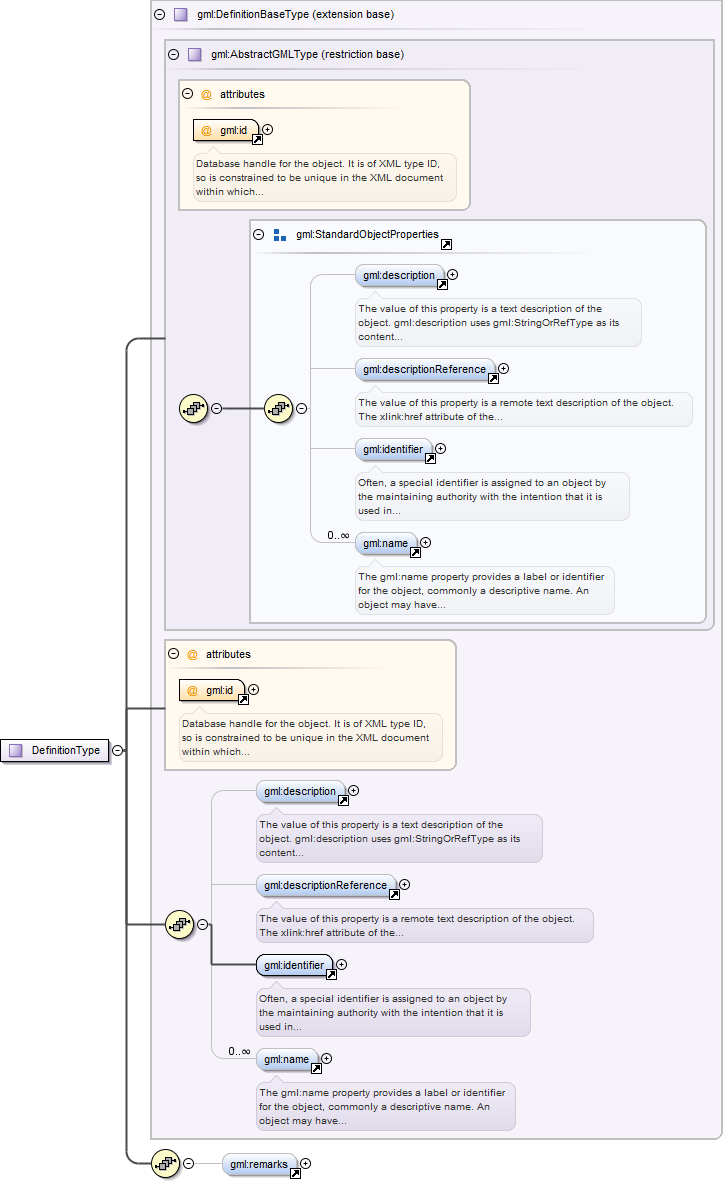
Element gml:Definition
Namespace http://www.opengis.net/gml/3.2
Annotations
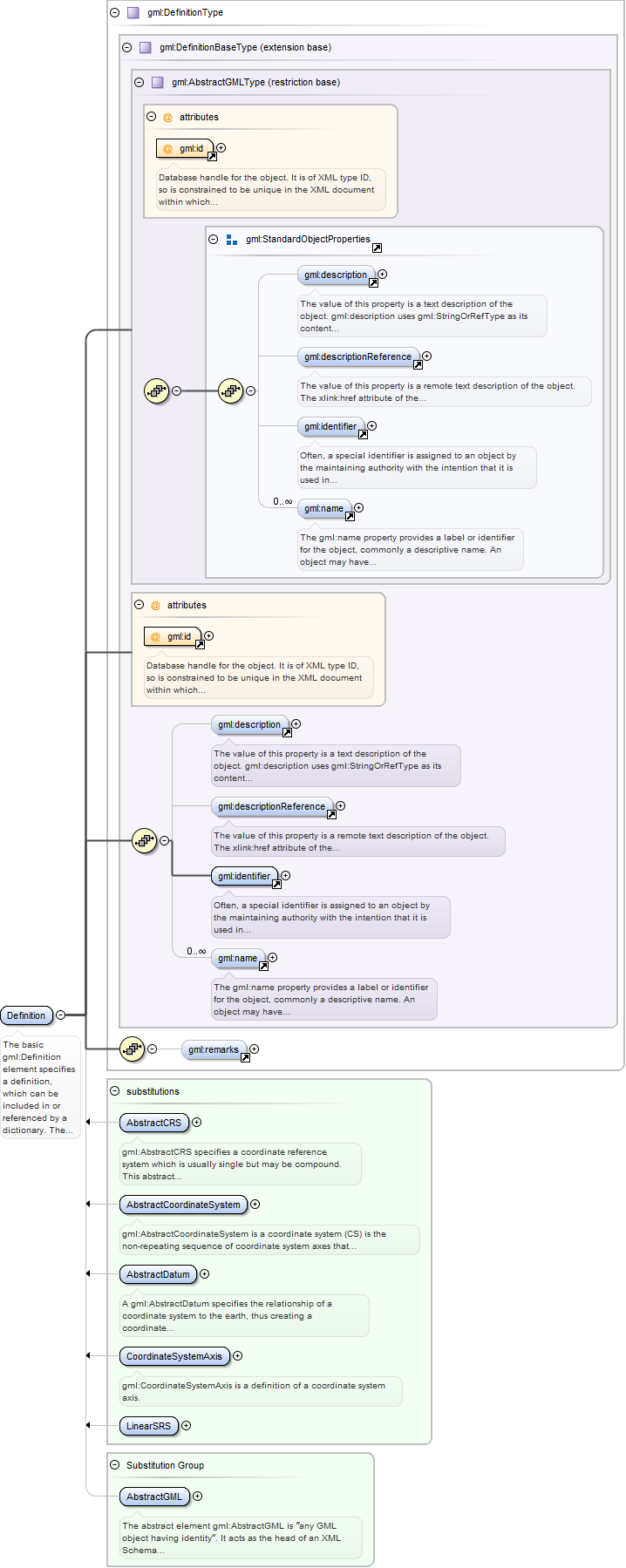
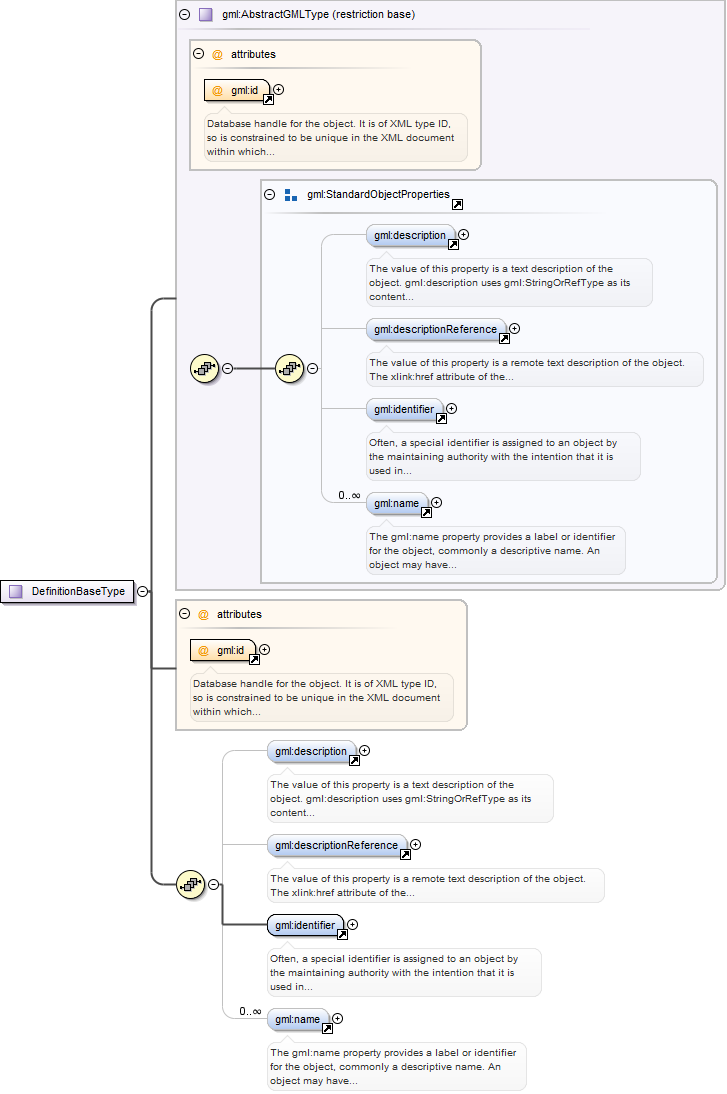
The basic gml:Definition element specifies a definition, which can be included
in or referenced by a dictionary. The content model for a generic definition is a derivation
from gml:AbstractGMLType. The gml:description property element shall hold the definition if
this can be captured in a simple text string, or the gml:descriptionReference property
element may carry a link to a description elsewhere. The gml:identifier element shall
provide one identifier identifying this definition. The identifier shall be unique within
the dictionaries using this definition. The gml:name elements shall provide zero or more
terms and synonyms for which this is the definition. The gml:remarks element shall be used
to hold additional textual information that is not conceptually part of the definition but
is useful in understanding the definition.
Diagram
Diagram 3_2.tmp#id 3_2.tmp#description 3_2.tmp#descriptionReference 3_2.tmp#identifier 3_2.tmp#name 3_2.tmp#StandardObjectProperties 3_2.tmp#AbstractGMLType 3_2.tmp#id 3_2.tmp#description 3_2.tmp#descriptionReference 3_2.tmp#identifier 3_2.tmp#name 3_2.tmp#DefinitionBaseType 3_2.tmp#remarks 3_2.tmp#DefinitionType 3_2.tmp#AbstractCRS 3_2.tmp#AbstractCoordinateSystem 3_2.tmp#AbstractDatum 3_2.tmp#CoordinateSystemAxis lr.tmp#LinearSRS 3_2.tmp#AbstractGML
Type gml:DefinitionType
Type hierarchy
Properties
content: complex
Substitution Group
Substitution Group Affiliation
Model gml:description{0,1} , gml:descriptionReference{0,1} , gml:identifier , gml:name* , gml:remarks{0,1}
Children gml:description, gml:descriptionReference, gml:identifier, gml:name, gml:remarks
Instance
<gml:Definition gml:id="" xmlns:gml="http://www.opengis.net/gml/3.2">
  <gml:description xlink:href="" nilReason="" xlink:title="">{0,1}</gml:description>
  <gml:descriptionReference xlink:href="" nilReason="" owns="false" xlink:title="">{0,1}</gml:descriptionReference>
  <gml:identifier codeSpace="">{1,1}</gml:identifier>
  <gml:name codeSpace="">{0,unbounded}</gml:name>
  <gml:remarks>{0,1}</gml:remarks>
</gml:Definition>
Attributes
QName Type Fixed Default Use Annotation
gml:id ID required
Database handle for the object. It is of XML type ID, so is constrained to be
unique in the XML document within which it occurs. An external identifier for the object in
the form of a URI may be constructed using standard XML and XPointer methods. This is done
by concatenating the URI for the document, a fragment separator, and the value of the id
attribute.
Source
<element name="Definition" type="gml:DefinitionType" substitutionGroup="gml:AbstractGML">
  <annotation>
    <documentation>The basic gml:Definition element specifies a definition, which can be included in or referenced by a dictionary. The content model for a generic definition is a derivation from gml:AbstractGMLType. The gml:description property element shall hold the definition if this can be captured in a simple text string, or the gml:descriptionReference property element may carry a link to a description elsewhere. The gml:identifier element shall provide one identifier identifying this definition. The identifier shall be unique within the dictionaries using this definition. The gml:name elements shall provide zero or more terms and synonyms for which this is the definition. The gml:remarks element shall be used to hold additional textual information that is not conceptually part of the definition but is useful in understanding the definition.</documentation>
  </annotation>
</element>
Schema location file:/C:/GaldosOffline/DIGGS_Offline - GMLProfile/Diggs2.0.a/Schemas/gml3.2Profile_diggs.xsd
Element gml:CoordinateSystemAxis
Namespace http://www.opengis.net/gml/3.2
Annotations
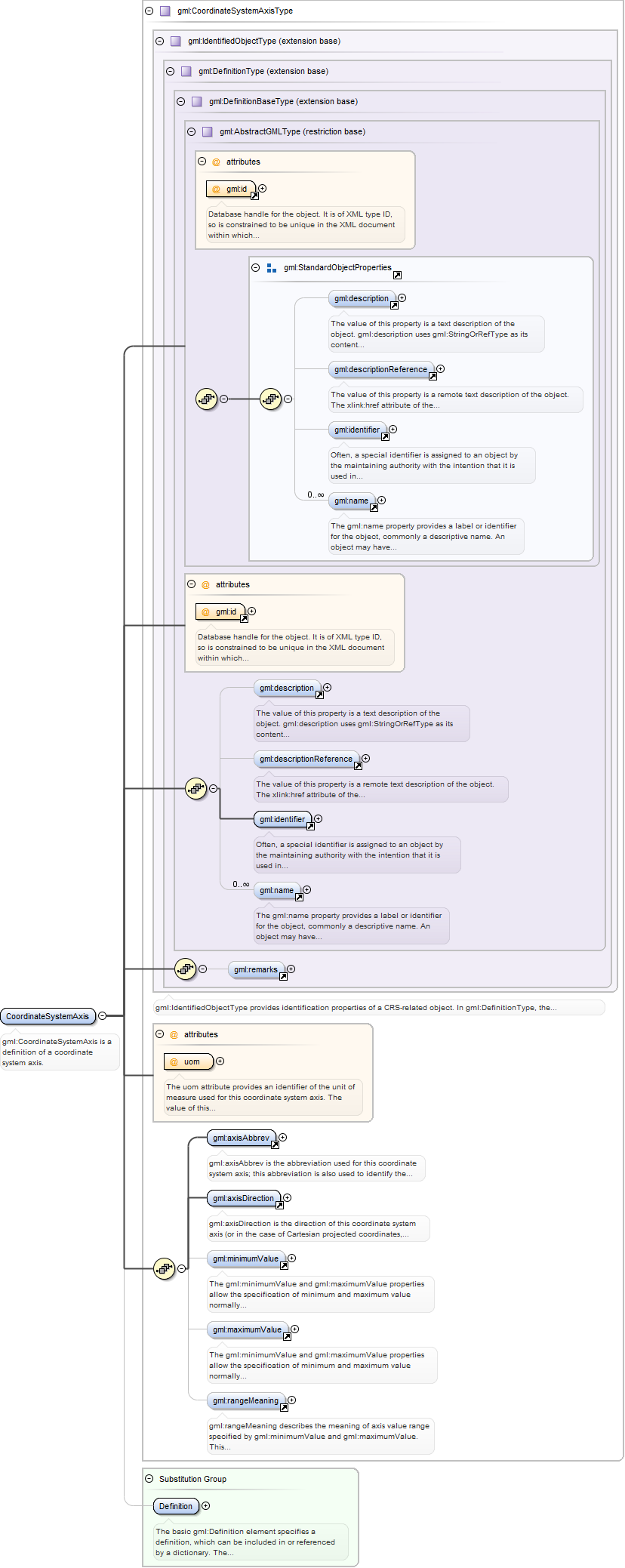
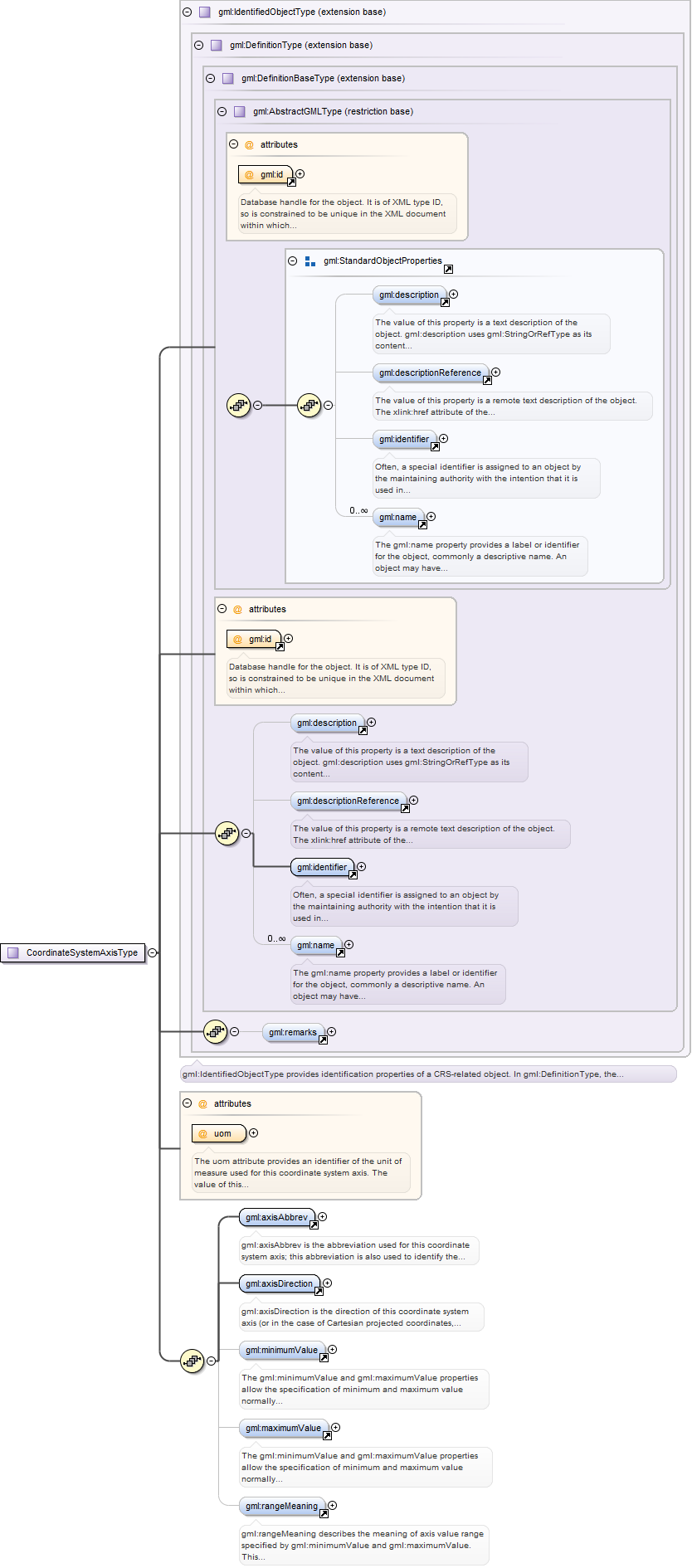
gml:CoordinateSystemAxis is a definition of a coordinate system
axis.
Diagram
Diagram 3_2.tmp#id 3_2.tmp#description 3_2.tmp#descriptionReference 3_2.tmp#identifier 3_2.tmp#name 3_2.tmp#StandardObjectProperties 3_2.tmp#AbstractGMLType 3_2.tmp#id 3_2.tmp#description 3_2.tmp#descriptionReference 3_2.tmp#identifier 3_2.tmp#name 3_2.tmp#DefinitionBaseType 3_2.tmp#remarks 3_2.tmp#DefinitionType 3_2.tmp#IdentifiedObjectType NO_NAMESPACE.tmp#CoordinateSystemAxisType_uom 3_2.tmp#axisAbbrev 3_2.tmp#axisDirection 3_2.tmp#minimumValue 3_2.tmp#maximumValue 3_2.tmp#rangeMeaning 3_2.tmp#CoordinateSystemAxisType 3_2.tmp#Definition
Type gml:CoordinateSystemAxisType
Type hierarchy
Properties
content: complex
Substitution Group Affiliation
Used by
Model gml:description{0,1} , gml:descriptionReference{0,1} , gml:identifier , gml:name* , gml:remarks{0,1} , gml:axisAbbrev , gml:axisDirection , gml:minimumValue{0,1} , gml:maximumValue{0,1} , gml:rangeMeaning{0,1}
Children gml:axisAbbrev, gml:axisDirection, gml:description, gml:descriptionReference, gml:identifier, gml:maximumValue, gml:minimumValue, gml:name, gml:rangeMeaning, gml:remarks
Instance
<gml:CoordinateSystemAxis gml:id="" uom="" xmlns:gml="http://www.opengis.net/gml/3.2">
  <gml:description xlink:href="" nilReason="" xlink:title="">{0,1}</gml:description>
  <gml:descriptionReference xlink:href="" nilReason="" owns="false" xlink:title="">{0,1}</gml:descriptionReference>
  <gml:identifier codeSpace="">{1,1}</gml:identifier>
  <gml:name codeSpace="">{0,unbounded}</gml:name>
  <gml:remarks>{0,1}</gml:remarks>
  <gml:axisAbbrev codeSpace="">{1,1}</gml:axisAbbrev>
  <gml:axisDirection codeSpace="">{1,1}</gml:axisDirection>
  <gml:minimumValue>{0,1}</gml:minimumValue>
  <gml:maximumValue>{0,1}</gml:maximumValue>
  <gml:rangeMeaning codeSpace="">{0,1}</gml:rangeMeaning>
</gml:CoordinateSystemAxis>
Attributes
QName Type Fixed Default Use Annotation
gml:id ID required
Database handle for the object. It is of XML type ID, so is constrained to be
unique in the XML document within which it occurs. An external identifier for the object in
the form of a URI may be constructed using standard XML and XPointer methods. This is done
by concatenating the URI for the document, a fragment separator, and the value of the id
attribute.
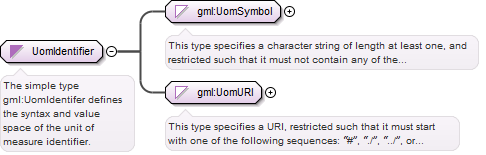
uom gml:UomIdentifier required
The uom attribute provides an identifier of the unit of measure used for
this coordinate system axis. The value of this coordinate in a coordinate tuple shall
be recorded using this unit of measure, whenever those coordinates use a coordinate
reference system that uses a coordinate system that uses this axis.
Source
<element name="CoordinateSystemAxis" type="gml:CoordinateSystemAxisType" substitutionGroup="gml:Definition">
  <annotation>
    <documentation>gml:CoordinateSystemAxis is a definition of a coordinate system axis.</documentation>
  </annotation>
</element>
Schema location file:/C:/GaldosOffline/DIGGS_Offline - GMLProfile/Diggs2.0.a/Schemas/gml3.2Profile_diggs.xsd
Element gml:axisAbbrev
Namespace http://www.opengis.net/gml/3.2
Annotations
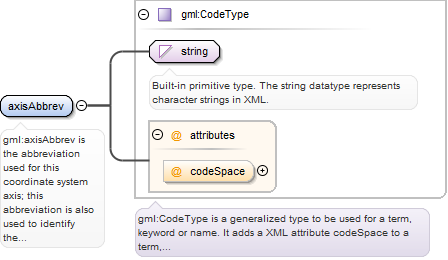
gml:axisAbbrev is the abbreviation used for this coordinate system axis; this
abbreviation is also used to identify the coordinates in the coordinate tuple. The codeSpace
attribute may reference a source of more information on a set of standardized abbreviations,
or on this abbreviation.
Diagram
Diagram NO_NAMESPACE.tmp#CodeType_codeSpace 3_2.tmp#CodeType
Type gml:CodeType
Properties
content: complex
Used by
Attributes
QName Type Fixed Default Use Annotation
codeSpace anyURI optional
Source
<element name="axisAbbrev" type="gml:CodeType">
  <annotation>
    <documentation>gml:axisAbbrev is the abbreviation used for this coordinate system axis; this abbreviation is also used to identify the coordinates in the coordinate tuple. The codeSpace attribute may reference a source of more information on a set of standardized abbreviations, or on this abbreviation.</documentation>
  </annotation>
</element>
Schema location file:/C:/GaldosOffline/DIGGS_Offline - GMLProfile/Diggs2.0.a/Schemas/gml3.2Profile_diggs.xsd
Element gml:axisDirection
Namespace http://www.opengis.net/gml/3.2
Annotations
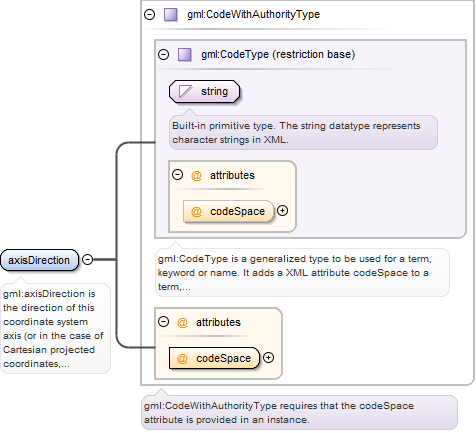
gml:axisDirection is the direction of this coordinate system axis (or in the
case of Cartesian projected coordinates, the direction of this coordinate system axis at the
origin). Within any set of coordinate system axes, only one of each pair of terms may be
used. For earth-fixed CRSs, this direction is often approximate and intended to provide a
human interpretable meaning to the axis. When a geodetic datum is used, the precise
directions of the axes may therefore vary slightly from this approximate direction. The
codeSpace attribute shall reference a source of information specifying the values and
meanings of all the allowed string values for this property.
Diagram
Diagram NO_NAMESPACE.tmp#CodeType_codeSpace 3_2.tmp#CodeType NO_NAMESPACE.tmp#CodeWithAuthorityType_codeSpace 3_2.tmp#CodeWithAuthorityType
Type gml:CodeWithAuthorityType
Type hierarchy
Properties
content: complex
Used by
Attributes
QName Type Fixed Default Use Annotation
codeSpace anyURI required
Source
<element name="axisDirection" type="gml:CodeWithAuthorityType">
  <annotation>
    <documentation>gml:axisDirection is the direction of this coordinate system axis (or in the case of Cartesian projected coordinates, the direction of this coordinate system axis at the origin). Within any set of coordinate system axes, only one of each pair of terms may be used. For earth-fixed CRSs, this direction is often approximate and intended to provide a human interpretable meaning to the axis. When a geodetic datum is used, the precise directions of the axes may therefore vary slightly from this approximate direction. The codeSpace attribute shall reference a source of information specifying the values and meanings of all the allowed string values for this property.</documentation>
  </annotation>
</element>
Schema location file:/C:/GaldosOffline/DIGGS_Offline - GMLProfile/Diggs2.0.a/Schemas/gml3.2Profile_diggs.xsd
Element gml:minimumValue
Namespace http://www.opengis.net/gml/3.2
Annotations
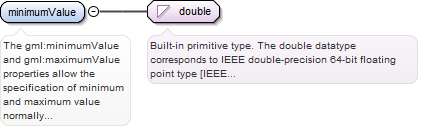
The gml:minimumValue and gml:maximumValue properties allow the specification of
minimum and maximum value normally allowed for this axis, in the unit of measure for the
axis. For a continuous angular axis such as longitude, the values wrap-around at this value.
Also, values beyond this minimum/maximum can be used for specified purposes, such as in a
bounding box. A value of minus infinity shall be allowed for the gml:minimumValue element, a
value of plus infiniy for the gml:maximumValue element. If these elements are omitted, the
value is unspecified.
Diagram
Diagram
Type double
Properties
content: simple
Used by
Source
<element name="minimumValue" type="double">
  <annotation>
    <documentation>The gml:minimumValue and gml:maximumValue properties allow the specification of minimum and maximum value normally allowed for this axis, in the unit of measure for the axis. For a continuous angular axis such as longitude, the values wrap-around at this value. Also, values beyond this minimum/maximum can be used for specified purposes, such as in a bounding box. A value of minus infinity shall be allowed for the gml:minimumValue element, a value of plus infiniy for the gml:maximumValue element. If these elements are omitted, the value is unspecified.</documentation>
  </annotation>
</element>
Schema location file:/C:/GaldosOffline/DIGGS_Offline - GMLProfile/Diggs2.0.a/Schemas/gml3.2Profile_diggs.xsd
Element gml:maximumValue
Namespace http://www.opengis.net/gml/3.2
Annotations
The gml:minimumValue and gml:maximumValue properties allow the specification of
minimum and maximum value normally allowed for this axis, in the unit of measure for the
axis. For a continuous angular axis such as longitude, the values wrap-around at this value.
Also, values beyond this minimum/maximum can be used for specified purposes, such as in a
bounding box. A value of minus infinity shall be allowed for the gml:minimumValue element, a
value of plus infiniy for the gml:maximumValue element. If these elements are omitted, the
value is unspecified.
Diagram
Diagram
Type double
Properties
content: simple
Used by
Source
<element name="maximumValue" type="double">
  <annotation>
    <documentation>The gml:minimumValue and gml:maximumValue properties allow the specification of minimum and maximum value normally allowed for this axis, in the unit of measure for the axis. For a continuous angular axis such as longitude, the values wrap-around at this value. Also, values beyond this minimum/maximum can be used for specified purposes, such as in a bounding box. A value of minus infinity shall be allowed for the gml:minimumValue element, a value of plus infiniy for the gml:maximumValue element. If these elements are omitted, the value is unspecified.</documentation>
  </annotation>
</element>
Schema location file:/C:/GaldosOffline/DIGGS_Offline - GMLProfile/Diggs2.0.a/Schemas/gml3.2Profile_diggs.xsd
Element gml:rangeMeaning
Namespace http://www.opengis.net/gml/3.2
Annotations
gml:rangeMeaning describes the meaning of axis value range specified by
gml:minimumValue and gml:maximumValue. This element shall be omitted when both
gml:minimumValue and gml:maximumValue are omitted. This element should be included when
gml:minimumValue and/or gml:maximumValue are included. If this element is omitted when the
gml:minimumValue and/or gml:maximumValue are included, the meaning is unspecified. The
codeSpace attribute shall reference a source of information specifying the values and
meanings of all the allowed string values for this property.
Diagram
Diagram NO_NAMESPACE.tmp#CodeType_codeSpace 3_2.tmp#CodeType NO_NAMESPACE.tmp#CodeWithAuthorityType_codeSpace 3_2.tmp#CodeWithAuthorityType
Type gml:CodeWithAuthorityType
Type hierarchy
Properties
content: complex
Used by
Attributes
QName Type Fixed Default Use Annotation
codeSpace anyURI required
Source
<element name="rangeMeaning" type="gml:CodeWithAuthorityType">
  <annotation>
    <documentation>gml:rangeMeaning describes the meaning of axis value range specified by gml:minimumValue and gml:maximumValue. This element shall be omitted when both gml:minimumValue and gml:maximumValue are omitted. This element should be included when gml:minimumValue and/or gml:maximumValue are included. If this element is omitted when the gml:minimumValue and/or gml:maximumValue are included, the meaning is unspecified. The codeSpace attribute shall reference a source of information specifying the values and meanings of all the allowed string values for this property.</documentation>
  </annotation>
</element>
Schema location file:/C:/GaldosOffline/DIGGS_Offline - GMLProfile/Diggs2.0.a/Schemas/gml3.2Profile_diggs.xsd
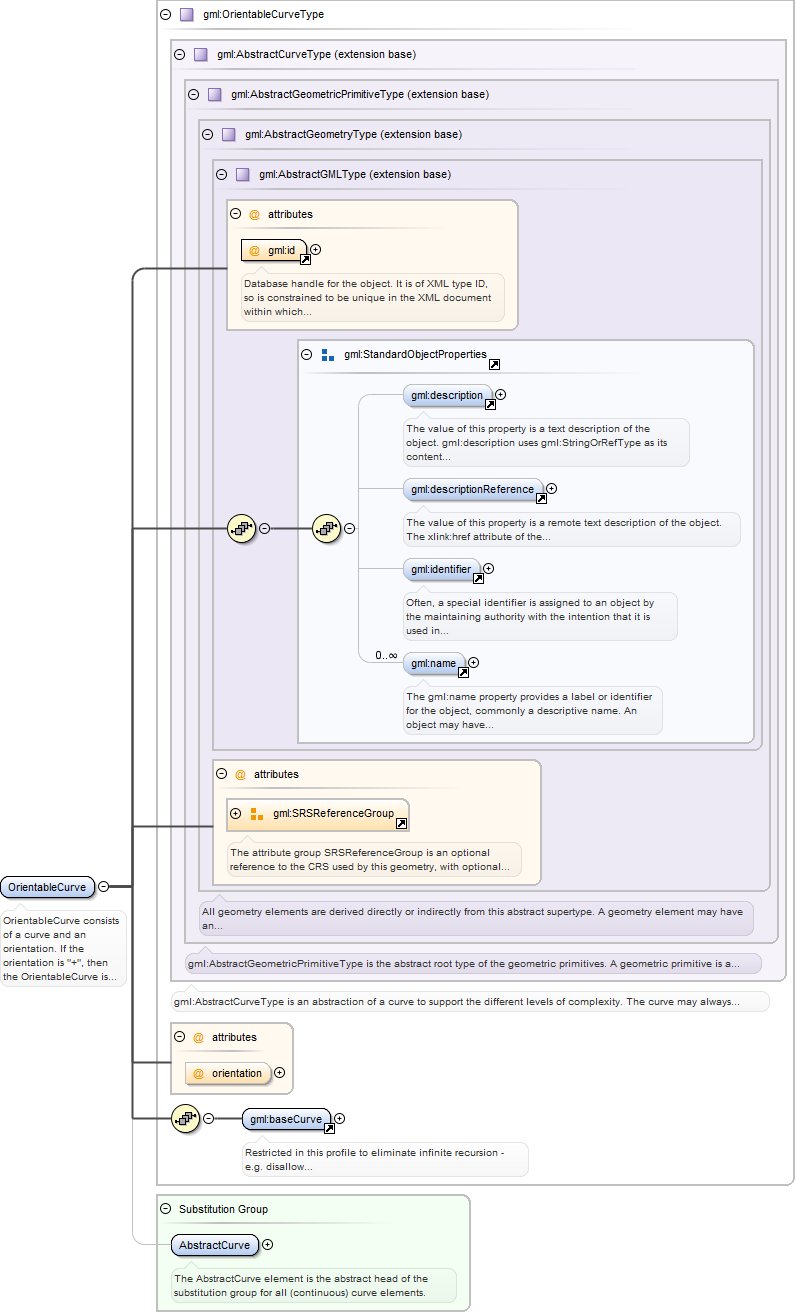
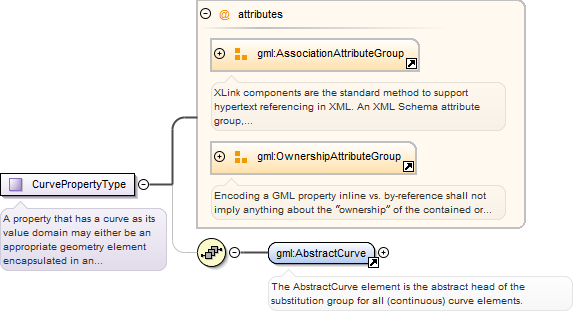
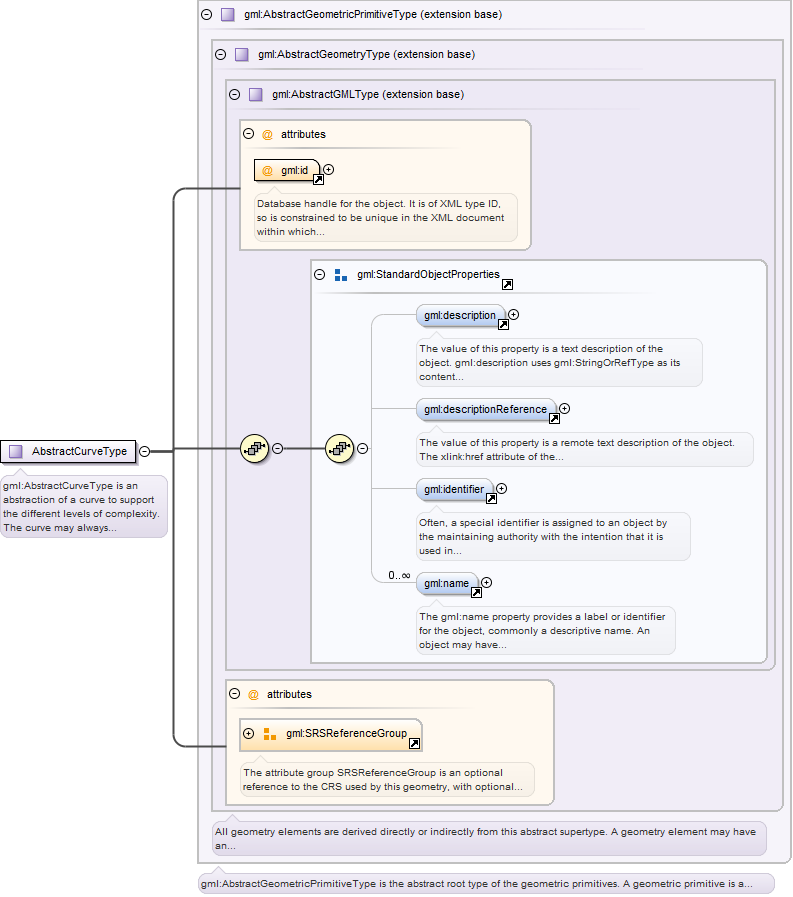
Element gml:AbstractCurve
Namespace http://www.opengis.net/gml/3.2
Annotations
The AbstractCurve element is the abstract head of the substitution group for
all (continuous) curve elements.
Diagram
Diagram 3_2.tmp#id 3_2.tmp#description 3_2.tmp#descriptionReference 3_2.tmp#identifier 3_2.tmp#name 3_2.tmp#StandardObjectProperties 3_2.tmp#AbstractGMLType 3_2.tmp#SRSReferenceGroup 3_2.tmp#AbstractGeometryType 3_2.tmp#AbstractGeometricPrimitiveType 3_2.tmp#AbstractCurveType 3_2.tmp#CompositeCurve 3_2.tmp#LineString 3_2.tmp#OrientableCurve 3_2.tmp#AbstractGeometricPrimitive
Type gml:AbstractCurveType
Type hierarchy
Properties
content: complex
abstract: true
Substitution Group
Substitution Group Affiliation
Used by
Model gml:description{0,1} , gml:descriptionReference{0,1} , gml:identifier{0,1} , gml:name*
Children gml:description, gml:descriptionReference, gml:identifier, gml:name
Instance
<gml:AbstractCurve axisLabels="" gml:id="" srsDimension="" srsName="" uomLabels="" xmlns:gml="http://www.opengis.net/gml/3.2">
  <gml:description xlink:href="" nilReason="" xlink:title="">{0,1}</gml:description>
  <gml:descriptionReference xlink:href="" nilReason="" owns="false" xlink:title="">{0,1}</gml:descriptionReference>
  <gml:identifier codeSpace="">{0,1}</gml:identifier>
  <gml:name codeSpace="">{0,unbounded}</gml:name>
</gml:AbstractCurve>
Attributes
QName Type Fixed Default Use Annotation
axisLabels gml:NCNameList optional
gml:id ID required
Database handle for the object. It is of XML type ID, so is constrained to be
unique in the XML document within which it occurs. An external identifier for the object in
the form of a URI may be constructed using standard XML and XPointer methods. This is done
by concatenating the URI for the document, a fragment separator, and the value of the id
attribute.
srsDimension positiveInteger optional
srsName anyURI optional
uomLabels gml:NCNameList optional
Source
<element name="AbstractCurve" type="gml:AbstractCurveType" abstract="true" substitutionGroup="gml:AbstractGeometricPrimitive">
  <annotation>
    <documentation>The AbstractCurve element is the abstract head of the substitution group for all (continuous) curve elements.</documentation>
  </annotation>
</element>
Schema location file:/C:/GaldosOffline/DIGGS_Offline - GMLProfile/Diggs2.0.a/Schemas/gml3.2Profile_diggs.xsd
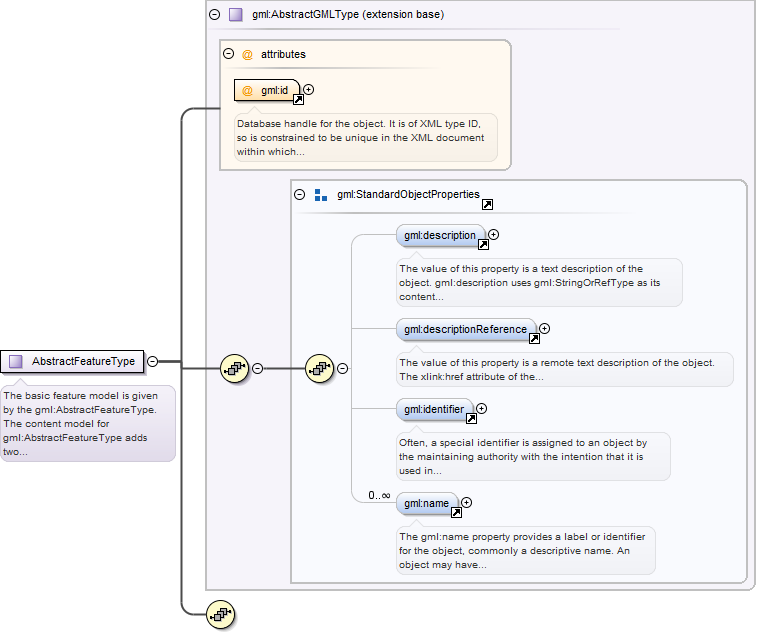
Element gml:AbstractFeature
Namespace http://www.opengis.net/gml/3.2
Annotations
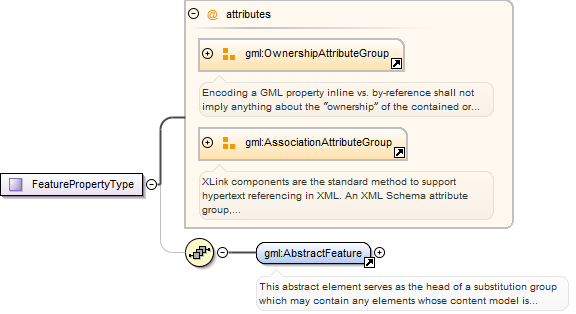
This abstract element serves as the head of a substitution group which may
contain any elements whose content model is derived from gml:AbstractFeatureType. This may
be used as a variable in the construction of content models. gml:AbstractFeature may be
thought of as “anything that is a GML feature” and may be used to define variables or
templates in which the value of a GML property is “any feature”. This occurs in particular
in a GML feature collection where the feature member properties contain one or multiple
copies of gml:AbstractFeature respectively.
Diagram
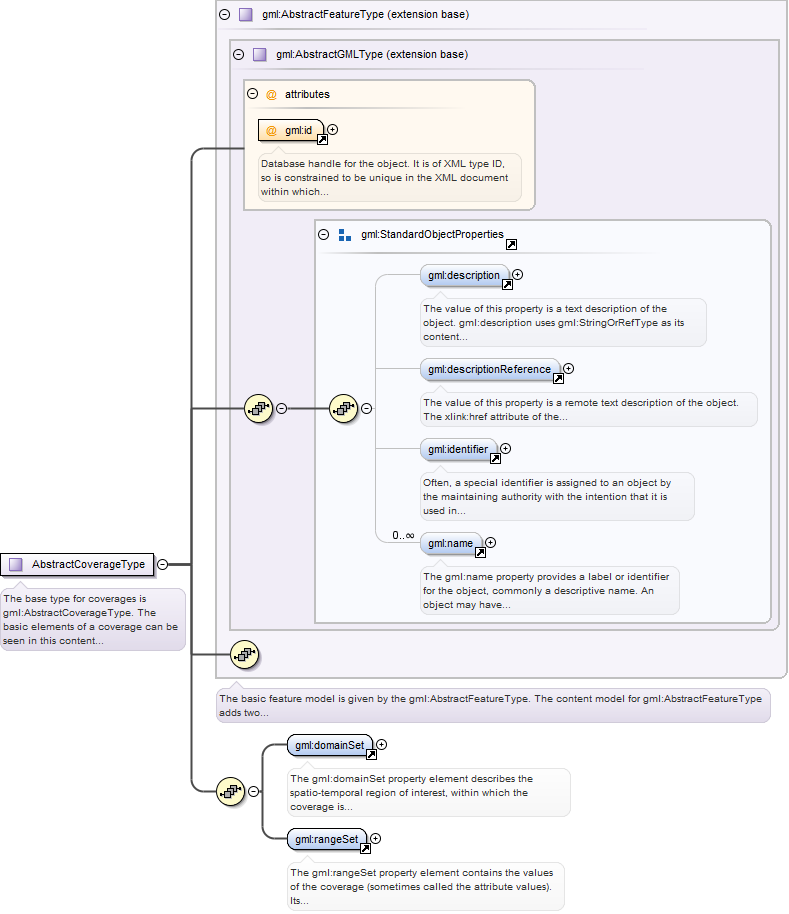
Diagram 3_2.tmp#id 3_2.tmp#description 3_2.tmp#descriptionReference 3_2.tmp#identifier 3_2.tmp#name 3_2.tmp#StandardObjectProperties 3_2.tmp#AbstractGMLType 3_2.tmp#AbstractFeatureType 3_2.tmp#AbstractCoverage 2_0_a.tmp#AbstractFeatureBase 2_0_a.tmp#Diggs 3_2.tmp#AbstractGML
Type gml:AbstractFeatureType
Type hierarchy
Properties
content: complex
abstract: true
Substitution Group
Substitution Group Affiliation
Used by
Model gml:description{0,1} , gml:descriptionReference{0,1} , gml:identifier{0,1} , gml:name*
Children gml:description, gml:descriptionReference, gml:identifier, gml:name
Instance
<gml:AbstractFeature gml:id="" xmlns:gml="http://www.opengis.net/gml/3.2">
  <gml:description xlink:href="" nilReason="" xlink:title="">{0,1}</gml:description>
  <gml:descriptionReference xlink:href="" nilReason="" owns="false" xlink:title="">{0,1}</gml:descriptionReference>
  <gml:identifier codeSpace="">{0,1}</gml:identifier>
  <gml:name codeSpace="">{0,unbounded}</gml:name>
</gml:AbstractFeature>
Attributes
QName Type Fixed Default Use Annotation
gml:id ID required
Database handle for the object. It is of XML type ID, so is constrained to be
unique in the XML document within which it occurs. An external identifier for the object in
the form of a URI may be constructed using standard XML and XPointer methods. This is done
by concatenating the URI for the document, a fragment separator, and the value of the id
attribute.
Source
<element name="AbstractFeature" type="gml:AbstractFeatureType" abstract="true" substitutionGroup="gml:AbstractGML">
  <annotation>
    <documentation>This abstract element serves as the head of a substitution group which may contain any elements whose content model is derived from gml:AbstractFeatureType. This may be used as a variable in the construction of content models. gml:AbstractFeature may be thought of as “anything that is a GML feature” and may be used to define variables or templates in which the value of a GML property is “any feature”. This occurs in particular in a GML feature collection where the feature member properties contain one or multiple copies of gml:AbstractFeature respectively.</documentation>
  </annotation>
</element>
Schema location file:/C:/GaldosOffline/DIGGS_Offline - GMLProfile/Diggs2.0.a/Schemas/gml3.2Profile_diggs.xsd
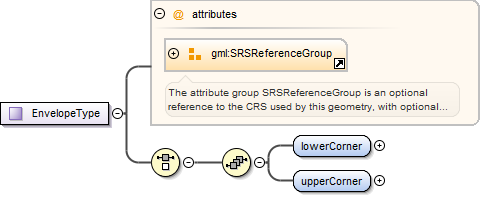
Element gml:EnvelopeType / gml:lowerCorner
Namespace http://www.opengis.net/gml/3.2
Diagram
Diagram 3_2.tmp#doubleList 3_2.tmp#SRSReferenceGroup 3_2.tmp#DirectPositionType
Type gml:DirectPositionType
Type hierarchy
Properties
content: complex
Attributes
QName Type Fixed Default Use Annotation
axisLabels gml:NCNameList optional
srsDimension positiveInteger optional
srsName anyURI optional
uomLabels gml:NCNameList optional
Source
<element name="lowerCorner" type="gml:DirectPositionType"/>
Schema location file:/C:/GaldosOffline/DIGGS_Offline - GMLProfile/Diggs2.0.a/Schemas/gml3.2Profile_diggs.xsd
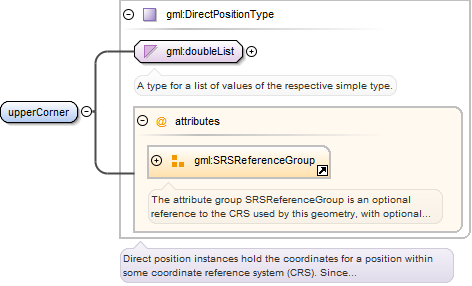
Element gml:EnvelopeType / gml:upperCorner
Namespace http://www.opengis.net/gml/3.2
Diagram
Diagram 3_2.tmp#doubleList 3_2.tmp#SRSReferenceGroup 3_2.tmp#DirectPositionType
Type gml:DirectPositionType
Type hierarchy
Properties
content: complex
Attributes
QName Type Fixed Default Use Annotation
axisLabels gml:NCNameList optional
srsDimension positiveInteger optional
srsName anyURI optional
uomLabels gml:NCNameList optional
Source
<element name="upperCorner" type="gml:DirectPositionType"/>
Schema location file:/C:/GaldosOffline/DIGGS_Offline - GMLProfile/Diggs2.0.a/Schemas/gml3.2Profile_diggs.xsd
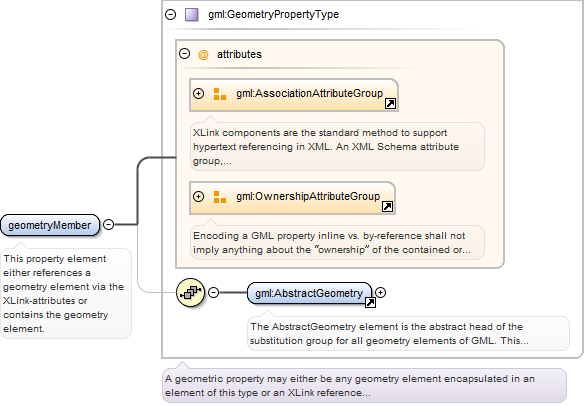
Element gml:geometryMember
Namespace http://www.opengis.net/gml/3.2
Annotations
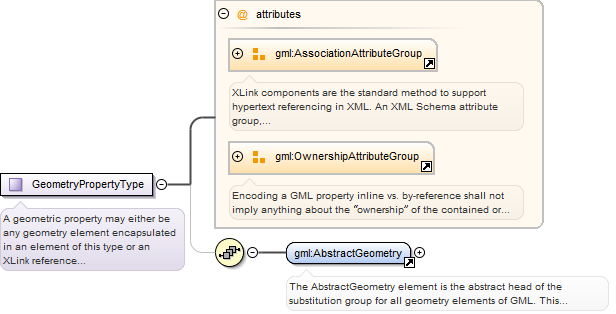
This property element either references a geometry element via the
XLink-attributes or contains the geometry element.
Diagram
Diagram 3_2.tmp#AssociationAttributeGroup 3_2.tmp#OwnershipAttributeGroup 3_2.tmp#AbstractGeometry 3_2.tmp#GeometryPropertyType
Type gml:GeometryPropertyType
Properties
content: complex
Used by
Complex Type gml:MultiGeometryType
Model gml:AbstractGeometry
Children gml:AbstractGeometry
Instance
<gml:geometryMember xlink:href="" nilReason="" owns="false" xlink:title="" xmlns:gml="http://www.opengis.net/gml/3.2">
  <gml:AbstractGeometry axisLabels="" gml:id="" srsDimension="" srsName="" uomLabels="">{1,1}</gml:AbstractGeometry>
</gml:geometryMember>
Attributes
QName Type Fixed Default Use Annotation
nilReason gml:NilReasonType optional
owns boolean false optional
xlink:href xlink:hrefType optional
xlink:title xlink:titleAttrType optional
Source
<element name="geometryMember" type="gml:GeometryPropertyType">
  <annotation>
    <documentation>This property element either references a geometry element via the XLink-attributes or contains the geometry element.</documentation>
  </annotation>
</element>
Schema location file:/C:/GaldosOffline/DIGGS_Offline - GMLProfile/Diggs2.0.a/Schemas/gml3.2Profile_diggs.xsd
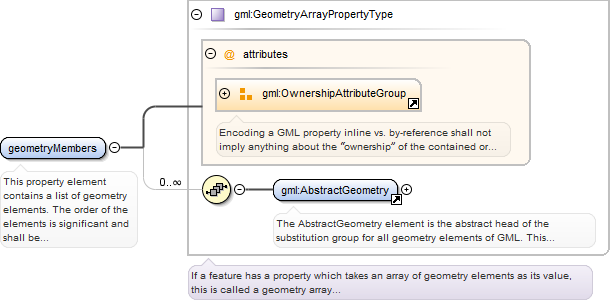
Element gml:geometryMembers
Namespace http://www.opengis.net/gml/3.2
Annotations
This property element contains a list of geometry elements. The order of the
elements is significant and shall be preserved when processing the array.
Diagram
Diagram 3_2.tmp#OwnershipAttributeGroup 3_2.tmp#AbstractGeometry 3_2.tmp#GeometryArrayPropertyType
Type gml:GeometryArrayPropertyType
Properties
content: complex
Used by
Complex Type gml:MultiGeometryType
Model gml:AbstractGeometry
Children gml:AbstractGeometry
Instance
<gml:geometryMembers owns="false" xmlns:gml="http://www.opengis.net/gml/3.2">
  <gml:AbstractGeometry axisLabels="" gml:id="" srsDimension="" srsName="" uomLabels="">{1,1}</gml:AbstractGeometry>
</gml:geometryMembers>
Attributes
QName Type Fixed Default Use Annotation
owns boolean false optional
Source
<element name="geometryMembers" type="gml:GeometryArrayPropertyType">
  <annotation>
    <documentation>This property element contains a list of geometry elements. The order of the elements is significant and shall be preserved when processing the array.</documentation>
  </annotation>
</element>
Schema location file:/C:/GaldosOffline/DIGGS_Offline - GMLProfile/Diggs2.0.a/Schemas/gml3.2Profile_diggs.xsd
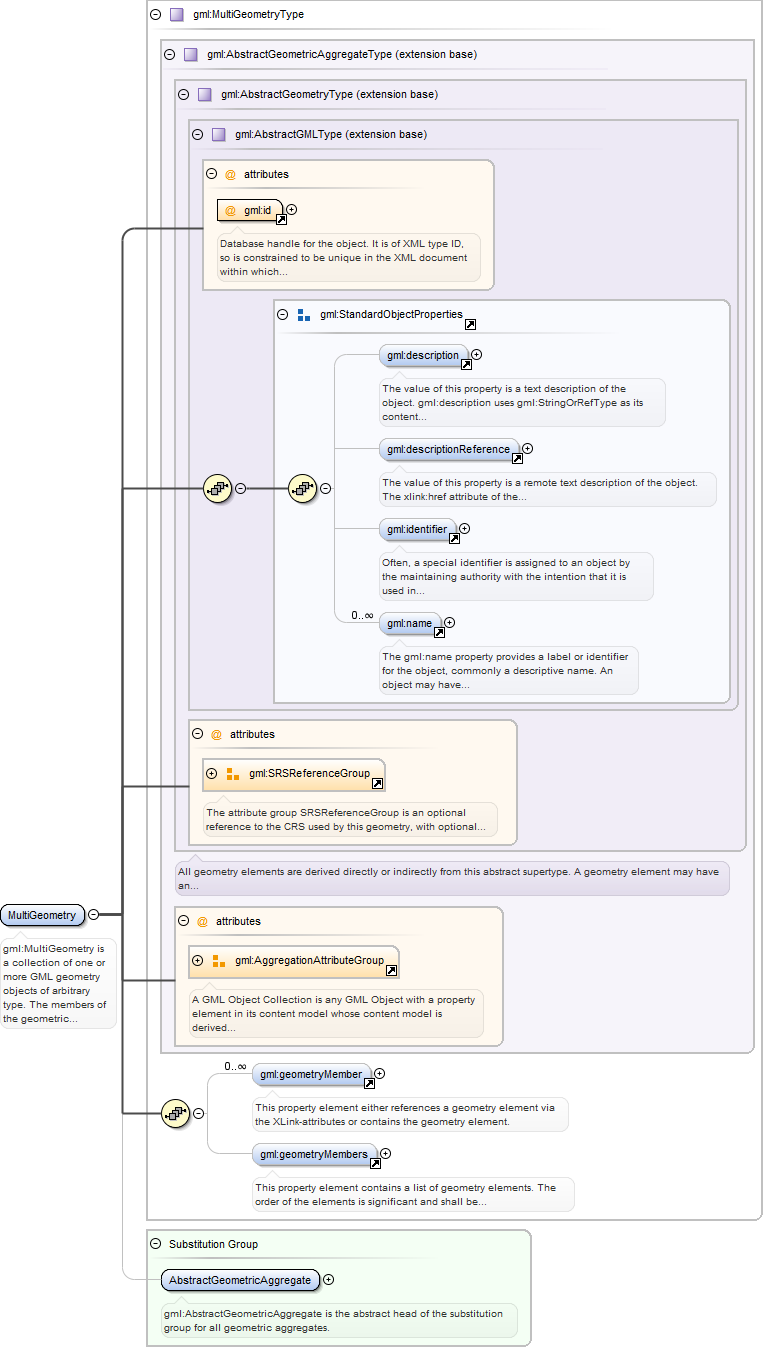
Element gml:MultiGeometry
Namespace http://www.opengis.net/gml/3.2
Annotations
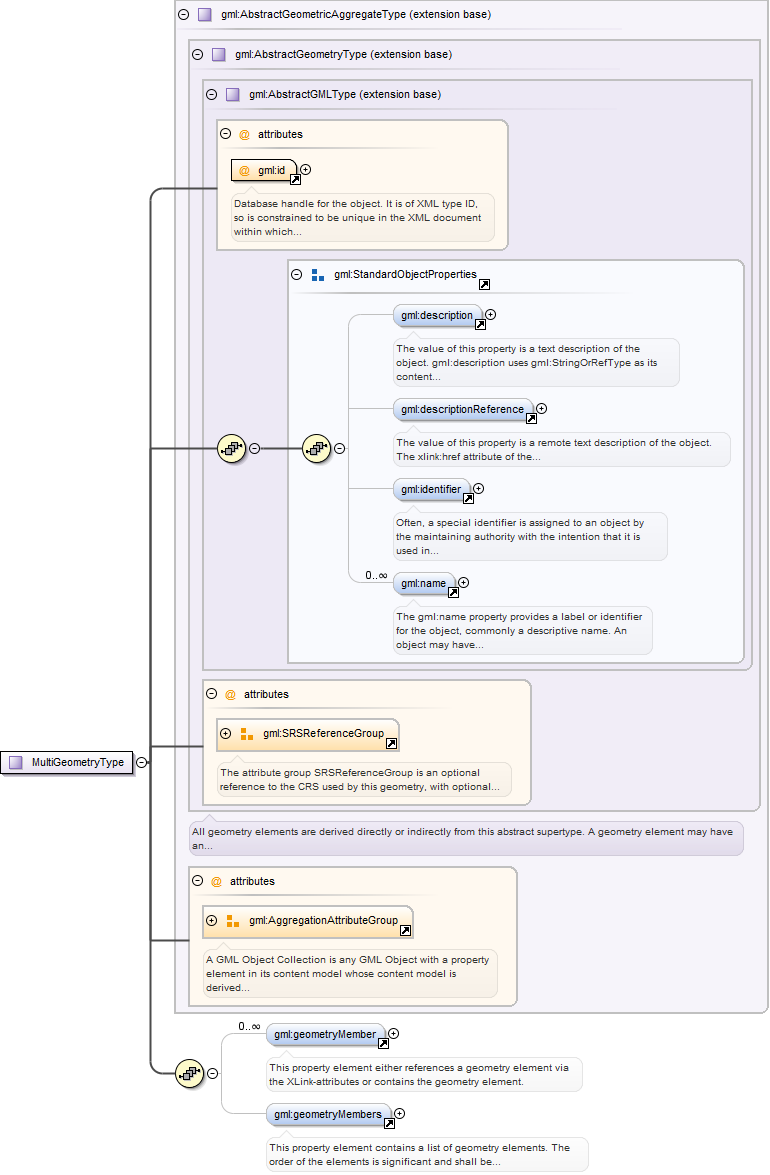
gml:MultiGeometry is a collection of one or more GML geometry objects of
arbitrary type. The members of the geometric aggregate may be specified either using the
"standard" property (gml:geometryMember) or the array property (gml:geometryMembers). It is
also valid to use both the "standard" and the array properties in the same
collection.
Diagram
Diagram 3_2.tmp#id 3_2.tmp#description 3_2.tmp#descriptionReference 3_2.tmp#identifier 3_2.tmp#name 3_2.tmp#StandardObjectProperties 3_2.tmp#AbstractGMLType 3_2.tmp#SRSReferenceGroup 3_2.tmp#AbstractGeometryType 3_2.tmp#AggregationAttributeGroup 3_2.tmp#AbstractGeometricAggregateType 3_2.tmp#geometryMember 3_2.tmp#geometryMembers 3_2.tmp#MultiGeometryType 3_2.tmp#AbstractGeometricAggregate
Type gml:MultiGeometryType
Type hierarchy
Properties
content: complex
Substitution Group Affiliation
Model gml:description{0,1} , gml:descriptionReference{0,1} , gml:identifier{0,1} , gml:name* , gml:geometryMember* , gml:geometryMembers{0,1}
Children gml:description, gml:descriptionReference, gml:geometryMember, gml:geometryMembers, gml:identifier, gml:name
Instance
<gml:MultiGeometry aggregationType="" axisLabels="" gml:id="" srsDimension="" srsName="" uomLabels="" xmlns:gml="http://www.opengis.net/gml/3.2">
  <gml:description xlink:href="" nilReason="" xlink:title="">{0,1}</gml:description>
  <gml:descriptionReference xlink:href="" nilReason="" owns="false" xlink:title="">{0,1}</gml:descriptionReference>
  <gml:identifier codeSpace="">{0,1}</gml:identifier>
  <gml:name codeSpace="">{0,unbounded}</gml:name>
  <gml:geometryMember xlink:href="" nilReason="" owns="false" xlink:title="">{0,unbounded}</gml:geometryMember>
  <gml:geometryMembers owns="false">{0,1}</gml:geometryMembers>
</gml:MultiGeometry>
Attributes
QName Type Fixed Default Use Annotation
aggregationType gml:AggregationType optional
axisLabels gml:NCNameList optional
gml:id ID required
Database handle for the object. It is of XML type ID, so is constrained to be
unique in the XML document within which it occurs. An external identifier for the object in
the form of a URI may be constructed using standard XML and XPointer methods. This is done
by concatenating the URI for the document, a fragment separator, and the value of the id
attribute.
srsDimension positiveInteger optional
srsName anyURI optional
uomLabels gml:NCNameList optional
Source
<element name="MultiGeometry" type="gml:MultiGeometryType" substitutionGroup="gml:AbstractGeometricAggregate">
  <annotation>
    <documentation>gml:MultiGeometry is a collection of one or more GML geometry objects of arbitrary type. The members of the geometric aggregate may be specified either using the "standard" property (gml:geometryMember) or the array property (gml:geometryMembers). It is also valid to use both the "standard" and the array properties in the same collection.</documentation>
  </annotation>
</element>
Schema location file:/C:/GaldosOffline/DIGGS_Offline - GMLProfile/Diggs2.0.a/Schemas/gml3.2Profile_diggs.xsd
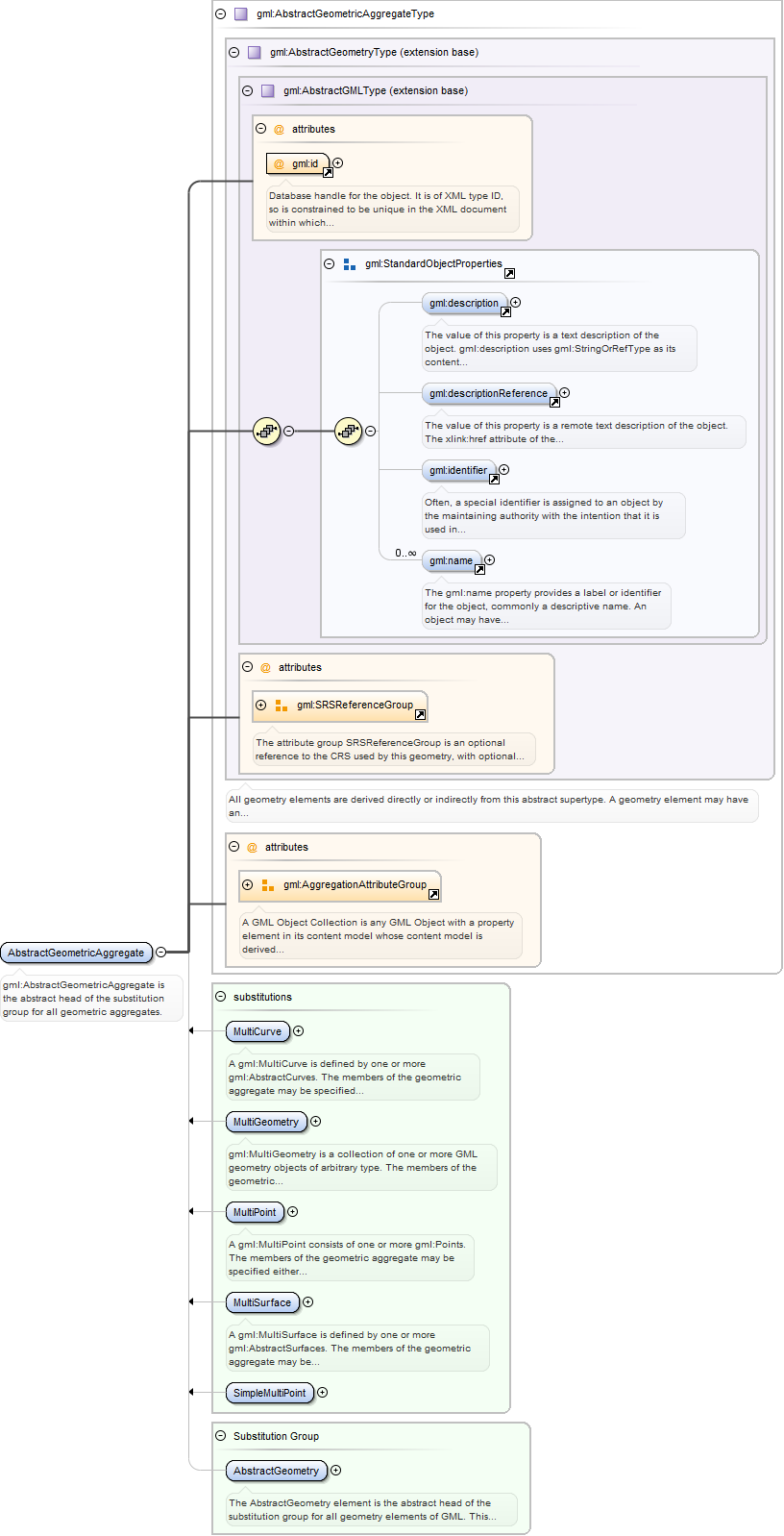
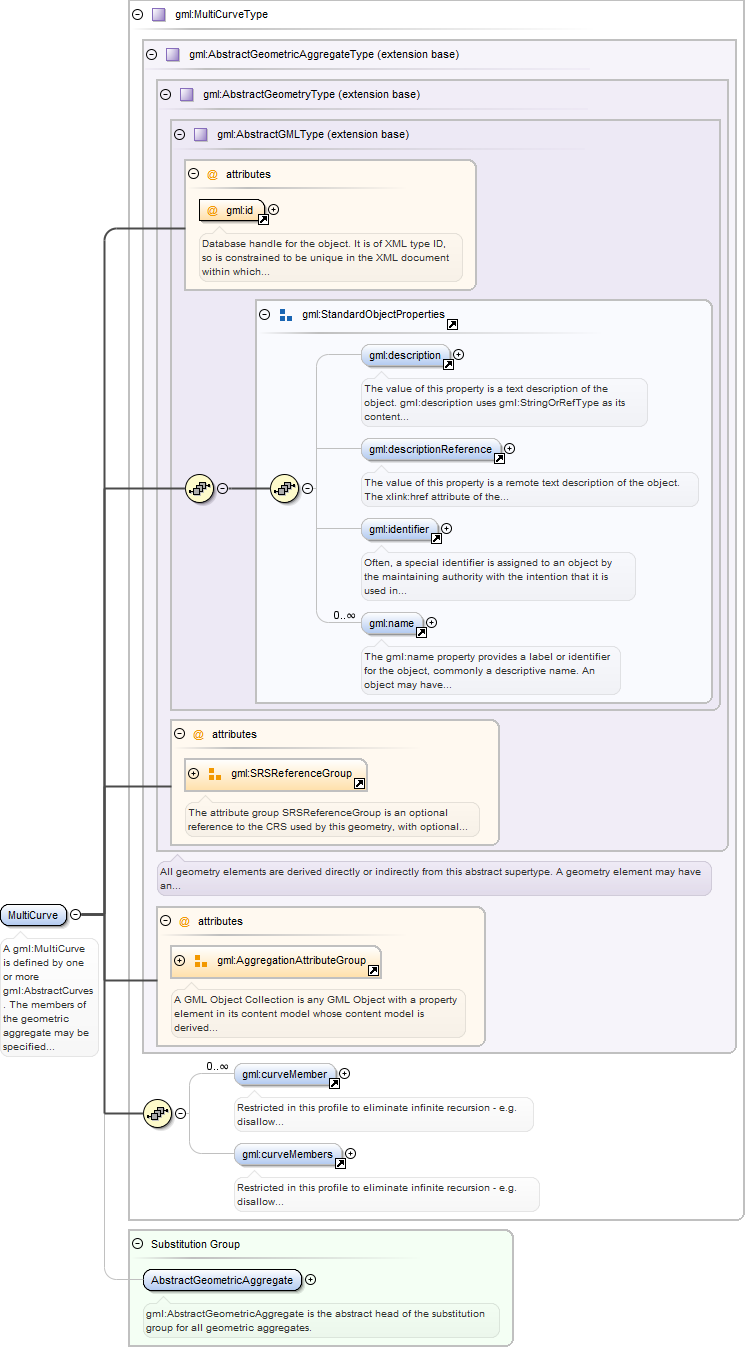
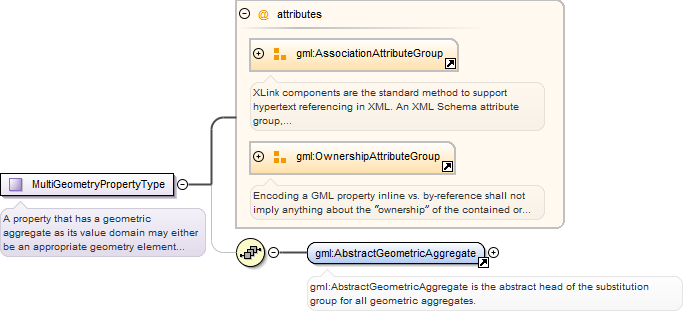
Element gml:AbstractGeometricAggregate
Namespace http://www.opengis.net/gml/3.2
Annotations
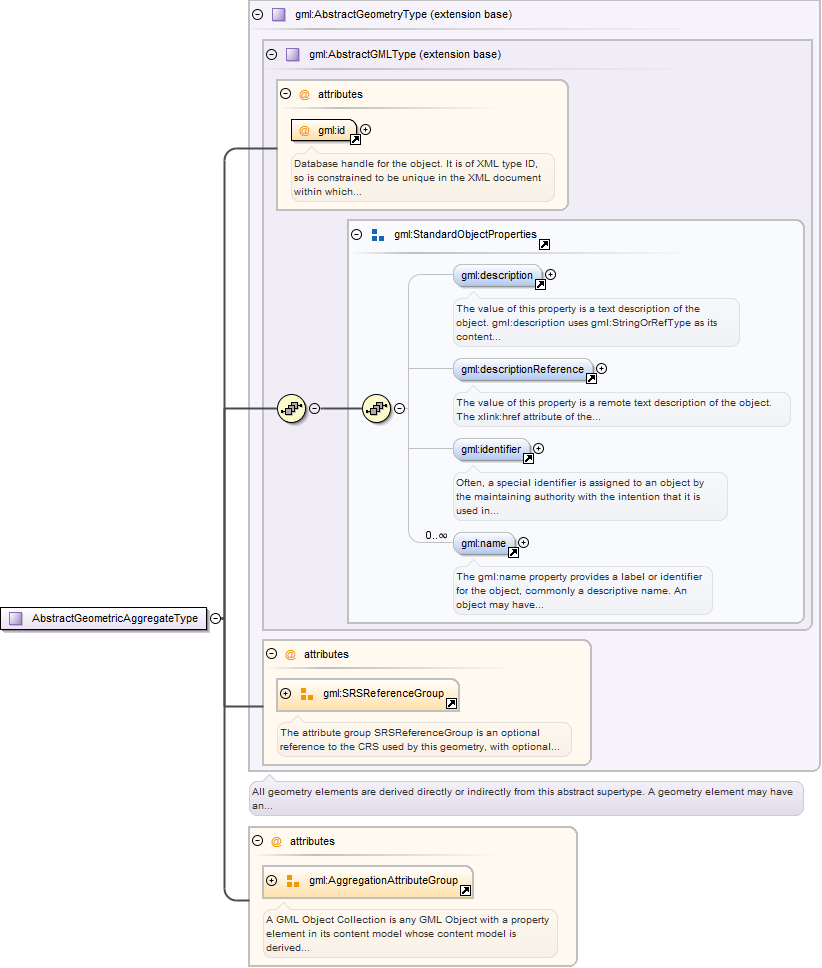
gml:AbstractGeometricAggregate is the abstract head of the substitution group
for all geometric aggregates.
Diagram
Diagram 3_2.tmp#id 3_2.tmp#description 3_2.tmp#descriptionReference 3_2.tmp#identifier 3_2.tmp#name 3_2.tmp#StandardObjectProperties 3_2.tmp#AbstractGMLType 3_2.tmp#SRSReferenceGroup 3_2.tmp#AbstractGeometryType 3_2.tmp#AggregationAttributeGroup 3_2.tmp#AbstractGeometricAggregateType 3_2.tmp#MultiCurve 3_2.tmp#MultiGeometry 3_2.tmp#MultiPoint 3_2.tmp#MultiSurface ce.tmp#SimpleMultiPoint 3_2.tmp#AbstractGeometry
Type gml:AbstractGeometricAggregateType
Type hierarchy
Properties
content: complex
abstract: true
Substitution Group
Substitution Group Affiliation
Used by
Model gml:description{0,1} , gml:descriptionReference{0,1} , gml:identifier{0,1} , gml:name*
Children gml:description, gml:descriptionReference, gml:identifier, gml:name
Instance
<gml:AbstractGeometricAggregate aggregationType="" axisLabels="" gml:id="" srsDimension="" srsName="" uomLabels="" xmlns:gml="http://www.opengis.net/gml/3.2">
  <gml:description xlink:href="" nilReason="" xlink:title="">{0,1}</gml:description>
  <gml:descriptionReference xlink:href="" nilReason="" owns="false" xlink:title="">{0,1}</gml:descriptionReference>
  <gml:identifier codeSpace="">{0,1}</gml:identifier>
  <gml:name codeSpace="">{0,unbounded}</gml:name>
</gml:AbstractGeometricAggregate>
Attributes
QName Type Fixed Default Use Annotation
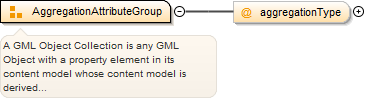
aggregationType gml:AggregationType optional
axisLabels gml:NCNameList optional
gml:id ID required
Database handle for the object. It is of XML type ID, so is constrained to be
unique in the XML document within which it occurs. An external identifier for the object in
the form of a URI may be constructed using standard XML and XPointer methods. This is done
by concatenating the URI for the document, a fragment separator, and the value of the id
attribute.
srsDimension positiveInteger optional
srsName anyURI optional
uomLabels gml:NCNameList optional
Source
<element name="AbstractGeometricAggregate" type="gml:AbstractGeometricAggregateType" abstract="true" substitutionGroup="gml:AbstractGeometry">
  <annotation>
    <documentation>gml:AbstractGeometricAggregate is the abstract head of the substitution group for all geometric aggregates.</documentation>
  </annotation>
</element>
Schema location file:/C:/GaldosOffline/DIGGS_Offline - GMLProfile/Diggs2.0.a/Schemas/gml3.2Profile_diggs.xsd
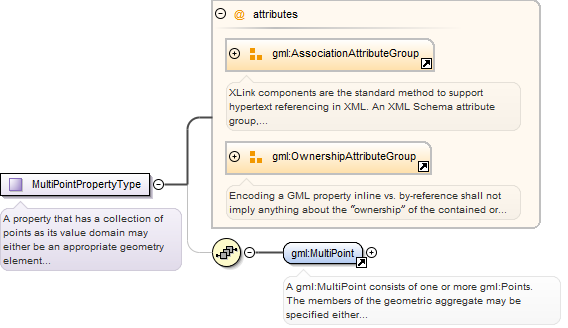
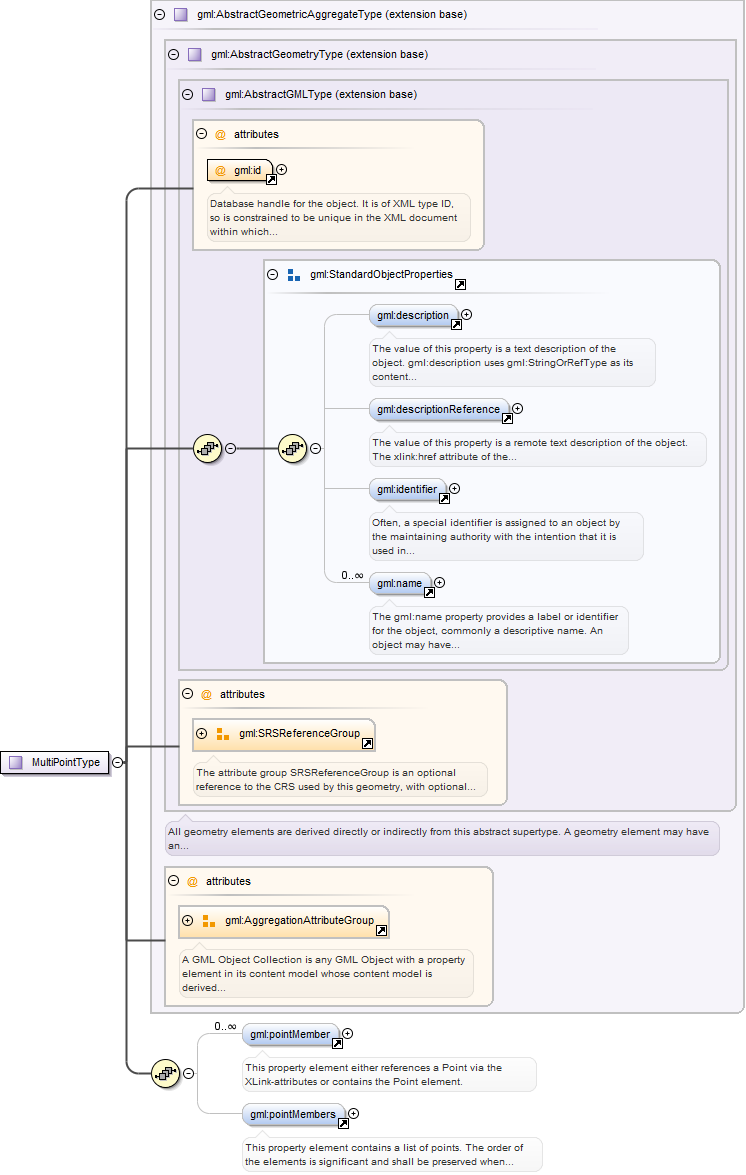
Element gml:MultiPoint
Namespace http://www.opengis.net/gml/3.2
Annotations
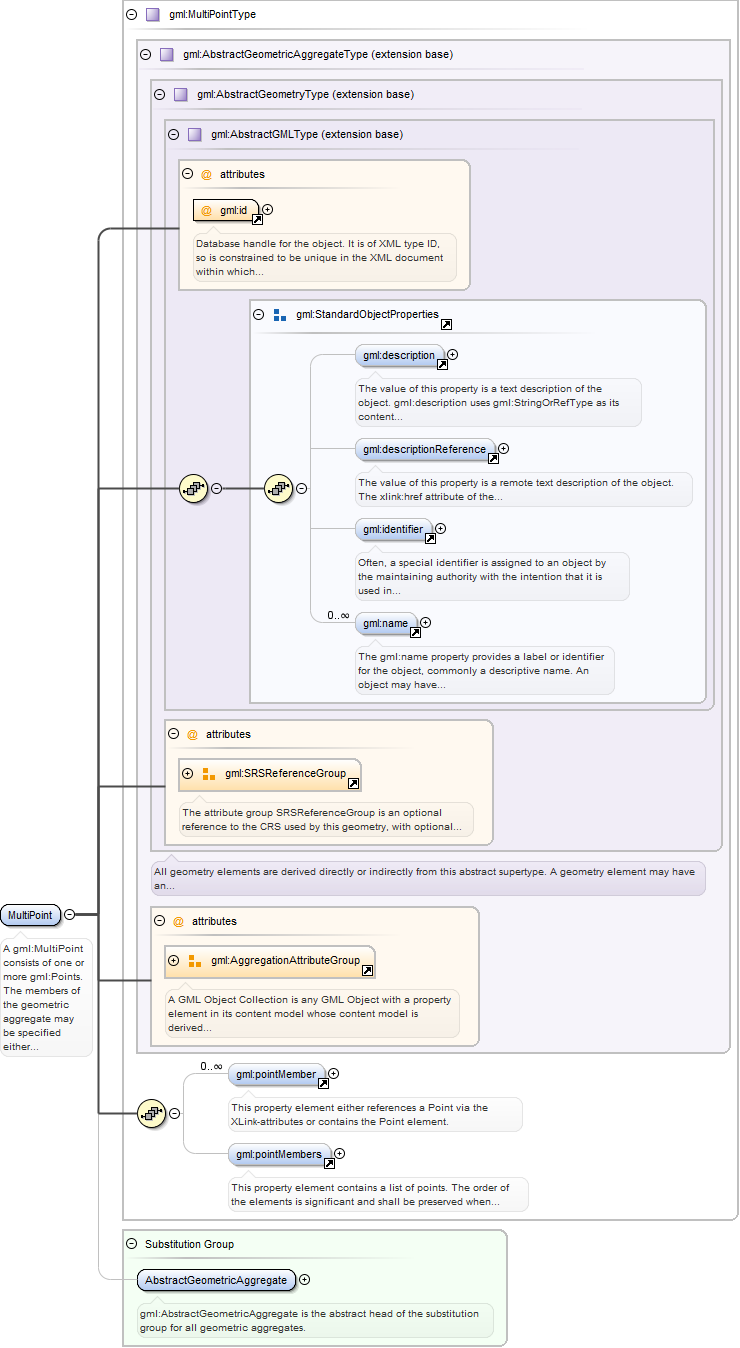
A gml:MultiPoint consists of one or more gml:Points. The members of the
geometric aggregate may be specified either using the "standard" property (gml:pointMember)
or the array property (gml:pointMembers). It is also valid to use both the "standard" and
the array properties in the same collection.
Diagram
Diagram 3_2.tmp#id 3_2.tmp#description 3_2.tmp#descriptionReference 3_2.tmp#identifier 3_2.tmp#name 3_2.tmp#StandardObjectProperties 3_2.tmp#AbstractGMLType 3_2.tmp#SRSReferenceGroup 3_2.tmp#AbstractGeometryType 3_2.tmp#AggregationAttributeGroup 3_2.tmp#AbstractGeometricAggregateType 3_2.tmp#pointMember 3_2.tmp#pointMembers 3_2.tmp#MultiPointType 3_2.tmp#AbstractGeometricAggregate
Type gml:MultiPointType
Type hierarchy
Properties
content: complex
Substitution Group Affiliation
Used by
Model gml:description{0,1} , gml:descriptionReference{0,1} , gml:identifier{0,1} , gml:name* , gml:pointMember* , gml:pointMembers{0,1}
Children gml:description, gml:descriptionReference, gml:identifier, gml:name, gml:pointMember, gml:pointMembers
Instance
<gml:MultiPoint aggregationType="" axisLabels="" gml:id="" srsDimension="" srsName="" uomLabels="" xmlns:gml="http://www.opengis.net/gml/3.2">
  <gml:description xlink:href="" nilReason="" xlink:title="">{0,1}</gml:description>
  <gml:descriptionReference xlink:href="" nilReason="" owns="false" xlink:title="">{0,1}</gml:descriptionReference>
  <gml:identifier codeSpace="">{0,1}</gml:identifier>
  <gml:name codeSpace="">{0,unbounded}</gml:name>
  <gml:pointMember xlink:href="" nilReason="" owns="false" xlink:title="">{0,unbounded}</gml:pointMember>
  <gml:pointMembers owns="false">{0,1}</gml:pointMembers>
</gml:MultiPoint>
Attributes
QName Type Fixed Default Use Annotation
aggregationType gml:AggregationType optional
axisLabels gml:NCNameList optional
gml:id ID required
Database handle for the object. It is of XML type ID, so is constrained to be
unique in the XML document within which it occurs. An external identifier for the object in
the form of a URI may be constructed using standard XML and XPointer methods. This is done
by concatenating the URI for the document, a fragment separator, and the value of the id
attribute.
srsDimension positiveInteger optional
srsName anyURI optional
uomLabels gml:NCNameList optional
Source
<element name="MultiPoint" type="gml:MultiPointType" substitutionGroup="gml:AbstractGeometricAggregate">
  <annotation>
    <documentation>A gml:MultiPoint consists of one or more gml:Points. The members of the geometric aggregate may be specified either using the "standard" property (gml:pointMember) or the array property (gml:pointMembers). It is also valid to use both the "standard" and the array properties in the same collection.</documentation>
  </annotation>
</element>
Schema location file:/C:/GaldosOffline/DIGGS_Offline - GMLProfile/Diggs2.0.a/Schemas/gml3.2Profile_diggs.xsd
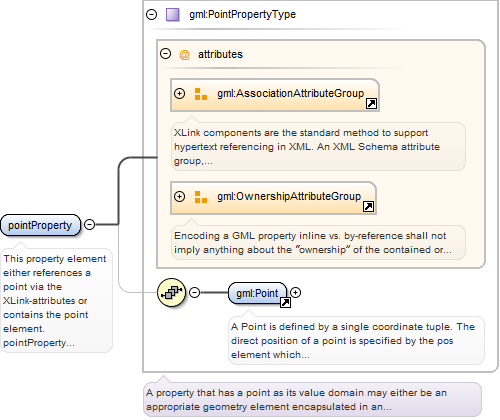
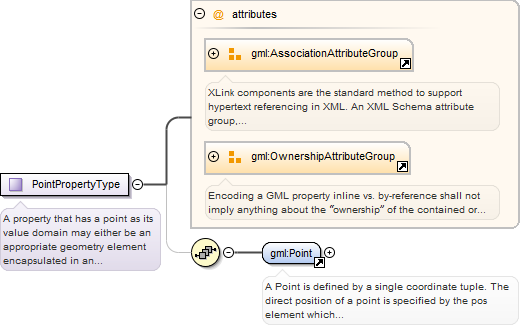
Element gml:pointMember
Namespace http://www.opengis.net/gml/3.2
Annotations
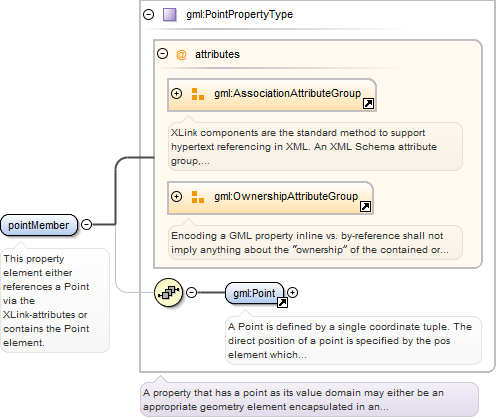
This property element either references a Point via the XLink-attributes or
contains the Point element.
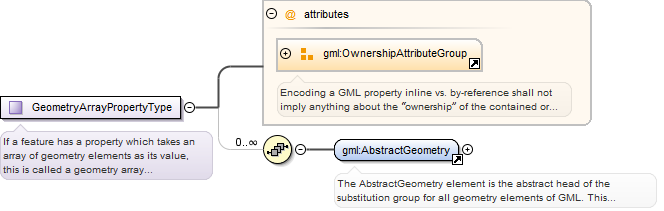
Diagram
Diagram 3_2.tmp#AssociationAttributeGroup 3_2.tmp#OwnershipAttributeGroup 3_2.tmp#Point 3_2.tmp#PointPropertyType
Type gml:PointPropertyType
Properties
content: complex
Used by
Complex Type gml:MultiPointType
Model gml:Point
Children gml:Point
Instance
<gml:pointMember xlink:href="" nilReason="" owns="false" xlink:title="" xmlns:gml="http://www.opengis.net/gml/3.2">
  <gml:Point axisLabels="" gml:id="" srsDimension="" srsName="" uomLabels="">{1,1}</gml:Point>
</gml:pointMember>
Attributes
QName Type Fixed Default Use Annotation
nilReason gml:NilReasonType optional
owns boolean false optional
xlink:href xlink:hrefType optional
xlink:title xlink:titleAttrType optional
Source
<element name="pointMember" type="gml:PointPropertyType">
  <annotation>
    <documentation>This property element either references a Point via the XLink-attributes or contains the Point element.</documentation>
  </annotation>
</element>
Schema location file:/C:/GaldosOffline/DIGGS_Offline - GMLProfile/Diggs2.0.a/Schemas/gml3.2Profile_diggs.xsd
Element gml:pointMembers
Namespace http://www.opengis.net/gml/3.2
Annotations
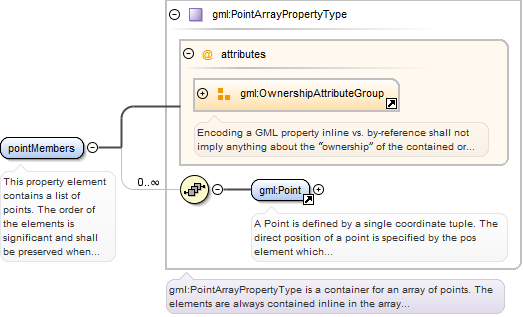
This property element contains a list of points. The order of the elements is
significant and shall be preserved when processing the array.
Diagram
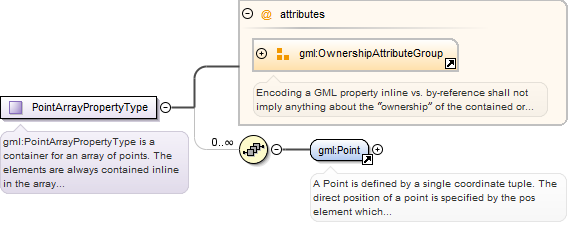
Diagram 3_2.tmp#OwnershipAttributeGroup 3_2.tmp#Point 3_2.tmp#PointArrayPropertyType
Type gml:PointArrayPropertyType
Properties
content: complex
Used by
Complex Type gml:MultiPointType
Model gml:Point
Children gml:Point
Instance
<gml:pointMembers owns="false" xmlns:gml="http://www.opengis.net/gml/3.2">
  <gml:Point axisLabels="" gml:id="" srsDimension="" srsName="" uomLabels="">{1,1}</gml:Point>
</gml:pointMembers>
Attributes
QName Type Fixed Default Use Annotation
owns boolean false optional
Source
<element name="pointMembers" type="gml:PointArrayPropertyType">
  <annotation>
    <documentation>This property element contains a list of points. The order of the elements is significant and shall be preserved when processing the array.</documentation>
  </annotation>
</element>
Schema location file:/C:/GaldosOffline/DIGGS_Offline - GMLProfile/Diggs2.0.a/Schemas/gml3.2Profile_diggs.xsd
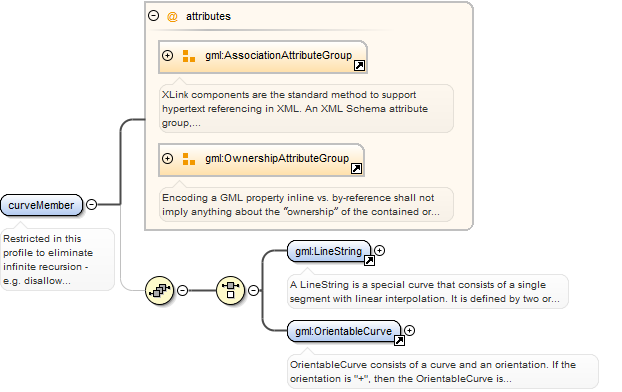
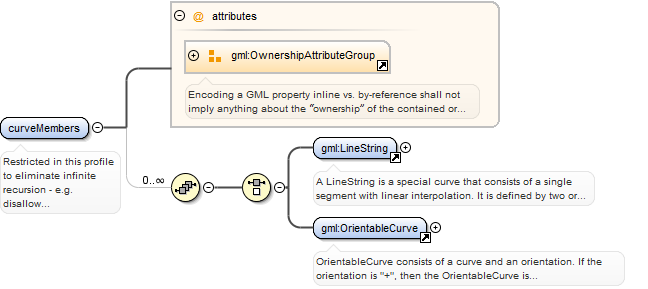
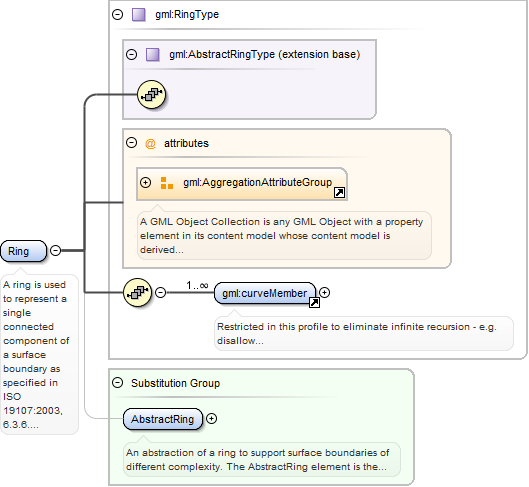
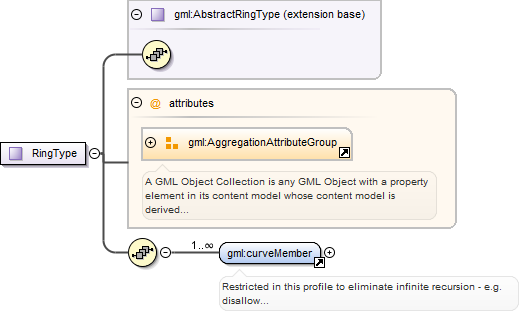
Element gml:curveMember
Namespace http://www.opengis.net/gml/3.2
Annotations
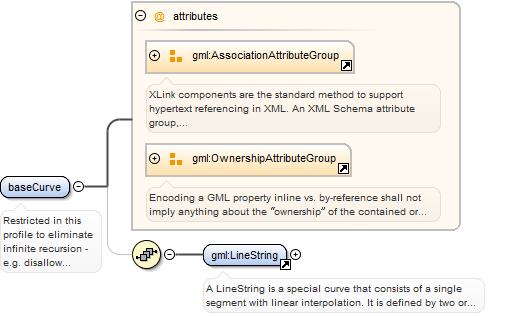
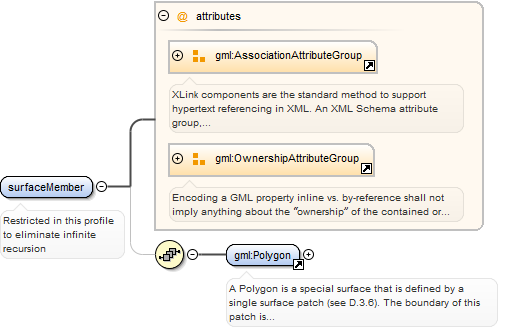
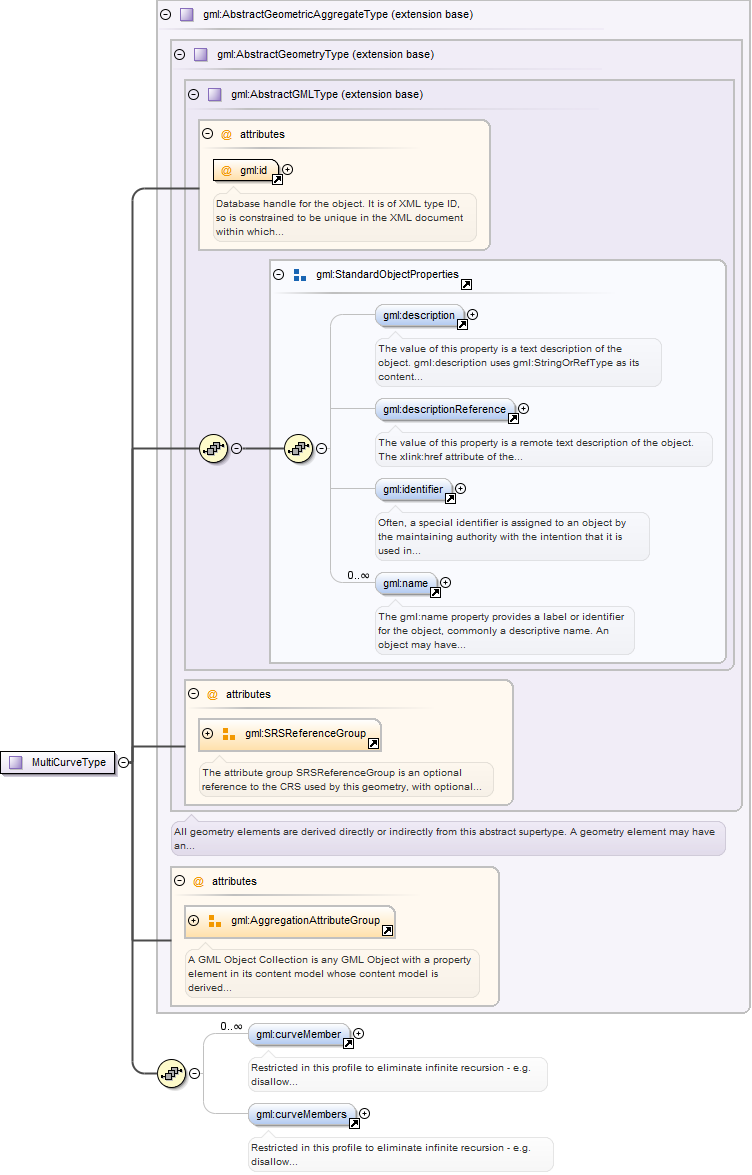
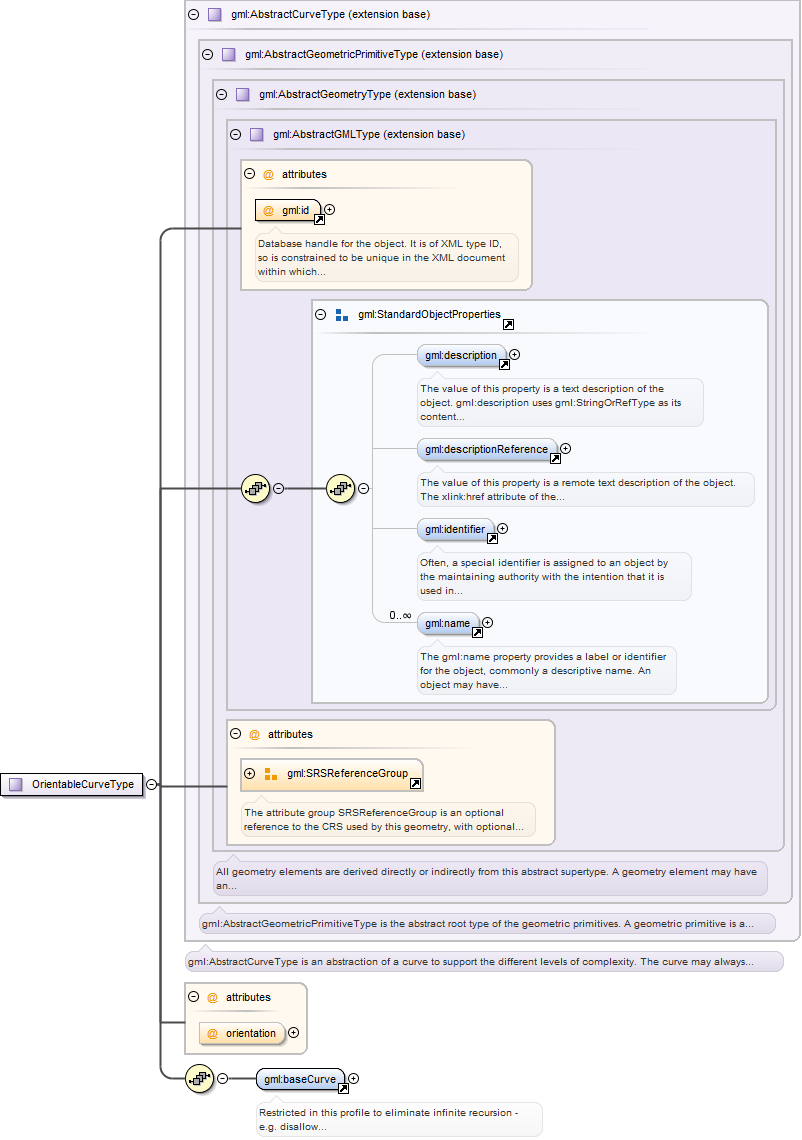
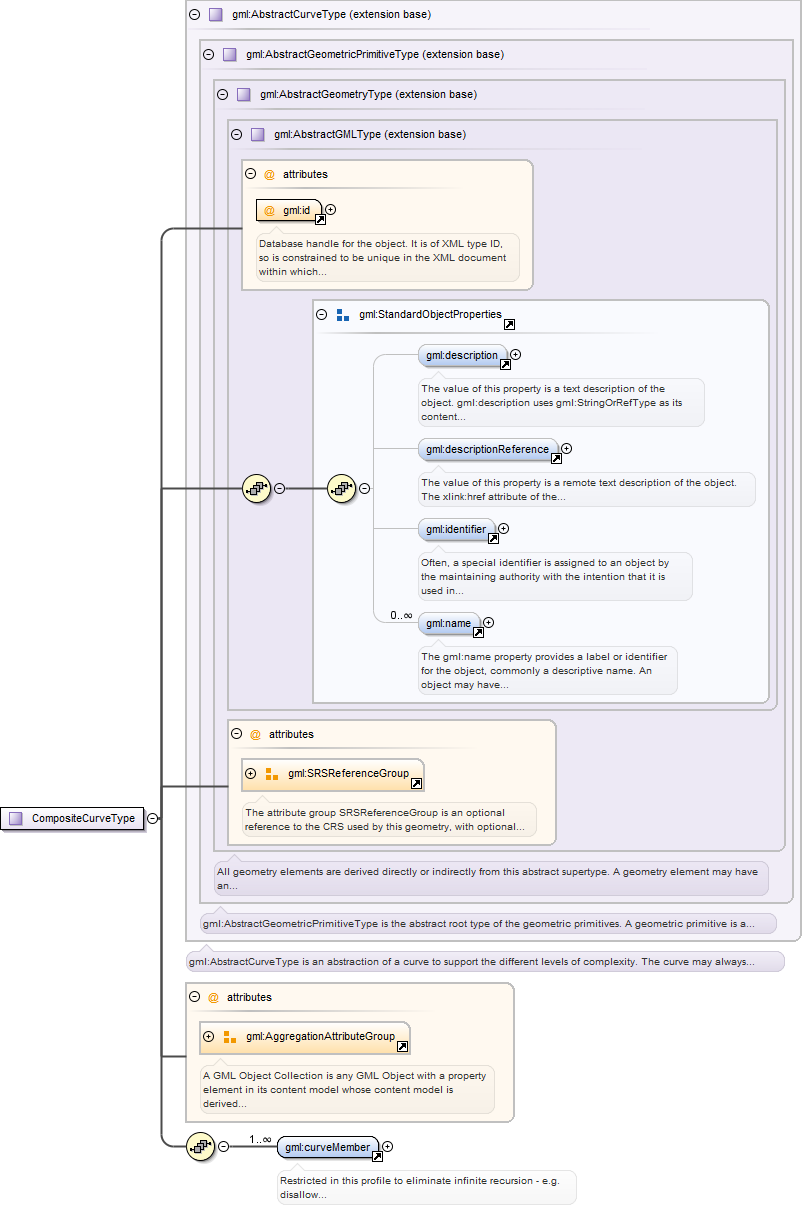
Restricted in this profile to eliminate infinite recursion - e.g. disallow
curveMember/CompositeCurve/curveMember/OrientableCurve/baseCurve/CompositeCurve/curveMember/...
Diagram
Diagram 3_2.tmp#AssociationAttributeGroup 3_2.tmp#OwnershipAttributeGroup 3_2.tmp#LineString 3_2.tmp#OrientableCurve
Properties
content: complex
Used by
Model (gml:LineString | gml:OrientableCurve)
Children gml:LineString, gml:OrientableCurve
Instance
<gml:curveMember xlink:href="" nilReason="" owns="false" xlink:title="" xmlns:gml="http://www.opengis.net/gml/3.2">
  <gml:LineString axisLabels="" gml:id="" srsDimension="" srsName="" uomLabels="">{1,1}</gml:LineString>
  <gml:OrientableCurve axisLabels="" gml:id="" orientation="+" srsDimension="" srsName="" uomLabels="">{1,1}</gml:OrientableCurve>
</gml:curveMember>
Attributes
QName Type Fixed Default Use Annotation
nilReason gml:NilReasonType optional
owns boolean false optional
xlink:href xlink:hrefType optional
xlink:title xlink:titleAttrType optional
Source
<element name="curveMember">
  <annotation>
    <documentation>Restricted in this profile to eliminate infinite recursion - e.g. disallow curveMember/CompositeCurve/curveMember/OrientableCurve/baseCurve/CompositeCurve/curveMember/...</documentation>
  </annotation>
  <complexType>
    <annotation>
      <documentation>A property that has a LineString as its value domain or an XLink reference to a remote LineString element (where remote includes the LineString element located elsewhere in the same document). Either the reference or the contained element shall be given, but neither both nor none.</documentation>
    </annotation>
    <sequence minOccurs="0">
      <choice>
        <element ref="gml:LineString"/>
        <element ref="gml:OrientableCurve"/>
      </choice>
    </sequence>
    <attributeGroup ref="gml:AssociationAttributeGroup"/>
    <attributeGroup ref="gml:OwnershipAttributeGroup"/>
  </complexType>
</element>
Schema location file:/C:/GaldosOffline/DIGGS_Offline - GMLProfile/Diggs2.0.a/Schemas/gml3.2Profile_diggs.xsd
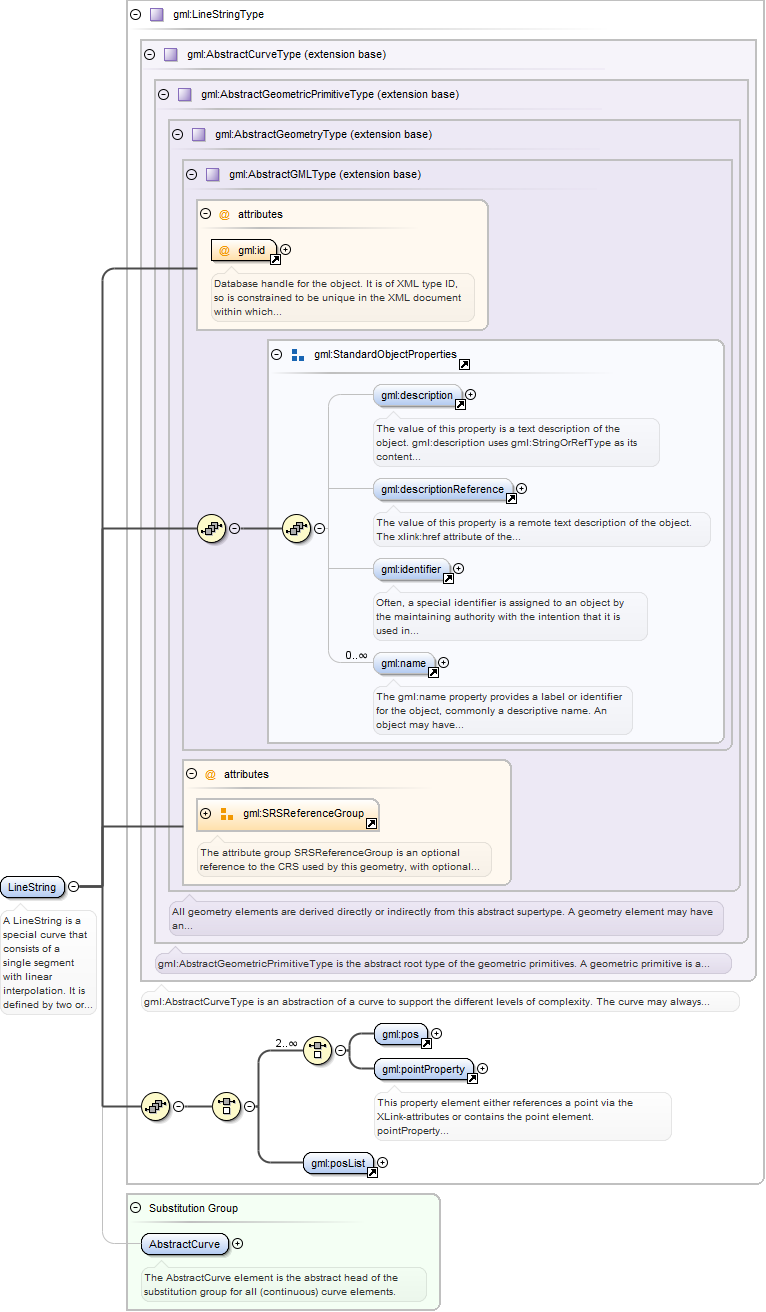
Element gml:LineString
Namespace http://www.opengis.net/gml/3.2
Annotations
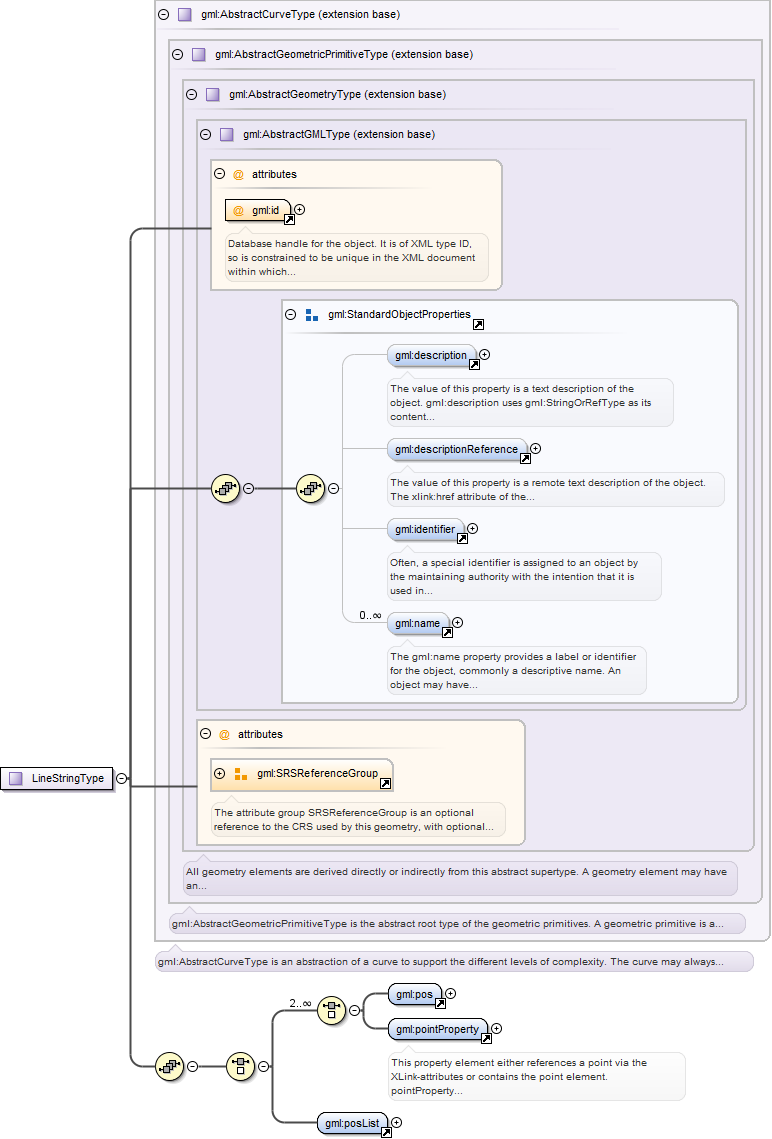
A LineString is a special curve that consists of a single segment with linear
interpolation. It is defined by two or more coordinate tuples, with linear interpolation
between them. The number of direct positions in the list shall be at least
two.
Diagram
Diagram 3_2.tmp#id 3_2.tmp#description 3_2.tmp#descriptionReference 3_2.tmp#identifier 3_2.tmp#name 3_2.tmp#StandardObjectProperties 3_2.tmp#AbstractGMLType 3_2.tmp#SRSReferenceGroup 3_2.tmp#AbstractGeometryType 3_2.tmp#AbstractGeometricPrimitiveType 3_2.tmp#AbstractCurveType 3_2.tmp#pos 3_2.tmp#pointProperty 3_2.tmp#posList 3_2.tmp#LineStringType 3_2.tmp#AbstractCurve
Type gml:LineStringType
Type hierarchy
Properties
content: complex
Substitution Group Affiliation
Used by
Model gml:description{0,1} , gml:descriptionReference{0,1} , gml:identifier{0,1} , gml:name* , (gml:pos | gml:pointProperty | gml:posList)
Children gml:description, gml:descriptionReference, gml:identifier, gml:name, gml:pointProperty, gml:pos, gml:posList
Instance
<gml:LineString axisLabels="" gml:id="" srsDimension="" srsName="" uomLabels="" xmlns:gml="http://www.opengis.net/gml/3.2">
  <gml:description xlink:href="" nilReason="" xlink:title="">{0,1}</gml:description>
  <gml:descriptionReference xlink:href="" nilReason="" owns="false" xlink:title="">{0,1}</gml:descriptionReference>
  <gml:identifier codeSpace="">{0,1}</gml:identifier>
  <gml:name codeSpace="">{0,unbounded}</gml:name>
  <gml:pos axisLabels="" srsDimension="" srsName="" uomLabels="">{1,1}</gml:pos>
  <gml:pointProperty xlink:href="" nilReason="" owns="false" xlink:title="">{1,1}</gml:pointProperty>
  <gml:posList axisLabels="" count="" srsDimension="" srsName="" uomLabels="">{1,1}</gml:posList>
</gml:LineString>
Attributes
QName Type Fixed Default Use Annotation
axisLabels gml:NCNameList optional
gml:id ID required
Database handle for the object. It is of XML type ID, so is constrained to be
unique in the XML document within which it occurs. An external identifier for the object in
the form of a URI may be constructed using standard XML and XPointer methods. This is done
by concatenating the URI for the document, a fragment separator, and the value of the id
attribute.
srsDimension positiveInteger optional
srsName anyURI optional
uomLabels gml:NCNameList optional
Source
<element name="LineString" type="gml:LineStringType" substitutionGroup="gml:AbstractCurve">
  <annotation>
    <documentation>A LineString is a special curve that consists of a single segment with linear interpolation. It is defined by two or more coordinate tuples, with linear interpolation between them. The number of direct positions in the list shall be at least two.</documentation>
  </annotation>
</element>
Schema location file:/C:/GaldosOffline/DIGGS_Offline - GMLProfile/Diggs2.0.a/Schemas/gml3.2Profile_diggs.xsd
Element gml:pointProperty
Namespace http://www.opengis.net/gml/3.2
Annotations
This property element either references a point via the XLink-attributes or
contains the point element. pointProperty is the predefined property which may be used by
GML Application Schemas whenever a GML feature has a property with a value that is
substitutable for Point.
Diagram
Diagram 3_2.tmp#AssociationAttributeGroup 3_2.tmp#OwnershipAttributeGroup 3_2.tmp#Point 3_2.tmp#PointPropertyType
Type gml:PointPropertyType
Properties
content: complex
Used by
Model gml:Point
Children gml:Point
Instance
<gml:pointProperty xlink:href="" nilReason="" owns="false" xlink:title="" xmlns:gml="http://www.opengis.net/gml/3.2">
  <gml:Point axisLabels="" gml:id="" srsDimension="" srsName="" uomLabels="">{1,1}</gml:Point>
</gml:pointProperty>
Attributes
QName Type Fixed Default Use Annotation
nilReason gml:NilReasonType optional
owns boolean false optional
xlink:href xlink:hrefType optional
xlink:title xlink:titleAttrType optional
Source
<element name="pointProperty" type="gml:PointPropertyType">
  <annotation>
    <documentation>This property element either references a point via the XLink-attributes or contains the point element. pointProperty is the predefined property which may be used by GML Application Schemas whenever a GML feature has a property with a value that is substitutable for Point.</documentation>
  </annotation>
</element>
Schema location file:/C:/GaldosOffline/DIGGS_Offline - GMLProfile/Diggs2.0.a/Schemas/gml3.2Profile_diggs.xsd
Element gml:posList
Namespace http://www.opengis.net/gml/3.2
Diagram
Diagram 3_2.tmp#doubleList 3_2.tmp#SRSReferenceGroup NO_NAMESPACE.tmp#DirectPositionListType_count 3_2.tmp#DirectPositionListType
Type gml:DirectPositionListType
Type hierarchy
Properties
content: complex
Used by
Attributes
QName Type Fixed Default Use Annotation
axisLabels gml:NCNameList optional
count positiveInteger optional
srsDimension positiveInteger optional
srsName anyURI optional
uomLabels gml:NCNameList optional
Source
<element name="posList" type="gml:DirectPositionListType"/>
Schema location file:/C:/GaldosOffline/DIGGS_Offline - GMLProfile/Diggs2.0.a/Schemas/gml3.2Profile_diggs.xsd
Element gml:OrientableCurve
Namespace http://www.opengis.net/gml/3.2
Annotations
OrientableCurve consists of a curve and an orientation. If the orientation is
"+", then the OrientableCurve is identical to the baseCurve. If the orientation is "-", then
the OrientableCurve is related to another AbstractCurve with a parameterization that
reverses the sense of the curve traversal.
Diagram
Diagram 3_2.tmp#id 3_2.tmp#description 3_2.tmp#descriptionReference 3_2.tmp#identifier 3_2.tmp#name 3_2.tmp#StandardObjectProperties 3_2.tmp#AbstractGMLType 3_2.tmp#SRSReferenceGroup 3_2.tmp#AbstractGeometryType 3_2.tmp#AbstractGeometricPrimitiveType 3_2.tmp#AbstractCurveType NO_NAMESPACE.tmp#OrientableCurveType_orientation 3_2.tmp#baseCurve 3_2.tmp#OrientableCurveType 3_2.tmp#AbstractCurve
Type gml:OrientableCurveType
Type hierarchy
Properties
content: complex
Substitution Group Affiliation
Used by
Model gml:description{0,1} , gml:descriptionReference{0,1} , gml:identifier{0,1} , gml:name* , gml:baseCurve
Children gml:baseCurve, gml:description, gml:descriptionReference, gml:identifier, gml:name
Instance
<gml:OrientableCurve axisLabels="" gml:id="" orientation="+" srsDimension="" srsName="" uomLabels="" xmlns:gml="http://www.opengis.net/gml/3.2">
  <gml:description xlink:href="" nilReason="" xlink:title="">{0,1}</gml:description>
  <gml:descriptionReference xlink:href="" nilReason="" owns="false" xlink:title="">{0,1}</gml:descriptionReference>
  <gml:identifier codeSpace="">{0,1}</gml:identifier>
  <gml:name codeSpace="">{0,unbounded}</gml:name>
  <gml:baseCurve xlink:href="" nilReason="" owns="false" xlink:title="">{1,1}</gml:baseCurve>
</gml:OrientableCurve>
Attributes
QName Type Fixed Default Use Annotation
axisLabels gml:NCNameList optional
gml:id ID required
Database handle for the object. It is of XML type ID, so is constrained to be
unique in the XML document within which it occurs. An external identifier for the object in
the form of a URI may be constructed using standard XML and XPointer methods. This is done
by concatenating the URI for the document, a fragment separator, and the value of the id
attribute.
orientation gml:SignType + optional
srsDimension positiveInteger optional
srsName anyURI optional
uomLabels gml:NCNameList optional
Source
<element name="OrientableCurve" type="gml:OrientableCurveType" substitutionGroup="gml:AbstractCurve">
  <annotation>
    <documentation>OrientableCurve consists of a curve and an orientation. If the orientation is "+", then the OrientableCurve is identical to the baseCurve. If the orientation is "-", then the OrientableCurve is related to another AbstractCurve with a parameterization that reverses the sense of the curve traversal.</documentation>
  </annotation>
</element>
Schema location file:/C:/GaldosOffline/DIGGS_Offline - GMLProfile/Diggs2.0.a/Schemas/gml3.2Profile_diggs.xsd
Element gml:baseCurve
Namespace http://www.opengis.net/gml/3.2
Annotations
Restricted in this profile to eliminate infinite recursion - e.g. disallow
baseCurve/OrientableCurve/baseCurve/OrientableCurve/baseCurve/OrientableCurve/...
Diagram
Diagram 3_2.tmp#AssociationAttributeGroup 3_2.tmp#OwnershipAttributeGroup 3_2.tmp#LineString
Properties
content: complex
Used by
Model gml:LineString
Children gml:LineString
Instance
<gml:baseCurve xlink:href="" nilReason="" owns="false" xlink:title="" xmlns:gml="http://www.opengis.net/gml/3.2">
  <gml:LineString axisLabels="" gml:id="" srsDimension="" srsName="" uomLabels="">{1,1}</gml:LineString>
</gml:baseCurve>
Attributes
QName Type Fixed Default Use Annotation
nilReason gml:NilReasonType optional
owns boolean false optional
xlink:href xlink:hrefType optional
xlink:title xlink:titleAttrType optional
Source
<element name="baseCurve">
  <annotation>
    <documentation>Restricted in this profile to eliminate infinite recursion - e.g. disallow baseCurve/OrientableCurve/baseCurve/OrientableCurve/baseCurve/OrientableCurve/...</documentation>
  </annotation>
  <complexType>
    <annotation>
      <documentation>A property that has a LineString as its value domain or an XLink reference to a remote LineString element (where remote includes the LineString element located elsewhere in the same document). Either the reference or the contained element shall be given, but neither both nor none.</documentation>
    </annotation>
    <sequence minOccurs="0">
      <element ref="gml:LineString"/>
    </sequence>
    <attributeGroup ref="gml:AssociationAttributeGroup"/>
    <attributeGroup ref="gml:OwnershipAttributeGroup"/>
  </complexType>
</element>
Schema location file:/C:/GaldosOffline/DIGGS_Offline - GMLProfile/Diggs2.0.a/Schemas/gml3.2Profile_diggs.xsd
Element gml:curveMembers
Namespace http://www.opengis.net/gml/3.2
Annotations
Restricted in this profile to eliminate infinite recursion - e.g. disallow
curveMembers/CompositeCurve/curveMember/OrientableCurve/baseCurve/CompositeCurve/curveMember/...
Diagram
Diagram 3_2.tmp#OwnershipAttributeGroup 3_2.tmp#LineString 3_2.tmp#OrientableCurve
Properties
content: complex
Used by
Complex Type gml:MultiCurveType
Model (gml:LineString | gml:OrientableCurve)
Children gml:LineString, gml:OrientableCurve
Instance
<gml:curveMembers owns="false" xmlns:gml="http://www.opengis.net/gml/3.2">
  <gml:LineString axisLabels="" gml:id="" srsDimension="" srsName="" uomLabels="">{1,1}</gml:LineString>
  <gml:OrientableCurve axisLabels="" gml:id="" orientation="+" srsDimension="" srsName="" uomLabels="">{1,1}</gml:OrientableCurve>
</gml:curveMembers>
Attributes
QName Type Fixed Default Use Annotation
owns boolean false optional
Source
<element name="curveMembers">
  <annotation>
    <documentation>Restricted in this profile to eliminate infinite recursion - e.g. disallow curveMembers/CompositeCurve/curveMember/OrientableCurve/baseCurve/CompositeCurve/curveMember/...</documentation>
  </annotation>
  <complexType>
    <annotation>
      <documentation>A container for an array of LineStrings. The LineString elements are always contained inline in the array property, referencing geometry elements or arrays of geometry elements via XLinks is not supported.</documentation>
    </annotation>
    <sequence minOccurs="0" maxOccurs="unbounded">
      <choice>
        <element ref="gml:LineString"/>
        <element ref="gml:OrientableCurve"/>
      </choice>
    </sequence>
    <attributeGroup ref="gml:OwnershipAttributeGroup"/>
  </complexType>
</element>
Schema location file:/C:/GaldosOffline/DIGGS_Offline - GMLProfile/Diggs2.0.a/Schemas/gml3.2Profile_diggs.xsd
Element gml:MultiCurve
Namespace http://www.opengis.net/gml/3.2
Annotations
A gml:MultiCurve is defined by one or more gml:AbstractCurves. The members of
the geometric aggregate may be specified either using the "standard" property
(gml:curveMember) or the array property (gml:curveMembers). It is also valid to use both the
"standard" and the array properties in the same collection.
Diagram
Diagram 3_2.tmp#id 3_2.tmp#description 3_2.tmp#descriptionReference 3_2.tmp#identifier 3_2.tmp#name 3_2.tmp#StandardObjectProperties 3_2.tmp#AbstractGMLType 3_2.tmp#SRSReferenceGroup 3_2.tmp#AbstractGeometryType 3_2.tmp#AggregationAttributeGroup 3_2.tmp#AbstractGeometricAggregateType 3_2.tmp#curveMember 3_2.tmp#curveMembers 3_2.tmp#MultiCurveType 3_2.tmp#AbstractGeometricAggregate
Type gml:MultiCurveType
Type hierarchy
Properties
content: complex
Substitution Group Affiliation
Used by
Model gml:description{0,1} , gml:descriptionReference{0,1} , gml:identifier{0,1} , gml:name* , gml:curveMember* , gml:curveMembers{0,1}
Children gml:curveMember, gml:curveMembers, gml:description, gml:descriptionReference, gml:identifier, gml:name
Instance
<gml:MultiCurve aggregationType="" axisLabels="" gml:id="" srsDimension="" srsName="" uomLabels="" xmlns:gml="http://www.opengis.net/gml/3.2">
  <gml:description xlink:href="" nilReason="" xlink:title="">{0,1}</gml:description>
  <gml:descriptionReference xlink:href="" nilReason="" owns="false" xlink:title="">{0,1}</gml:descriptionReference>
  <gml:identifier codeSpace="">{0,1}</gml:identifier>
  <gml:name codeSpace="">{0,unbounded}</gml:name>
  <gml:curveMember xlink:href="" nilReason="" owns="false" xlink:title="">{0,unbounded}</gml:curveMember>
  <gml:curveMembers owns="false">{0,1}</gml:curveMembers>
</gml:MultiCurve>
Attributes
QName Type Fixed Default Use Annotation
aggregationType gml:AggregationType optional
axisLabels gml:NCNameList optional
gml:id ID required
Database handle for the object. It is of XML type ID, so is constrained to be
unique in the XML document within which it occurs. An external identifier for the object in
the form of a URI may be constructed using standard XML and XPointer methods. This is done
by concatenating the URI for the document, a fragment separator, and the value of the id
attribute.
srsDimension positiveInteger optional
srsName anyURI optional
uomLabels gml:NCNameList optional
Source
<element name="MultiCurve" type="gml:MultiCurveType" substitutionGroup="gml:AbstractGeometricAggregate">
  <annotation>
    <documentation>A gml:MultiCurve is defined by one or more gml:AbstractCurves. The members of the geometric aggregate may be specified either using the "standard" property (gml:curveMember) or the array property (gml:curveMembers). It is also valid to use both the "standard" and the array properties in the same collection.</documentation>
  </annotation>
</element>
Schema location file:/C:/GaldosOffline/DIGGS_Offline - GMLProfile/Diggs2.0.a/Schemas/gml3.2Profile_diggs.xsd
Element gml:surfaceMember
Namespace http://www.opengis.net/gml/3.2
Annotations
Restricted in this profile to eliminate infinite recursion
Diagram
Diagram 3_2.tmp#AssociationAttributeGroup 3_2.tmp#OwnershipAttributeGroup 3_2.tmp#Polygon
Properties
content: complex
Used by
Model gml:Polygon
Children gml:Polygon
Instance
<gml:surfaceMember xlink:href="" nilReason="" owns="false" xlink:title="" xmlns:gml="http://www.opengis.net/gml/3.2">
  <gml:Polygon axisLabels="" gml:id="" srsDimension="" srsName="" uomLabels="">{1,1}</gml:Polygon>
</gml:surfaceMember>
Attributes
QName Type Fixed Default Use Annotation
nilReason gml:NilReasonType optional
owns boolean false optional
xlink:href xlink:hrefType optional
xlink:title xlink:titleAttrType optional
Source
<element name="surfaceMember">
  <annotation>
    <documentation>Restricted in this profile to eliminate infinite recursion</documentation>
  </annotation>
  <complexType>
    <annotation>
      <documentation>This property element either references a gml:Polygon via the XLink-attributes or contains the gml:Polygon element inline.</documentation>
    </annotation>
    <sequence minOccurs="0">
      <element ref="gml:Polygon"/>
    </sequence>
    <attributeGroup ref="gml:AssociationAttributeGroup"/>
    <attributeGroup ref="gml:OwnershipAttributeGroup"/>
  </complexType>
</element>
Schema location file:/C:/GaldosOffline/DIGGS_Offline - GMLProfile/Diggs2.0.a/Schemas/gml3.2Profile_diggs.xsd
Element gml:Polygon
Namespace http://www.opengis.net/gml/3.2
Annotations
A Polygon is a special surface that is defined by a single surface patch (see
D.3.6). The boundary of this patch is coplanar and the polygon uses planar interpolation in
its interior. The elements exterior and interior describe the surface boundary of the
polygon.
Diagram
Diagram 3_2.tmp#id 3_2.tmp#description 3_2.tmp#descriptionReference 3_2.tmp#identifier 3_2.tmp#name 3_2.tmp#StandardObjectProperties 3_2.tmp#AbstractGMLType 3_2.tmp#SRSReferenceGroup 3_2.tmp#AbstractGeometryType 3_2.tmp#AbstractGeometricPrimitiveType 3_2.tmp#AbstractSurfaceType 3_2.tmp#exterior 3_2.tmp#PolygonType 3_2.tmp#AbstractSurface
Type gml:PolygonType
Type hierarchy
Properties
content: complex
Substitution Group Affiliation
Used by
Model gml:description{0,1} , gml:descriptionReference{0,1} , gml:identifier{0,1} , gml:name* , gml:exterior{0,1}
Children gml:description, gml:descriptionReference, gml:exterior, gml:identifier, gml:name
Instance
<gml:Polygon axisLabels="" gml:id="" srsDimension="" srsName="" uomLabels="" xmlns:gml="http://www.opengis.net/gml/3.2">
  <gml:description xlink:href="" nilReason="" xlink:title="">{0,1}</gml:description>
  <gml:descriptionReference xlink:href="" nilReason="" owns="false" xlink:title="">{0,1}</gml:descriptionReference>
  <gml:identifier codeSpace="">{0,1}</gml:identifier>
  <gml:name codeSpace="">{0,unbounded}</gml:name>
  <gml:exterior>{0,1}</gml:exterior>
</gml:Polygon>
Attributes
QName Type Fixed Default Use Annotation
axisLabels gml:NCNameList optional
gml:id ID required
Database handle for the object. It is of XML type ID, so is constrained to be
unique in the XML document within which it occurs. An external identifier for the object in
the form of a URI may be constructed using standard XML and XPointer methods. This is done
by concatenating the URI for the document, a fragment separator, and the value of the id
attribute.
srsDimension positiveInteger optional
srsName anyURI optional
uomLabels gml:NCNameList optional
Source
<element name="Polygon" type="gml:PolygonType" substitutionGroup="gml:AbstractSurface">
  <annotation>
    <documentation>A Polygon is a special surface that is defined by a single surface patch (see D.3.6). The boundary of this patch is coplanar and the polygon uses planar interpolation in its interior. The elements exterior and interior describe the surface boundary of the polygon.</documentation>
  </annotation>
</element>
Schema location file:/C:/GaldosOffline/DIGGS_Offline - GMLProfile/Diggs2.0.a/Schemas/gml3.2Profile_diggs.xsd
Element gml:exterior
Namespace http://www.opengis.net/gml/3.2
Annotations
A boundary of a surface consists of a number of rings. In the normal 2D case,
one of these rings is distinguished as being the exterior boundary. In a general manifold
this is not always possible, in which case all boundaries shall be listed as interior
boundaries, and the exterior will be empty.
Diagram
Diagram 3_2.tmp#AbstractRing 3_2.tmp#AbstractRingPropertyType
Type gml:AbstractRingPropertyType
Properties
content: complex
Used by
Model gml:AbstractRing
Children gml:AbstractRing
Instance
<gml:exterior xmlns:gml="http://www.opengis.net/gml/3.2">
  <gml:AbstractRing>{1,1}</gml:AbstractRing>
</gml:exterior>
Source
<element name="exterior" type="gml:AbstractRingPropertyType">
  <annotation>
    <documentation>A boundary of a surface consists of a number of rings. In the normal 2D case, one of these rings is distinguished as being the exterior boundary. In a general manifold this is not always possible, in which case all boundaries shall be listed as interior boundaries, and the exterior will be empty.</documentation>
  </annotation>
</element>
Schema location file:/C:/GaldosOffline/DIGGS_Offline - GMLProfile/Diggs2.0.a/Schemas/gml3.2Profile_diggs.xsd
Element gml:AbstractRing
Namespace http://www.opengis.net/gml/3.2
Annotations
An abstraction of a ring to support surface boundaries of different complexity.
The AbstractRing element is the abstract head of the substituition group for all closed
boundaries of a surface patch.
Diagram
Diagram 3_2.tmp#AbstractRingType 3_2.tmp#LinearRing 3_2.tmp#Ring 3_2.tmp#AbstractObject
Type gml:AbstractRingType
Properties
content: complex
abstract: true
Substitution Group
Substitution Group Affiliation
Used by
Model
Source
<element name="AbstractRing" type="gml:AbstractRingType" abstract="true" substitutionGroup="gml:AbstractObject">
  <annotation>
    <documentation>An abstraction of a ring to support surface boundaries of different complexity. The AbstractRing element is the abstract head of the substituition group for all closed boundaries of a surface patch.</documentation>
  </annotation>
</element>
Schema location file:/C:/GaldosOffline/DIGGS_Offline - GMLProfile/Diggs2.0.a/Schemas/gml3.2Profile_diggs.xsd
Element gml:surfaceMembers
Namespace http://www.opengis.net/gml/3.2
Annotations
Restricted in this profile to eliminate infinite recursion
Diagram
Diagram 3_2.tmp#OwnershipAttributeGroup 3_2.tmp#Polygon
Properties
content: complex
Used by
Complex Type gml:MultiSurfaceType
Model gml:Polygon
Children gml:Polygon
Instance
<gml:surfaceMembers owns="false" xmlns:gml="http://www.opengis.net/gml/3.2">
  <gml:Polygon axisLabels="" gml:id="" srsDimension="" srsName="" uomLabels="">{1,1}</gml:Polygon>
</gml:surfaceMembers>
Attributes
QName Type Fixed Default Use Annotation
owns boolean false optional
Source
<element name="surfaceMembers">
  <annotation>
    <documentation>Restricted in this profile to eliminate infinite recursion</documentation>
  </annotation>
  <complexType>
    <annotation>
      <documentation>A container for an array of Polygons. The elements are always contained in the array property, referencing geometry elements or arrays of geometry elements via XLinks is not supported.</documentation>
    </annotation>
    <sequence minOccurs="0" maxOccurs="unbounded">
      <element ref="gml:Polygon"/>
    </sequence>
    <attributeGroup ref="gml:OwnershipAttributeGroup"/>
  </complexType>
</element>
Schema location file:/C:/GaldosOffline/DIGGS_Offline - GMLProfile/Diggs2.0.a/Schemas/gml3.2Profile_diggs.xsd
Element gml:AbstractSurface
Namespace http://www.opengis.net/gml/3.2
Annotations
The AbstractSurface element is the abstract head of the substitution group for
all (continuous) surface elements.
Diagram
Diagram 3_2.tmp#id 3_2.tmp#description 3_2.tmp#descriptionReference 3_2.tmp#identifier 3_2.tmp#name 3_2.tmp#StandardObjectProperties 3_2.tmp#AbstractGMLType 3_2.tmp#SRSReferenceGroup 3_2.tmp#AbstractGeometryType 3_2.tmp#AbstractGeometricPrimitiveType 3_2.tmp#AbstractSurfaceType 3_2.tmp#CompositeSurface 3_2.tmp#Polygon 3_2.tmp#AbstractGeometricPrimitive
Type gml:AbstractSurfaceType
Type hierarchy
Properties
content: complex
abstract: true
Substitution Group
Substitution Group Affiliation
Used by
Model gml:description{0,1} , gml:descriptionReference{0,1} , gml:identifier{0,1} , gml:name*
Children gml:description, gml:descriptionReference, gml:identifier, gml:name
Instance
<gml:AbstractSurface axisLabels="" gml:id="" srsDimension="" srsName="" uomLabels="" xmlns:gml="http://www.opengis.net/gml/3.2">
  <gml:description xlink:href="" nilReason="" xlink:title="">{0,1}</gml:description>
  <gml:descriptionReference xlink:href="" nilReason="" owns="false" xlink:title="">{0,1}</gml:descriptionReference>
  <gml:identifier codeSpace="">{0,1}</gml:identifier>
  <gml:name codeSpace="">{0,unbounded}</gml:name>
</gml:AbstractSurface>
Attributes
QName Type Fixed Default Use Annotation
axisLabels gml:NCNameList optional
gml:id ID required
Database handle for the object. It is of XML type ID, so is constrained to be
unique in the XML document within which it occurs. An external identifier for the object in
the form of a URI may be constructed using standard XML and XPointer methods. This is done
by concatenating the URI for the document, a fragment separator, and the value of the id
attribute.
srsDimension positiveInteger optional
srsName anyURI optional
uomLabels gml:NCNameList optional
Source
<element name="AbstractSurface" type="gml:AbstractSurfaceType" abstract="true" substitutionGroup="gml:AbstractGeometricPrimitive">
  <annotation>
    <documentation>The AbstractSurface element is the abstract head of the substitution group for all (continuous) surface elements.</documentation>
  </annotation>
</element>
Schema location file:/C:/GaldosOffline/DIGGS_Offline - GMLProfile/Diggs2.0.a/Schemas/gml3.2Profile_diggs.xsd
Element gml:MultiSurface
Namespace http://www.opengis.net/gml/3.2
Annotations
A gml:MultiSurface is defined by one or more gml:AbstractSurfaces. The members
of the geometric aggregate may be specified either using the "standard" property
(gml:surfaceMember) or the array property (gml:surfaceMembers). It is also valid to use both
the "standard" and the array properties in the same collection.
Diagram
Diagram 3_2.tmp#id 3_2.tmp#description 3_2.tmp#descriptionReference 3_2.tmp#identifier 3_2.tmp#name 3_2.tmp#StandardObjectProperties 3_2.tmp#AbstractGMLType 3_2.tmp#SRSReferenceGroup 3_2.tmp#AbstractGeometryType 3_2.tmp#AggregationAttributeGroup 3_2.tmp#AbstractGeometricAggregateType 3_2.tmp#surfaceMember 3_2.tmp#surfaceMembers 3_2.tmp#MultiSurfaceType 3_2.tmp#AbstractGeometricAggregate
Type gml:MultiSurfaceType
Type hierarchy
Properties
content: complex
Substitution Group Affiliation
Used by
Model gml:description{0,1} , gml:descriptionReference{0,1} , gml:identifier{0,1} , gml:name* , gml:surfaceMember* , gml:surfaceMembers{0,1}
Children gml:description, gml:descriptionReference, gml:identifier, gml:name, gml:surfaceMember, gml:surfaceMembers
Instance
<gml:MultiSurface aggregationType="" axisLabels="" gml:id="" srsDimension="" srsName="" uomLabels="" xmlns:gml="http://www.opengis.net/gml/3.2">
  <gml:description xlink:href="" nilReason="" xlink:title="">{0,1}</gml:description>
  <gml:descriptionReference xlink:href="" nilReason="" owns="false" xlink:title="">{0,1}</gml:descriptionReference>
  <gml:identifier codeSpace="">{0,1}</gml:identifier>
  <gml:name codeSpace="">{0,unbounded}</gml:name>
  <gml:surfaceMember xlink:href="" nilReason="" owns="false" xlink:title="">{0,unbounded}</gml:surfaceMember>
  <gml:surfaceMembers owns="false">{0,1}</gml:surfaceMembers>
</gml:MultiSurface>
Attributes
QName Type Fixed Default Use Annotation
aggregationType gml:AggregationType optional
axisLabels gml:NCNameList optional
gml:id ID required
Database handle for the object. It is of XML type ID, so is constrained to be
unique in the XML document within which it occurs. An external identifier for the object in
the form of a URI may be constructed using standard XML and XPointer methods. This is done
by concatenating the URI for the document, a fragment separator, and the value of the id
attribute.
srsDimension positiveInteger optional
srsName anyURI optional
uomLabels gml:NCNameList optional
Source
<element name="MultiSurface" type="gml:MultiSurfaceType" substitutionGroup="gml:AbstractGeometricAggregate">
  <annotation>
    <documentation>A gml:MultiSurface is defined by one or more gml:AbstractSurfaces. The members of the geometric aggregate may be specified either using the "standard" property (gml:surfaceMember) or the array property (gml:surfaceMembers). It is also valid to use both the "standard" and the array properties in the same collection.</documentation>
  </annotation>
</element>
Schema location file:/C:/GaldosOffline/DIGGS_Offline - GMLProfile/Diggs2.0.a/Schemas/gml3.2Profile_diggs.xsd
Element gml:LinearRing
Namespace http://www.opengis.net/gml/3.2
Annotations
A LinearRing is defined by four or more coordinate tuples, with linear
interpolation between them; the first and last coordinates shall be coincident. The number
of direct positions in the list shall be at least four.
Diagram
Diagram 3_2.tmp#AbstractRingType 3_2.tmp#pos 3_2.tmp#pointProperty 3_2.tmp#posList 3_2.tmp#LinearRingType 3_2.tmp#AbstractRing
Type gml:LinearRingType
Type hierarchy
Properties
content: complex
Substitution Group Affiliation
Model (gml:pos | gml:pointProperty | gml:posList)
Children gml:pointProperty, gml:pos, gml:posList
Instance
<gml:LinearRing xmlns:gml="http://www.opengis.net/gml/3.2">
  <gml:pos axisLabels="" srsDimension="" srsName="" uomLabels="">{1,1}</gml:pos>
  <gml:pointProperty xlink:href="" nilReason="" owns="false" xlink:title="">{1,1}</gml:pointProperty>
  <gml:posList axisLabels="" count="" srsDimension="" srsName="" uomLabels="">{1,1}</gml:posList>
</gml:LinearRing>
Source
<element name="LinearRing" type="gml:LinearRingType" substitutionGroup="gml:AbstractRing">
  <annotation>
    <documentation>A LinearRing is defined by four or more coordinate tuples, with linear interpolation between them; the first and last coordinates shall be coincident. The number of direct positions in the list shall be at least four.</documentation>
  </annotation>
</element>
Schema location file:/C:/GaldosOffline/DIGGS_Offline - GMLProfile/Diggs2.0.a/Schemas/gml3.2Profile_diggs.xsd
Element gml:EngineeringCRS
Namespace http://www.opengis.net/gml/3.2
Annotations
gml:EngineeringCRS is a contextually local coordinate reference system which
can be divided into two broad categories: - earth-fixed systems applied to engineering
activities on or near the surface of the earth; - CRSs on moving platforms such as road
vehicles, vessels, aircraft, or spacecraft, see ISO 19111 8.3.
Diagram
Diagram 3_2.tmp#id 3_2.tmp#description 3_2.tmp#descriptionReference 3_2.tmp#identifier 3_2.tmp#name 3_2.tmp#StandardObjectProperties 3_2.tmp#AbstractGMLType 3_2.tmp#id 3_2.tmp#description 3_2.tmp#descriptionReference 3_2.tmp#identifier 3_2.tmp#name 3_2.tmp#DefinitionBaseType 3_2.tmp#remarks 3_2.tmp#DefinitionType 3_2.tmp#IdentifiedObjectType 3_2.tmp#domainOfValidity 3_2.tmp#scope 3_2.tmp#AbstractCRSType 3_2.tmp#affineCS 3_2.tmp#cartesianCS 3_2.tmp#cylindricalCS 3_2.tmp#linearCS 3_2.tmp#polarCS 3_2.tmp#sphericalCS 3_2.tmp#userDefinedCS 3_2.tmp#engineeringDatum 3_2.tmp#EngineeringCRSType 3_2.tmp#AbstractSingleCRS
Type gml:EngineeringCRSType
Type hierarchy
Properties
content: complex
Substitution Group Affiliation
Model gml:description{0,1} , gml:descriptionReference{0,1} , gml:identifier , gml:name* , gml:remarks{0,1} , gml:domainOfValidity* , gml:scope+ , (gml:affineCS | gml:cartesianCS | gml:cylindricalCS | gml:linearCS | gml:polarCS | gml:sphericalCS | gml:userDefinedCS) , gml:engineeringDatum
Children gml:affineCS, gml:cartesianCS, gml:cylindricalCS, gml:description, gml:descriptionReference, gml:domainOfValidity, gml:engineeringDatum, gml:identifier, gml:linearCS, gml:name, gml:polarCS, gml:remarks, gml:scope, gml:sphericalCS, gml:userDefinedCS
Instance
<gml:EngineeringCRS gml:id="" xmlns:gml="http://www.opengis.net/gml/3.2">
  <gml:description xlink:href="" nilReason="" xlink:title="">{0,1}</gml:description>
  <gml:descriptionReference xlink:href="" nilReason="" owns="false" xlink:title="">{0,1}</gml:descriptionReference>
  <gml:identifier codeSpace="">{1,1}</gml:identifier>
  <gml:name codeSpace="">{0,unbounded}</gml:name>
  <gml:remarks>{0,1}</gml:remarks>
  <gml:domainOfValidity xlink:href="" nilReason="" xlink:title="">{0,unbounded}</gml:domainOfValidity>
  <gml:scope>{1,unbounded}</gml:scope>
  <gml:affineCS xlink:href="" nilReason="" xlink:title="">{1,1}</gml:affineCS>
  <gml:cartesianCS xlink:href="" nilReason="" xlink:title="">{1,1}</gml:cartesianCS>
  <gml:cylindricalCS xlink:href="" nilReason="" xlink:title="">{1,1}</gml:cylindricalCS>
  <gml:linearCS xlink:href="" nilReason="" xlink:title="">{1,1}</gml:linearCS>
  <gml:polarCS xlink:href="" nilReason="" xlink:title="">{1,1}</gml:polarCS>
  <gml:sphericalCS xlink:href="" nilReason="" xlink:title="">{1,1}</gml:sphericalCS>
  <gml:userDefinedCS xlink:href="" nilReason="" xlink:title="">{1,1}</gml:userDefinedCS>
  <gml:engineeringDatum xlink:href="" nilReason="" xlink:title="">{1,1}</gml:engineeringDatum>
</gml:EngineeringCRS>
Attributes
QName Type Fixed Default Use Annotation
gml:id ID required
Database handle for the object. It is of XML type ID, so is constrained to be
unique in the XML document within which it occurs. An external identifier for the object in
the form of a URI may be constructed using standard XML and XPointer methods. This is done
by concatenating the URI for the document, a fragment separator, and the value of the id
attribute.
Source
<element name="EngineeringCRS" type="gml:EngineeringCRSType" substitutionGroup="gml:AbstractSingleCRS">
  <annotation>
    <documentation>gml:EngineeringCRS is a contextually local coordinate reference system which can be divided into two broad categories: - earth-fixed systems applied to engineering activities on or near the surface of the earth; - CRSs on moving platforms such as road vehicles, vessels, aircraft, or spacecraft, see ISO 19111 8.3.</documentation>
  </annotation>
</element>
Schema location file:/C:/GaldosOffline/DIGGS_Offline - GMLProfile/Diggs2.0.a/Schemas/gml3.2Profile_diggs.xsd
Element gml:affineCS
Namespace http://www.opengis.net/gml/3.2
Annotations
gml:affineCS is an association role to the affine coordinate system used by
this CRS.
Diagram
Diagram 3_2.tmp#AssociationAttributeGroup 3_2.tmp#AffineCS 3_2.tmp#AffineCSPropertyType
Type gml:AffineCSPropertyType
Properties
content: complex
Used by
Complex Type gml:EngineeringCRSType
Model gml:AffineCS
Children gml:AffineCS
Instance
<gml:affineCS xlink:href="" nilReason="" xlink:title="" xmlns:gml="http://www.opengis.net/gml/3.2">
  <gml:AffineCS aggregationType="" gml:id="">{1,1}</gml:AffineCS>
</gml:affineCS>
Attributes
QName Type Fixed Default Use Annotation
nilReason gml:NilReasonType optional
xlink:href xlink:hrefType optional
xlink:title xlink:titleAttrType optional
Source
<element name="affineCS" type="gml:AffineCSPropertyType">
  <annotation>
    <documentation>gml:affineCS is an association role to the affine coordinate system used by this CRS.</documentation>
  </annotation>
</element>
Schema location file:/C:/GaldosOffline/DIGGS_Offline - GMLProfile/Diggs2.0.a/Schemas/gml3.2Profile_diggs.xsd
Element gml:AffineCS
Namespace http://www.opengis.net/gml/3.2
Annotations
gml:AffineCS is a two- or three-dimensional coordinate system with straight
axes that are not necessarily orthogonal. An AffineCS shall have two or three gml:axis
property elements; the number of property elements shall equal the dimension of the
CS.
Diagram
Diagram 3_2.tmp#id 3_2.tmp#description 3_2.tmp#descriptionReference 3_2.tmp#identifier 3_2.tmp#name 3_2.tmp#StandardObjectProperties 3_2.tmp#AbstractGMLType 3_2.tmp#id 3_2.tmp#description 3_2.tmp#descriptionReference 3_2.tmp#identifier 3_2.tmp#name 3_2.tmp#DefinitionBaseType 3_2.tmp#remarks 3_2.tmp#DefinitionType 3_2.tmp#IdentifiedObjectType 3_2.tmp#AggregationAttributeGroup 3_2.tmp#axis 3_2.tmp#AbstractCoordinateSystemType 3_2.tmp#AffineCSType 3_2.tmp#AbstractCoordinateSystem
Type gml:AffineCSType
Type hierarchy
Properties
content: complex
Substitution Group Affiliation
Used by
Model gml:description{0,1} , gml:descriptionReference{0,1} , gml:identifier , gml:name* , gml:remarks{0,1} , gml:axis+
Children gml:axis, gml:description, gml:descriptionReference, gml:identifier, gml:name, gml:remarks
Instance
<gml:AffineCS aggregationType="" gml:id="" xmlns:gml="http://www.opengis.net/gml/3.2">
  <gml:description xlink:href="" nilReason="" xlink:title="">{0,1}</gml:description>
  <gml:descriptionReference xlink:href="" nilReason="" owns="false" xlink:title="">{0,1}</gml:descriptionReference>
  <gml:identifier codeSpace="">{1,1}</gml:identifier>
  <gml:name codeSpace="">{0,unbounded}</gml:name>
  <gml:remarks>{0,1}</gml:remarks>
  <gml:axis xlink:href="" nilReason="" xlink:title="">{1,unbounded}</gml:axis>
</gml:AffineCS>
Attributes
QName Type Fixed Default Use Annotation
aggregationType gml:AggregationType optional
gml:id ID required
Database handle for the object. It is of XML type ID, so is constrained to be
unique in the XML document within which it occurs. An external identifier for the object in
the form of a URI may be constructed using standard XML and XPointer methods. This is done
by concatenating the URI for the document, a fragment separator, and the value of the id
attribute.
Source
<element name="AffineCS" type="gml:AffineCSType" substitutionGroup="gml:AbstractCoordinateSystem">
  <annotation>
    <documentation>gml:AffineCS is a two- or three-dimensional coordinate system with straight axes that are not necessarily orthogonal. An AffineCS shall have two or three gml:axis property elements; the number of property elements shall equal the dimension of the CS.</documentation>
  </annotation>
</element>
Schema location file:/C:/GaldosOffline/DIGGS_Offline - GMLProfile/Diggs2.0.a/Schemas/gml3.2Profile_diggs.xsd
Element gml:axis
Namespace http://www.opengis.net/gml/3.2
Annotations
The gml:axis property is an association role (ordered sequence) to the
coordinate system axes included in this coordinate system. The coordinate values in a
coordinate tuple shall be recorded in the order in which the coordinate system axes
associations are recorded, whenever those coordinates use a coordinate reference system that
uses this coordinate system. The gml:AggregationAttributeGroup should be used to specify
that the axis objects are ordered.
Diagram
Diagram 3_2.tmp#AssociationAttributeGroup 3_2.tmp#CoordinateSystemAxis 3_2.tmp#CoordinateSystemAxisPropertyType
Type gml:CoordinateSystemAxisPropertyType
Properties
content: complex
Used by
Model gml:CoordinateSystemAxis
Children gml:CoordinateSystemAxis
Instance
<gml:axis xlink:href="" nilReason="" xlink:title="" xmlns:gml="http://www.opengis.net/gml/3.2">
  <gml:CoordinateSystemAxis gml:id="" uom="">{1,1}</gml:CoordinateSystemAxis>
</gml:axis>
Attributes
QName Type Fixed Default Use Annotation
nilReason gml:NilReasonType optional
xlink:href xlink:hrefType optional
xlink:title xlink:titleAttrType optional
Source
<element name="axis" type="gml:CoordinateSystemAxisPropertyType">
  <annotation>
    <documentation>The gml:axis property is an association role (ordered sequence) to the coordinate system axes included in this coordinate system. The coordinate values in a coordinate tuple shall be recorded in the order in which the coordinate system axes associations are recorded, whenever those coordinates use a coordinate reference system that uses this coordinate system. The gml:AggregationAttributeGroup should be used to specify that the axis objects are ordered.</documentation>
  </annotation>
</element>
Schema location file:/C:/GaldosOffline/DIGGS_Offline - GMLProfile/Diggs2.0.a/Schemas/gml3.2Profile_diggs.xsd
Element gml:cartesianCS
Namespace http://www.opengis.net/gml/3.2
Annotations
gml:cartesianCS is an association role to the Cartesian coordinate system used
by this CRS.
Diagram
Diagram 3_2.tmp#AssociationAttributeGroup 3_2.tmp#CartesianCS 3_2.tmp#CartesianCSPropertyType
Type gml:CartesianCSPropertyType
Properties
content: complex
Used by
Complex Type gml:EngineeringCRSType
Model gml:CartesianCS
Children gml:CartesianCS
Instance
<gml:cartesianCS xlink:href="" nilReason="" xlink:title="" xmlns:gml="http://www.opengis.net/gml/3.2">
  <gml:CartesianCS aggregationType="" gml:id="">{1,1}</gml:CartesianCS>
</gml:cartesianCS>
Attributes
QName Type Fixed Default Use Annotation
nilReason gml:NilReasonType optional
xlink:href xlink:hrefType optional
xlink:title xlink:titleAttrType optional
Source
<element name="cartesianCS" type="gml:CartesianCSPropertyType">
  <annotation>
    <documentation>gml:cartesianCS is an association role to the Cartesian coordinate system used by this CRS.</documentation>
  </annotation>
</element>
Schema location file:/C:/GaldosOffline/DIGGS_Offline - GMLProfile/Diggs2.0.a/Schemas/gml3.2Profile_diggs.xsd
Element gml:CartesianCS
Namespace http://www.opengis.net/gml/3.2
Annotations
gml:CartesianCS is a 1-, 2-, or 3-dimensional coordinate system. In the
1-dimensional case, it contains a single straight coordinate axis. In the 2- and
3-dimensional cases gives the position of points relative to orthogonal straight axes. In
the multi-dimensional case, all axes shall have the same length unit of measure. A
CartesianCS shall have one, two, or three gml:axis property elements.
Diagram
Diagram 3_2.tmp#id 3_2.tmp#description 3_2.tmp#descriptionReference 3_2.tmp#identifier 3_2.tmp#name 3_2.tmp#StandardObjectProperties 3_2.tmp#AbstractGMLType 3_2.tmp#id 3_2.tmp#description 3_2.tmp#descriptionReference 3_2.tmp#identifier 3_2.tmp#name 3_2.tmp#DefinitionBaseType 3_2.tmp#remarks 3_2.tmp#DefinitionType 3_2.tmp#IdentifiedObjectType 3_2.tmp#AggregationAttributeGroup 3_2.tmp#axis 3_2.tmp#AbstractCoordinateSystemType 3_2.tmp#CartesianCSType 3_2.tmp#AbstractCoordinateSystem
Type gml:CartesianCSType
Type hierarchy
Properties
content: complex
Substitution Group Affiliation
Used by
Model gml:description{0,1} , gml:descriptionReference{0,1} , gml:identifier , gml:name* , gml:remarks{0,1} , gml:axis+
Children gml:axis, gml:description, gml:descriptionReference, gml:identifier, gml:name, gml:remarks
Instance
<gml:CartesianCS aggregationType="" gml:id="" xmlns:gml="http://www.opengis.net/gml/3.2">
  <gml:description xlink:href="" nilReason="" xlink:title="">{0,1}</gml:description>
  <gml:descriptionReference xlink:href="" nilReason="" owns="false" xlink:title="">{0,1}</gml:descriptionReference>
  <gml:identifier codeSpace="">{1,1}</gml:identifier>
  <gml:name codeSpace="">{0,unbounded}</gml:name>
  <gml:remarks>{0,1}</gml:remarks>
  <gml:axis xlink:href="" nilReason="" xlink:title="">{1,unbounded}</gml:axis>
</gml:CartesianCS>
Attributes
QName Type Fixed Default Use Annotation
aggregationType gml:AggregationType optional
gml:id ID required
Database handle for the object. It is of XML type ID, so is constrained to be
unique in the XML document within which it occurs. An external identifier for the object in
the form of a URI may be constructed using standard XML and XPointer methods. This is done
by concatenating the URI for the document, a fragment separator, and the value of the id
attribute.
Source
<element name="CartesianCS" type="gml:CartesianCSType" substitutionGroup="gml:AbstractCoordinateSystem">
  <annotation>
    <documentation>gml:CartesianCS is a 1-, 2-, or 3-dimensional coordinate system. In the 1-dimensional case, it contains a single straight coordinate axis. In the 2- and 3-dimensional cases gives the position of points relative to orthogonal straight axes. In the multi-dimensional case, all axes shall have the same length unit of measure. A CartesianCS shall have one, two, or three gml:axis property elements.</documentation>
  </annotation>
</element>
Schema location file:/C:/GaldosOffline/DIGGS_Offline - GMLProfile/Diggs2.0.a/Schemas/gml3.2Profile_diggs.xsd
Element gml:cylindricalCS
Namespace http://www.opengis.net/gml/3.2
Annotations
gml:cylindricalCS is an association role to the cylindrical coordinate system
used by this CRS.
Diagram
Diagram 3_2.tmp#AssociationAttributeGroup 3_2.tmp#CylindricalCS 3_2.tmp#CylindricalCSPropertyType
Type gml:CylindricalCSPropertyType
Properties
content: complex
Used by
Complex Type gml:EngineeringCRSType
Model gml:CylindricalCS
Children gml:CylindricalCS
Instance
<gml:cylindricalCS xlink:href="" nilReason="" xlink:title="" xmlns:gml="http://www.opengis.net/gml/3.2">
  <gml:CylindricalCS aggregationType="" gml:id="">{1,1}</gml:CylindricalCS>
</gml:cylindricalCS>
Attributes
QName Type Fixed Default Use Annotation
nilReason gml:NilReasonType optional
xlink:href xlink:hrefType optional
xlink:title xlink:titleAttrType optional
Source
<element name="cylindricalCS" type="gml:CylindricalCSPropertyType">
  <annotation>
    <documentation>gml:cylindricalCS is an association role to the cylindrical coordinate system used by this CRS.</documentation>
  </annotation>
</element>
Schema location file:/C:/GaldosOffline/DIGGS_Offline - GMLProfile/Diggs2.0.a/Schemas/gml3.2Profile_diggs.xsd
Element gml:CylindricalCS
Namespace http://www.opengis.net/gml/3.2
Annotations
gml:CylindricalCS is a three-dimensional coordinate system consisting of a
polar coordinate system extended by a straight coordinate axis perpendicular to the plane
spanned by the polar coordinate system. A CylindricalCS shall have three gml:axis property
elements.
Diagram
Diagram 3_2.tmp#id 3_2.tmp#description 3_2.tmp#descriptionReference 3_2.tmp#identifier 3_2.tmp#name 3_2.tmp#StandardObjectProperties 3_2.tmp#AbstractGMLType 3_2.tmp#id 3_2.tmp#description 3_2.tmp#descriptionReference 3_2.tmp#identifier 3_2.tmp#name 3_2.tmp#DefinitionBaseType 3_2.tmp#remarks 3_2.tmp#DefinitionType 3_2.tmp#IdentifiedObjectType 3_2.tmp#AggregationAttributeGroup 3_2.tmp#axis 3_2.tmp#AbstractCoordinateSystemType 3_2.tmp#CylindricalCSType 3_2.tmp#AbstractCoordinateSystem
Type gml:CylindricalCSType
Type hierarchy
Properties
content: complex
Substitution Group Affiliation
Used by
Model gml:description{0,1} , gml:descriptionReference{0,1} , gml:identifier , gml:name* , gml:remarks{0,1} , gml:axis+
Children gml:axis, gml:description, gml:descriptionReference, gml:identifier, gml:name, gml:remarks
Instance
<gml:CylindricalCS aggregationType="" gml:id="" xmlns:gml="http://www.opengis.net/gml/3.2">
  <gml:description xlink:href="" nilReason="" xlink:title="">{0,1}</gml:description>
  <gml:descriptionReference xlink:href="" nilReason="" owns="false" xlink:title="">{0,1}</gml:descriptionReference>
  <gml:identifier codeSpace="">{1,1}</gml:identifier>
  <gml:name codeSpace="">{0,unbounded}</gml:name>
  <gml:remarks>{0,1}</gml:remarks>
  <gml:axis xlink:href="" nilReason="" xlink:title="">{1,unbounded}</gml:axis>
</gml:CylindricalCS>
Attributes
QName Type Fixed Default Use Annotation
aggregationType gml:AggregationType optional
gml:id ID required
Database handle for the object. It is of XML type ID, so is constrained to be
unique in the XML document within which it occurs. An external identifier for the object in
the form of a URI may be constructed using standard XML and XPointer methods. This is done
by concatenating the URI for the document, a fragment separator, and the value of the id
attribute.
Source
<element name="CylindricalCS" type="gml:CylindricalCSType" substitutionGroup="gml:AbstractCoordinateSystem">
  <annotation>
    <documentation>gml:CylindricalCS is a three-dimensional coordinate system consisting of a polar coordinate system extended by a straight coordinate axis perpendicular to the plane spanned by the polar coordinate system. A CylindricalCS shall have three gml:axis property elements.</documentation>
  </annotation>
</element>
Schema location file:/C:/GaldosOffline/DIGGS_Offline - GMLProfile/Diggs2.0.a/Schemas/gml3.2Profile_diggs.xsd
Element gml:linearCS
Namespace http://www.opengis.net/gml/3.2
Annotations
gml:linearCS is an association role to the linear coordinate system used by
this CRS.
Diagram
Diagram 3_2.tmp#AssociationAttributeGroup 3_2.tmp#LinearCS 3_2.tmp#LinearCSPropertyType
Type gml:LinearCSPropertyType
Properties
content: complex
Used by
Complex Type gml:EngineeringCRSType
Model gml:LinearCS
Children gml:LinearCS
Instance
<gml:linearCS xlink:href="" nilReason="" xlink:title="" xmlns:gml="http://www.opengis.net/gml/3.2">
  <gml:LinearCS aggregationType="" gml:id="">{1,1}</gml:LinearCS>
</gml:linearCS>
Attributes
QName Type Fixed Default Use Annotation
nilReason gml:NilReasonType optional
xlink:href xlink:hrefType optional
xlink:title xlink:titleAttrType optional
Source
<element name="linearCS" type="gml:LinearCSPropertyType">
  <annotation>
    <documentation>gml:linearCS is an association role to the linear coordinate system used by this CRS.</documentation>
  </annotation>
</element>
Schema location file:/C:/GaldosOffline/DIGGS_Offline - GMLProfile/Diggs2.0.a/Schemas/gml3.2Profile_diggs.xsd
Element gml:LinearCS
Namespace http://www.opengis.net/gml/3.2
Annotations
gml:LinearCS is a one-dimensional coordinate system that consists of the points
that lie on the single axis described. The associated coordinate is the distance – with or
without offset – from the specified datum to the point along the axis. A LinearCS shall have
one gml:axis property element.
Diagram
Diagram 3_2.tmp#id 3_2.tmp#description 3_2.tmp#descriptionReference 3_2.tmp#identifier 3_2.tmp#name 3_2.tmp#StandardObjectProperties 3_2.tmp#AbstractGMLType 3_2.tmp#id 3_2.tmp#description 3_2.tmp#descriptionReference 3_2.tmp#identifier 3_2.tmp#name 3_2.tmp#DefinitionBaseType 3_2.tmp#remarks 3_2.tmp#DefinitionType 3_2.tmp#IdentifiedObjectType 3_2.tmp#AggregationAttributeGroup 3_2.tmp#axis 3_2.tmp#AbstractCoordinateSystemType 3_2.tmp#LinearCSType 3_2.tmp#AbstractCoordinateSystem
Type gml:LinearCSType
Type hierarchy
Properties
content: complex
Substitution Group Affiliation
Used by
Model gml:description{0,1} , gml:descriptionReference{0,1} , gml:identifier , gml:name* , gml:remarks{0,1} , gml:axis+
Children gml:axis, gml:description, gml:descriptionReference, gml:identifier, gml:name, gml:remarks
Instance
<gml:LinearCS aggregationType="" gml:id="" xmlns:gml="http://www.opengis.net/gml/3.2">
  <gml:description xlink:href="" nilReason="" xlink:title="">{0,1}</gml:description>
  <gml:descriptionReference xlink:href="" nilReason="" owns="false" xlink:title="">{0,1}</gml:descriptionReference>
  <gml:identifier codeSpace="">{1,1}</gml:identifier>
  <gml:name codeSpace="">{0,unbounded}</gml:name>
  <gml:remarks>{0,1}</gml:remarks>
  <gml:axis xlink:href="" nilReason="" xlink:title="">{1,unbounded}</gml:axis>
</gml:LinearCS>
Attributes
QName Type Fixed Default Use Annotation
aggregationType gml:AggregationType optional
gml:id ID required
Database handle for the object. It is of XML type ID, so is constrained to be
unique in the XML document within which it occurs. An external identifier for the object in
the form of a URI may be constructed using standard XML and XPointer methods. This is done
by concatenating the URI for the document, a fragment separator, and the value of the id
attribute.
Source
<element name="LinearCS" type="gml:LinearCSType" substitutionGroup="gml:AbstractCoordinateSystem">
  <annotation>
    <documentation>gml:LinearCS is a one-dimensional coordinate system that consists of the points that lie on the single axis described. The associated coordinate is the distance – with or without offset – from the specified datum to the point along the axis. A LinearCS shall have one gml:axis property element.</documentation>
  </annotation>
</element>
Schema location file:/C:/GaldosOffline/DIGGS_Offline - GMLProfile/Diggs2.0.a/Schemas/gml3.2Profile_diggs.xsd
Element gml:polarCS
Namespace http://www.opengis.net/gml/3.2
Annotations
gml:polarCS is an association role to the polar coordinate system used by this
CRS.
Diagram
Diagram 3_2.tmp#AssociationAttributeGroup 3_2.tmp#PolarCS 3_2.tmp#PolarCSPropertyType
Type gml:PolarCSPropertyType
Properties
content: complex
Used by
Complex Type gml:EngineeringCRSType
Model gml:PolarCS
Children gml:PolarCS
Instance
<gml:polarCS xlink:href="" nilReason="" xlink:title="" xmlns:gml="http://www.opengis.net/gml/3.2">
  <gml:PolarCS aggregationType="" gml:id="">{1,1}</gml:PolarCS>
</gml:polarCS>
Attributes
QName Type Fixed Default Use Annotation
nilReason gml:NilReasonType optional
xlink:href xlink:hrefType optional
xlink:title xlink:titleAttrType optional
Source
<element name="polarCS" type="gml:PolarCSPropertyType">
  <annotation>
    <documentation>gml:polarCS is an association role to the polar coordinate system used by this CRS.</documentation>
  </annotation>
</element>
Schema location file:/C:/GaldosOffline/DIGGS_Offline - GMLProfile/Diggs2.0.a/Schemas/gml3.2Profile_diggs.xsd
Element gml:PolarCS
Namespace http://www.opengis.net/gml/3.2
Annotations
gml:PolarCS ia s two-dimensional coordinate system in which position is
specified by the distance from the origin and the angle between the line from the origin to
a point and a reference direction. A PolarCS shall have two gml:axis property
elements.
Diagram
Diagram 3_2.tmp#id 3_2.tmp#description 3_2.tmp#descriptionReference 3_2.tmp#identifier 3_2.tmp#name 3_2.tmp#StandardObjectProperties 3_2.tmp#AbstractGMLType 3_2.tmp#id 3_2.tmp#description 3_2.tmp#descriptionReference 3_2.tmp#identifier 3_2.tmp#name 3_2.tmp#DefinitionBaseType 3_2.tmp#remarks 3_2.tmp#DefinitionType 3_2.tmp#IdentifiedObjectType 3_2.tmp#AggregationAttributeGroup 3_2.tmp#axis 3_2.tmp#AbstractCoordinateSystemType 3_2.tmp#PolarCSType 3_2.tmp#AbstractCoordinateSystem
Type gml:PolarCSType
Type hierarchy
Properties
content: complex
Substitution Group Affiliation
Used by
Model gml:description{0,1} , gml:descriptionReference{0,1} , gml:identifier , gml:name* , gml:remarks{0,1} , gml:axis+
Children gml:axis, gml:description, gml:descriptionReference, gml:identifier, gml:name, gml:remarks
Instance
<gml:PolarCS aggregationType="" gml:id="" xmlns:gml="http://www.opengis.net/gml/3.2">
  <gml:description xlink:href="" nilReason="" xlink:title="">{0,1}</gml:description>
  <gml:descriptionReference xlink:href="" nilReason="" owns="false" xlink:title="">{0,1}</gml:descriptionReference>
  <gml:identifier codeSpace="">{1,1}</gml:identifier>
  <gml:name codeSpace="">{0,unbounded}</gml:name>
  <gml:remarks>{0,1}</gml:remarks>
  <gml:axis xlink:href="" nilReason="" xlink:title="">{1,unbounded}</gml:axis>
</gml:PolarCS>
Attributes
QName Type Fixed Default Use Annotation
aggregationType gml:AggregationType optional
gml:id ID required
Database handle for the object. It is of XML type ID, so is constrained to be
unique in the XML document within which it occurs. An external identifier for the object in
the form of a URI may be constructed using standard XML and XPointer methods. This is done
by concatenating the URI for the document, a fragment separator, and the value of the id
attribute.
Source
<element name="PolarCS" type="gml:PolarCSType" substitutionGroup="gml:AbstractCoordinateSystem">
  <annotation>
    <documentation>gml:PolarCS ia s two-dimensional coordinate system in which position is specified by the distance from the origin and the angle between the line from the origin to a point and a reference direction. A PolarCS shall have two gml:axis property elements.</documentation>
  </annotation>
</element>
Schema location file:/C:/GaldosOffline/DIGGS_Offline - GMLProfile/Diggs2.0.a/Schemas/gml3.2Profile_diggs.xsd
Element gml:sphericalCS
Namespace http://www.opengis.net/gml/3.2
Annotations
gml:sphericalCS is an association role to the spherical coordinate system used
by this CRS.
Diagram
Diagram 3_2.tmp#AssociationAttributeGroup 3_2.tmp#SphericalCS 3_2.tmp#SphericalCSPropertyType
Type gml:SphericalCSPropertyType
Properties
content: complex
Used by
Complex Type gml:EngineeringCRSType
Model gml:SphericalCS
Children gml:SphericalCS
Instance
<gml:sphericalCS xlink:href="" nilReason="" xlink:title="" xmlns:gml="http://www.opengis.net/gml/3.2">
  <gml:SphericalCS aggregationType="" gml:id="">{1,1}</gml:SphericalCS>
</gml:sphericalCS>
Attributes
QName Type Fixed Default Use Annotation
nilReason gml:NilReasonType optional
xlink:href xlink:hrefType optional
xlink:title xlink:titleAttrType optional
Source
<element name="sphericalCS" type="gml:SphericalCSPropertyType">
  <annotation>
    <documentation>gml:sphericalCS is an association role to the spherical coordinate system used by this CRS.</documentation>
  </annotation>
</element>
Schema location file:/C:/GaldosOffline/DIGGS_Offline - GMLProfile/Diggs2.0.a/Schemas/gml3.2Profile_diggs.xsd
Element gml:SphericalCS
Namespace http://www.opengis.net/gml/3.2
Annotations
gml:SphericalCS is a three-dimensional coordinate system with one distance
measured from the origin and two angular coordinates. A SphericalCS shall have three
gml:axis property elements.
Diagram
Diagram 3_2.tmp#id 3_2.tmp#description 3_2.tmp#descriptionReference 3_2.tmp#identifier 3_2.tmp#name 3_2.tmp#StandardObjectProperties 3_2.tmp#AbstractGMLType 3_2.tmp#id 3_2.tmp#description 3_2.tmp#descriptionReference 3_2.tmp#identifier 3_2.tmp#name 3_2.tmp#DefinitionBaseType 3_2.tmp#remarks 3_2.tmp#DefinitionType 3_2.tmp#IdentifiedObjectType 3_2.tmp#AggregationAttributeGroup 3_2.tmp#axis 3_2.tmp#AbstractCoordinateSystemType 3_2.tmp#SphericalCSType 3_2.tmp#AbstractCoordinateSystem
Type gml:SphericalCSType
Type hierarchy
Properties
content: complex
Substitution Group Affiliation
Used by
Model gml:description{0,1} , gml:descriptionReference{0,1} , gml:identifier , gml:name* , gml:remarks{0,1} , gml:axis+
Children gml:axis, gml:description, gml:descriptionReference, gml:identifier, gml:name, gml:remarks
Instance
<gml:SphericalCS aggregationType="" gml:id="" xmlns:gml="http://www.opengis.net/gml/3.2">
  <gml:description xlink:href="" nilReason="" xlink:title="">{0,1}</gml:description>
  <gml:descriptionReference xlink:href="" nilReason="" owns="false" xlink:title="">{0,1}</gml:descriptionReference>
  <gml:identifier codeSpace="">{1,1}</gml:identifier>
  <gml:name codeSpace="">{0,unbounded}</gml:name>
  <gml:remarks>{0,1}</gml:remarks>
  <gml:axis xlink:href="" nilReason="" xlink:title="">{1,unbounded}</gml:axis>
</gml:SphericalCS>
Attributes
QName Type Fixed Default Use Annotation
aggregationType gml:AggregationType optional
gml:id ID required
Database handle for the object. It is of XML type ID, so is constrained to be
unique in the XML document within which it occurs. An external identifier for the object in
the form of a URI may be constructed using standard XML and XPointer methods. This is done
by concatenating the URI for the document, a fragment separator, and the value of the id
attribute.
Source
<element name="SphericalCS" type="gml:SphericalCSType" substitutionGroup="gml:AbstractCoordinateSystem">
  <annotation>
    <documentation>gml:SphericalCS is a three-dimensional coordinate system with one distance measured from the origin and two angular coordinates. A SphericalCS shall have three gml:axis property elements.</documentation>
  </annotation>
</element>
Schema location file:/C:/GaldosOffline/DIGGS_Offline - GMLProfile/Diggs2.0.a/Schemas/gml3.2Profile_diggs.xsd
Element gml:userDefinedCS
Namespace http://www.opengis.net/gml/3.2
Annotations
gml:userDefinedCS is an association role to the user defined coordinate system
used by this CRS.
Diagram
Diagram 3_2.tmp#AssociationAttributeGroup 3_2.tmp#UserDefinedCS 3_2.tmp#UserDefinedCSPropertyType
Type gml:UserDefinedCSPropertyType
Properties
content: complex
Used by
Complex Type gml:EngineeringCRSType
Model gml:UserDefinedCS
Children gml:UserDefinedCS
Instance
<gml:userDefinedCS xlink:href="" nilReason="" xlink:title="" xmlns:gml="http://www.opengis.net/gml/3.2">
  <gml:UserDefinedCS aggregationType="" gml:id="">{1,1}</gml:UserDefinedCS>
</gml:userDefinedCS>
Attributes
QName Type Fixed Default Use Annotation
nilReason gml:NilReasonType optional
xlink:href xlink:hrefType optional
xlink:title xlink:titleAttrType optional
Source
<element name="userDefinedCS" type="gml:UserDefinedCSPropertyType">
  <annotation>
    <documentation>gml:userDefinedCS is an association role to the user defined coordinate system used by this CRS.</documentation>
  </annotation>
</element>
Schema location file:/C:/GaldosOffline/DIGGS_Offline - GMLProfile/Diggs2.0.a/Schemas/gml3.2Profile_diggs.xsd
Element gml:UserDefinedCS
Namespace http://www.opengis.net/gml/3.2
Annotations
gml:UserDefinedCS is a two- or three-dimensional coordinate system that
consists of any combination of coordinate axes not covered by any other coordinate system
type. A UserDefinedCS shall have two or three gml:axis property elements; the number of
property elements shall equal the dimension of the CS.
Diagram
Diagram 3_2.tmp#id 3_2.tmp#description 3_2.tmp#descriptionReference 3_2.tmp#identifier 3_2.tmp#name 3_2.tmp#StandardObjectProperties 3_2.tmp#AbstractGMLType 3_2.tmp#id 3_2.tmp#description 3_2.tmp#descriptionReference 3_2.tmp#identifier 3_2.tmp#name 3_2.tmp#DefinitionBaseType 3_2.tmp#remarks 3_2.tmp#DefinitionType 3_2.tmp#IdentifiedObjectType 3_2.tmp#AggregationAttributeGroup 3_2.tmp#axis 3_2.tmp#AbstractCoordinateSystemType 3_2.tmp#UserDefinedCSType 3_2.tmp#AbstractCoordinateSystem
Type gml:UserDefinedCSType
Type hierarchy
Properties
content: complex
Substitution Group Affiliation
Used by
Model gml:description{0,1} , gml:descriptionReference{0,1} , gml:identifier , gml:name* , gml:remarks{0,1} , gml:axis+
Children gml:axis, gml:description, gml:descriptionReference, gml:identifier, gml:name, gml:remarks
Instance
<gml:UserDefinedCS aggregationType="" gml:id="" xmlns:gml="http://www.opengis.net/gml/3.2">
  <gml:description xlink:href="" nilReason="" xlink:title="">{0,1}</gml:description>
  <gml:descriptionReference xlink:href="" nilReason="" owns="false" xlink:title="">{0,1}</gml:descriptionReference>
  <gml:identifier codeSpace="">{1,1}</gml:identifier>
  <gml:name codeSpace="">{0,unbounded}</gml:name>
  <gml:remarks>{0,1}</gml:remarks>
  <gml:axis xlink:href="" nilReason="" xlink:title="">{1,unbounded}</gml:axis>
</gml:UserDefinedCS>
Attributes
QName Type Fixed Default Use Annotation
aggregationType gml:AggregationType optional
gml:id ID required
Database handle for the object. It is of XML type ID, so is constrained to be
unique in the XML document within which it occurs. An external identifier for the object in
the form of a URI may be constructed using standard XML and XPointer methods. This is done
by concatenating the URI for the document, a fragment separator, and the value of the id
attribute.
Source
<element name="UserDefinedCS" type="gml:UserDefinedCSType" substitutionGroup="gml:AbstractCoordinateSystem">
  <annotation>
    <documentation>gml:UserDefinedCS is a two- or three-dimensional coordinate system that consists of any combination of coordinate axes not covered by any other coordinate system type. A UserDefinedCS shall have two or three gml:axis property elements; the number of property elements shall equal the dimension of the CS.</documentation>
  </annotation>
</element>
Schema location file:/C:/GaldosOffline/DIGGS_Offline - GMLProfile/Diggs2.0.a/Schemas/gml3.2Profile_diggs.xsd
Element gml:engineeringDatum
Namespace http://www.opengis.net/gml/3.2
Annotations
gml:engineeringDatum is an association role to the engineering datum used by
this CRS.
Diagram
Diagram 3_2.tmp#AssociationAttributeGroup 3_2.tmp#EngineeringDatum 3_2.tmp#EngineeringDatumPropertyType
Type gml:EngineeringDatumPropertyType
Properties
content: complex
Used by
Complex Type gml:EngineeringCRSType
Model gml:EngineeringDatum
Children gml:EngineeringDatum
Instance
<gml:engineeringDatum xlink:href="" nilReason="" xlink:title="" xmlns:gml="http://www.opengis.net/gml/3.2">
  <gml:EngineeringDatum gml:id="">{1,1}</gml:EngineeringDatum>
</gml:engineeringDatum>
Attributes
QName Type Fixed Default Use Annotation
nilReason gml:NilReasonType optional
xlink:href xlink:hrefType optional
xlink:title xlink:titleAttrType optional
Source
<element name="engineeringDatum" type="gml:EngineeringDatumPropertyType">
  <annotation>
    <documentation>gml:engineeringDatum is an association role to the engineering datum used by this CRS.</documentation>
  </annotation>
</element>
Schema location file:/C:/GaldosOffline/DIGGS_Offline - GMLProfile/Diggs2.0.a/Schemas/gml3.2Profile_diggs.xsd
Element gml:AbstractCoordinateSystem
Namespace http://www.opengis.net/gml/3.2
Annotations
gml:AbstractCoordinateSystem is a coordinate system (CS) is the non-repeating
sequence of coordinate system axes that spans a given coordinate space. A CS is derived from
a set of mathematical rules for specifying how coordinates in a given space are to be
assigned to points. The coordinate values in a coordinate tuple shall be recorded in the
order in which the coordinate system axes associations are recorded. This abstract complex
type shall not be used, extended, or restricted, in an Application Schema, to define a
concrete subtype with a meaning equivalent to a concrete subtype specified in this
document.
Diagram
Diagram 3_2.tmp#id 3_2.tmp#description 3_2.tmp#descriptionReference 3_2.tmp#identifier 3_2.tmp#name 3_2.tmp#StandardObjectProperties 3_2.tmp#AbstractGMLType 3_2.tmp#id 3_2.tmp#description 3_2.tmp#descriptionReference 3_2.tmp#identifier 3_2.tmp#name 3_2.tmp#DefinitionBaseType 3_2.tmp#remarks 3_2.tmp#DefinitionType 3_2.tmp#IdentifiedObjectType 3_2.tmp#AggregationAttributeGroup 3_2.tmp#axis 3_2.tmp#AbstractCoordinateSystemType 3_2.tmp#AffineCS 3_2.tmp#CartesianCS 3_2.tmp#CylindricalCS 3_2.tmp#LinearCS 3_2.tmp#PolarCS 3_2.tmp#SphericalCS 3_2.tmp#UserDefinedCS 3_2.tmp#Definition
Type gml:AbstractCoordinateSystemType
Type hierarchy
Properties
content: complex
abstract: true
Substitution Group
Substitution Group Affiliation
Used by
Model gml:description{0,1} , gml:descriptionReference{0,1} , gml:identifier , gml:name* , gml:remarks{0,1} , gml:axis+
Children gml:axis, gml:description, gml:descriptionReference, gml:identifier, gml:name, gml:remarks
Instance
<gml:AbstractCoordinateSystem aggregationType="" gml:id="" xmlns:gml="http://www.opengis.net/gml/3.2">
  <gml:description xlink:href="" nilReason="" xlink:title="">{0,1}</gml:description>
  <gml:descriptionReference xlink:href="" nilReason="" owns="false" xlink:title="">{0,1}</gml:descriptionReference>
  <gml:identifier codeSpace="">{1,1}</gml:identifier>
  <gml:name codeSpace="">{0,unbounded}</gml:name>
  <gml:remarks>{0,1}</gml:remarks>
  <gml:axis xlink:href="" nilReason="" xlink:title="">{1,unbounded}</gml:axis>
</gml:AbstractCoordinateSystem>
Attributes
QName Type Fixed Default Use Annotation
aggregationType gml:AggregationType optional
gml:id ID required
Database handle for the object. It is of XML type ID, so is constrained to be
unique in the XML document within which it occurs. An external identifier for the object in
the form of a URI may be constructed using standard XML and XPointer methods. This is done
by concatenating the URI for the document, a fragment separator, and the value of the id
attribute.
Source
<element name="AbstractCoordinateSystem" type="gml:AbstractCoordinateSystemType" abstract="true" substitutionGroup="gml:Definition">
  <annotation>
    <documentation>gml:AbstractCoordinateSystem is a coordinate system (CS) is the non-repeating sequence of coordinate system axes that spans a given coordinate space. A CS is derived from a set of mathematical rules for specifying how coordinates in a given space are to be assigned to points. The coordinate values in a coordinate tuple shall be recorded in the order in which the coordinate system axes associations are recorded. This abstract complex type shall not be used, extended, or restricted, in an Application Schema, to define a concrete subtype with a meaning equivalent to a concrete subtype specified in this document.</documentation>
  </annotation>
</element>
Schema location file:/C:/GaldosOffline/DIGGS_Offline - GMLProfile/Diggs2.0.a/Schemas/gml3.2Profile_diggs.xsd
Element gml:AbstractSingleCRS
Namespace http://www.opengis.net/gml/3.2
Annotations
gml:AbstractSingleCRS implements a coordinate reference system consisting of
one coordinate system and one datum (as opposed to a Compound CRS).
Diagram
Diagram 3_2.tmp#id 3_2.tmp#description 3_2.tmp#descriptionReference 3_2.tmp#identifier 3_2.tmp#name 3_2.tmp#StandardObjectProperties 3_2.tmp#AbstractGMLType 3_2.tmp#id 3_2.tmp#description 3_2.tmp#descriptionReference 3_2.tmp#identifier 3_2.tmp#name 3_2.tmp#DefinitionBaseType 3_2.tmp#remarks 3_2.tmp#DefinitionType 3_2.tmp#IdentifiedObjectType 3_2.tmp#domainOfValidity 3_2.tmp#scope 3_2.tmp#AbstractCRSType 3_2.tmp#EngineeringCRS 3_2.tmp#AbstractCRS
Type gml:AbstractCRSType
Type hierarchy
Properties
content: complex
abstract: true
Substitution Group
Substitution Group Affiliation
Model gml:description{0,1} , gml:descriptionReference{0,1} , gml:identifier , gml:name* , gml:remarks{0,1} , gml:domainOfValidity* , gml:scope+
Children gml:description, gml:descriptionReference, gml:domainOfValidity, gml:identifier, gml:name, gml:remarks, gml:scope
Instance
<gml:AbstractSingleCRS gml:id="" xmlns:gml="http://www.opengis.net/gml/3.2">
  <gml:description xlink:href="" nilReason="" xlink:title="">{0,1}</gml:description>
  <gml:descriptionReference xlink:href="" nilReason="" owns="false" xlink:title="">{0,1}</gml:descriptionReference>
  <gml:identifier codeSpace="">{1,1}</gml:identifier>
  <gml:name codeSpace="">{0,unbounded}</gml:name>
  <gml:remarks>{0,1}</gml:remarks>
  <gml:domainOfValidity xlink:href="" nilReason="" xlink:title="">{0,unbounded}</gml:domainOfValidity>
  <gml:scope>{1,unbounded}</gml:scope>
</gml:AbstractSingleCRS>
Attributes
QName Type Fixed Default Use Annotation
gml:id ID required
Database handle for the object. It is of XML type ID, so is constrained to be
unique in the XML document within which it occurs. An external identifier for the object in
the form of a URI may be constructed using standard XML and XPointer methods. This is done
by concatenating the URI for the document, a fragment separator, and the value of the id
attribute.
Source
<element name="AbstractSingleCRS" type="gml:AbstractCRSType" abstract="true" substitutionGroup="gml:AbstractCRS">
  <annotation>
    <documentation>gml:AbstractSingleCRS implements a coordinate reference system consisting of one coordinate system and one datum (as opposed to a Compound CRS).</documentation>
  </annotation>
</element>
Schema location file:/C:/GaldosOffline/DIGGS_Offline - GMLProfile/Diggs2.0.a/Schemas/gml3.2Profile_diggs.xsd
Element gml:AbstractCRS
Namespace http://www.opengis.net/gml/3.2
Annotations
gml:AbstractCRS specifies a coordinate reference system which is usually single
but may be compound. This abstract complex type shall not be used, extended, or restricted,
in a GML Application Schema, to define a concrete subtype with a meaning equivalent to a
concrete subtype specified in this document.
Diagram
Diagram 3_2.tmp#id 3_2.tmp#description 3_2.tmp#descriptionReference 3_2.tmp#identifier 3_2.tmp#name 3_2.tmp#StandardObjectProperties 3_2.tmp#AbstractGMLType 3_2.tmp#id 3_2.tmp#description 3_2.tmp#descriptionReference 3_2.tmp#identifier 3_2.tmp#name 3_2.tmp#DefinitionBaseType 3_2.tmp#remarks 3_2.tmp#DefinitionType 3_2.tmp#IdentifiedObjectType 3_2.tmp#domainOfValidity 3_2.tmp#scope 3_2.tmp#AbstractCRSType 3_2.tmp#AbstractSingleCRS 3_2.tmp#Definition
Type gml:AbstractCRSType
Type hierarchy
Properties
content: complex
abstract: true
Substitution Group
Substitution Group Affiliation
Model gml:description{0,1} , gml:descriptionReference{0,1} , gml:identifier , gml:name* , gml:remarks{0,1} , gml:domainOfValidity* , gml:scope+
Children gml:description, gml:descriptionReference, gml:domainOfValidity, gml:identifier, gml:name, gml:remarks, gml:scope
Instance
<gml:AbstractCRS gml:id="" xmlns:gml="http://www.opengis.net/gml/3.2">
  <gml:description xlink:href="" nilReason="" xlink:title="">{0,1}</gml:description>
  <gml:descriptionReference xlink:href="" nilReason="" owns="false" xlink:title="">{0,1}</gml:descriptionReference>
  <gml:identifier codeSpace="">{1,1}</gml:identifier>
  <gml:name codeSpace="">{0,unbounded}</gml:name>
  <gml:remarks>{0,1}</gml:remarks>
  <gml:domainOfValidity xlink:href="" nilReason="" xlink:title="">{0,unbounded}</gml:domainOfValidity>
  <gml:scope>{1,unbounded}</gml:scope>
</gml:AbstractCRS>
Attributes
QName Type Fixed Default Use Annotation
gml:id ID required
Database handle for the object. It is of XML type ID, so is constrained to be
unique in the XML document within which it occurs. An external identifier for the object in
the form of a URI may be constructed using standard XML and XPointer methods. This is done
by concatenating the URI for the document, a fragment separator, and the value of the id
attribute.
Source
<element name="AbstractCRS" type="gml:AbstractCRSType" abstract="true" substitutionGroup="gml:Definition">
  <annotation>
    <documentation>gml:AbstractCRS specifies a coordinate reference system which is usually single but may be compound. This abstract complex type shall not be used, extended, or restricted, in a GML Application Schema, to define a concrete subtype with a meaning equivalent to a concrete subtype specified in this document.</documentation>
  </annotation>
</element>
Schema location file:/C:/GaldosOffline/DIGGS_Offline - GMLProfile/Diggs2.0.a/Schemas/gml3.2Profile_diggs.xsd
Element gml:usesCS
Namespace http://www.opengis.net/gml/3.2
Annotations
Association to the coordinate system used by this CRS.
Diagram
Diagram 3_2.tmp#AssociationAttributeGroup 3_2.tmp#AbstractCoordinateSystem 3_2.tmp#CoordinateSystemRefType
Type gml:CoordinateSystemRefType
Properties
content: complex
Model gml:AbstractCoordinateSystem
Children gml:AbstractCoordinateSystem
Instance
<gml:usesCS xlink:href="" nilReason="" xlink:title="" xmlns:gml="http://www.opengis.net/gml/3.2">
  <gml:AbstractCoordinateSystem aggregationType="" gml:id="">{1,1}</gml:AbstractCoordinateSystem>
</gml:usesCS>
Attributes
QName Type Fixed Default Use Annotation
nilReason gml:NilReasonType optional
xlink:href xlink:hrefType optional
xlink:title xlink:titleAttrType optional
Source
<element name="usesCS" type="gml:CoordinateSystemRefType">
  <annotation>
    <documentation>Association to the coordinate system used by this CRS.</documentation>
  </annotation>
</element>
Schema location file:/C:/GaldosOffline/DIGGS_Offline - GMLProfile/Diggs2.0.a/Schemas/gml3.2Profile_diggs.xsd
Element gml:usesEngineeringDatum
Namespace http://www.opengis.net/gml/3.2
Annotations
Association to the engineering datum used by this CRS.
Diagram
Diagram 3_2.tmp#AssociationAttributeGroup 3_2.tmp#EngineeringDatum 3_2.tmp#EngineeringDatumRefType
Type gml:EngineeringDatumRefType
Properties
content: complex
Model gml:EngineeringDatum
Children gml:EngineeringDatum
Instance
<gml:usesEngineeringDatum xlink:href="" nilReason="" xlink:title="" xmlns:gml="http://www.opengis.net/gml/3.2">
  <gml:EngineeringDatum gml:id="">{1,1}</gml:EngineeringDatum>
</gml:usesEngineeringDatum>
Attributes
QName Type Fixed Default Use Annotation
nilReason gml:NilReasonType optional
xlink:href xlink:hrefType optional
xlink:title xlink:titleAttrType optional
Source
<element name="usesEngineeringDatum" type="gml:EngineeringDatumRefType">
  <annotation>
    <documentation>Association to the engineering datum used by this CRS.</documentation>
  </annotation>
</element>
Schema location file:/C:/GaldosOffline/DIGGS_Offline - GMLProfile/Diggs2.0.a/Schemas/gml3.2Profile_diggs.xsd
Element gml:CompositeCurve
Namespace http://www.opengis.net/gml/3.2
Annotations
A gml:CompositeCurve is represented by a sequence of (orientable) curves such
that each curve in the sequence terminates at the start point of the subsequent curve in the
list. curveMember references or contains inline one curve in the composite curve. The curves
are contiguous, the collection of curves is ordered. Therefore, if provided, the
aggregationType attribute shall have the value “sequence”.
Diagram
Diagram 3_2.tmp#id 3_2.tmp#description 3_2.tmp#descriptionReference 3_2.tmp#identifier 3_2.tmp#name 3_2.tmp#StandardObjectProperties 3_2.tmp#AbstractGMLType 3_2.tmp#SRSReferenceGroup 3_2.tmp#AbstractGeometryType 3_2.tmp#AbstractGeometricPrimitiveType 3_2.tmp#AbstractCurveType 3_2.tmp#AggregationAttributeGroup 3_2.tmp#curveMember 3_2.tmp#CompositeCurveType 3_2.tmp#AbstractCurve
Type gml:CompositeCurveType
Type hierarchy
Properties
content: complex
Substitution Group Affiliation
Model gml:description{0,1} , gml:descriptionReference{0,1} , gml:identifier{0,1} , gml:name* , gml:curveMember+
Children gml:curveMember, gml:description, gml:descriptionReference, gml:identifier, gml:name
Instance
<gml:CompositeCurve aggregationType="" axisLabels="" gml:id="" srsDimension="" srsName="" uomLabels="" xmlns:gml="http://www.opengis.net/gml/3.2">
  <gml:description xlink:href="" nilReason="" xlink:title="">{0,1}</gml:description>
  <gml:descriptionReference xlink:href="" nilReason="" owns="false" xlink:title="">{0,1}</gml:descriptionReference>
  <gml:identifier codeSpace="">{0,1}</gml:identifier>
  <gml:name codeSpace="">{0,unbounded}</gml:name>
  <gml:curveMember xlink:href="" nilReason="" owns="false" xlink:title="">{1,unbounded}</gml:curveMember>
</gml:CompositeCurve>
Attributes
QName Type Fixed Default Use Annotation
aggregationType gml:AggregationType optional
axisLabels gml:NCNameList optional
gml:id ID required
Database handle for the object. It is of XML type ID, so is constrained to be
unique in the XML document within which it occurs. An external identifier for the object in
the form of a URI may be constructed using standard XML and XPointer methods. This is done
by concatenating the URI for the document, a fragment separator, and the value of the id
attribute.
srsDimension positiveInteger optional
srsName anyURI optional
uomLabels gml:NCNameList optional
Source
<element name="CompositeCurve" type="gml:CompositeCurveType" substitutionGroup="gml:AbstractCurve">
  <annotation>
    <documentation>A gml:CompositeCurve is represented by a sequence of (orientable) curves such that each curve in the sequence terminates at the start point of the subsequent curve in the list. curveMember references or contains inline one curve in the composite curve. The curves are contiguous, the collection of curves is ordered. Therefore, if provided, the aggregationType attribute shall have the value “sequence”.</documentation>
  </annotation>
</element>
Schema location file:/C:/GaldosOffline/DIGGS_Offline - GMLProfile/Diggs2.0.a/Schemas/gml3.2Profile_diggs.xsd
Element gml:CompositeSurface
Namespace http://www.opengis.net/gml/3.2
Annotations
A gml:CompositeSurface is represented by a set of orientable surfaces. It is
geometry type with all the geometric properties of a (primitive) surface. Essentially, a
composite surface is a collection of surfaces that join in pairs on common boundary curves
and which, when considered as a whole, form a single surface. surfaceMember references or
contains inline one surface in the composite surface. The surfaces are
contiguous.
Diagram
Diagram 3_2.tmp#id 3_2.tmp#description 3_2.tmp#descriptionReference 3_2.tmp#identifier 3_2.tmp#name 3_2.tmp#StandardObjectProperties 3_2.tmp#AbstractGMLType 3_2.tmp#SRSReferenceGroup 3_2.tmp#AbstractGeometryType 3_2.tmp#AbstractGeometricPrimitiveType 3_2.tmp#AbstractSurfaceType 3_2.tmp#AggregationAttributeGroup 3_2.tmp#surfaceMember 3_2.tmp#CompositeSurfaceType 3_2.tmp#AbstractSurface
Type gml:CompositeSurfaceType
Type hierarchy
Properties
content: complex
Substitution Group Affiliation
Model gml:description{0,1} , gml:descriptionReference{0,1} , gml:identifier{0,1} , gml:name* , gml:surfaceMember+
Children gml:description, gml:descriptionReference, gml:identifier, gml:name, gml:surfaceMember
Instance
<gml:CompositeSurface aggregationType="" axisLabels="" gml:id="" srsDimension="" srsName="" uomLabels="" xmlns:gml="http://www.opengis.net/gml/3.2">
  <gml:description xlink:href="" nilReason="" xlink:title="">{0,1}</gml:description>
  <gml:descriptionReference xlink:href="" nilReason="" owns="false" xlink:title="">{0,1}</gml:descriptionReference>
  <gml:identifier codeSpace="">{0,1}</gml:identifier>
  <gml:name codeSpace="">{0,unbounded}</gml:name>
  <gml:surfaceMember xlink:href="" nilReason="" owns="false" xlink:title="">{1,unbounded}</gml:surfaceMember>
</gml:CompositeSurface>
Attributes
QName Type Fixed Default Use Annotation
aggregationType gml:AggregationType optional
axisLabels gml:NCNameList optional
gml:id ID required
Database handle for the object. It is of XML type ID, so is constrained to be
unique in the XML document within which it occurs. An external identifier for the object in
the form of a URI may be constructed using standard XML and XPointer methods. This is done
by concatenating the URI for the document, a fragment separator, and the value of the id
attribute.
srsDimension positiveInteger optional
srsName anyURI optional
uomLabels gml:NCNameList optional
Source
<element name="CompositeSurface" type="gml:CompositeSurfaceType" substitutionGroup="gml:AbstractSurface">
  <annotation>
    <documentation>A gml:CompositeSurface is represented by a set of orientable surfaces. It is geometry type with all the geometric properties of a (primitive) surface. Essentially, a composite surface is a collection of surfaces that join in pairs on common boundary curves and which, when considered as a whole, form a single surface. surfaceMember references or contains inline one surface in the composite surface. The surfaces are contiguous.</documentation>
  </annotation>
</element>
Schema location file:/C:/GaldosOffline/DIGGS_Offline - GMLProfile/Diggs2.0.a/Schemas/gml3.2Profile_diggs.xsd
Element gml:RectifiedGridCoverage
Namespace http://www.opengis.net/gml/3.2
Annotations
The gml:RectifiedGridCoverage is a discrete point coverage based on a rectified
grid. It is similar to the grid coverage except that the points of the grid are
geometrically referenced. The rectified grid coverage has a domain that is a
gml:RectifiedGrid geometry.
Diagram
Diagram 3_2.tmp#id 3_2.tmp#description 3_2.tmp#descriptionReference 3_2.tmp#identifier 3_2.tmp#name 3_2.tmp#StandardObjectProperties 3_2.tmp#AbstractGMLType 3_2.tmp#AbstractFeatureType 3_2.tmp#domainSet 3_2.tmp#rangeSet 3_2.tmp#AbstractCoverageType 3_2.tmp#coverageFunction 3_2.tmp#DiscreteCoverageType 3_2.tmp#AbstractDiscreteCoverage
Type gml:DiscreteCoverageType
Type hierarchy
Properties
content: complex
Substitution Group Affiliation
Model gml:description{0,1} , gml:descriptionReference{0,1} , gml:identifier{0,1} , gml:name* , gml:domainSet , gml:rangeSet , gml:coverageFunction{0,1}
Children gml:coverageFunction, gml:description, gml:descriptionReference, gml:domainSet, gml:identifier, gml:name, gml:rangeSet
Instance
<gml:RectifiedGridCoverage gml:id="" xmlns:gml="http://www.opengis.net/gml/3.2">
  <gml:description xlink:href="" nilReason="" xlink:title="">{0,1}</gml:description>
  <gml:descriptionReference xlink:href="" nilReason="" owns="false" xlink:title="">{0,1}</gml:descriptionReference>
  <gml:identifier codeSpace="">{0,1}</gml:identifier>
  <gml:name codeSpace="">{0,unbounded}</gml:name>
  <gml:domainSet xlink:href="" nilReason="" owns="false" xlink:title="">{1,1}</gml:domainSet>
  <gml:rangeSet>{1,1}</gml:rangeSet>
  <gml:coverageFunction>{0,1}</gml:coverageFunction>
</gml:RectifiedGridCoverage>
Attributes
QName Type Fixed Default Use Annotation
gml:id ID required
Database handle for the object. It is of XML type ID, so is constrained to be
unique in the XML document within which it occurs. An external identifier for the object in
the form of a URI may be constructed using standard XML and XPointer methods. This is done
by concatenating the URI for the document, a fragment separator, and the value of the id
attribute.
Source
<element name="RectifiedGridCoverage" type="gml:DiscreteCoverageType" substitutionGroup="gml:AbstractDiscreteCoverage">
  <annotation>
    <documentation>The gml:RectifiedGridCoverage is a discrete point coverage based on a rectified grid. It is similar to the grid coverage except that the points of the grid are geometrically referenced. The rectified grid coverage has a domain that is a gml:RectifiedGrid geometry.</documentation>
  </annotation>
</element>
Schema location file:/C:/GaldosOffline/DIGGS_Offline - GMLProfile/Diggs2.0.a/Schemas/gml3.2Profile_diggs.xsd
Element gml:domainSet
Namespace http://www.opengis.net/gml/3.2
Annotations
The gml:domainSet property element describes the spatio-temporal region of
interest, within which the coverage is defined. Its content model is given by
gml:DomainSetType. The value of the domain is thus a choice between a gml:AbstractGeometry
and a gml:AbstractTimeObject. In the instance these abstract elements will normally be
substituted by a geometry complex or temporal complex, to represent spatial coverages and
time-series, respectively. The presence of the gml:AssociationAttributeGroup means that
domainSet follows the usual GML property model and may use the xlink:href attribute to point
to the domain, as an alternative to describing the domain inline. Ownership semantics may be
provided using the gml:OwnershipAttributeGroup.
Diagram
Diagram 3_2.tmp#OwnershipAttributeGroup 3_2.tmp#AssociationAttributeGroup 3_2.tmp#AbstractGeometry 3_2.tmp#DomainSetType 2_0_a.tmp#location
Type gml:DomainSetType
Properties
content: complex
Substitution Group
Used by
Model (gml:AbstractGeometry)
Children gml:AbstractGeometry
Instance
<gml:domainSet xlink:href="" nilReason="" owns="false" xlink:title="" xmlns:gml="http://www.opengis.net/gml/3.2">
  <gml:AbstractGeometry axisLabels="" gml:id="" srsDimension="" srsName="" uomLabels="">{1,1}</gml:AbstractGeometry>
</gml:domainSet>
Attributes
QName Type Fixed Default Use Annotation
nilReason gml:NilReasonType optional
owns boolean false optional
xlink:href xlink:hrefType optional
xlink:title xlink:titleAttrType optional
Source
<element name="domainSet" type="gml:DomainSetType">
  <annotation>
    <documentation>The gml:domainSet property element describes the spatio-temporal region of interest, within which the coverage is defined. Its content model is given by gml:DomainSetType. The value of the domain is thus a choice between a gml:AbstractGeometry and a gml:AbstractTimeObject. In the instance these abstract elements will normally be substituted by a geometry complex or temporal complex, to represent spatial coverages and time-series, respectively. The presence of the gml:AssociationAttributeGroup means that domainSet follows the usual GML property model and may use the xlink:href attribute to point to the domain, as an alternative to describing the domain inline. Ownership semantics may be provided using the gml:OwnershipAttributeGroup.</documentation>
  </annotation>
</element>
Schema location file:/C:/GaldosOffline/DIGGS_Offline - GMLProfile/Diggs2.0.a/Schemas/gml3.2Profile_diggs.xsd
Element gml:rangeSet
Namespace http://www.opengis.net/gml/3.2
Annotations
The gml:rangeSet property element contains the values of the coverage
(sometimes called the attribute values). Its content model is given by gml:RangeSetType.
This content model supports a structural description of the range. The semantic information
describing the range set is embedded using a uniform method, as part of the explicit values,
or as a template value accompanying the representation using gml:DataBlock and gml:File. The
values from each component (or “band”) in the range may be encoded within a
gml:ValueArray element or a concrete member of the gml:AbstractScalarValueList substitution
group . Use of these elements satisfies the value-type homogeneity
requirement.
Diagram
Diagram 3_2.tmp#DataBlock 3_2.tmp#RangeSetType 2_0_a.tmp#results
Type gml:RangeSetType
Properties
content: complex
Substitution Group
Used by
Model gml:DataBlock
Children gml:DataBlock
Instance
<gml:rangeSet xmlns:gml="http://www.opengis.net/gml/3.2">
  <gml:DataBlock>{1,1}</gml:DataBlock>
</gml:rangeSet>
Source
<element name="rangeSet" type="gml:RangeSetType">
  <annotation>
    <documentation>The gml:rangeSet property element contains the values of the coverage (sometimes called the attribute values). Its content model is given by gml:RangeSetType. This content model supports a structural description of the range. The semantic information describing the range set is embedded using a uniform method, as part of the explicit values, or as a template value accompanying the representation using gml:DataBlock and gml:File. The values from each component (or “band”) in the range may be encoded within a gml:ValueArray element or a concrete member of the gml:AbstractScalarValueList substitution group . Use of these elements satisfies the value-type homogeneity requirement.</documentation>
  </annotation>
</element>
Schema location file:/C:/GaldosOffline/DIGGS_Offline - GMLProfile/Diggs2.0.a/Schemas/gml3.2Profile_diggs.xsd
Element gml:DataBlock
Namespace http://www.opengis.net/gml/3.2
Annotations
gml:DataBlock describes the Range as a block of text encoded values similar to
a Common Separated Value (CSV) representation. The range set parameterization is described
by the property gml:rangeParameters.
Diagram
Diagram 3_2.tmp#rangeParameters 3_2.tmp#tupleList 3_2.tmp#doubleOrNilReasonTupleList 3_2.tmp#DataBlockType 2_0_a.tmp#ResultSet 3_2.tmp#AbstractObject
Type gml:DataBlockType
Properties
content: complex
Substitution Group
Substitution Group Affiliation
Used by
Complex Type gml:RangeSetType
Model gml:rangeParameters , (gml:tupleList | gml:doubleOrNilReasonTupleList)
Children gml:doubleOrNilReasonTupleList, gml:rangeParameters, gml:tupleList
Instance
<gml:DataBlock xmlns:gml="http://www.opengis.net/gml/3.2">
  <gml:rangeParameters xlink:href="" nilReason="" owns="false" xlink:title="">{1,1}</gml:rangeParameters>
  <gml:tupleList cs="," decimal="." ts=" ">{1,1}</gml:tupleList>
  <gml:doubleOrNilReasonTupleList>{1,1}</gml:doubleOrNilReasonTupleList>
</gml:DataBlock>
Source
<element name="DataBlock" type="gml:DataBlockType" substitutionGroup="gml:AbstractObject">
  <annotation>
    <documentation>gml:DataBlock describes the Range as a block of text encoded values similar to a Common Separated Value (CSV) representation. The range set parameterization is described by the property gml:rangeParameters.</documentation>
  </annotation>
</element>
Schema location file:/C:/GaldosOffline/DIGGS_Offline - GMLProfile/Diggs2.0.a/Schemas/gml3.2Profile_diggs.xsd
Element gml:rangeParameters
Namespace http://www.opengis.net/gml/3.2
Diagram
Diagram 3_2.tmp#OwnershipAttributeGroup 3_2.tmp#AssociationAttributeGroup 3_2.tmp#AssociationRoleType 2_0_a.tmp#parameters
Type gml:AssociationRoleType
Properties
content: complex
Substitution Group
Used by
Complex Type gml:DataBlockType
Model ANY element from ANY namespace
Attributes
QName Type Fixed Default Use Annotation
nilReason gml:NilReasonType optional
owns boolean false optional
xlink:href xlink:hrefType optional
xlink:title xlink:titleAttrType optional
Source
<element name="rangeParameters" type="gml:AssociationRoleType"/>
Schema location file:/C:/GaldosOffline/DIGGS_Offline - GMLProfile/Diggs2.0.a/Schemas/gml3.2Profile_diggs.xsd
Element gml:tupleList
Namespace http://www.opengis.net/gml/3.2
Annotations
gml:CoordinatesType consists of a list of coordinate tuples, with each
coordinate tuple separated by the ts or tuple separator (whitespace), and each coordinate in
the tuple by the cs or coordinate separator (comma). The gml:tupleList encoding is
effectively “band-interleaved”.
Diagram
Diagram NO_NAMESPACE.tmp#CoordinatesType_decimal NO_NAMESPACE.tmp#CoordinatesType_cs NO_NAMESPACE.tmp#CoordinatesType_ts 3_2.tmp#CoordinatesType 2_0_a.tmp#dataValues
Type gml:CoordinatesType
Properties
content: complex
Substitution Group
Used by
Complex Type gml:DataBlockType
Attributes
QName Type Fixed Default Use Annotation
cs string , optional
decimal string . optional
ts string optional
Source
<element name="tupleList" type="gml:CoordinatesType">
  <annotation>
    <documentation>gml:CoordinatesType consists of a list of coordinate tuples, with each coordinate tuple separated by the ts or tuple separator (whitespace), and each coordinate in the tuple by the cs or coordinate separator (comma). The gml:tupleList encoding is effectively “band-interleaved”.</documentation>
  </annotation>
</element>
Schema location file:/C:/GaldosOffline/DIGGS_Offline - GMLProfile/Diggs2.0.a/Schemas/gml3.2Profile_diggs.xsd
Element gml:doubleOrNilReasonTupleList
Namespace http://www.opengis.net/gml/3.2
Annotations
gml:doubleOrNilReasonList consists of a list of gml:doubleOrNilReason values,
each separated by a whitespace. The gml:doubleOrNilReason values are grouped into tuples
where the dimension of each tuple in the list is equal to the number of range
parameters.
Diagram
Diagram 3_2.tmp#doubleOrNilReasonList
Type gml:doubleOrNilReasonList
Properties
content: simple
Used by
Complex Type gml:DataBlockType
Source
<element name="doubleOrNilReasonTupleList" type="gml:doubleOrNilReasonList">
  <annotation>
    <documentation>gml:doubleOrNilReasonList consists of a list of gml:doubleOrNilReason values, each separated by a whitespace. The gml:doubleOrNilReason values are grouped into tuples where the dimension of each tuple in the list is equal to the number of range parameters.</documentation>
  </annotation>
</element>
Schema location file:/C:/GaldosOffline/DIGGS_Offline - GMLProfile/Diggs2.0.a/Schemas/gml3.2Profile_diggs.xsd
Element gml:coverageFunction
Namespace http://www.opengis.net/gml/3.2
Annotations
The gml:coverageFunction property describes the mapping function from the
domain to the range of the coverage. The value of the CoverageFunction is one of
gml:CoverageMappingRule and gml:GridFunction. If the gml:coverageFunction property is
omitted for a gridded coverage (including rectified gridded coverages) the gml:startPoint is
assumed to be the value of the gml:low property in the gml:Grid geometry, and the
gml:sequenceRule is assumed to be linear and the gml:axisOrder property is assumed to be
“+1 +2”.
Diagram
Diagram 3_2.tmp#GridFunction 3_2.tmp#CoverageFunctionType 3_2.tmp#AbstractObject
Type gml:CoverageFunctionType
Properties
content: complex
Substitution Group Affiliation
Used by
Model gml:GridFunction
Children gml:GridFunction
Instance
<gml:coverageFunction xmlns:gml="http://www.opengis.net/gml/3.2">
  <gml:GridFunction>{1,1}</gml:GridFunction>
</gml:coverageFunction>
Source
<element name="coverageFunction" type="gml:CoverageFunctionType" substitutionGroup="gml:AbstractObject">
  <annotation>
    <documentation>The gml:coverageFunction property describes the mapping function from the domain to the range of the coverage. The value of the CoverageFunction is one of gml:CoverageMappingRule and gml:GridFunction. If the gml:coverageFunction property is omitted for a gridded coverage (including rectified gridded coverages) the gml:startPoint is assumed to be the value of the gml:low property in the gml:Grid geometry, and the gml:sequenceRule is assumed to be linear and the gml:axisOrder property is assumed to be “+1 +2”.</documentation>
  </annotation>
</element>
Schema location file:/C:/GaldosOffline/DIGGS_Offline - GMLProfile/Diggs2.0.a/Schemas/gml3.2Profile_diggs.xsd
Element gml:GridFunction
Namespace http://www.opengis.net/gml/3.2
Annotations
gml:GridFunction provides an explicit mapping rule for grid geometries, i.e.
the domain shall be a geometry of type grid. It describes the mapping of grid posts
(discrete point grid coverage) or grid cells (discrete surface coverage) to the values in
the range set. The gml:startPoint is the index position of a point in the grid that is
mapped to the first point in the range set (this is also the index position of the first
grid post). If the gml:startPoint property is omitted the gml:startPoint is assumed to be
equal to the value of gml:low in the gml:Grid geometry. Subsequent points in the mapping are
determined by the value of the gml:sequenceRule.
Diagram
Diagram 3_2.tmp#GridFunctionType_sequenceRule 3_2.tmp#GridFunctionType_startPoint 3_2.tmp#GridFunctionType 3_2.tmp#AbstractObject
Type gml:GridFunctionType
Properties
content: complex
Substitution Group Affiliation
Used by
Model gml:sequenceRule{0,1} , gml:startPoint{0,1}
Children gml:sequenceRule, gml:startPoint
Instance
<gml:GridFunction xmlns:gml="http://www.opengis.net/gml/3.2">
  <gml:sequenceRule axisOrder="">{0,1}</gml:sequenceRule>
  <gml:startPoint>{0,1}</gml:startPoint>
</gml:GridFunction>
Source
<element name="GridFunction" type="gml:GridFunctionType" substitutionGroup="gml:AbstractObject">
  <annotation>
    <documentation>gml:GridFunction provides an explicit mapping rule for grid geometries, i.e. the domain shall be a geometry of type grid. It describes the mapping of grid posts (discrete point grid coverage) or grid cells (discrete surface coverage) to the values in the range set. The gml:startPoint is the index position of a point in the grid that is mapped to the first point in the range set (this is also the index position of the first grid post). If the gml:startPoint property is omitted the gml:startPoint is assumed to be equal to the value of gml:low in the gml:Grid geometry. Subsequent points in the mapping are determined by the value of the gml:sequenceRule.</documentation>
  </annotation>
</element>
Schema location file:/C:/GaldosOffline/DIGGS_Offline - GMLProfile/Diggs2.0.a/Schemas/gml3.2Profile_diggs.xsd
Element gml:GridFunctionType / gml:sequenceRule
Namespace http://www.opengis.net/gml/3.2
Diagram
Diagram 3_2.tmp#SequenceRuleEnumeration NO_NAMESPACE.tmp#SequenceRuleType_axisOrder 3_2.tmp#SequenceRuleType
Type gml:SequenceRuleType
Type hierarchy
Properties
content: complex
minOccurs: 0
Attributes
QName Type Fixed Default Use Annotation
axisOrder gml:AxisDirectionList optional
Source
<element name="sequenceRule" type="gml:SequenceRuleType" minOccurs="0"/>
Schema location file:/C:/GaldosOffline/DIGGS_Offline - GMLProfile/Diggs2.0.a/Schemas/gml3.2Profile_diggs.xsd
Element gml:GridFunctionType / gml:startPoint
Namespace http://www.opengis.net/gml/3.2
Diagram
Diagram 3_2.tmp#integerList
Type gml:integerList
Properties
content: simple
minOccurs: 0
Source
<element name="startPoint" type="gml:integerList" minOccurs="0"/>
Schema location file:/C:/GaldosOffline/DIGGS_Offline - GMLProfile/Diggs2.0.a/Schemas/gml3.2Profile_diggs.xsd
Element gml:AbstractCoverage
Namespace http://www.opengis.net/gml/3.2
Annotations
This element serves as the head of a substitution group which may contain any
coverage whose type is derived from gml:AbstractCoverageType. It may act as a variable in
the definition of content models where it is required to permit any coverage to be
valid.
Diagram
Diagram 3_2.tmp#id 3_2.tmp#description 3_2.tmp#descriptionReference 3_2.tmp#identifier 3_2.tmp#name 3_2.tmp#StandardObjectProperties 3_2.tmp#AbstractGMLType 3_2.tmp#AbstractFeatureType 3_2.tmp#domainSet 3_2.tmp#rangeSet 3_2.tmp#AbstractCoverageType 3_2.tmp#AbstractDiscreteCoverage 3_2.tmp#AbstractFeature
Type gml:AbstractCoverageType
Type hierarchy
Properties
content: complex
abstract: true
Substitution Group
Substitution Group Affiliation
Model gml:description{0,1} , gml:descriptionReference{0,1} , gml:identifier{0,1} , gml:name* , gml:domainSet , gml:rangeSet
Children gml:description, gml:descriptionReference, gml:domainSet, gml:identifier, gml:name, gml:rangeSet
Instance
<gml:AbstractCoverage gml:id="" xmlns:gml="http://www.opengis.net/gml/3.2">
  <gml:description xlink:href="" nilReason="" xlink:title="">{0,1}</gml:description>
  <gml:descriptionReference xlink:href="" nilReason="" owns="false" xlink:title="">{0,1}</gml:descriptionReference>
  <gml:identifier codeSpace="">{0,1}</gml:identifier>
  <gml:name codeSpace="">{0,unbounded}</gml:name>
  <gml:domainSet xlink:href="" nilReason="" owns="false" xlink:title="">{1,1}</gml:domainSet>
  <gml:rangeSet>{1,1}</gml:rangeSet>
</gml:AbstractCoverage>
Attributes
QName Type Fixed Default Use Annotation
gml:id ID required
Database handle for the object. It is of XML type ID, so is constrained to be
unique in the XML document within which it occurs. An external identifier for the object in
the form of a URI may be constructed using standard XML and XPointer methods. This is done
by concatenating the URI for the document, a fragment separator, and the value of the id
attribute.
Source
<element name="AbstractCoverage" type="gml:AbstractCoverageType" abstract="true" substitutionGroup="gml:AbstractFeature">
  <annotation>
    <documentation>This element serves as the head of a substitution group which may contain any coverage whose type is derived from gml:AbstractCoverageType. It may act as a variable in the definition of content models where it is required to permit any coverage to be valid.</documentation>
  </annotation>
</element>
Schema location file:/C:/GaldosOffline/DIGGS_Offline - GMLProfile/Diggs2.0.a/Schemas/gml3.2Profile_diggs.xsd
Element gml:AbstractDiscreteCoverage
Namespace http://www.opengis.net/gml/3.2
Annotations
A discrete coverage consists of a domain set, range set and optionally a
coverage function. The domain set consists of either spatial or temporal geometry objects,
finite in number. The range set is comprised of a finite number of attribute values each of
which is associated to every direct position within any single spatiotemporal object in the
domain. In other words, the range values are constant on each spatiotemporal object in the
domain. This coverage function maps each element from the coverage domain to an element in
its range. The coverageFunction element describes the mapping function. This element serves
as the head of a substitution group which may contain any discrete coverage whose type is
derived from gml:DiscreteCoverageType.
Diagram
Diagram 3_2.tmp#id 3_2.tmp#description 3_2.tmp#descriptionReference 3_2.tmp#identifier 3_2.tmp#name 3_2.tmp#StandardObjectProperties 3_2.tmp#AbstractGMLType 3_2.tmp#AbstractFeatureType 3_2.tmp#domainSet 3_2.tmp#rangeSet 3_2.tmp#AbstractCoverageType 3_2.tmp#coverageFunction 3_2.tmp#DiscreteCoverageType 3_2.tmp#MultiPointCoverage 3_2.tmp#RectifiedGridCoverage 3_2.tmp#AbstractCoverage
Type gml:DiscreteCoverageType
Type hierarchy
Properties
content: complex
abstract: true
Substitution Group
Substitution Group Affiliation
Model gml:description{0,1} , gml:descriptionReference{0,1} , gml:identifier{0,1} , gml:name* , gml:domainSet , gml:rangeSet , gml:coverageFunction{0,1}
Children gml:coverageFunction, gml:description, gml:descriptionReference, gml:domainSet, gml:identifier, gml:name, gml:rangeSet
Instance
<gml:AbstractDiscreteCoverage gml:id="" xmlns:gml="http://www.opengis.net/gml/3.2">
  <gml:description xlink:href="" nilReason="" xlink:title="">{0,1}</gml:description>
  <gml:descriptionReference xlink:href="" nilReason="" owns="false" xlink:title="">{0,1}</gml:descriptionReference>
  <gml:identifier codeSpace="">{0,1}</gml:identifier>
  <gml:name codeSpace="">{0,unbounded}</gml:name>
  <gml:domainSet xlink:href="" nilReason="" owns="false" xlink:title="">{1,1}</gml:domainSet>
  <gml:rangeSet>{1,1}</gml:rangeSet>
  <gml:coverageFunction>{0,1}</gml:coverageFunction>
</gml:AbstractDiscreteCoverage>
Attributes
QName Type Fixed Default Use Annotation
gml:id ID required
Database handle for the object. It is of XML type ID, so is constrained to be
unique in the XML document within which it occurs. An external identifier for the object in
the form of a URI may be constructed using standard XML and XPointer methods. This is done
by concatenating the URI for the document, a fragment separator, and the value of the id
attribute.
Source
<element name="AbstractDiscreteCoverage" type="gml:DiscreteCoverageType" abstract="true" substitutionGroup="gml:AbstractCoverage">
  <annotation>
    <documentation>A discrete coverage consists of a domain set, range set and optionally a coverage function. The domain set consists of either spatial or temporal geometry objects, finite in number. The range set is comprised of a finite number of attribute values each of which is associated to every direct position within any single spatiotemporal object in the domain. In other words, the range values are constant on each spatiotemporal object in the domain. This coverage function maps each element from the coverage domain to an element in its range. The coverageFunction element describes the mapping function. This element serves as the head of a substitution group which may contain any discrete coverage whose type is derived from gml:DiscreteCoverageType.</documentation>
  </annotation>
</element>
Schema location file:/C:/GaldosOffline/DIGGS_Offline - GMLProfile/Diggs2.0.a/Schemas/gml3.2Profile_diggs.xsd
Element gml:CompositeValue
Namespace http://www.opengis.net/gml/3.2
Annotations
gml:CompositeValue is an aggregate value built from other values . It contains
zero or an arbitrary number of gml:valueComponent elements, and zero or one
gml:valueComponents property elements. It may be used for strongly coupled aggregates
(vectors, tensors) or for arbitrary collections of values.
Diagram
Diagram 3_2.tmp#id 3_2.tmp#description 3_2.tmp#descriptionReference 3_2.tmp#identifier 3_2.tmp#name 3_2.tmp#StandardObjectProperties 3_2.tmp#AbstractGMLType 3_2.tmp#AggregationAttributeGroup 3_2.tmp#valueComponent 3_2.tmp#valueComponents 3_2.tmp#CompositeValueType 2_0_a.tmp#PropertyParameters 3_2.tmp#AbstractValue
Type gml:CompositeValueType
Type hierarchy
Properties
content: complex
Substitution Group
Substitution Group Affiliation
Model gml:description{0,1} , gml:descriptionReference{0,1} , gml:identifier{0,1} , gml:name* , gml:valueComponent* , gml:valueComponents{0,1}
Children gml:description, gml:descriptionReference, gml:identifier, gml:name, gml:valueComponent, gml:valueComponents
Instance
<gml:CompositeValue aggregationType="" gml:id="" xmlns:gml="http://www.opengis.net/gml/3.2">
  <gml:description xlink:href="" nilReason="" xlink:title="">{0,1}</gml:description>
  <gml:descriptionReference xlink:href="" nilReason="" owns="false" xlink:title="">{0,1}</gml:descriptionReference>
  <gml:identifier codeSpace="">{0,1}</gml:identifier>
  <gml:name codeSpace="">{0,unbounded}</gml:name>
  <gml:valueComponent xlink:href="" nilReason="" owns="false" xlink:title="">{0,unbounded}</gml:valueComponent>
  <gml:valueComponents owns="false">{0,1}</gml:valueComponents>
</gml:CompositeValue>
Attributes
QName Type Fixed Default Use Annotation
aggregationType gml:AggregationType optional
gml:id ID required
Database handle for the object. It is of XML type ID, so is constrained to be
unique in the XML document within which it occurs. An external identifier for the object in
the form of a URI may be constructed using standard XML and XPointer methods. This is done
by concatenating the URI for the document, a fragment separator, and the value of the id
attribute.
Source
<element name="CompositeValue" type="gml:CompositeValueType" substitutionGroup="gml:AbstractValue">
  <annotation>
    <documentation>gml:CompositeValue is an aggregate value built from other values . It contains zero or an arbitrary number of gml:valueComponent elements, and zero or one gml:valueComponents property elements. It may be used for strongly coupled aggregates (vectors, tensors) or for arbitrary collections of values.</documentation>
  </annotation>
</element>
Schema location file:/C:/GaldosOffline/DIGGS_Offline - GMLProfile/Diggs2.0.a/Schemas/gml3.2Profile_diggs.xsd
Element gml:valueComponent
Namespace http://www.opengis.net/gml/3.2
Annotations
Property that refers to, or contains, a Value.
Diagram
Diagram 3_2.tmp#AssociationAttributeGroup 3_2.tmp#OwnershipAttributeGroup 3_2.tmp#AbstractValue 3_2.tmp#ValuePropertyType
Type gml:ValuePropertyType
Properties
content: complex
Used by
Complex Type gml:CompositeValueType
Model gml:AbstractValue
Children gml:AbstractValue
Instance
<gml:valueComponent xlink:href="" nilReason="" owns="false" xlink:title="" xmlns:gml="http://www.opengis.net/gml/3.2">
  <gml:AbstractValue>{1,1}</gml:AbstractValue>
</gml:valueComponent>
Attributes
QName Type Fixed Default Use Annotation
nilReason gml:NilReasonType optional
owns boolean false optional
xlink:href xlink:hrefType optional
xlink:title xlink:titleAttrType optional
Source
<element name="valueComponent" type="gml:ValuePropertyType">
  <annotation>
    <documentation>Property that refers to, or contains, a Value.</documentation>
  </annotation>
</element>
Schema location file:/C:/GaldosOffline/DIGGS_Offline - GMLProfile/Diggs2.0.a/Schemas/gml3.2Profile_diggs.xsd
Element gml:AbstractValue
Namespace http://www.opengis.net/gml/3.2
Annotations
gml:AbstractValue is an abstract element which acts as the head of a
substitution group which contains gml:AbstractScalarValue, gml:AbstractScalarValueList,
gml:CompositeValue and gml:ValueExtent, and (transitively) the elements in their
substitution groups. These elements may be used in an application schema as variables, so
that in an XML instance document any member of its substitution group may
occur.
Diagram
Diagram 3_2.tmp#CompositeValue 2_0_a.tmp#Property environmental.tmp#TICResult 3_2.tmp#AbstractObject
Properties
abstract: true
Substitution Group
Substitution Group Affiliation
Used by
Source
<element name="AbstractValue" type="anyType" abstract="true" substitutionGroup="gml:AbstractObject">
  <annotation>
    <documentation>gml:AbstractValue is an abstract element which acts as the head of a substitution group which contains gml:AbstractScalarValue, gml:AbstractScalarValueList, gml:CompositeValue and gml:ValueExtent, and (transitively) the elements in their substitution groups. These elements may be used in an application schema as variables, so that in an XML instance document any member of its substitution group may occur.</documentation>
  </annotation>
</element>
Schema location file:/C:/GaldosOffline/DIGGS_Offline - GMLProfile/Diggs2.0.a/Schemas/gml3.2Profile_diggs.xsd
Element gml:valueComponents
Namespace http://www.opengis.net/gml/3.2
Annotations
Property that contains Values.
Diagram
Diagram 3_2.tmp#OwnershipAttributeGroup 3_2.tmp#AbstractValue 3_2.tmp#ValueArrayPropertyType 2_0_a.tmp#properties
Type gml:ValueArrayPropertyType
Properties
content: complex
Substitution Group
Used by
Complex Type gml:CompositeValueType
Model gml:AbstractValue
Children gml:AbstractValue
Instance
<gml:valueComponents owns="false" xmlns:gml="http://www.opengis.net/gml/3.2">
  <gml:AbstractValue>{1,1}</gml:AbstractValue>
</gml:valueComponents>
Attributes
QName Type Fixed Default Use Annotation
owns boolean false optional
Source
<element name="valueComponents" type="gml:ValueArrayPropertyType">
  <annotation>
    <documentation>Property that contains Values.</documentation>
  </annotation>
</element>
Schema location file:/C:/GaldosOffline/DIGGS_Offline - GMLProfile/Diggs2.0.a/Schemas/gml3.2Profile_diggs.xsd
Element gml:CoverageMappingRule
Namespace http://www.opengis.net/gml/3.2
Annotations
gml:CoverageMappingRule provides a formal or informal description of the
coverage function. The mapping rule may be defined as an in-line string (gml:ruleDefinition)
or via a remote reference through xlink:href (gml:ruleReference). If no rule name is
specified, the default is ‘Linear’ with respect to members of the domain in document
order.
Diagram
Diagram 3_2.tmp#MappingRuleType_ruleDefinition 3_2.tmp#MappingRuleType_ruleReference 3_2.tmp#MappingRuleType 3_2.tmp#AbstractObject
Type gml:MappingRuleType
Properties
content: complex
Substitution Group Affiliation
Model gml:ruleDefinition | gml:ruleReference
Children gml:ruleDefinition, gml:ruleReference
Instance
<gml:CoverageMappingRule xmlns:gml="http://www.opengis.net/gml/3.2">
  <gml:ruleDefinition>{1,1}</gml:ruleDefinition>
  <gml:ruleReference xlink:href="" nilReason="" owns="false" xlink:title="">{1,1}</gml:ruleReference>
</gml:CoverageMappingRule>
Source
<element name="CoverageMappingRule" type="gml:MappingRuleType" substitutionGroup="gml:AbstractObject">
  <annotation>
    <documentation>gml:CoverageMappingRule provides a formal or informal description of the coverage function. The mapping rule may be defined as an in-line string (gml:ruleDefinition) or via a remote reference through xlink:href (gml:ruleReference). If no rule name is specified, the default is ‘Linear’ with respect to members of the domain in document order.</documentation>
  </annotation>
</element>
Schema location file:/C:/GaldosOffline/DIGGS_Offline - GMLProfile/Diggs2.0.a/Schemas/gml3.2Profile_diggs.xsd
Element gml:MappingRuleType / gml:ruleDefinition
Namespace http://www.opengis.net/gml/3.2
Diagram
Diagram
Type string
Properties
content: simple
Source
<element name="ruleDefinition" type="string"/>
Schema location file:/C:/GaldosOffline/DIGGS_Offline - GMLProfile/Diggs2.0.a/Schemas/gml3.2Profile_diggs.xsd
Element gml:MappingRuleType / gml:ruleReference
Namespace http://www.opengis.net/gml/3.2
Diagram
Diagram 3_2.tmp#OwnershipAttributeGroup 3_2.tmp#AssociationAttributeGroup 3_2.tmp#ReferenceType
Type gml:ReferenceType
Properties
content: complex
Model
Attributes
QName Type Fixed Default Use Annotation
nilReason gml:NilReasonType optional
owns boolean false optional
xlink:href xlink:hrefType optional
xlink:title xlink:titleAttrType optional
Source
<element name="ruleReference" type="gml:ReferenceType"/>
Schema location file:/C:/GaldosOffline/DIGGS_Offline - GMLProfile/Diggs2.0.a/Schemas/gml3.2Profile_diggs.xsd
Element gml:Grid
Namespace http://www.opengis.net/gml/3.2
Annotations
The gml:Grid implicitly defines an unrectified grid, which is a network
composed of two or more sets of curves in which the members of each set intersect the
members of the other sets in an algorithmic way. The region of interest within the grid is
given in terms of its gml:limits, being the grid coordinates of diagonally opposed corners
of a rectangular region. gml:axisLabels is provided with a list of labels of the axes of the
grid (gml:axisName has been deprecated). gml:dimension specifies the dimension of the grid.
The gml:limits element contains a single gml:GridEnvelope. The gml:low and gml:high property
elements of the envelope are each integerLists, which are coordinate tuples, the coordinates
being measured as offsets from the origin of the grid along each axis, of the diagonally
opposing corners of a “rectangular” region of interest.
Diagram
Diagram 3_2.tmp#id 3_2.tmp#description 3_2.tmp#descriptionReference 3_2.tmp#identifier 3_2.tmp#name 3_2.tmp#StandardObjectProperties 3_2.tmp#AbstractGMLType 3_2.tmp#SRSReferenceGroup 3_2.tmp#AbstractGeometryType NO_NAMESPACE.tmp#GridType_dimension 3_2.tmp#GridType_limits 3_2.tmp#GridType_axisLabels 3_2.tmp#GridType_axisName 3_2.tmp#GridType 3_2.tmp#RectifiedGrid 3_2.tmp#AbstractImplicitGeometry
Type gml:GridType
Type hierarchy
Properties
content: complex
Substitution Group
Substitution Group Affiliation
Model gml:description{0,1} , gml:descriptionReference{0,1} , gml:identifier{0,1} , gml:name* , gml:limits , (gml:axisLabels | gml:axisName+)
Children gml:axisLabels, gml:axisName, gml:description, gml:descriptionReference, gml:identifier, gml:limits, gml:name
Instance
<gml:Grid axisLabels="" dimension="" gml:id="" srsDimension="" srsName="" uomLabels="" xmlns:gml="http://www.opengis.net/gml/3.2">
  <gml:description xlink:href="" nilReason="" xlink:title="">{0,1}</gml:description>
  <gml:descriptionReference xlink:href="" nilReason="" owns="false" xlink:title="">{0,1}</gml:descriptionReference>
  <gml:identifier codeSpace="">{0,1}</gml:identifier>
  <gml:name codeSpace="">{0,unbounded}</gml:name>
  <gml:limits>{1,1}</gml:limits>
  <gml:axisLabels>{1,1}</gml:axisLabels>
  <gml:axisName>{1,unbounded}</gml:axisName>
</gml:Grid>
Attributes
QName Type Fixed Default Use Annotation
axisLabels gml:NCNameList optional
dimension positiveInteger required
gml:id ID required
Database handle for the object. It is of XML type ID, so is constrained to be
unique in the XML document within which it occurs. An external identifier for the object in
the form of a URI may be constructed using standard XML and XPointer methods. This is done
by concatenating the URI for the document, a fragment separator, and the value of the id
attribute.
srsDimension positiveInteger optional
srsName anyURI optional
uomLabels gml:NCNameList optional
Source
<element name="Grid" type="gml:GridType" substitutionGroup="gml:AbstractImplicitGeometry">
  <annotation>
    <documentation>The gml:Grid implicitly defines an unrectified grid, which is a network composed of two or more sets of curves in which the members of each set intersect the members of the other sets in an algorithmic way. The region of interest within the grid is given in terms of its gml:limits, being the grid coordinates of diagonally opposed corners of a rectangular region. gml:axisLabels is provided with a list of labels of the axes of the grid (gml:axisName has been deprecated). gml:dimension specifies the dimension of the grid. The gml:limits element contains a single gml:GridEnvelope. The gml:low and gml:high property elements of the envelope are each integerLists, which are coordinate tuples, the coordinates being measured as offsets from the origin of the grid along each axis, of the diagonally opposing corners of a “rectangular” region of interest.</documentation>
  </annotation>
</element>
Schema location file:/C:/GaldosOffline/DIGGS_Offline - GMLProfile/Diggs2.0.a/Schemas/gml3.2Profile_diggs.xsd
Element gml:GridType / gml:limits
Namespace http://www.opengis.net/gml/3.2
Diagram
Diagram 3_2.tmp#GridLimitsType_GridEnvelope 3_2.tmp#GridLimitsType
Type gml:GridLimitsType
Properties
content: complex
Model gml:GridEnvelope
Children gml:GridEnvelope
Instance
<gml:limits xmlns:gml="http://www.opengis.net/gml/3.2">
  <gml:GridEnvelope>{1,1}</gml:GridEnvelope>
</gml:limits>
Source
<element name="limits" type="gml:GridLimitsType"/>
Schema location file:/C:/GaldosOffline/DIGGS_Offline - GMLProfile/Diggs2.0.a/Schemas/gml3.2Profile_diggs.xsd
Element gml:GridLimitsType / gml:GridEnvelope
Namespace http://www.opengis.net/gml/3.2
Diagram
Diagram 3_2.tmp#GridEnvelopeType_low 3_2.tmp#GridEnvelopeType_high 3_2.tmp#GridEnvelopeType
Type gml:GridEnvelopeType
Properties
content: complex
Model gml:low , gml:high
Children gml:high, gml:low
Instance
<gml:GridEnvelope xmlns:gml="http://www.opengis.net/gml/3.2">
  <gml:low>{1,1}</gml:low>
  <gml:high>{1,1}</gml:high>
</gml:GridEnvelope>
Source
<element name="GridEnvelope" type="gml:GridEnvelopeType"/>
Schema location file:/C:/GaldosOffline/DIGGS_Offline - GMLProfile/Diggs2.0.a/Schemas/gml3.2Profile_diggs.xsd
Element gml:GridEnvelopeType / gml:low
Namespace http://www.opengis.net/gml/3.2
Diagram
Diagram 3_2.tmp#integerList
Type gml:integerList
Properties
content: simple
Source
<element name="low" type="gml:integerList"/>
Schema location file:/C:/GaldosOffline/DIGGS_Offline - GMLProfile/Diggs2.0.a/Schemas/gml3.2Profile_diggs.xsd
Element gml:GridEnvelopeType / gml:high
Namespace http://www.opengis.net/gml/3.2
Diagram
Diagram 3_2.tmp#integerList
Type gml:integerList
Properties
content: simple
Source
<element name="high" type="gml:integerList"/>
Schema location file:/C:/GaldosOffline/DIGGS_Offline - GMLProfile/Diggs2.0.a/Schemas/gml3.2Profile_diggs.xsd
Element gml:GridType / gml:axisLabels
Namespace http://www.opengis.net/gml/3.2
Diagram
Diagram 3_2.tmp#NCNameList
Type gml:NCNameList
Properties
content: simple
Source
<element name="axisLabels" type="gml:NCNameList"/>
Schema location file:/C:/GaldosOffline/DIGGS_Offline - GMLProfile/Diggs2.0.a/Schemas/gml3.2Profile_diggs.xsd
Element gml:GridType / gml:axisName
Namespace http://www.opengis.net/gml/3.2
Diagram
Diagram
Type string
Properties
content: simple
maxOccurs: unbounded
Source
<element name="axisName" type="string" maxOccurs="unbounded"/>
Schema location file:/C:/GaldosOffline/DIGGS_Offline - GMLProfile/Diggs2.0.a/Schemas/gml3.2Profile_diggs.xsd
Element gml:AbstractImplicitGeometry
Namespace http://www.opengis.net/gml/3.2
Diagram
Diagram 3_2.tmp#id 3_2.tmp#description 3_2.tmp#descriptionReference 3_2.tmp#identifier 3_2.tmp#name 3_2.tmp#StandardObjectProperties 3_2.tmp#AbstractGMLType 3_2.tmp#SRSReferenceGroup 3_2.tmp#AbstractGeometryType 3_2.tmp#Grid 3_2.tmp#AbstractGeometry
Type gml:AbstractGeometryType
Type hierarchy
Properties
content: complex
abstract: true
Substitution Group
Substitution Group Affiliation
Model gml:description{0,1} , gml:descriptionReference{0,1} , gml:identifier{0,1} , gml:name*
Children gml:description, gml:descriptionReference, gml:identifier, gml:name
Instance
<gml:AbstractImplicitGeometry axisLabels="" gml:id="" srsDimension="" srsName="" uomLabels="" xmlns:gml="http://www.opengis.net/gml/3.2">
  <gml:description xlink:href="" nilReason="" xlink:title="">{0,1}</gml:description>
  <gml:descriptionReference xlink:href="" nilReason="" owns="false" xlink:title="">{0,1}</gml:descriptionReference>
  <gml:identifier codeSpace="">{0,1}</gml:identifier>
  <gml:name codeSpace="">{0,unbounded}</gml:name>
</gml:AbstractImplicitGeometry>
Attributes
QName Type Fixed Default Use Annotation
axisLabels gml:NCNameList optional
gml:id ID required
Database handle for the object. It is of XML type ID, so is constrained to be
unique in the XML document within which it occurs. An external identifier for the object in
the form of a URI may be constructed using standard XML and XPointer methods. This is done
by concatenating the URI for the document, a fragment separator, and the value of the id
attribute.
srsDimension positiveInteger optional
srsName anyURI optional
uomLabels gml:NCNameList optional
Source
<element name="AbstractImplicitGeometry" type="gml:AbstractGeometryType" abstract="true" substitutionGroup="gml:AbstractGeometry"/>
Schema location file:/C:/GaldosOffline/DIGGS_Offline - GMLProfile/Diggs2.0.a/Schemas/gml3.2Profile_diggs.xsd
Element gml:RectifiedGrid
Namespace http://www.opengis.net/gml/3.2
Annotations
A rectified grid is a grid for which there is an affine transformation between
the grid coordinates and the coordinates of an external coordinate reference system. It is
defined by specifying the position (in some geometric space) of the grid “origin” and of
the vectors that specify the post locations. Note that the grid limits (post indexes) and
axis name properties are inherited from gml:GridType and that gml:RectifiedGrid adds a
gml:origin property (contains or references a gml:Point) and a set of gml:offsetVector
properties.
Diagram
Diagram 3_2.tmp#id 3_2.tmp#description 3_2.tmp#descriptionReference 3_2.tmp#identifier 3_2.tmp#name 3_2.tmp#StandardObjectProperties 3_2.tmp#AbstractGMLType 3_2.tmp#SRSReferenceGroup 3_2.tmp#AbstractGeometryType NO_NAMESPACE.tmp#GridType_dimension 3_2.tmp#GridType_limits 3_2.tmp#GridType_axisLabels 3_2.tmp#GridType_axisName 3_2.tmp#GridType 3_2.tmp#RectifiedGridType_origin 3_2.tmp#RectifiedGridType_offsetVector 3_2.tmp#RectifiedGridType 3_2.tmp#Grid
Type gml:RectifiedGridType
Type hierarchy
Properties
content: complex
Substitution Group Affiliation
Model gml:description{0,1} , gml:descriptionReference{0,1} , gml:identifier{0,1} , gml:name* , gml:limits , (gml:axisLabels | gml:axisName+) , gml:origin , gml:offsetVector+
Children gml:axisLabels, gml:axisName, gml:description, gml:descriptionReference, gml:identifier, gml:limits, gml:name, gml:offsetVector, gml:origin
Instance
<gml:RectifiedGrid axisLabels="" dimension="" gml:id="" srsDimension="" srsName="" uomLabels="" xmlns:gml="http://www.opengis.net/gml/3.2">
  <gml:description xlink:href="" nilReason="" xlink:title="">{0,1}</gml:description>
  <gml:descriptionReference xlink:href="" nilReason="" owns="false" xlink:title="">{0,1}</gml:descriptionReference>
  <gml:identifier codeSpace="">{0,1}</gml:identifier>
  <gml:name codeSpace="">{0,unbounded}</gml:name>
  <gml:limits>{1,1}</gml:limits>
  <gml:axisLabels>{1,1}</gml:axisLabels>
  <gml:axisName>{1,unbounded}</gml:axisName>
  <gml:origin xlink:href="" nilReason="" owns="false" xlink:title="">{1,1}</gml:origin>
  <gml:offsetVector axisLabels="" srsDimension="" srsName="" uomLabels="">{1,unbounded}</gml:offsetVector>
</gml:RectifiedGrid>
Attributes
QName Type Fixed Default Use Annotation
axisLabels gml:NCNameList optional
dimension positiveInteger required
gml:id ID required
Database handle for the object. It is of XML type ID, so is constrained to be
unique in the XML document within which it occurs. An external identifier for the object in
the form of a URI may be constructed using standard XML and XPointer methods. This is done
by concatenating the URI for the document, a fragment separator, and the value of the id
attribute.
srsDimension positiveInteger optional
srsName anyURI optional
uomLabels gml:NCNameList optional
Source
<element name="RectifiedGrid" type="gml:RectifiedGridType" substitutionGroup="gml:Grid">
  <annotation>
    <documentation>A rectified grid is a grid for which there is an affine transformation between the grid coordinates and the coordinates of an external coordinate reference system. It is defined by specifying the position (in some geometric space) of the grid “origin” and of the vectors that specify the post locations. Note that the grid limits (post indexes) and axis name properties are inherited from gml:GridType and that gml:RectifiedGrid adds a gml:origin property (contains or references a gml:Point) and a set of gml:offsetVector properties.</documentation>
  </annotation>
</element>
Schema location file:/C:/GaldosOffline/DIGGS_Offline - GMLProfile/Diggs2.0.a/Schemas/gml3.2Profile_diggs.xsd
Element gml:RectifiedGridType / gml:origin
Namespace http://www.opengis.net/gml/3.2
Diagram
Diagram 3_2.tmp#AssociationAttributeGroup 3_2.tmp#OwnershipAttributeGroup 3_2.tmp#Point 3_2.tmp#PointPropertyType
Type gml:PointPropertyType
Properties
content: complex
Model gml:Point
Children gml:Point
Instance
<gml:origin xlink:href="" nilReason="" owns="false" xlink:title="" xmlns:gml="http://www.opengis.net/gml/3.2">
  <gml:Point axisLabels="" gml:id="" srsDimension="" srsName="" uomLabels="">{1,1}</gml:Point>
</gml:origin>
Attributes
QName Type Fixed Default Use Annotation
nilReason gml:NilReasonType optional
owns boolean false optional
xlink:href xlink:hrefType optional
xlink:title xlink:titleAttrType optional
Source
<element name="origin" type="gml:PointPropertyType"/>
Schema location file:/C:/GaldosOffline/DIGGS_Offline - GMLProfile/Diggs2.0.a/Schemas/gml3.2Profile_diggs.xsd
Element gml:RectifiedGridType / gml:offsetVector
Namespace http://www.opengis.net/gml/3.2
Diagram
Diagram 3_2.tmp#doubleList 3_2.tmp#SRSReferenceGroup 3_2.tmp#DirectPositionType 3_2.tmp#VectorType
Type gml:VectorType
Type hierarchy
Properties
content: complex
maxOccurs: unbounded
Attributes
QName Type Fixed Default Use Annotation
axisLabels gml:NCNameList optional
srsDimension positiveInteger optional
srsName anyURI optional
uomLabels gml:NCNameList optional
Source
<element name="offsetVector" type="gml:VectorType" maxOccurs="unbounded"/>
Schema location file:/C:/GaldosOffline/DIGGS_Offline - GMLProfile/Diggs2.0.a/Schemas/gml3.2Profile_diggs.xsd
Element gml:MultiPointCoverage
Namespace http://www.opengis.net/gml/3.2
Annotations
In a gml:MultiPointCoverage the domain set is a gml:MultiPoint, that is a
collection of arbitrarily distributed geometric points. The content model is identical with
gml:DiscreteCoverageType, but that gml:domainSet shall have values gml:MultiPoint. In a
gml:MultiPointCoverage the mapping from the domain to the range is straightforward. - For
gml:DataBlock encodings the points of the gml:MultiPoint are mapped in document order to the
tuples of the data block. - For gml:CompositeValue encodings the points of the
gml:MultiPoint are mapped to the members of the composite value in document order. - For
gml:File encodings the points of the gml:MultiPoint are mapped to the records of the file in
sequential order.
Diagram
Diagram 3_2.tmp#id 3_2.tmp#description 3_2.tmp#descriptionReference 3_2.tmp#identifier 3_2.tmp#name 3_2.tmp#StandardObjectProperties 3_2.tmp#AbstractGMLType 3_2.tmp#AbstractFeatureType 3_2.tmp#domainSet 3_2.tmp#rangeSet 3_2.tmp#AbstractCoverageType 3_2.tmp#coverageFunction 3_2.tmp#DiscreteCoverageType 3_2.tmp#AbstractDiscreteCoverage
Type gml:DiscreteCoverageType
Type hierarchy
Properties
content: complex
Substitution Group Affiliation
Model gml:description{0,1} , gml:descriptionReference{0,1} , gml:identifier{0,1} , gml:name* , gml:domainSet , gml:rangeSet , gml:coverageFunction{0,1}
Children gml:coverageFunction, gml:description, gml:descriptionReference, gml:domainSet, gml:identifier, gml:name, gml:rangeSet
Instance
<gml:MultiPointCoverage gml:id="" xmlns:gml="http://www.opengis.net/gml/3.2">
  <gml:description xlink:href="" nilReason="" xlink:title="">{0,1}</gml:description>
  <gml:descriptionReference xlink:href="" nilReason="" owns="false" xlink:title="">{0,1}</gml:descriptionReference>
  <gml:identifier codeSpace="">{0,1}</gml:identifier>
  <gml:name codeSpace="">{0,unbounded}</gml:name>
  <gml:domainSet xlink:href="" nilReason="" owns="false" xlink:title="">{1,1}</gml:domainSet>
  <gml:rangeSet>{1,1}</gml:rangeSet>
  <gml:coverageFunction>{0,1}</gml:coverageFunction>
</gml:MultiPointCoverage>
Attributes
QName Type Fixed Default Use Annotation
gml:id ID required
Database handle for the object. It is of XML type ID, so is constrained to be
unique in the XML document within which it occurs. An external identifier for the object in
the form of a URI may be constructed using standard XML and XPointer methods. This is done
by concatenating the URI for the document, a fragment separator, and the value of the id
attribute.
Source
<element name="MultiPointCoverage" type="gml:DiscreteCoverageType" substitutionGroup="gml:AbstractDiscreteCoverage">
  <annotation>
    <documentation>In a gml:MultiPointCoverage the domain set is a gml:MultiPoint, that is a collection of arbitrarily distributed geometric points. The content model is identical with gml:DiscreteCoverageType, but that gml:domainSet shall have values gml:MultiPoint. In a gml:MultiPointCoverage the mapping from the domain to the range is straightforward. - For gml:DataBlock encodings the points of the gml:MultiPoint are mapped in document order to the tuples of the data block. - For gml:CompositeValue encodings the points of the gml:MultiPoint are mapped to the members of the composite value in document order. - For gml:File encodings the points of the gml:MultiPoint are mapped to the records of the file in sequential order.</documentation>
  </annotation>
</element>
Schema location file:/C:/GaldosOffline/DIGGS_Offline - GMLProfile/Diggs2.0.a/Schemas/gml3.2Profile_diggs.xsd
Element gml:Ring
Namespace http://www.opengis.net/gml/3.2
Annotations
A ring is used to represent a single connected component of a surface boundary
as specified in ISO 19107:2003, 6.3.6. Every gml:curveMember references or contains one
curve, i.e. any element which is substitutable for gml:AbstractCurve. In the context of a
ring, the curves describe the boundary of the surface. The sequence of curves shall be
contiguous and connected in a cycle. If provided, the aggregationType attribute shall have
the value “sequence”.
Diagram
Diagram 3_2.tmp#AbstractRingType 3_2.tmp#AggregationAttributeGroup 3_2.tmp#curveMember 3_2.tmp#RingType 3_2.tmp#AbstractRing
Type gml:RingType
Type hierarchy
Properties
content: complex
Substitution Group Affiliation
Model gml:curveMember+
Children gml:curveMember
Instance
<gml:Ring aggregationType="" xmlns:gml="http://www.opengis.net/gml/3.2">
  <gml:curveMember xlink:href="" nilReason="" owns="false" xlink:title="">{1,unbounded}</gml:curveMember>
</gml:Ring>
Attributes
QName Type Fixed Default Use Annotation
aggregationType gml:AggregationType optional
Source
<element name="Ring" type="gml:RingType" substitutionGroup="gml:AbstractRing">
  <annotation>
    <documentation>A ring is used to represent a single connected component of a surface boundary as specified in ISO 19107:2003, 6.3.6. Every gml:curveMember references or contains one curve, i.e. any element which is substitutable for gml:AbstractCurve. In the context of a ring, the curves describe the boundary of the surface. The sequence of curves shall be contiguous and connected in a cycle. If provided, the aggregationType attribute shall have the value “sequence”.</documentation>
  </annotation>
</element>
Schema location file:/C:/GaldosOffline/DIGGS_Offline - GMLProfile/Diggs2.0.a/Schemas/gml3.2Profile_diggs.xsd
Complex Type gml:PointPropertyType
Namespace http://www.opengis.net/gml/3.2
Annotations
A property that has a point as its value domain may either be an appropriate
geometry element encapsulated in an element of this type or an XLink reference to a remote
geometry element (where remote includes geometry elements located elsewhere in the same
document). Either the reference or the contained element shall be given, but neither both
nor none.
Diagram
Diagram 3_2.tmp#AssociationAttributeGroup 3_2.tmp#OwnershipAttributeGroup 3_2.tmp#Point
Used by
Model gml:Point
Children gml:Point
Attributes
QName Type Fixed Default Use Annotation
nilReason gml:NilReasonType optional
owns boolean false optional
xlink:href xlink:hrefType optional
xlink:title xlink:titleAttrType optional
Source
<complexType name="PointPropertyType">
  <annotation>
    <documentation>A property that has a point as its value domain may either be an appropriate geometry element encapsulated in an element of this type or an XLink reference to a remote geometry element (where remote includes geometry elements located elsewhere in the same document). Either the reference or the contained element shall be given, but neither both nor none.</documentation>
  </annotation>
  <sequence minOccurs="0">
    <element ref="gml:Point"/>
  </sequence>
  <attributeGroup ref="gml:AssociationAttributeGroup"/>
  <attributeGroup ref="gml:OwnershipAttributeGroup"/>
</complexType>
Schema location file:/C:/GaldosOffline/DIGGS_Offline - GMLProfile/Diggs2.0.a/Schemas/gml3.2Profile_diggs.xsd
Complex Type gml:PointType
Namespace http://www.opengis.net/gml/3.2
Diagram
Diagram 3_2.tmp#id 3_2.tmp#description 3_2.tmp#descriptionReference 3_2.tmp#identifier 3_2.tmp#name 3_2.tmp#StandardObjectProperties 3_2.tmp#AbstractGMLType 3_2.tmp#SRSReferenceGroup 3_2.tmp#AbstractGeometryType 3_2.tmp#AbstractGeometricPrimitiveType 3_2.tmp#pos
Type extension of gml:AbstractGeometricPrimitiveType
Type hierarchy
Used by
Element gml:Point
Model gml:description{0,1} , gml:descriptionReference{0,1} , gml:identifier{0,1} , gml:name* , (gml:pos)
Children gml:description, gml:descriptionReference, gml:identifier, gml:name, gml:pos
Attributes
QName Type Fixed Default Use Annotation
axisLabels gml:NCNameList optional
gml:id ID required
Database handle for the object. It is of XML type ID, so is constrained to be
unique in the XML document within which it occurs. An external identifier for the object in
the form of a URI may be constructed using standard XML and XPointer methods. This is done
by concatenating the URI for the document, a fragment separator, and the value of the id
attribute.
srsDimension positiveInteger optional
srsName anyURI optional
uomLabels gml:NCNameList optional
Source
<complexType name="PointType">
  <complexContent>
    <extension base="gml:AbstractGeometricPrimitiveType">
      <sequence>
        <choice>
          <element ref="gml:pos"/>
        </choice>
      </sequence>
    </extension>
  </complexContent>
</complexType>
Schema location file:/C:/GaldosOffline/DIGGS_Offline - GMLProfile/Diggs2.0.a/Schemas/gml3.2Profile_diggs.xsd
Complex Type gml:AbstractGeometricPrimitiveType
Namespace http://www.opengis.net/gml/3.2
Annotations
gml:AbstractGeometricPrimitiveType is the abstract root type of the geometric
primitives. A geometric primitive is a geometric object that is not decomposed further into
other primitives in the system. All primitives are oriented in the direction implied by the
sequence of their coordinate tuples.
Diagram
Diagram 3_2.tmp#id 3_2.tmp#description 3_2.tmp#descriptionReference 3_2.tmp#identifier 3_2.tmp#name 3_2.tmp#StandardObjectProperties 3_2.tmp#AbstractGMLType 3_2.tmp#SRSReferenceGroup 3_2.tmp#AbstractGeometryType
Type extension of gml:AbstractGeometryType
Type hierarchy
Properties
abstract: true
Used by
Model gml:description{0,1} , gml:descriptionReference{0,1} , gml:identifier{0,1} , gml:name*
Children gml:description, gml:descriptionReference, gml:identifier, gml:name
Attributes
QName Type Fixed Default Use Annotation
axisLabels gml:NCNameList optional
gml:id ID required
Database handle for the object. It is of XML type ID, so is constrained to be
unique in the XML document within which it occurs. An external identifier for the object in
the form of a URI may be constructed using standard XML and XPointer methods. This is done
by concatenating the URI for the document, a fragment separator, and the value of the id
attribute.
srsDimension positiveInteger optional
srsName anyURI optional
uomLabels gml:NCNameList optional
Source
<complexType name="AbstractGeometricPrimitiveType" abstract="true">
  <annotation>
    <documentation>gml:AbstractGeometricPrimitiveType is the abstract root type of the geometric primitives. A geometric primitive is a geometric object that is not decomposed further into other primitives in the system. All primitives are oriented in the direction implied by the sequence of their coordinate tuples.</documentation>
  </annotation>
  <complexContent>
    <extension base="gml:AbstractGeometryType"/>
  </complexContent>
</complexType>
Schema location file:/C:/GaldosOffline/DIGGS_Offline - GMLProfile/Diggs2.0.a/Schemas/gml3.2Profile_diggs.xsd
Complex Type gml:AbstractGeometryType
Namespace http://www.opengis.net/gml/3.2
Annotations
All geometry elements are derived directly or indirectly from this abstract
supertype. A geometry element may have an identifying attribute (gml:id), one or more names
(elements identifier and name) and a description (elements description and
descriptionReference) . It may be associated with a spatial reference system (attribute
group gml:SRSReferenceGroup). The following rules shall be adhered to: - Every geometry type
shall derive from this abstract type. - Every geometry element (i.e. an element of a
geometry type) shall be directly or indirectly in the substitution group of
AbstractGeometry.
Diagram
Diagram 3_2.tmp#id 3_2.tmp#description 3_2.tmp#descriptionReference 3_2.tmp#identifier 3_2.tmp#name 3_2.tmp#StandardObjectProperties 3_2.tmp#AbstractGMLType 3_2.tmp#SRSReferenceGroup
Type extension of gml:AbstractGMLType
Type hierarchy
Properties
abstract: true
Used by
Model gml:description{0,1} , gml:descriptionReference{0,1} , gml:identifier{0,1} , gml:name*
Children gml:description, gml:descriptionReference, gml:identifier, gml:name
Attributes
QName Type Fixed Default Use Annotation
axisLabels gml:NCNameList optional
gml:id ID required
Database handle for the object. It is of XML type ID, so is constrained to be
unique in the XML document within which it occurs. An external identifier for the object in
the form of a URI may be constructed using standard XML and XPointer methods. This is done
by concatenating the URI for the document, a fragment separator, and the value of the id
attribute.
srsDimension positiveInteger optional
srsName anyURI optional
uomLabels gml:NCNameList optional
Source
<complexType name="AbstractGeometryType" abstract="true">
  <annotation>
    <documentation>All geometry elements are derived directly or indirectly from this abstract supertype. A geometry element may have an identifying attribute (gml:id), one or more names (elements identifier and name) and a description (elements description and descriptionReference) . It may be associated with a spatial reference system (attribute group gml:SRSReferenceGroup). The following rules shall be adhered to: - Every geometry type shall derive from this abstract type. - Every geometry element (i.e. an element of a geometry type) shall be directly or indirectly in the substitution group of AbstractGeometry.</documentation>
  </annotation>
  <complexContent>
    <extension base="gml:AbstractGMLType">
      <attributeGroup ref="gml:SRSReferenceGroup"/>
    </extension>
  </complexContent>
</complexType>
Schema location file:/C:/GaldosOffline/DIGGS_Offline - GMLProfile/Diggs2.0.a/Schemas/gml3.2Profile_diggs.xsd
Complex Type gml:AbstractGMLType
Namespace http://www.opengis.net/gml/3.2
Diagram
Diagram 3_2.tmp#id 3_2.tmp#description 3_2.tmp#descriptionReference 3_2.tmp#identifier 3_2.tmp#name 3_2.tmp#StandardObjectProperties
Properties
abstract: true
Used by
Model gml:description{0,1} , gml:descriptionReference{0,1} , gml:identifier{0,1} , gml:name*
Children gml:description, gml:descriptionReference, gml:identifier, gml:name
Attributes
QName Type Fixed Default Use Annotation
gml:id ID required
Database handle for the object. It is of XML type ID, so is constrained to be
unique in the XML document within which it occurs. An external identifier for the object in
the form of a URI may be constructed using standard XML and XPointer methods. This is done
by concatenating the URI for the document, a fragment separator, and the value of the id
attribute.
Source
<complexType name="AbstractGMLType" abstract="true">
  <sequence>
    <group ref="gml:StandardObjectProperties"/>
  </sequence>
  <attribute ref="gml:id" use="required"/>
</complexType>
Schema location file:/C:/GaldosOffline/DIGGS_Offline - GMLProfile/Diggs2.0.a/Schemas/gml3.2Profile_diggs.xsd
Complex Type gml:StringOrRefType
Namespace http://www.opengis.net/gml/3.2
Diagram
Diagram 3_2.tmp#AssociationAttributeGroup
Type extension of string
Used by
Element gml:description
Attributes
QName Type Fixed Default Use Annotation
nilReason gml:NilReasonType optional
xlink:href xlink:hrefType optional
xlink:title xlink:titleAttrType optional
Source
<complexType name="StringOrRefType">
  <annotation>
    <appinfo>deprecated</appinfo>
  </annotation>
  <simpleContent>
    <extension base="string">
      <attributeGroup ref="gml:AssociationAttributeGroup"/>
    </extension>
  </simpleContent>
</complexType>
Schema location file:/C:/GaldosOffline/DIGGS_Offline - GMLProfile/Diggs2.0.a/Schemas/gml3.2Profile_diggs.xsd
Simple Type gml:NilReasonType
Namespace http://www.opengis.net/gml/3.2
Annotations
gml:NilReasonType defines a content model that allows recording of an
explanation for a void value or other exception. gml:NilReasonType is a union of the
following enumerated values: - inapplicable there is no value - missing the correct value is
not readily available to the sender of this data. Furthermore, a correct value may not exist
- template the value will be available later - unknown the correct value is not known to,
and not computable by, the sender of this data. However, a correct value probably exists -
withheld the value is not divulged - other:text other brief explanation, where text is a
string of two or more characters with no included spaces and - anyURI which should refer to
a resource which describes the reason for the exception A particular community may choose to
assign more detailed semantics to the standard values provided. Alternatively, the URI
method enables a specific or more complete explanation for the absence of a value to be
provided elsewhere and indicated by-reference in an instance document. gml:NilReasonType is
used as a member of a union in a number of simple content types where it is necessary to
permit a value from the NilReasonType union as an alternative to the primary
type.
Diagram
Diagram 3_2.tmp#NilReasonEnumeration
Type union of(gml:NilReasonEnumeration, anyURI)
Used by
Source
<simpleType name="NilReasonType">
  <annotation>
    <documentation>gml:NilReasonType defines a content model that allows recording of an explanation for a void value or other exception. gml:NilReasonType is a union of the following enumerated values: - inapplicable there is no value - missing the correct value is not readily available to the sender of this data. Furthermore, a correct value may not exist - template the value will be available later - unknown the correct value is not known to, and not computable by, the sender of this data. However, a correct value probably exists - withheld the value is not divulged - other:text other brief explanation, where text is a string of two or more characters with no included spaces and - anyURI which should refer to a resource which describes the reason for the exception A particular community may choose to assign more detailed semantics to the standard values provided. Alternatively, the URI method enables a specific or more complete explanation for the absence of a value to be provided elsewhere and indicated by-reference in an instance document. gml:NilReasonType is used as a member of a union in a number of simple content types where it is necessary to permit a value from the NilReasonType union as an alternative to the primary type.</documentation>
  </annotation>
  <union memberTypes="gml:NilReasonEnumeration anyURI"/>
</simpleType>
Schema location file:/C:/GaldosOffline/DIGGS_Offline - GMLProfile/Diggs2.0.a/Schemas/gml3.2Profile_diggs.xsd
Complex Type gml:ReferenceType
Namespace http://www.opengis.net/gml/3.2
Annotations
gml:ReferenceType is intended to be used in application schemas directly, if a
property element shall use a “by-reference only” encoding.
Diagram
Diagram 3_2.tmp#OwnershipAttributeGroup 3_2.tmp#AssociationAttributeGroup
Used by
Model
Attributes
QName Type Fixed Default Use Annotation
nilReason gml:NilReasonType optional
owns boolean false optional
xlink:href xlink:hrefType optional
xlink:title xlink:titleAttrType optional
Source
<complexType name="ReferenceType">
  <annotation>
    <documentation>gml:ReferenceType is intended to be used in application schemas directly, if a property element shall use a “by-reference only” encoding.</documentation>
  </annotation>
  <sequence/>
  <attributeGroup ref="gml:OwnershipAttributeGroup"/>
  <attributeGroup ref="gml:AssociationAttributeGroup"/>
</complexType>
Schema location file:/C:/GaldosOffline/DIGGS_Offline - GMLProfile/Diggs2.0.a/Schemas/gml3.2Profile_diggs.xsd
Complex Type gml:CodeWithAuthorityType
Namespace http://www.opengis.net/gml/3.2
Annotations
gml:CodeWithAuthorityType requires that the codeSpace attribute is provided in
an instance.
Diagram
Diagram NO_NAMESPACE.tmp#CodeType_codeSpace 3_2.tmp#CodeType NO_NAMESPACE.tmp#CodeWithAuthorityType_codeSpace
Type restriction of gml:CodeType
Type hierarchy
Used by
Attributes
QName Type Fixed Default Use Annotation
codeSpace anyURI required
Source
<complexType name="CodeWithAuthorityType">
  <annotation>
    <documentation>gml:CodeWithAuthorityType requires that the codeSpace attribute is provided in an instance.</documentation>
  </annotation>
  <simpleContent>
    <restriction base="gml:CodeType">
      <pattern value="urn:diggs:def:feature:[A-Z]{1,8}:[A-z0-9_\.\-]{1,200}"/>
      <attribute name="codeSpace" type="anyURI" use="required"/>
    </restriction>
  </simpleContent>
</complexType>
Schema location file:/C:/GaldosOffline/DIGGS_Offline - GMLProfile/Diggs2.0.a/Schemas/gml3.2Profile_diggs.xsd
Complex Type gml:CodeType
Namespace http://www.opengis.net/gml/3.2
Annotations
gml:CodeType is a generalized type to be used for a term, keyword or name. It
adds a XML attribute codeSpace to a term, where the value of the codeSpace attribute (if
present) shall indicate a dictionary, thesaurus, classification scheme, authority, or
pattern for the term.
Diagram
Diagram NO_NAMESPACE.tmp#CodeType_codeSpace
Type extension of string
Used by
Complex Types diggs:DescriptorCodeType, glr:LRMNameType, glr:LRMTypeType, gml:CodeWithAuthorityType
Elements diggs:AbstractFeatureType/diggs:status, diggs:AbstractNamedFeatureType/diggs:status, diggs:AbstractNamedObjectType/diggs:status, diggs:AbstractObjectType/diggs:status, diggs:AssociatedFileType/diggs:documentType, diggs:BackfillLayerType/diggs:backFillMaterial, diggs:BoreholeType/diggs:boreholePurpose, diggs:BoundaryType/diggs:distinctness, diggs:BoundaryType/diggs:origin, diggs:BoundaryType/diggs:topography, diggs:CasingType/diggs:casingMaterial, diggs:ChainOfCustodyEventType/diggs:containerType, diggs:ChainOfCustodyEventType/diggs:preservativeAdded, diggs:ChiselingType/diggs:chiselingToolUsed, diggs:CodeOrPercentType/diggs:description, diggs:ColorType/diggs:abundanceCode, diggs:ColorType/diggs:colorCode, diggs:ComponentLithologyType/diggs:abundanceCode, diggs:ComponentType/diggs:abundanceCode, diggs:ComponentType/diggs:codeValue, diggs:ConstituentType/diggs:abundanceCode, diggs:ConstituentType/diggs:distribution, diggs:ConstructionMethodType/diggs:equipmentUsed, diggs:ConstructionMethodType/diggs:procedure, diggs:DelayEventType/diggs:delayType, diggs:DescriptivePropertyType/diggs:value, diggs:DetectionLimitType/diggs:constraint, diggs:DetectionLimitType/diggs:type, diggs:DetectorType/diggs:type, diggs:DocumentInformationType/diggs:protocol, diggs:EquipmentType/diggs:class, diggs:FlushType/diggs:fluidType, diggs:FractureDescriptionType/diggs:fractureHealing, diggs:FractureDescriptionType/diggs:infillHardness, diggs:FractureDescriptionType/diggs:infillMaterial, diggs:FractureDescriptionType/diggs:planarity, diggs:FractureDescriptionType/diggs:roughness, diggs:FractureDescriptionType/diggs:seepageRating, diggs:FractureDescriptionType/diggs:termination, diggs:FractureDescriptionType/diggs:type, diggs:LithologyType/diggs:alternateCode, diggs:LithologyType/diggs:particleSize, diggs:LocationAccuracyType/diggs:measurementMethod, diggs:ParameterType/diggs:name, diggs:ParticleSizeType/diggs:descriptor, diggs:ProjectType/diggs:location, diggs:ProjectType/diggs:purpose, diggs:PropertyType/diggs:correctionUsed, diggs:PropertyType/diggs:propertyCode, diggs:RoleType/diggs:rolePerformed, diggs:SampleType/diggs:classification, diggs:SampleType/diggs:matrix, diggs:SampleType/diggs:medium, diggs:SamplingActivityType/diggs:samplingEquipment, diggs:SamplingActivityType/diggs:samplingProcedure, diggs:SensorType/diggs:type, diggs:StationType/diggs:type, diggs:StratigraphyLayerType/diggs:name, diggs:TestMetadataProperties/diggs:equipment, diggs:TestMetadataProperties/diggs:specification, diggs:TrenchWallType/diggs:trenchPurpose, diggs:TrialPitType/diggs:trialPitPurpose, diggs:WellOpeningType/diggs:openingMaterial, diggs:WellOpeningType/diggs:openingType, diggs:WellType/diggs:fluidPurpose, diggs:WellType/diggs:initialDevelopmentMethod, diggs:WellType/diggs:sanitarySealType, diggs:WellType/diggs:wellFinishType, diggs:WellType/diggs:wellPurpose, diggs_env:ChemicalAnalysisType/diggs_env:analysisType, diggs_env:FiltrationType/diggs_env:phase, diggs_env:PurgeType/diggs_env:type, diggs_env:WaterLevelReadingMeasurementsType/diggs_env:cRSType, diggs_env:WaterLevelReadingType/diggs_env:captureQualifier, diggs_env:WaterLevelReadingType/diggs_env:productType, diggs_env:WaterLevelReadingType/diggs_env:readingMethod, diggs_env:WaterLevelReadingType/diggs_env:type, diggs_geo:CationExchangeTestType/diggs_geo:methodType, diggs_geo:CompactionTestType/diggs_geo:compactionMouldType, diggs_geo:CompressiveStrengthTestType/diggs_geo:failureMode, diggs_geo:ConsolidationTestType/diggs_geo:consolidationTestType, diggs_geo:DirectShearTestTrialsType/diggs_geo:failureCriteria, diggs_geo:DirectShearTestType/diggs_geo:directShearTestType, diggs_geo:DrivenPenetrationTestType/diggs_geo:hammerType, diggs_geo:DrivenPenetrationTestType/diggs_geo:penetrationTestType, diggs_geo:DrivenPenetrationTestType/diggs_geo:rodType, diggs_geo:FlatDilatometerTestType/diggs_geo:membraneType, diggs_geo:GradingType/diggs_geo:sieveNumber, diggs_geo:InsituCBRTestType/diggs_geo:cbrType, diggs_geo:InsituPermeabilityTestType/diggs_geo:permeabilityTestType, diggs_geo:InsituVaneTestType/diggs_geo:torqueDevice, diggs_geo:InsituVaneTestType/diggs_geo:vaneShape, diggs_geo:InsituVaneTestType/diggs_geo:vaneType, diggs_geo:LabPermeabilityTestType/diggs_geo:drainMethod, diggs_geo:LabPermeabilityTestType/diggs_geo:methodOfSaturation, diggs_geo:LabPermeabilityTestType/diggs_geo:testType, diggs_geo:LabVelocityTestType/diggs_geo:testType, diggs_geo:MCVTestTrialsType/diggs_geo:interpretationMethod, diggs_geo:PointLoadTestType/diggs_geo:testType, diggs_geo:PorePressureElementType/diggs_geo:porousElementType, diggs_geo:PorePressureElementType/diggs_geo:saturationFluid, diggs_geo:PorePressureElementType/diggs_geo:saturationMethod, diggs_geo:PressuremeterTestType/diggs_geo:pressuremeterType, diggs_geo:RedoxTestType/diggs_geo:redoxTestType, diggs_geo:RockPorosityDensityTestType/diggs_geo:testType, diggs_geo:SchmidtReboundHardnessTestType/diggs_geo:clampingMethod, diggs_geo:SchmidtReboundHardnessTestType/diggs_geo:hammerOrientation, diggs_geo:StaticConePenetrationTestType/diggs_geo:penetrometerType, diggs_geo:StaticConePenetrationTestType/diggs_geo:piezoconeType, diggs_geo:StaticConePenetrationTestType/diggs_geo:pushRodType, gml:anchorDefinition, gml:axisAbbrev, gml:name
Attributes
QName Type Fixed Default Use Annotation
codeSpace anyURI optional
Source
<complexType name="CodeType">
  <annotation>
    <documentation>gml:CodeType is a generalized type to be used for a term, keyword or name. It adds a XML attribute codeSpace to a term, where the value of the codeSpace attribute (if present) shall indicate a dictionary, thesaurus, classification scheme, authority, or pattern for the term.</documentation>
  </annotation>
  <simpleContent>
    <extension base="string">
      <attribute name="codeSpace" type="anyURI"/>
    </extension>
  </simpleContent>
</complexType>
Schema location file:/C:/GaldosOffline/DIGGS_Offline - GMLProfile/Diggs2.0.a/Schemas/gml3.2Profile_diggs.xsd
Simple Type gml:NCNameList
Namespace http://www.opengis.net/gml/3.2
Annotations
A type for a list of values of the respective simple type.
Diagram
Diagram
Type list of NCName
Used by
Source
<simpleType name="NCNameList">
  <annotation>
    <documentation>A type for a list of values of the respective simple type.</documentation>
  </annotation>
  <list itemType="NCName"/>
</simpleType>
Schema location file:/C:/GaldosOffline/DIGGS_Offline - GMLProfile/Diggs2.0.a/Schemas/gml3.2Profile_diggs.xsd
Complex Type gml:DirectPositionType
Namespace http://www.opengis.net/gml/3.2
Annotations
Direct position instances hold the coordinates for a position within some
coordinate reference system (CRS). Since direct positions, as data types, will often be
included in larger objects (such as geometry elements) that have references to CRS, the
srsName attribute will in general be missing, if this particular direct position is included
in a larger element with such a reference to a CRS. In this case, the CRS is implicitly
assumed to take on the value of the containing object's CRS. if no srsName attribute is
given, the CRS shall be specified as part of the larger context this geometry element is
part of, typically a geometric object like a point, curve, etc.
Diagram
Diagram 3_2.tmp#doubleList 3_2.tmp#SRSReferenceGroup
Type extension of gml:doubleList
Type hierarchy
Used by
Attributes
QName Type Fixed Default Use Annotation
axisLabels gml:NCNameList optional
srsDimension positiveInteger optional
srsName anyURI optional
uomLabels gml:NCNameList optional
Source
<complexType name="DirectPositionType">
  <annotation>
    <documentation>Direct position instances hold the coordinates for a position within some coordinate reference system (CRS). Since direct positions, as data types, will often be included in larger objects (such as geometry elements) that have references to CRS, the srsName attribute will in general be missing, if this particular direct position is included in a larger element with such a reference to a CRS. In this case, the CRS is implicitly assumed to take on the value of the containing object's CRS. if no srsName attribute is given, the CRS shall be specified as part of the larger context this geometry element is part of, typically a geometric object like a point, curve, etc.</documentation>
  </annotation>
  <simpleContent>
    <extension base="gml:doubleList">
      <attributeGroup ref="gml:SRSReferenceGroup"/>
    </extension>
  </simpleContent>
</complexType>
Schema location file:/C:/GaldosOffline/DIGGS_Offline - GMLProfile/Diggs2.0.a/Schemas/gml3.2Profile_diggs.xsd
Simple Type gml:doubleList
Namespace http://www.opengis.net/gml/3.2
Annotations
A type for a list of values of the respective simple type.
Diagram
Diagram
Type list of double
Used by
Source
<simpleType name="doubleList">
  <annotation>
    <documentation>A type for a list of values of the respective simple type.</documentation>
  </annotation>
  <list itemType="double"/>
</simpleType>
Schema location file:/C:/GaldosOffline/DIGGS_Offline - GMLProfile/Diggs2.0.a/Schemas/gml3.2Profile_diggs.xsd
Simple Type gml:NilReasonEnumeration
Namespace http://www.opengis.net/gml/3.2
Diagram
Diagram
Type union of(restriction of string, restriction of string)
Source
<simpleType name="NilReasonEnumeration">
  <union>
    <simpleType>
      <restriction base="string">
        <enumeration value="inapplicable"/>
        <enumeration value="missing"/>
        <enumeration value="template"/>
        <enumeration value="unknown"/>
        <enumeration value="withheld"/>
      </restriction>
    </simpleType>
    <simpleType>
      <restriction base="string">
        <pattern value="other:\w{2,}"/>
      </restriction>
    </simpleType>
  </union>
</simpleType>
Schema location file:/C:/GaldosOffline/DIGGS_Offline - GMLProfile/Diggs2.0.a/Schemas/gml3.2Profile_diggs.xsd
Complex Type gml:EngineeringDatumType
Namespace http://www.opengis.net/gml/3.2
Diagram
Diagram 3_2.tmp#id 3_2.tmp#description 3_2.tmp#descriptionReference 3_2.tmp#identifier 3_2.tmp#name 3_2.tmp#StandardObjectProperties 3_2.tmp#AbstractGMLType 3_2.tmp#id 3_2.tmp#description 3_2.tmp#descriptionReference 3_2.tmp#identifier 3_2.tmp#name 3_2.tmp#DefinitionBaseType 3_2.tmp#remarks 3_2.tmp#DefinitionType 3_2.tmp#IdentifiedObjectType 3_2.tmp#domainOfValidity 3_2.tmp#scope 3_2.tmp#anchorDefinition 3_2.tmp#realizationEpoch 3_2.tmp#AbstractDatumType
Type extension of gml:AbstractDatumType
Type hierarchy
Used by
Model gml:description{0,1} , gml:descriptionReference{0,1} , gml:identifier , gml:name* , gml:remarks{0,1} , gml:domainOfValidity{0,1} , gml:scope+ , gml:anchorDefinition{0,1} , gml:realizationEpoch{0,1}
Children gml:anchorDefinition, gml:description, gml:descriptionReference, gml:domainOfValidity, gml:identifier, gml:name, gml:realizationEpoch, gml:remarks, gml:scope
Attributes
QName Type Fixed Default Use Annotation
gml:id ID required
Database handle for the object. It is of XML type ID, so is constrained to be
unique in the XML document within which it occurs. An external identifier for the object in
the form of a URI may be constructed using standard XML and XPointer methods. This is done
by concatenating the URI for the document, a fragment separator, and the value of the id
attribute.
Source
<complexType name="EngineeringDatumType">
  <complexContent>
    <extension base="gml:AbstractDatumType"/>
  </complexContent>
</complexType>
Schema location file:/C:/GaldosOffline/DIGGS_Offline - GMLProfile/Diggs2.0.a/Schemas/gml3.2Profile_diggs.xsd
Complex Type gml:AbstractDatumType
Namespace http://www.opengis.net/gml/3.2
Diagram
Diagram 3_2.tmp#id 3_2.tmp#description 3_2.tmp#descriptionReference 3_2.tmp#identifier 3_2.tmp#name 3_2.tmp#StandardObjectProperties 3_2.tmp#AbstractGMLType 3_2.tmp#id 3_2.tmp#description 3_2.tmp#descriptionReference 3_2.tmp#identifier 3_2.tmp#name 3_2.tmp#DefinitionBaseType 3_2.tmp#remarks 3_2.tmp#DefinitionType 3_2.tmp#IdentifiedObjectType 3_2.tmp#domainOfValidity 3_2.tmp#scope 3_2.tmp#anchorDefinition 3_2.tmp#realizationEpoch
Type extension of gml:IdentifiedObjectType
Type hierarchy
Properties
abstract: true
Used by
Model gml:description{0,1} , gml:descriptionReference{0,1} , gml:identifier , gml:name* , gml:remarks{0,1} , gml:domainOfValidity{0,1} , gml:scope+ , gml:anchorDefinition{0,1} , gml:realizationEpoch{0,1}
Children gml:anchorDefinition, gml:description, gml:descriptionReference, gml:domainOfValidity, gml:identifier, gml:name, gml:realizationEpoch, gml:remarks, gml:scope
Attributes
QName Type Fixed Default Use Annotation
gml:id ID required
Database handle for the object. It is of XML type ID, so is constrained to be
unique in the XML document within which it occurs. An external identifier for the object in
the form of a URI may be constructed using standard XML and XPointer methods. This is done
by concatenating the URI for the document, a fragment separator, and the value of the id
attribute.
Source
<complexType name="AbstractDatumType" abstract="true">
  <complexContent>
    <extension base="gml:IdentifiedObjectType">
      <sequence>
        <element ref="gml:domainOfValidity" minOccurs="0"/>
        <element ref="gml:scope" maxOccurs="unbounded"/>
        <element ref="gml:anchorDefinition" minOccurs="0"/>
        <element ref="gml:realizationEpoch" minOccurs="0"/>
      </sequence>
    </extension>
  </complexContent>
</complexType>
Schema location file:/C:/GaldosOffline/DIGGS_Offline - GMLProfile/Diggs2.0.a/Schemas/gml3.2Profile_diggs.xsd
Complex Type gml:IdentifiedObjectType
Namespace http://www.opengis.net/gml/3.2
Annotations
gml:IdentifiedObjectType provides identification properties of a CRS-related
object. In gml:DefinitionType, the gml:identifier element shall be the primary name by which
this object is identified, encoding the "name" attribute in the UML model. Zero or more of
the gml:name elements can be an unordered set of "identifiers", encoding the "identifier"
attribute in the UML model. Each of these gml:name elements can reference elsewhere the
object's defining information or be an identifier by which this object can be referenced.
Zero or more other gml:name elements can be an unordered set of "alias" alternative names by
which this CRS related object is identified, encoding the "alias" attributes in the UML
model. An object may have several aliases, typically used in different contexts. The context
for an alias is indicated by the value of its (optional) codeSpace attribute. Any needed
version information shall be included in the codeSpace attribute of a gml:identifier and
gml:name elements. In this use, the gml:remarks element in the gml:DefinitionType shall
contain comments on or information about this object, including data source
information.
Diagram
Diagram 3_2.tmp#id 3_2.tmp#description 3_2.tmp#descriptionReference 3_2.tmp#identifier 3_2.tmp#name 3_2.tmp#StandardObjectProperties 3_2.tmp#AbstractGMLType 3_2.tmp#id 3_2.tmp#description 3_2.tmp#descriptionReference 3_2.tmp#identifier 3_2.tmp#name 3_2.tmp#DefinitionBaseType 3_2.tmp#remarks 3_2.tmp#DefinitionType
Type extension of gml:DefinitionType
Type hierarchy
Properties
abstract: true
Used by
Model gml:description{0,1} , gml:descriptionReference{0,1} , gml:identifier , gml:name* , gml:remarks{0,1}
Children gml:description, gml:descriptionReference, gml:identifier, gml:name, gml:remarks
Attributes
QName Type Fixed Default Use Annotation
gml:id ID required
Database handle for the object. It is of XML type ID, so is constrained to be
unique in the XML document within which it occurs. An external identifier for the object in
the form of a URI may be constructed using standard XML and XPointer methods. This is done
by concatenating the URI for the document, a fragment separator, and the value of the id
attribute.
Source
<complexType name="IdentifiedObjectType" abstract="true">
  <annotation>
    <documentation>gml:IdentifiedObjectType provides identification properties of a CRS-related object. In gml:DefinitionType, the gml:identifier element shall be the primary name by which this object is identified, encoding the "name" attribute in the UML model. Zero or more of the gml:name elements can be an unordered set of "identifiers", encoding the "identifier" attribute in the UML model. Each of these gml:name elements can reference elsewhere the object's defining information or be an identifier by which this object can be referenced. Zero or more other gml:name elements can be an unordered set of "alias" alternative names by which this CRS related object is identified, encoding the "alias" attributes in the UML model. An object may have several aliases, typically used in different contexts. The context for an alias is indicated by the value of its (optional) codeSpace attribute. Any needed version information shall be included in the codeSpace attribute of a gml:identifier and gml:name elements. In this use, the gml:remarks element in the gml:DefinitionType shall contain comments on or information about this object, including data source information.</documentation>
  </annotation>
  <complexContent>
    <extension base="gml:DefinitionType"/>
  </complexContent>
</complexType>
Schema location file:/C:/GaldosOffline/DIGGS_Offline - GMLProfile/Diggs2.0.a/Schemas/gml3.2Profile_diggs.xsd
Complex Type gml:DefinitionType
Namespace http://www.opengis.net/gml/3.2
Diagram
Diagram 3_2.tmp#id 3_2.tmp#description 3_2.tmp#descriptionReference 3_2.tmp#identifier 3_2.tmp#name 3_2.tmp#StandardObjectProperties 3_2.tmp#AbstractGMLType 3_2.tmp#id 3_2.tmp#description 3_2.tmp#descriptionReference 3_2.tmp#identifier 3_2.tmp#name 3_2.tmp#DefinitionBaseType 3_2.tmp#remarks
Type extension of gml:DefinitionBaseType
Type hierarchy
Used by
Model gml:description{0,1} , gml:descriptionReference{0,1} , gml:identifier , gml:name* , gml:remarks{0,1}
Children gml:description, gml:descriptionReference, gml:identifier, gml:name, gml:remarks
Attributes
QName Type Fixed Default Use Annotation
gml:id ID required
Database handle for the object. It is of XML type ID, so is constrained to be
unique in the XML document within which it occurs. An external identifier for the object in
the form of a URI may be constructed using standard XML and XPointer methods. This is done
by concatenating the URI for the document, a fragment separator, and the value of the id
attribute.
Source
<complexType name="DefinitionType">
  <complexContent>
    <extension base="gml:DefinitionBaseType">
      <sequence>
        <element ref="gml:remarks" minOccurs="0"/>
      </sequence>
    </extension>
  </complexContent>
</complexType>
Schema location file:/C:/GaldosOffline/DIGGS_Offline - GMLProfile/Diggs2.0.a/Schemas/gml3.2Profile_diggs.xsd
Complex Type gml:DefinitionBaseType
Namespace http://www.opengis.net/gml/3.2
Diagram
Diagram 3_2.tmp#id 3_2.tmp#description 3_2.tmp#descriptionReference 3_2.tmp#identifier 3_2.tmp#name 3_2.tmp#StandardObjectProperties 3_2.tmp#AbstractGMLType 3_2.tmp#id 3_2.tmp#description 3_2.tmp#descriptionReference 3_2.tmp#identifier 3_2.tmp#name
Type restriction of gml:AbstractGMLType
Type hierarchy
Used by
Complex Type gml:DefinitionType
Model gml:description{0,1} , gml:descriptionReference{0,1} , gml:identifier , gml:name*
Children gml:description, gml:descriptionReference, gml:identifier, gml:name
Attributes
QName Type Fixed Default Use Annotation
gml:id ID required
Database handle for the object. It is of XML type ID, so is constrained to be
unique in the XML document within which it occurs. An external identifier for the object in
the form of a URI may be constructed using standard XML and XPointer methods. This is done
by concatenating the URI for the document, a fragment separator, and the value of the id
attribute.
Source
<complexType name="DefinitionBaseType">
  <complexContent>
    <restriction base="gml:AbstractGMLType">
      <sequence>
        <element ref="gml:description" minOccurs="0"/>
        <element ref="gml:descriptionReference" minOccurs="0"/>
        <element ref="gml:identifier"/>
        <element ref="gml:name" minOccurs="0" maxOccurs="unbounded"/>
      </sequence>
      <attribute ref="gml:id" use="required"/>
    </restriction>
  </complexContent>
</complexType>
Schema location file:/C:/GaldosOffline/DIGGS_Offline - GMLProfile/Diggs2.0.a/Schemas/gml3.2Profile_diggs.xsd
Complex Type gml:CoordinateSystemAxisType
Namespace http://www.opengis.net/gml/3.2
Diagram
Diagram 3_2.tmp#id 3_2.tmp#description 3_2.tmp#descriptionReference 3_2.tmp#identifier 3_2.tmp#name 3_2.tmp#StandardObjectProperties 3_2.tmp#AbstractGMLType 3_2.tmp#id 3_2.tmp#description 3_2.tmp#descriptionReference 3_2.tmp#identifier 3_2.tmp#name 3_2.tmp#DefinitionBaseType 3_2.tmp#remarks 3_2.tmp#DefinitionType 3_2.tmp#IdentifiedObjectType NO_NAMESPACE.tmp#CoordinateSystemAxisType_uom 3_2.tmp#axisAbbrev 3_2.tmp#axisDirection 3_2.tmp#minimumValue 3_2.tmp#maximumValue 3_2.tmp#rangeMeaning
Type extension of gml:IdentifiedObjectType
Type hierarchy
Used by
Model gml:description{0,1} , gml:descriptionReference{0,1} , gml:identifier , gml:name* , gml:remarks{0,1} , gml:axisAbbrev , gml:axisDirection , gml:minimumValue{0,1} , gml:maximumValue{0,1} , gml:rangeMeaning{0,1}
Children gml:axisAbbrev, gml:axisDirection, gml:description, gml:descriptionReference, gml:identifier, gml:maximumValue, gml:minimumValue, gml:name, gml:rangeMeaning, gml:remarks
Attributes
QName Type Fixed Default Use Annotation
gml:id ID required
Database handle for the object. It is of XML type ID, so is constrained to be
unique in the XML document within which it occurs. An external identifier for the object in
the form of a URI may be constructed using standard XML and XPointer methods. This is done
by concatenating the URI for the document, a fragment separator, and the value of the id
attribute.
uom gml:UomIdentifier required
The uom attribute provides an identifier of the unit of measure used for
this coordinate system axis. The value of this coordinate in a coordinate tuple shall
be recorded using this unit of measure, whenever those coordinates use a coordinate
reference system that uses a coordinate system that uses this axis.
Source
<complexType name="CoordinateSystemAxisType">
  <complexContent>
    <extension base="gml:IdentifiedObjectType">
      <sequence>
        <element ref="gml:axisAbbrev"/>
        <element ref="gml:axisDirection"/>
        <element ref="gml:minimumValue" minOccurs="0"/>
        <element ref="gml:maximumValue" minOccurs="0"/>
        <element ref="gml:rangeMeaning" minOccurs="0"/>
      </sequence>
      <attribute name="uom" type="gml:UomIdentifier" use="required">
        <annotation>
          <documentation>The uom attribute provides an identifier of the unit of measure used for this coordinate system axis. The value of this coordinate in a coordinate tuple shall be recorded using this unit of measure, whenever those coordinates use a coordinate reference system that uses a coordinate system that uses this axis.</documentation>
        </annotation>
      </attribute>
    </extension>
  </complexContent>
</complexType>
Schema location file:/C:/GaldosOffline/DIGGS_Offline - GMLProfile/Diggs2.0.a/Schemas/gml3.2Profile_diggs.xsd
Simple Type gml:UomIdentifier
Namespace http://www.opengis.net/gml/3.2
Annotations
The simple type gml:UomIdentifer defines the syntax and value space of the unit
of measure identifier.
Diagram
Diagram 3_2.tmp#UomSymbol 3_2.tmp#UomURI
Type union of(gml:UomSymbol, gml:UomURI)
Used by
Source
<simpleType name="UomIdentifier">
  <annotation>
    <documentation>The simple type gml:UomIdentifer defines the syntax and value space of the unit of measure identifier.</documentation>
  </annotation>
  <union memberTypes="gml:UomSymbol gml:UomURI"/>
</simpleType>
Schema location file:/C:/GaldosOffline/DIGGS_Offline - GMLProfile/Diggs2.0.a/Schemas/gml3.2Profile_diggs.xsd
Simple Type gml:UomSymbol
Namespace http://www.opengis.net/gml/3.2
Annotations
This type specifies a character string of length at least one, and restricted
such that it must not contain any of the following characters: “:” (colon), “ “ (space),
(newline), (carriage return), (tab). This allows values corresponding to familiar
abbreviations, such as “kg”, “m/s”, etc. It is recommended that the symbol be an identifier
for a unit of measure as specified in the “Unified Code of Units of Measure" (UCUM)
(http://aurora.regenstrief.org/UCUM). This provides a set of symbols and a grammar for
constructing identifiers for units of measure that are unique, and may be easily entered
with a keyboard supporting the limited character set known as 7-bit ASCII. ISO 2955 formerly
provided a specification with this scope, but was withdrawn in 2001. UCUM largely follows
ISO 2955 with modifications to remove ambiguities and other problems.
Diagram
Diagram
Type restriction of string
Facets
pattern [^: \n\r\t]+
Source
<simpleType name="UomSymbol">
  <annotation>
    <documentation>This type specifies a character string of length at least one, and restricted such that it must not contain any of the following characters: “:” (colon), “ “ (space), (newline), (carriage return), (tab). This allows values corresponding to familiar abbreviations, such as “kg”, “m/s”, etc. It is recommended that the symbol be an identifier for a unit of measure as specified in the “Unified Code of Units of Measure" (UCUM) (http://aurora.regenstrief.org/UCUM). This provides a set of symbols and a grammar for constructing identifiers for units of measure that are unique, and may be easily entered with a keyboard supporting the limited character set known as 7-bit ASCII. ISO 2955 formerly provided a specification with this scope, but was withdrawn in 2001. UCUM largely follows ISO 2955 with modifications to remove ambiguities and other problems.</documentation>
  </annotation>
  <restriction base="string">
    <pattern value="[^: \n\r\t]+"/>
  </restriction>
</simpleType>
Schema location file:/C:/GaldosOffline/DIGGS_Offline - GMLProfile/Diggs2.0.a/Schemas/gml3.2Profile_diggs.xsd
Simple Type gml:UomURI
Namespace http://www.opengis.net/gml/3.2
Annotations
This type specifies a URI, restricted such that it must start with one of the
following sequences: “#”, “./”, “../”, or a string of characters followed by a “:”. These
patterns ensure that the most common URI forms are supported, including absolute and
relative URIs and URIs that are simple fragment identifiers, but prohibits certain forms of
relative URI that could be mistaken for unit of measure symbol . NOTE It is possible to
re-write such a relative URI to conform to the restriction (e.g. “./m/s”). In an instance
document, on elements of type gml:MeasureType the mandatory uom attribute shall carry a
value corresponding to either - a conventional unit of measure symbol, - a link to a
definition of a unit of measure that does not have a conventional symbol, or when it is
desired to indicate a precise or variant definition.
Diagram
Diagram
Type restriction of anyURI
Facets
pattern ([a-zA-Z][a-zA-Z0-9\-\+\.]*:|\.\./|\./|#).*
Source
<simpleType name="UomURI">
  <annotation>
    <documentation>This type specifies a URI, restricted such that it must start with one of the following sequences: “#”, “./”, “../”, or a string of characters followed by a “:”. These patterns ensure that the most common URI forms are supported, including absolute and relative URIs and URIs that are simple fragment identifiers, but prohibits certain forms of relative URI that could be mistaken for unit of measure symbol . NOTE It is possible to re-write such a relative URI to conform to the restriction (e.g. “./m/s”). In an instance document, on elements of type gml:MeasureType the mandatory uom attribute shall carry a value corresponding to either - a conventional unit of measure symbol, - a link to a definition of a unit of measure that does not have a conventional symbol, or when it is desired to indicate a precise or variant definition.</documentation>
  </annotation>
  <restriction base="anyURI">
    <pattern value="([a-zA-Z][a-zA-Z0-9\-\+\.]*:|\.\./|\./|#).*"/>
  </restriction>
</simpleType>
Schema location file:/C:/GaldosOffline/DIGGS_Offline - GMLProfile/Diggs2.0.a/Schemas/gml3.2Profile_diggs.xsd
Complex Type gml:CurvePropertyType
Namespace http://www.opengis.net/gml/3.2
Annotations
A property that has a curve as its value domain may either be an appropriate
geometry element encapsulated in an element of this type or an XLink reference to a remote
geometry element (where remote includes geometry elements located elsewhere in the same
document). Either the reference or the contained element shall be given, but neither both
nor none.
Diagram
Diagram 3_2.tmp#AssociationAttributeGroup 3_2.tmp#OwnershipAttributeGroup 3_2.tmp#AbstractCurve
Model gml:AbstractCurve
Children gml:AbstractCurve
Attributes
QName Type Fixed Default Use Annotation
nilReason gml:NilReasonType optional
owns boolean false optional
xlink:href xlink:hrefType optional
xlink:title xlink:titleAttrType optional
Source
<complexType name="CurvePropertyType">
  <annotation>
    <documentation>A property that has a curve as its value domain may either be an appropriate geometry element encapsulated in an element of this type or an XLink reference to a remote geometry element (where remote includes geometry elements located elsewhere in the same document). Either the reference or the contained element shall be given, but neither both nor none.</documentation>
  </annotation>
  <sequence minOccurs="0">
    <element ref="gml:AbstractCurve"/>
  </sequence>
  <attributeGroup ref="gml:AssociationAttributeGroup"/>
  <attributeGroup ref="gml:OwnershipAttributeGroup"/>
</complexType>
Schema location file:/C:/GaldosOffline/DIGGS_Offline - GMLProfile/Diggs2.0.a/Schemas/gml3.2Profile_diggs.xsd
Complex Type gml:AbstractCurveType
Namespace http://www.opengis.net/gml/3.2
Annotations
gml:AbstractCurveType is an abstraction of a curve to support the different
levels of complexity. The curve may always be viewed as a geometric primitive, i.e. is
continuous.
Diagram
Diagram 3_2.tmp#id 3_2.tmp#description 3_2.tmp#descriptionReference 3_2.tmp#identifier 3_2.tmp#name 3_2.tmp#StandardObjectProperties 3_2.tmp#AbstractGMLType 3_2.tmp#SRSReferenceGroup 3_2.tmp#AbstractGeometryType 3_2.tmp#AbstractGeometricPrimitiveType
Type extension of gml:AbstractGeometricPrimitiveType
Type hierarchy
Properties
abstract: true
Used by
Model gml:description{0,1} , gml:descriptionReference{0,1} , gml:identifier{0,1} , gml:name*
Children gml:description, gml:descriptionReference, gml:identifier, gml:name
Attributes
QName Type Fixed Default Use Annotation
axisLabels gml:NCNameList optional
gml:id ID required
Database handle for the object. It is of XML type ID, so is constrained to be
unique in the XML document within which it occurs. An external identifier for the object in
the form of a URI may be constructed using standard XML and XPointer methods. This is done
by concatenating the URI for the document, a fragment separator, and the value of the id
attribute.
srsDimension positiveInteger optional
srsName anyURI optional
uomLabels gml:NCNameList optional
Source
<complexType name="AbstractCurveType" abstract="true">
  <annotation>
    <documentation>gml:AbstractCurveType is an abstraction of a curve to support the different levels of complexity. The curve may always be viewed as a geometric primitive, i.e. is continuous.</documentation>
  </annotation>
  <complexContent>
    <extension base="gml:AbstractGeometricPrimitiveType"/>
  </complexContent>
</complexType>
Schema location file:/C:/GaldosOffline/DIGGS_Offline - GMLProfile/Diggs2.0.a/Schemas/gml3.2Profile_diggs.xsd
Complex Type gml:AbstractFeatureType
Namespace http://www.opengis.net/gml/3.2
Annotations
The basic feature model is given by the gml:AbstractFeatureType. The content
model for gml:AbstractFeatureType adds two specific properties suitable for geographic
features to the content model defined in gml:AbstractGMLType. The value of the gml:boundedBy
property describes an envelope that encloses the entire feature instance, and is primarily
useful for supporting rapid searching for features that occur in a particular location. The
value of the gml:location property describes the extent, position or relative location of
the feature.
Diagram
Diagram 3_2.tmp#id 3_2.tmp#description 3_2.tmp#descriptionReference 3_2.tmp#identifier 3_2.tmp#name 3_2.tmp#StandardObjectProperties 3_2.tmp#AbstractGMLType
Type extension of gml:AbstractGMLType
Type hierarchy
Properties
abstract: true
Used by
Model gml:description{0,1} , gml:descriptionReference{0,1} , gml:identifier{0,1} , gml:name*
Children gml:description, gml:descriptionReference, gml:identifier, gml:name
Attributes
QName Type Fixed Default Use Annotation
gml:id ID required
Database handle for the object. It is of XML type ID, so is constrained to be
unique in the XML document within which it occurs. An external identifier for the object in
the form of a URI may be constructed using standard XML and XPointer methods. This is done
by concatenating the URI for the document, a fragment separator, and the value of the id
attribute.
Source
<complexType name="AbstractFeatureType" abstract="true">
  <annotation>
    <documentation>The basic feature model is given by the gml:AbstractFeatureType. The content model for gml:AbstractFeatureType adds two specific properties suitable for geographic features to the content model defined in gml:AbstractGMLType. The value of the gml:boundedBy property describes an envelope that encloses the entire feature instance, and is primarily useful for supporting rapid searching for features that occur in a particular location. The value of the gml:location property describes the extent, position or relative location of the feature.</documentation>
  </annotation>
  <complexContent>
    <extension base="gml:AbstractGMLType">
      <sequence>
        <!-- DSB restricted from profile
					<element ref="gml:boundedBy" minOccurs="0"/>
					-->
      </sequence>
    </extension>
  </complexContent>
</complexType>
Schema location file:/C:/GaldosOffline/DIGGS_Offline - GMLProfile/Diggs2.0.a/Schemas/gml3.2Profile_diggs.xsd
Complex Type gml:EnvelopeType
Namespace http://www.opengis.net/gml/3.2
Diagram
Diagram 3_2.tmp#SRSReferenceGroup 3_2.tmp#EnvelopeType_lowerCorner 3_2.tmp#EnvelopeType_upperCorner
Model (gml:lowerCorner , gml:upperCorner)
Children gml:lowerCorner, gml:upperCorner
Attributes
QName Type Fixed Default Use Annotation
axisLabels gml:NCNameList optional
srsDimension positiveInteger optional
srsName anyURI optional
uomLabels gml:NCNameList optional
Source
<complexType name="EnvelopeType">
  <choice>
    <sequence>
      <element name="lowerCorner" type="gml:DirectPositionType"/>
      <element name="upperCorner" type="gml:DirectPositionType"/>
    </sequence>
    <!--DSB: restricted from profile
			<element ref="gml:pos" minOccurs="2" maxOccurs="2">
				<annotation>
					<appinfo>deprecated</appinfo>
				</annotation>
			</element>
			-->
  </choice>
  <attributeGroup ref="gml:SRSReferenceGroup"/>
</complexType>
Schema location file:/C:/GaldosOffline/DIGGS_Offline - GMLProfile/Diggs2.0.a/Schemas/gml3.2Profile_diggs.xsd
Complex Type gml:MultiGeometryType
Namespace http://www.opengis.net/gml/3.2
Diagram
Diagram 3_2.tmp#id 3_2.tmp#description 3_2.tmp#descriptionReference 3_2.tmp#identifier 3_2.tmp#name 3_2.tmp#StandardObjectProperties 3_2.tmp#AbstractGMLType 3_2.tmp#SRSReferenceGroup 3_2.tmp#AbstractGeometryType 3_2.tmp#AggregationAttributeGroup 3_2.tmp#AbstractGeometricAggregateType 3_2.tmp#geometryMember 3_2.tmp#geometryMembers
Type extension of gml:AbstractGeometricAggregateType
Type hierarchy
Used by
Model gml:description{0,1} , gml:descriptionReference{0,1} , gml:identifier{0,1} , gml:name* , gml:geometryMember* , gml:geometryMembers{0,1}
Children gml:description, gml:descriptionReference, gml:geometryMember, gml:geometryMembers, gml:identifier, gml:name
Attributes
QName Type Fixed Default Use Annotation
aggregationType gml:AggregationType optional
axisLabels gml:NCNameList optional
gml:id ID required
Database handle for the object. It is of XML type ID, so is constrained to be
unique in the XML document within which it occurs. An external identifier for the object in
the form of a URI may be constructed using standard XML and XPointer methods. This is done
by concatenating the URI for the document, a fragment separator, and the value of the id
attribute.
srsDimension positiveInteger optional
srsName anyURI optional
uomLabels gml:NCNameList optional
Source
<complexType name="MultiGeometryType">
  <complexContent>
    <extension base="gml:AbstractGeometricAggregateType">
      <sequence>
        <element ref="gml:geometryMember" minOccurs="0" maxOccurs="unbounded"/>
        <element ref="gml:geometryMembers" minOccurs="0"/>
      </sequence>
    </extension>
  </complexContent>
</complexType>
Schema location file:/C:/GaldosOffline/DIGGS_Offline - GMLProfile/Diggs2.0.a/Schemas/gml3.2Profile_diggs.xsd
Complex Type gml:AbstractGeometricAggregateType
Namespace http://www.opengis.net/gml/3.2
Diagram
Diagram 3_2.tmp#id 3_2.tmp#description 3_2.tmp#descriptionReference 3_2.tmp#identifier 3_2.tmp#name 3_2.tmp#StandardObjectProperties 3_2.tmp#AbstractGMLType 3_2.tmp#SRSReferenceGroup 3_2.tmp#AbstractGeometryType 3_2.tmp#AggregationAttributeGroup
Type extension of gml:AbstractGeometryType
Type hierarchy
Properties
abstract: true
Used by
Model gml:description{0,1} , gml:descriptionReference{0,1} , gml:identifier{0,1} , gml:name*
Children gml:description, gml:descriptionReference, gml:identifier, gml:name
Attributes
QName Type Fixed Default Use Annotation
aggregationType gml:AggregationType optional
axisLabels gml:NCNameList optional
gml:id ID required
Database handle for the object. It is of XML type ID, so is constrained to be
unique in the XML document within which it occurs. An external identifier for the object in
the form of a URI may be constructed using standard XML and XPointer methods. This is done
by concatenating the URI for the document, a fragment separator, and the value of the id
attribute.
srsDimension positiveInteger optional
srsName anyURI optional
uomLabels gml:NCNameList optional
Source
<complexType name="AbstractGeometricAggregateType" abstract="true">
  <complexContent>
    <extension base="gml:AbstractGeometryType">
      <attributeGroup ref="gml:AggregationAttributeGroup"/>
    </extension>
  </complexContent>
</complexType>
Schema location file:/C:/GaldosOffline/DIGGS_Offline - GMLProfile/Diggs2.0.a/Schemas/gml3.2Profile_diggs.xsd
Simple Type gml:AggregationType
Namespace http://www.opengis.net/gml/3.2
Diagram
Diagram
Type restriction of string
Properties
final: restriction, list, union
Facets
enumeration set
enumeration bag
enumeration sequence
enumeration array
enumeration record
enumeration table
Used by
Source
<simpleType name="AggregationType" final="#all">
  <restriction base="string">
    <enumeration value="set"/>
    <enumeration value="bag"/>
    <enumeration value="sequence"/>
    <enumeration value="array"/>
    <enumeration value="record"/>
    <enumeration value="table"/>
  </restriction>
</simpleType>
Schema location file:/C:/GaldosOffline/DIGGS_Offline - GMLProfile/Diggs2.0.a/Schemas/gml3.2Profile_diggs.xsd
Complex Type gml:GeometryPropertyType
Namespace http://www.opengis.net/gml/3.2
Annotations
A geometric property may either be any geometry element encapsulated in an
element of this type or an XLink reference to a remote geometry element (where remote
includes geometry elements located elsewhere in the same or another document). Note that
either the reference or the contained element shall be given, but not both or none. If a
feature has a property that takes a geometry element as its value, this is called a geometry
property. A generic type for such a geometry property is
GeometryPropertyType.
Diagram
Diagram 3_2.tmp#AssociationAttributeGroup 3_2.tmp#OwnershipAttributeGroup 3_2.tmp#AbstractGeometry
Used by
Model gml:AbstractGeometry
Children gml:AbstractGeometry
Attributes
QName Type Fixed Default Use Annotation
nilReason gml:NilReasonType optional
owns boolean false optional
xlink:href xlink:hrefType optional
xlink:title xlink:titleAttrType optional
Source
<complexType name="GeometryPropertyType">
  <annotation>
    <documentation>A geometric property may either be any geometry element encapsulated in an element of this type or an XLink reference to a remote geometry element (where remote includes geometry elements located elsewhere in the same or another document). Note that either the reference or the contained element shall be given, but not both or none. If a feature has a property that takes a geometry element as its value, this is called a geometry property. A generic type for such a geometry property is GeometryPropertyType.</documentation>
  </annotation>
  <sequence minOccurs="0">
    <element ref="gml:AbstractGeometry"/>
  </sequence>
  <attributeGroup ref="gml:AssociationAttributeGroup"/>
  <attributeGroup ref="gml:OwnershipAttributeGroup"/>
</complexType>
Schema location file:/C:/GaldosOffline/DIGGS_Offline - GMLProfile/Diggs2.0.a/Schemas/gml3.2Profile_diggs.xsd
Complex Type gml:GeometryArrayPropertyType
Namespace http://www.opengis.net/gml/3.2
Annotations
If a feature has a property which takes an array of geometry elements as its
value, this is called a geometry array property. A generic type for such a geometry property
is GeometryArrayPropertyType. The elements are always contained inline in the array
property, referencing geometry elements or arrays of geometry elements via XLinks is not
supported.
Diagram
Diagram 3_2.tmp#OwnershipAttributeGroup 3_2.tmp#AbstractGeometry
Used by
Model gml:AbstractGeometry
Children gml:AbstractGeometry
Attributes
QName Type Fixed Default Use Annotation
owns boolean false optional
Source
<complexType name="GeometryArrayPropertyType">
  <annotation>
    <documentation>If a feature has a property which takes an array of geometry elements as its value, this is called a geometry array property. A generic type for such a geometry property is GeometryArrayPropertyType. The elements are always contained inline in the array property, referencing geometry elements or arrays of geometry elements via XLinks is not supported.</documentation>
  </annotation>
  <sequence minOccurs="0" maxOccurs="unbounded">
    <element ref="gml:AbstractGeometry"/>
  </sequence>
  <attributeGroup ref="gml:OwnershipAttributeGroup"/>
</complexType>
Schema location file:/C:/GaldosOffline/DIGGS_Offline - GMLProfile/Diggs2.0.a/Schemas/gml3.2Profile_diggs.xsd
Complex Type gml:MultiGeometryPropertyType
Namespace http://www.opengis.net/gml/3.2
Annotations
A property that has a geometric aggregate as its value domain may either be an
appropriate geometry element encapsulated in an element of this type or an XLink reference
to a remote geometry element (where remote includes geometry elements located elsewhere in
the same document). Either the reference or the contained element shall be given, but
neither both nor none.
Diagram
Diagram 3_2.tmp#AssociationAttributeGroup 3_2.tmp#OwnershipAttributeGroup 3_2.tmp#AbstractGeometricAggregate
Model gml:AbstractGeometricAggregate
Children gml:AbstractGeometricAggregate
Attributes
QName Type Fixed Default Use Annotation
nilReason gml:NilReasonType optional
owns boolean false optional
xlink:href xlink:hrefType optional
xlink:title xlink:titleAttrType optional
Source
<complexType name="MultiGeometryPropertyType">
  <annotation>
    <documentation>A property that has a geometric aggregate as its value domain may either be an appropriate geometry element encapsulated in an element of this type or an XLink reference to a remote geometry element (where remote includes geometry elements located elsewhere in the same document). Either the reference or the contained element shall be given, but neither both nor none.</documentation>
  </annotation>
  <sequence minOccurs="0">
    <element ref="gml:AbstractGeometricAggregate"/>
  </sequence>
  <attributeGroup ref="gml:AssociationAttributeGroup"/>
  <attributeGroup ref="gml:OwnershipAttributeGroup"/>
</complexType>
Schema location file:/C:/GaldosOffline/DIGGS_Offline - GMLProfile/Diggs2.0.a/Schemas/gml3.2Profile_diggs.xsd
Complex Type gml:MultiPointPropertyType
Namespace http://www.opengis.net/gml/3.2
Annotations
A property that has a collection of points as its value domain may either be an
appropriate geometry element encapsulated in an element of this type or an XLink reference
to a remote geometry element (where remote includes geometry elements located elsewhere in
the same document). Either the reference or the contained element shall be given, but
neither both nor none.
Diagram
Diagram 3_2.tmp#AssociationAttributeGroup 3_2.tmp#OwnershipAttributeGroup 3_2.tmp#MultiPoint
Model gml:MultiPoint
Children gml:MultiPoint
Attributes
QName Type Fixed Default Use Annotation
nilReason gml:NilReasonType optional
owns boolean false optional
xlink:href xlink:hrefType optional
xlink:title xlink:titleAttrType optional
Source
<complexType name="MultiPointPropertyType">
  <annotation>
    <documentation>A property that has a collection of points as its value domain may either be an appropriate geometry element encapsulated in an element of this type or an XLink reference to a remote geometry element (where remote includes geometry elements located elsewhere in the same document). Either the reference or the contained element shall be given, but neither both nor none.</documentation>
  </annotation>
  <sequence minOccurs="0">
    <element ref="gml:MultiPoint"/>
  </sequence>
  <attributeGroup ref="gml:AssociationAttributeGroup"/>
  <attributeGroup ref="gml:OwnershipAttributeGroup"/>
</complexType>
Schema location file:/C:/GaldosOffline/DIGGS_Offline - GMLProfile/Diggs2.0.a/Schemas/gml3.2Profile_diggs.xsd
Complex Type gml:MultiPointType
Namespace http://www.opengis.net/gml/3.2
Diagram
Diagram 3_2.tmp#id 3_2.tmp#description 3_2.tmp#descriptionReference 3_2.tmp#identifier 3_2.tmp#name 3_2.tmp#StandardObjectProperties 3_2.tmp#AbstractGMLType 3_2.tmp#SRSReferenceGroup 3_2.tmp#AbstractGeometryType 3_2.tmp#AggregationAttributeGroup 3_2.tmp#AbstractGeometricAggregateType 3_2.tmp#pointMember 3_2.tmp#pointMembers
Type extension of gml:AbstractGeometricAggregateType
Type hierarchy
Used by
Element gml:MultiPoint
Model gml:description{0,1} , gml:descriptionReference{0,1} , gml:identifier{0,1} , gml:name* , gml:pointMember* , gml:pointMembers{0,1}
Children gml:description, gml:descriptionReference, gml:identifier, gml:name, gml:pointMember, gml:pointMembers
Attributes
QName Type Fixed Default Use Annotation
aggregationType gml:AggregationType optional
axisLabels gml:NCNameList optional
gml:id ID required
Database handle for the object. It is of XML type ID, so is constrained to be
unique in the XML document within which it occurs. An external identifier for the object in
the form of a URI may be constructed using standard XML and XPointer methods. This is done
by concatenating the URI for the document, a fragment separator, and the value of the id
attribute.
srsDimension positiveInteger optional
srsName anyURI optional
uomLabels gml:NCNameList optional
Source
<complexType name="MultiPointType">
  <complexContent>
    <extension base="gml:AbstractGeometricAggregateType">
      <sequence>
        <element ref="gml:pointMember" minOccurs="0" maxOccurs="unbounded"/>
        <element ref="gml:pointMembers" minOccurs="0"/>
      </sequence>
    </extension>
  </complexContent>
</complexType>
Schema location file:/C:/GaldosOffline/DIGGS_Offline - GMLProfile/Diggs2.0.a/Schemas/gml3.2Profile_diggs.xsd
Complex Type gml:PointArrayPropertyType
Namespace http://www.opengis.net/gml/3.2
Annotations
gml:PointArrayPropertyType is a container for an array of points. The elements
are always contained inline in the array property, referencing geometry elements or arrays
of geometry elements via XLinks is not supported.
Diagram
Diagram 3_2.tmp#OwnershipAttributeGroup 3_2.tmp#Point
Used by
Model gml:Point
Children gml:Point
Attributes
QName Type Fixed Default Use Annotation
owns boolean false optional
Source
<complexType name="PointArrayPropertyType">
  <annotation>
    <documentation>gml:PointArrayPropertyType is a container for an array of points. The elements are always contained inline in the array property, referencing geometry elements or arrays of geometry elements via XLinks is not supported.</documentation>
  </annotation>
  <sequence minOccurs="0" maxOccurs="unbounded">
    <element ref="gml:Point"/>
  </sequence>
  <attributeGroup ref="gml:OwnershipAttributeGroup"/>
</complexType>
Schema location file:/C:/GaldosOffline/DIGGS_Offline - GMLProfile/Diggs2.0.a/Schemas/gml3.2Profile_diggs.xsd
Complex Type gml:FeaturePropertyType
Namespace http://www.opengis.net/gml/3.2
Diagram
Diagram 3_2.tmp#OwnershipAttributeGroup 3_2.tmp#AssociationAttributeGroup 3_2.tmp#AbstractFeature
Model gml:AbstractFeature
Children gml:AbstractFeature
Attributes
QName Type Fixed Default Use Annotation
nilReason gml:NilReasonType optional
owns boolean false optional
xlink:href xlink:hrefType optional
xlink:title xlink:titleAttrType optional
Source
<complexType name="FeaturePropertyType">
  <sequence minOccurs="0">
    <element ref="gml:AbstractFeature"/>
  </sequence>
  <attributeGroup ref="gml:OwnershipAttributeGroup"/>
  <attributeGroup ref="gml:AssociationAttributeGroup"/>
</complexType>
Schema location file:/C:/GaldosOffline/DIGGS_Offline - GMLProfile/Diggs2.0.a/Schemas/gml3.2Profile_diggs.xsd
Complex Type gml:MultiCurveType
Namespace http://www.opengis.net/gml/3.2
Diagram
Diagram 3_2.tmp#id 3_2.tmp#description 3_2.tmp#descriptionReference 3_2.tmp#identifier 3_2.tmp#name 3_2.tmp#StandardObjectProperties 3_2.tmp#AbstractGMLType 3_2.tmp#SRSReferenceGroup 3_2.tmp#AbstractGeometryType 3_2.tmp#AggregationAttributeGroup 3_2.tmp#AbstractGeometricAggregateType 3_2.tmp#curveMember 3_2.tmp#curveMembers
Type extension of gml:AbstractGeometricAggregateType
Type hierarchy
Used by
Element gml:MultiCurve
Model gml:description{0,1} , gml:descriptionReference{0,1} , gml:identifier{0,1} , gml:name* , gml:curveMember* , gml:curveMembers{0,1}
Children gml:curveMember, gml:curveMembers, gml:description, gml:descriptionReference, gml:identifier, gml:name
Attributes
QName Type Fixed Default Use Annotation
aggregationType gml:AggregationType optional
axisLabels gml:NCNameList optional
gml:id ID required
Database handle for the object. It is of XML type ID, so is constrained to be
unique in the XML document within which it occurs. An external identifier for the object in
the form of a URI may be constructed using standard XML and XPointer methods. This is done
by concatenating the URI for the document, a fragment separator, and the value of the id
attribute.
srsDimension positiveInteger optional
srsName anyURI optional
uomLabels gml:NCNameList optional
Source
<complexType name="MultiCurveType">
  <complexContent>
    <extension base="gml:AbstractGeometricAggregateType">
      <sequence>
        <element ref="gml:curveMember" minOccurs="0" maxOccurs="unbounded"/>
        <element ref="gml:curveMembers" minOccurs="0"/>
      </sequence>
    </extension>
  </complexContent>
</complexType>
Schema location file:/C:/GaldosOffline/DIGGS_Offline - GMLProfile/Diggs2.0.a/Schemas/gml3.2Profile_diggs.xsd
Complex Type gml:LineStringType
Namespace http://www.opengis.net/gml/3.2
Diagram
Diagram 3_2.tmp#id 3_2.tmp#description 3_2.tmp#descriptionReference 3_2.tmp#identifier 3_2.tmp#name 3_2.tmp#StandardObjectProperties 3_2.tmp#AbstractGMLType 3_2.tmp#SRSReferenceGroup 3_2.tmp#AbstractGeometryType 3_2.tmp#AbstractGeometricPrimitiveType 3_2.tmp#AbstractCurveType 3_2.tmp#pos 3_2.tmp#pointProperty 3_2.tmp#posList
Type extension of gml:AbstractCurveType
Type hierarchy
Used by
Element gml:LineString
Model gml:description{0,1} , gml:descriptionReference{0,1} , gml:identifier{0,1} , gml:name* , (gml:pos | gml:pointProperty | gml:posList)
Children gml:description, gml:descriptionReference, gml:identifier, gml:name, gml:pointProperty, gml:pos, gml:posList
Attributes
QName Type Fixed Default Use Annotation
axisLabels gml:NCNameList optional
gml:id ID required
Database handle for the object. It is of XML type ID, so is constrained to be
unique in the XML document within which it occurs. An external identifier for the object in
the form of a URI may be constructed using standard XML and XPointer methods. This is done
by concatenating the URI for the document, a fragment separator, and the value of the id
attribute.
srsDimension positiveInteger optional
srsName anyURI optional
uomLabels gml:NCNameList optional
Source
<complexType name="LineStringType">
  <complexContent>
    <extension base="gml:AbstractCurveType">
      <sequence>
        <choice>
          <choice minOccurs="2" maxOccurs="unbounded">
            <element ref="gml:pos"/>
            <element ref="gml:pointProperty"/>
            <!--DSB restricted from profile
                <element ref="gml:pointRep"/>
                -->
          </choice>
          <element ref="gml:posList"/>
          <!--DSB restricted from profile
            <element ref="gml:coordinates"/>
            -->
        </choice>
      </sequence>
    </extension>
  </complexContent>
</complexType>
Schema location file:/C:/GaldosOffline/DIGGS_Offline - GMLProfile/Diggs2.0.a/Schemas/gml3.2Profile_diggs.xsd
Complex Type gml:DirectPositionListType
Namespace http://www.opengis.net/gml/3.2
Annotations
posList instances (and other instances with the content model specified by
DirectPositionListType) hold the coordinates for a sequence of direct positions within the
same coordinate reference system (CRS). if no srsName attribute is given, the CRS shall be
specified as part of the larger context this geometry element is part of, typically a
geometric object like a point, curve, etc. The optional attribute count specifies the number
of direct positions in the list. If the attribute count is present then the attribute
srsDimension shall be present, too. The number of entries in the list is equal to the
product of the dimensionality of the coordinate reference system (i.e. it is a derived value
of the coordinate reference system definition) and the number of direct
positions.
Diagram
Diagram 3_2.tmp#doubleList 3_2.tmp#SRSReferenceGroup NO_NAMESPACE.tmp#DirectPositionListType_count
Type extension of gml:doubleList
Type hierarchy
Used by
Element gml:posList
Attributes
QName Type Fixed Default Use Annotation
axisLabels gml:NCNameList optional
count positiveInteger optional
srsDimension positiveInteger optional
srsName anyURI optional
uomLabels gml:NCNameList optional
Source
<complexType name="DirectPositionListType">
  <annotation>
    <documentation>posList instances (and other instances with the content model specified by DirectPositionListType) hold the coordinates for a sequence of direct positions within the same coordinate reference system (CRS). if no srsName attribute is given, the CRS shall be specified as part of the larger context this geometry element is part of, typically a geometric object like a point, curve, etc. The optional attribute count specifies the number of direct positions in the list. If the attribute count is present then the attribute srsDimension shall be present, too. The number of entries in the list is equal to the product of the dimensionality of the coordinate reference system (i.e. it is a derived value of the coordinate reference system definition) and the number of direct positions.</documentation>
  </annotation>
  <simpleContent>
    <extension base="gml:doubleList">
      <attributeGroup ref="gml:SRSReferenceGroup"/>
      <attribute name="count" type="positiveInteger"/>
    </extension>
  </simpleContent>
</complexType>
Schema location file:/C:/GaldosOffline/DIGGS_Offline - GMLProfile/Diggs2.0.a/Schemas/gml3.2Profile_diggs.xsd
Complex Type gml:OrientableCurveType
Namespace http://www.opengis.net/gml/3.2
Diagram
Diagram 3_2.tmp#id 3_2.tmp#description 3_2.tmp#descriptionReference 3_2.tmp#identifier 3_2.tmp#name 3_2.tmp#StandardObjectProperties 3_2.tmp#AbstractGMLType 3_2.tmp#SRSReferenceGroup 3_2.tmp#AbstractGeometryType 3_2.tmp#AbstractGeometricPrimitiveType 3_2.tmp#AbstractCurveType NO_NAMESPACE.tmp#OrientableCurveType_orientation 3_2.tmp#baseCurve
Type extension of gml:AbstractCurveType
Type hierarchy
Used by
Model gml:description{0,1} , gml:descriptionReference{0,1} , gml:identifier{0,1} , gml:name* , gml:baseCurve
Children gml:baseCurve, gml:description, gml:descriptionReference, gml:identifier, gml:name
Attributes
QName Type Fixed Default Use Annotation
axisLabels gml:NCNameList optional
gml:id ID required
Database handle for the object. It is of XML type ID, so is constrained to be
unique in the XML document within which it occurs. An external identifier for the object in
the form of a URI may be constructed using standard XML and XPointer methods. This is done
by concatenating the URI for the document, a fragment separator, and the value of the id
attribute.
orientation gml:SignType + optional
srsDimension positiveInteger optional
srsName anyURI optional
uomLabels gml:NCNameList optional
Source
<complexType name="OrientableCurveType">
  <complexContent>
    <extension base="gml:AbstractCurveType">
      <sequence>
        <element ref="gml:baseCurve"/>
      </sequence>
      <attribute name="orientation" type="gml:SignType" default="+"/>
    </extension>
  </complexContent>
</complexType>
Schema location file:/C:/GaldosOffline/DIGGS_Offline - GMLProfile/Diggs2.0.a/Schemas/gml3.2Profile_diggs.xsd
Simple Type gml:SignType
Namespace http://www.opengis.net/gml/3.2
Annotations
gml:SignType is a convenience type with values “+” (plus) and “-“
(minus).
Diagram
Diagram
Type restriction of string
Facets
enumeration -
enumeration +
Used by
Source
<simpleType name="SignType">
  <annotation>
    <documentation>gml:SignType is a convenience type with values “+” (plus) and “-“ (minus).</documentation>
  </annotation>
  <restriction base="string">
    <enumeration value="-"/>
    <enumeration value="+"/>
  </restriction>
</simpleType>
Schema location file:/C:/GaldosOffline/DIGGS_Offline - GMLProfile/Diggs2.0.a/Schemas/gml3.2Profile_diggs.xsd
Complex Type gml:CurveArrayPropertyType
Namespace http://www.opengis.net/gml/3.2
Annotations
A container for an array of curves. The elements are always contained in the
array property, referencing geometry elements or arrays of geometry elements via XLinks is
not supported.
Diagram
Diagram 3_2.tmp#OwnershipAttributeGroup 3_2.tmp#AbstractCurve
Model gml:AbstractCurve
Children gml:AbstractCurve
Attributes
QName Type Fixed Default Use Annotation
owns boolean false optional
Source
<complexType name="CurveArrayPropertyType">
  <annotation>
    <documentation>A container for an array of curves. The elements are always contained in the array property, referencing geometry elements or arrays of geometry elements via XLinks is not supported.</documentation>
  </annotation>
  <sequence minOccurs="0" maxOccurs="unbounded">
    <element ref="gml:AbstractCurve"/>
  </sequence>
  <attributeGroup ref="gml:OwnershipAttributeGroup"/>
</complexType>
Schema location file:/C:/GaldosOffline/DIGGS_Offline - GMLProfile/Diggs2.0.a/Schemas/gml3.2Profile_diggs.xsd
Complex Type gml:MultiCurvePropertyType
Namespace http://www.opengis.net/gml/3.2
Annotations
A property that has a collection of curves as its value domain may either be an
appropriate geometry element encapsulated in an element of this type or an XLink reference
to a remote geometry element (where remote includes geometry elements located elsewhere in
the same document). Either the reference or the contained element shall be given, but
neither both nor none.
Diagram
Diagram 3_2.tmp#AssociationAttributeGroup 3_2.tmp#OwnershipAttributeGroup 3_2.tmp#MultiCurve
Model gml:MultiCurve
Children gml:MultiCurve
Attributes
QName Type Fixed Default Use Annotation
nilReason gml:NilReasonType optional
owns boolean false optional
xlink:href xlink:hrefType optional
xlink:title xlink:titleAttrType optional
Source
<complexType name="MultiCurvePropertyType">
  <annotation>
    <documentation>A property that has a collection of curves as its value domain may either be an appropriate geometry element encapsulated in an element of this type or an XLink reference to a remote geometry element (where remote includes geometry elements located elsewhere in the same document). Either the reference or the contained element shall be given, but neither both nor none.</documentation>
  </annotation>
  <sequence minOccurs="0">
    <element ref="gml:MultiCurve"/>
  </sequence>
  <attributeGroup ref="gml:AssociationAttributeGroup"/>
  <attributeGroup ref="gml:OwnershipAttributeGroup"/>
</complexType>
Schema location file:/C:/GaldosOffline/DIGGS_Offline - GMLProfile/Diggs2.0.a/Schemas/gml3.2Profile_diggs.xsd
Complex Type gml:MultiSurfaceType
Namespace http://www.opengis.net/gml/3.2
Diagram
Diagram 3_2.tmp#id 3_2.tmp#description 3_2.tmp#descriptionReference 3_2.tmp#identifier 3_2.tmp#name 3_2.tmp#StandardObjectProperties 3_2.tmp#AbstractGMLType 3_2.tmp#SRSReferenceGroup 3_2.tmp#AbstractGeometryType 3_2.tmp#AggregationAttributeGroup 3_2.tmp#AbstractGeometricAggregateType 3_2.tmp#surfaceMember 3_2.tmp#surfaceMembers
Type extension of gml:AbstractGeometricAggregateType
Type hierarchy
Used by
Model gml:description{0,1} , gml:descriptionReference{0,1} , gml:identifier{0,1} , gml:name* , gml:surfaceMember* , gml:surfaceMembers{0,1}
Children gml:description, gml:descriptionReference, gml:identifier, gml:name, gml:surfaceMember, gml:surfaceMembers
Attributes
QName Type Fixed Default Use Annotation
aggregationType gml:AggregationType optional
axisLabels gml:NCNameList optional
gml:id ID required
Database handle for the object. It is of XML type ID, so is constrained to be
unique in the XML document within which it occurs. An external identifier for the object in
the form of a URI may be constructed using standard XML and XPointer methods. This is done
by concatenating the URI for the document, a fragment separator, and the value of the id
attribute.
srsDimension positiveInteger optional
srsName anyURI optional
uomLabels gml:NCNameList optional
Source
<complexType name="MultiSurfaceType">
  <complexContent>
    <extension base="gml:AbstractGeometricAggregateType">
      <sequence>
        <element ref="gml:surfaceMember" minOccurs="0" maxOccurs="unbounded"/>
        <element ref="gml:surfaceMembers" minOccurs="0"/>
      </sequence>
    </extension>
  </complexContent>
</complexType>
Schema location file:/C:/GaldosOffline/DIGGS_Offline - GMLProfile/Diggs2.0.a/Schemas/gml3.2Profile_diggs.xsd
Complex Type gml:PolygonType
Namespace http://www.opengis.net/gml/3.2
Diagram
Diagram 3_2.tmp#id 3_2.tmp#description 3_2.tmp#descriptionReference 3_2.tmp#identifier 3_2.tmp#name 3_2.tmp#StandardObjectProperties 3_2.tmp#AbstractGMLType 3_2.tmp#SRSReferenceGroup 3_2.tmp#AbstractGeometryType 3_2.tmp#AbstractGeometricPrimitiveType 3_2.tmp#AbstractSurfaceType 3_2.tmp#exterior
Type extension of gml:AbstractSurfaceType
Type hierarchy
Used by
Element gml:Polygon
Model gml:description{0,1} , gml:descriptionReference{0,1} , gml:identifier{0,1} , gml:name* , gml:exterior{0,1}
Children gml:description, gml:descriptionReference, gml:exterior, gml:identifier, gml:name
Attributes
QName Type Fixed Default Use Annotation
axisLabels gml:NCNameList optional
gml:id ID required
Database handle for the object. It is of XML type ID, so is constrained to be
unique in the XML document within which it occurs. An external identifier for the object in
the form of a URI may be constructed using standard XML and XPointer methods. This is done
by concatenating the URI for the document, a fragment separator, and the value of the id
attribute.
srsDimension positiveInteger optional
srsName anyURI optional
uomLabels gml:NCNameList optional
Source
<complexType name="PolygonType">
  <complexContent>
    <extension base="gml:AbstractSurfaceType">
      <sequence>
        <element ref="gml:exterior" minOccurs="0"/>
        <!--DSB: restricted from profile
          <element ref="gml:interior" minOccurs="0" maxOccurs="unbounded"/>
          -->
      </sequence>
    </extension>
  </complexContent>
</complexType>
Schema location file:/C:/GaldosOffline/DIGGS_Offline - GMLProfile/Diggs2.0.a/Schemas/gml3.2Profile_diggs.xsd
Complex Type gml:AbstractSurfaceType
Namespace http://www.opengis.net/gml/3.2
Annotations
gml:AbstractSurfaceType is an abstraction of a surface to support the different
levels of complexity. A surface is always a continuous region of a plane.
Diagram
Diagram 3_2.tmp#id 3_2.tmp#description 3_2.tmp#descriptionReference 3_2.tmp#identifier 3_2.tmp#name 3_2.tmp#StandardObjectProperties 3_2.tmp#AbstractGMLType 3_2.tmp#SRSReferenceGroup 3_2.tmp#AbstractGeometryType 3_2.tmp#AbstractGeometricPrimitiveType
Type extension of gml:AbstractGeometricPrimitiveType
Type hierarchy
Properties
abstract: true
Used by
Model gml:description{0,1} , gml:descriptionReference{0,1} , gml:identifier{0,1} , gml:name*
Children gml:description, gml:descriptionReference, gml:identifier, gml:name
Attributes
QName Type Fixed Default Use Annotation
axisLabels gml:NCNameList optional
gml:id ID required
Database handle for the object. It is of XML type ID, so is constrained to be
unique in the XML document within which it occurs. An external identifier for the object in
the form of a URI may be constructed using standard XML and XPointer methods. This is done
by concatenating the URI for the document, a fragment separator, and the value of the id
attribute.
srsDimension positiveInteger optional
srsName anyURI optional
uomLabels gml:NCNameList optional
Source
<complexType name="AbstractSurfaceType" abstract="true">
  <annotation>
    <documentation>gml:AbstractSurfaceType is an abstraction of a surface to support the different levels of complexity. A surface is always a continuous region of a plane.</documentation>
  </annotation>
  <complexContent>
    <extension base="gml:AbstractGeometricPrimitiveType"/>
  </complexContent>
</complexType>
Schema location file:/C:/GaldosOffline/DIGGS_Offline - GMLProfile/Diggs2.0.a/Schemas/gml3.2Profile_diggs.xsd
Complex Type gml:AbstractRingPropertyType
Namespace http://www.opengis.net/gml/3.2
Annotations
A property with the content model of gml:AbstractRingPropertyType encapsulates
a ring to represent the surface boundary property of a surface.
Diagram
Diagram 3_2.tmp#AbstractRing
Used by
Element gml:exterior
Model gml:AbstractRing
Children gml:AbstractRing
Source
<complexType name="AbstractRingPropertyType">
  <annotation>
    <documentation>A property with the content model of gml:AbstractRingPropertyType encapsulates a ring to represent the surface boundary property of a surface.</documentation>
  </annotation>
  <sequence>
    <element ref="gml:AbstractRing"/>
  </sequence>
</complexType>
Schema location file:/C:/GaldosOffline/DIGGS_Offline - GMLProfile/Diggs2.0.a/Schemas/gml3.2Profile_diggs.xsd
Complex Type gml:AbstractRingType
Namespace http://www.opengis.net/gml/3.2
Diagram
Diagram
Properties
abstract: true
Used by
Model
Source
<complexType name="AbstractRingType" abstract="true">
  <sequence/>
</complexType>
Schema location file:/C:/GaldosOffline/DIGGS_Offline - GMLProfile/Diggs2.0.a/Schemas/gml3.2Profile_diggs.xsd
Complex Type gml:SurfacePropertyType
Namespace http://www.opengis.net/gml/3.2
Annotations
A property that has a surface as its value domain may either be an appropriate
geometry element encapsulated in an element of this type or an XLink reference to a remote
geometry element (where remote includes geometry elements located elsewhere in the same
document). Either the reference or the contained element shall be given, but neither both
nor none.
Diagram
Diagram 3_2.tmp#AssociationAttributeGroup 3_2.tmp#OwnershipAttributeGroup 3_2.tmp#AbstractSurface
Used by
Model gml:AbstractSurface
Children gml:AbstractSurface
Attributes
QName Type Fixed Default Use Annotation
nilReason gml:NilReasonType optional
owns boolean false optional
xlink:href xlink:hrefType optional
xlink:title xlink:titleAttrType optional
Source
<complexType name="SurfacePropertyType">
  <annotation>
    <documentation>A property that has a surface as its value domain may either be an appropriate geometry element encapsulated in an element of this type or an XLink reference to a remote geometry element (where remote includes geometry elements located elsewhere in the same document). Either the reference or the contained element shall be given, but neither both nor none.</documentation>
  </annotation>
  <sequence minOccurs="0">
    <element ref="gml:AbstractSurface"/>
  </sequence>
  <attributeGroup ref="gml:AssociationAttributeGroup"/>
  <attributeGroup ref="gml:OwnershipAttributeGroup"/>
</complexType>
Schema location file:/C:/GaldosOffline/DIGGS_Offline - GMLProfile/Diggs2.0.a/Schemas/gml3.2Profile_diggs.xsd
Complex Type gml:MultiSurfacePropertyType
Namespace http://www.opengis.net/gml/3.2
Annotations
A property that has a collection of surfaces as its value domain may either be
an appropriate geometry element encapsulated in an element of this type or an XLink
reference to a remote geometry element (where remote includes geometry elements located
elsewhere in the same document). Either the reference or the contained element shall be
given, but neither both nor none.
Diagram
Diagram 3_2.tmp#AssociationAttributeGroup 3_2.tmp#OwnershipAttributeGroup 3_2.tmp#MultiSurface
Model gml:MultiSurface
Children gml:MultiSurface
Attributes
QName Type Fixed Default Use Annotation
nilReason gml:NilReasonType optional
owns boolean false optional
xlink:href xlink:hrefType optional
xlink:title xlink:titleAttrType optional
Source
<complexType name="MultiSurfacePropertyType">
  <annotation>
    <documentation>A property that has a collection of surfaces as its value domain may either be an appropriate geometry element encapsulated in an element of this type or an XLink reference to a remote geometry element (where remote includes geometry elements located elsewhere in the same document). Either the reference or the contained element shall be given, but neither both nor none.</documentation>
  </annotation>
  <sequence minOccurs="0">
    <element ref="gml:MultiSurface"/>
  </sequence>
  <attributeGroup ref="gml:AssociationAttributeGroup"/>
  <attributeGroup ref="gml:OwnershipAttributeGroup"/>
</complexType>
Schema location file:/C:/GaldosOffline/DIGGS_Offline - GMLProfile/Diggs2.0.a/Schemas/gml3.2Profile_diggs.xsd
Complex Type gml:SurfaceArrayPropertyType
Namespace http://www.opengis.net/gml/3.2
Annotations
gml:SurfaceArrayPropertyType is a container for an array of surfaces. The
elements are always contained in the array property, referencing geometry elements or arrays
of geometry elements via XLinks is not supported.
Diagram
Diagram 3_2.tmp#OwnershipAttributeGroup 3_2.tmp#AbstractSurface
Model gml:AbstractSurface
Children gml:AbstractSurface
Attributes
QName Type Fixed Default Use Annotation
owns boolean false optional
Source
<complexType name="SurfaceArrayPropertyType">
  <annotation>
    <documentation>gml:SurfaceArrayPropertyType is a container for an array of surfaces. The elements are always contained in the array property, referencing geometry elements or arrays of geometry elements via XLinks is not supported.</documentation>
  </annotation>
  <sequence minOccurs="0" maxOccurs="unbounded">
    <element ref="gml:AbstractSurface"/>
  </sequence>
  <attributeGroup ref="gml:OwnershipAttributeGroup"/>
</complexType>
Schema location file:/C:/GaldosOffline/DIGGS_Offline - GMLProfile/Diggs2.0.a/Schemas/gml3.2Profile_diggs.xsd
Complex Type gml:LinearRingType
Namespace http://www.opengis.net/gml/3.2
Diagram
Diagram 3_2.tmp#AbstractRingType 3_2.tmp#pos 3_2.tmp#pointProperty 3_2.tmp#posList
Type extension of gml:AbstractRingType
Type hierarchy
Used by
Element gml:LinearRing
Model (gml:pos | gml:pointProperty | gml:posList)
Children gml:pointProperty, gml:pos, gml:posList
Source
<complexType name="LinearRingType">
  <complexContent>
    <extension base="gml:AbstractRingType">
      <sequence>
        <choice>
          <choice minOccurs="4" maxOccurs="unbounded">
            <element ref="gml:pos"/>
            <element ref="gml:pointProperty"/>
            <!--DSB: restricted from profile
                <element ref="gml:pointRep"/>
                -->
          </choice>
          <element ref="gml:posList"/>
          <!--DSB: restricted from profile
            <element ref="gml:coordinates"/>
            -->
        </choice>
      </sequence>
    </extension>
  </complexContent>
</complexType>
Schema location file:/C:/GaldosOffline/DIGGS_Offline - GMLProfile/Diggs2.0.a/Schemas/gml3.2Profile_diggs.xsd
Complex Type gml:EngineeringCRSType
Namespace http://www.opengis.net/gml/3.2
Diagram
Diagram 3_2.tmp#id 3_2.tmp#description 3_2.tmp#descriptionReference 3_2.tmp#identifier 3_2.tmp#name 3_2.tmp#StandardObjectProperties 3_2.tmp#AbstractGMLType 3_2.tmp#id 3_2.tmp#description 3_2.tmp#descriptionReference 3_2.tmp#identifier 3_2.tmp#name 3_2.tmp#DefinitionBaseType 3_2.tmp#remarks 3_2.tmp#DefinitionType 3_2.tmp#IdentifiedObjectType 3_2.tmp#domainOfValidity 3_2.tmp#scope 3_2.tmp#AbstractCRSType 3_2.tmp#affineCS 3_2.tmp#cartesianCS 3_2.tmp#cylindricalCS 3_2.tmp#linearCS 3_2.tmp#polarCS 3_2.tmp#sphericalCS 3_2.tmp#userDefinedCS 3_2.tmp#engineeringDatum
Type extension of gml:AbstractCRSType
Type hierarchy
Used by
Model gml:description{0,1} , gml:descriptionReference{0,1} , gml:identifier , gml:name* , gml:remarks{0,1} , gml:domainOfValidity* , gml:scope+ , (gml:affineCS | gml:cartesianCS | gml:cylindricalCS | gml:linearCS | gml:polarCS | gml:sphericalCS | gml:userDefinedCS) , gml:engineeringDatum
Children gml:affineCS, gml:cartesianCS, gml:cylindricalCS, gml:description, gml:descriptionReference, gml:domainOfValidity, gml:engineeringDatum, gml:identifier, gml:linearCS, gml:name, gml:polarCS, gml:remarks, gml:scope, gml:sphericalCS, gml:userDefinedCS
Attributes
QName Type Fixed Default Use Annotation
gml:id ID required
Database handle for the object. It is of XML type ID, so is constrained to be
unique in the XML document within which it occurs. An external identifier for the object in
the form of a URI may be constructed using standard XML and XPointer methods. This is done
by concatenating the URI for the document, a fragment separator, and the value of the id
attribute.
Source
<complexType name="EngineeringCRSType">
  <complexContent>
    <extension base="gml:AbstractCRSType">
      <sequence>
        <choice>
          <element ref="gml:affineCS"/>
          <element ref="gml:cartesianCS"/>
          <element ref="gml:cylindricalCS"/>
          <element ref="gml:linearCS"/>
          <element ref="gml:polarCS"/>
          <element ref="gml:sphericalCS"/>
          <element ref="gml:userDefinedCS"/>
          <!--DSB: restricted from profile
  <element ref="gml:coordinateSystem">
              <annotation>
                <appinfo>deprecated</appinfo>
              </annotation>
            </element>
            -->
        </choice>
        <element ref="gml:engineeringDatum"/>
      </sequence>
    </extension>
  </complexContent>
</complexType>
Schema location file:/C:/GaldosOffline/DIGGS_Offline - GMLProfile/Diggs2.0.a/Schemas/gml3.2Profile_diggs.xsd
Complex Type gml:AbstractCRSType
Namespace http://www.opengis.net/gml/3.2
Diagram
Diagram 3_2.tmp#id 3_2.tmp#description 3_2.tmp#descriptionReference 3_2.tmp#identifier 3_2.tmp#name 3_2.tmp#StandardObjectProperties 3_2.tmp#AbstractGMLType 3_2.tmp#id 3_2.tmp#description 3_2.tmp#descriptionReference 3_2.tmp#identifier 3_2.tmp#name 3_2.tmp#DefinitionBaseType 3_2.tmp#remarks 3_2.tmp#DefinitionType 3_2.tmp#IdentifiedObjectType 3_2.tmp#domainOfValidity 3_2.tmp#scope
Type extension of gml:IdentifiedObjectType
Type hierarchy
Properties
abstract: true
Used by
Model gml:description{0,1} , gml:descriptionReference{0,1} , gml:identifier , gml:name* , gml:remarks{0,1} , gml:domainOfValidity* , gml:scope+
Children gml:description, gml:descriptionReference, gml:domainOfValidity, gml:identifier, gml:name, gml:remarks, gml:scope
Attributes
QName Type Fixed Default Use Annotation
gml:id ID required
Database handle for the object. It is of XML type ID, so is constrained to be
unique in the XML document within which it occurs. An external identifier for the object in
the form of a URI may be constructed using standard XML and XPointer methods. This is done
by concatenating the URI for the document, a fragment separator, and the value of the id
attribute.
Source
<complexType name="AbstractCRSType" abstract="true">
  <complexContent>
    <extension base="gml:IdentifiedObjectType">
      <sequence>
        <element ref="gml:domainOfValidity" minOccurs="0" maxOccurs="unbounded"/>
        <element ref="gml:scope" maxOccurs="unbounded"/>
      </sequence>
    </extension>
  </complexContent>
</complexType>
Schema location file:/C:/GaldosOffline/DIGGS_Offline - GMLProfile/Diggs2.0.a/Schemas/gml3.2Profile_diggs.xsd
Complex Type gml:AffineCSPropertyType
Namespace http://www.opengis.net/gml/3.2
Annotations
gml:AffineCSPropertyType is a property type for association roles to an affine
coordinate system, either referencing or containing the definition of that coordinate
system.
Diagram
Diagram 3_2.tmp#AssociationAttributeGroup 3_2.tmp#AffineCS
Used by
Element gml:affineCS
Model gml:AffineCS
Children gml:AffineCS
Attributes
QName Type Fixed Default Use Annotation
nilReason gml:NilReasonType optional
xlink:href xlink:hrefType optional
xlink:title xlink:titleAttrType optional
Source
<complexType name="AffineCSPropertyType">
  <annotation>
    <documentation>gml:AffineCSPropertyType is a property type for association roles to an affine coordinate system, either referencing or containing the definition of that coordinate system.</documentation>
  </annotation>
  <sequence minOccurs="0">
    <element ref="gml:AffineCS"/>
  </sequence>
  <attributeGroup ref="gml:AssociationAttributeGroup"/>
</complexType>
Schema location file:/C:/GaldosOffline/DIGGS_Offline - GMLProfile/Diggs2.0.a/Schemas/gml3.2Profile_diggs.xsd
Complex Type gml:AffineCSType
Namespace http://www.opengis.net/gml/3.2
Diagram
Diagram 3_2.tmp#id 3_2.tmp#description 3_2.tmp#descriptionReference 3_2.tmp#identifier 3_2.tmp#name 3_2.tmp#StandardObjectProperties 3_2.tmp#AbstractGMLType 3_2.tmp#id 3_2.tmp#description 3_2.tmp#descriptionReference 3_2.tmp#identifier 3_2.tmp#name 3_2.tmp#DefinitionBaseType 3_2.tmp#remarks 3_2.tmp#DefinitionType 3_2.tmp#IdentifiedObjectType 3_2.tmp#AggregationAttributeGroup 3_2.tmp#axis 3_2.tmp#AbstractCoordinateSystemType
Type extension of gml:AbstractCoordinateSystemType
Type hierarchy
Used by
Element gml:AffineCS
Model gml:description{0,1} , gml:descriptionReference{0,1} , gml:identifier , gml:name* , gml:remarks{0,1} , gml:axis+
Children gml:axis, gml:description, gml:descriptionReference, gml:identifier, gml:name, gml:remarks
Attributes
QName Type Fixed Default Use Annotation
aggregationType gml:AggregationType optional
gml:id ID required
Database handle for the object. It is of XML type ID, so is constrained to be
unique in the XML document within which it occurs. An external identifier for the object in
the form of a URI may be constructed using standard XML and XPointer methods. This is done
by concatenating the URI for the document, a fragment separator, and the value of the id
attribute.
Source
<complexType name="AffineCSType">
  <complexContent>
    <extension base="gml:AbstractCoordinateSystemType"/>
  </complexContent>
</complexType>
Schema location file:/C:/GaldosOffline/DIGGS_Offline - GMLProfile/Diggs2.0.a/Schemas/gml3.2Profile_diggs.xsd
Complex Type gml:AbstractCoordinateSystemType
Namespace http://www.opengis.net/gml/3.2
Diagram
Diagram 3_2.tmp#id 3_2.tmp#description 3_2.tmp#descriptionReference 3_2.tmp#identifier 3_2.tmp#name 3_2.tmp#StandardObjectProperties 3_2.tmp#AbstractGMLType 3_2.tmp#id 3_2.tmp#description 3_2.tmp#descriptionReference 3_2.tmp#identifier 3_2.tmp#name 3_2.tmp#DefinitionBaseType 3_2.tmp#remarks 3_2.tmp#DefinitionType 3_2.tmp#IdentifiedObjectType 3_2.tmp#AggregationAttributeGroup 3_2.tmp#axis
Type extension of gml:IdentifiedObjectType
Type hierarchy
Properties
abstract: true
Used by
Model gml:description{0,1} , gml:descriptionReference{0,1} , gml:identifier , gml:name* , gml:remarks{0,1} , gml:axis+
Children gml:axis, gml:description, gml:descriptionReference, gml:identifier, gml:name, gml:remarks
Attributes
QName Type Fixed Default Use Annotation
aggregationType gml:AggregationType optional
gml:id ID required
Database handle for the object. It is of XML type ID, so is constrained to be
unique in the XML document within which it occurs. An external identifier for the object in
the form of a URI may be constructed using standard XML and XPointer methods. This is done
by concatenating the URI for the document, a fragment separator, and the value of the id
attribute.
Source
<complexType name="AbstractCoordinateSystemType" abstract="true">
  <complexContent>
    <extension base="gml:IdentifiedObjectType">
      <sequence>
        <element ref="gml:axis" maxOccurs="unbounded"/>
      </sequence>
      <attributeGroup ref="gml:AggregationAttributeGroup"/>
    </extension>
  </complexContent>
</complexType>
Schema location file:/C:/GaldosOffline/DIGGS_Offline - GMLProfile/Diggs2.0.a/Schemas/gml3.2Profile_diggs.xsd
Complex Type gml:CoordinateSystemAxisPropertyType
Namespace http://www.opengis.net/gml/3.2
Annotations
gml:CoordinateSystemAxisPropertyType is a property type for association roles
to a coordinate system axis, either referencing or containing the definition of that
axis.
Diagram
Diagram 3_2.tmp#AssociationAttributeGroup 3_2.tmp#CoordinateSystemAxis
Used by
Element gml:axis
Model gml:CoordinateSystemAxis
Children gml:CoordinateSystemAxis
Attributes
QName Type Fixed Default Use Annotation
nilReason gml:NilReasonType optional
xlink:href xlink:hrefType optional
xlink:title xlink:titleAttrType optional
Source
<complexType name="CoordinateSystemAxisPropertyType">
  <annotation>
    <documentation>gml:CoordinateSystemAxisPropertyType is a property type for association roles to a coordinate system axis, either referencing or containing the definition of that axis.</documentation>
  </annotation>
  <sequence minOccurs="0">
    <element ref="gml:CoordinateSystemAxis"/>
  </sequence>
  <attributeGroup ref="gml:AssociationAttributeGroup"/>
</complexType>
Schema location file:/C:/GaldosOffline/DIGGS_Offline - GMLProfile/Diggs2.0.a/Schemas/gml3.2Profile_diggs.xsd
Complex Type gml:CartesianCSPropertyType
Namespace http://www.opengis.net/gml/3.2
Annotations
gml:CartesianCSPropertyType is a property type for association roles to a
Cartesian coordinate system, either referencing or containing the definition of that
coordinate system.
Diagram
Diagram 3_2.tmp#AssociationAttributeGroup 3_2.tmp#CartesianCS
Used by
Element gml:cartesianCS
Model gml:CartesianCS
Children gml:CartesianCS
Attributes
QName Type Fixed Default Use Annotation
nilReason gml:NilReasonType optional
xlink:href xlink:hrefType optional
xlink:title xlink:titleAttrType optional
Source
<complexType name="CartesianCSPropertyType">
  <annotation>
    <documentation>gml:CartesianCSPropertyType is a property type for association roles to a Cartesian coordinate system, either referencing or containing the definition of that coordinate system.</documentation>
  </annotation>
  <sequence minOccurs="0">
    <element ref="gml:CartesianCS"/>
  </sequence>
  <attributeGroup ref="gml:AssociationAttributeGroup"/>
</complexType>
Schema location file:/C:/GaldosOffline/DIGGS_Offline - GMLProfile/Diggs2.0.a/Schemas/gml3.2Profile_diggs.xsd
Complex Type gml:CartesianCSType
Namespace http://www.opengis.net/gml/3.2
Diagram
Diagram 3_2.tmp#id 3_2.tmp#description 3_2.tmp#descriptionReference 3_2.tmp#identifier 3_2.tmp#name 3_2.tmp#StandardObjectProperties 3_2.tmp#AbstractGMLType 3_2.tmp#id 3_2.tmp#description 3_2.tmp#descriptionReference 3_2.tmp#identifier 3_2.tmp#name 3_2.tmp#DefinitionBaseType 3_2.tmp#remarks 3_2.tmp#DefinitionType 3_2.tmp#IdentifiedObjectType 3_2.tmp#AggregationAttributeGroup 3_2.tmp#axis 3_2.tmp#AbstractCoordinateSystemType
Type extension of gml:AbstractCoordinateSystemType
Type hierarchy
Used by
Element gml:CartesianCS
Model gml:description{0,1} , gml:descriptionReference{0,1} , gml:identifier , gml:name* , gml:remarks{0,1} , gml:axis+
Children gml:axis, gml:description, gml:descriptionReference, gml:identifier, gml:name, gml:remarks
Attributes
QName Type Fixed Default Use Annotation
aggregationType gml:AggregationType optional
gml:id ID required
Database handle for the object. It is of XML type ID, so is constrained to be
unique in the XML document within which it occurs. An external identifier for the object in
the form of a URI may be constructed using standard XML and XPointer methods. This is done
by concatenating the URI for the document, a fragment separator, and the value of the id
attribute.
Source
<complexType name="CartesianCSType">
  <complexContent>
    <extension base="gml:AbstractCoordinateSystemType"/>
  </complexContent>
</complexType>
Schema location file:/C:/GaldosOffline/DIGGS_Offline - GMLProfile/Diggs2.0.a/Schemas/gml3.2Profile_diggs.xsd
Complex Type gml:CylindricalCSPropertyType
Namespace http://www.opengis.net/gml/3.2
Annotations
gml:CylindricalCSPropertyType is a property type for association roles to a
cylindrical coordinate system, either referencing or containing the definition of that
coordinate system.
Diagram
Diagram 3_2.tmp#AssociationAttributeGroup 3_2.tmp#CylindricalCS
Used by
Model gml:CylindricalCS
Children gml:CylindricalCS
Attributes
QName Type Fixed Default Use Annotation
nilReason gml:NilReasonType optional
xlink:href xlink:hrefType optional
xlink:title xlink:titleAttrType optional
Source
<complexType name="CylindricalCSPropertyType">
  <annotation>
    <documentation>gml:CylindricalCSPropertyType is a property type for association roles to a cylindrical coordinate system, either referencing or containing the definition of that coordinate system.</documentation>
  </annotation>
  <sequence minOccurs="0">
    <element ref="gml:CylindricalCS"/>
  </sequence>
  <attributeGroup ref="gml:AssociationAttributeGroup"/>
</complexType>
Schema location file:/C:/GaldosOffline/DIGGS_Offline - GMLProfile/Diggs2.0.a/Schemas/gml3.2Profile_diggs.xsd
Complex Type gml:CylindricalCSType
Namespace http://www.opengis.net/gml/3.2
Diagram
Diagram 3_2.tmp#id 3_2.tmp#description 3_2.tmp#descriptionReference 3_2.tmp#identifier 3_2.tmp#name 3_2.tmp#StandardObjectProperties 3_2.tmp#AbstractGMLType 3_2.tmp#id 3_2.tmp#description 3_2.tmp#descriptionReference 3_2.tmp#identifier 3_2.tmp#name 3_2.tmp#DefinitionBaseType 3_2.tmp#remarks 3_2.tmp#DefinitionType 3_2.tmp#IdentifiedObjectType 3_2.tmp#AggregationAttributeGroup 3_2.tmp#axis 3_2.tmp#AbstractCoordinateSystemType
Type extension of gml:AbstractCoordinateSystemType
Type hierarchy
Used by
Model gml:description{0,1} , gml:descriptionReference{0,1} , gml:identifier , gml:name* , gml:remarks{0,1} , gml:axis+
Children gml:axis, gml:description, gml:descriptionReference, gml:identifier, gml:name, gml:remarks
Attributes
QName Type Fixed Default Use Annotation
aggregationType gml:AggregationType optional
gml:id ID required
Database handle for the object. It is of XML type ID, so is constrained to be
unique in the XML document within which it occurs. An external identifier for the object in
the form of a URI may be constructed using standard XML and XPointer methods. This is done
by concatenating the URI for the document, a fragment separator, and the value of the id
attribute.
Source
<complexType name="CylindricalCSType">
  <complexContent>
    <extension base="gml:AbstractCoordinateSystemType"/>
  </complexContent>
</complexType>
Schema location file:/C:/GaldosOffline/DIGGS_Offline - GMLProfile/Diggs2.0.a/Schemas/gml3.2Profile_diggs.xsd
Complex Type gml:LinearCSPropertyType
Namespace http://www.opengis.net/gml/3.2
Annotations
gml:LinearCSPropertyType is a property type for association roles to a linear
coordinate system, either referencing or containing the definition of that coordinate
system.
Diagram
Diagram 3_2.tmp#AssociationAttributeGroup 3_2.tmp#LinearCS
Used by
Element gml:linearCS
Model gml:LinearCS
Children gml:LinearCS
Attributes
QName Type Fixed Default Use Annotation
nilReason gml:NilReasonType optional
xlink:href xlink:hrefType optional
xlink:title xlink:titleAttrType optional
Source
<complexType name="LinearCSPropertyType">
  <annotation>
    <documentation>gml:LinearCSPropertyType is a property type for association roles to a linear coordinate system, either referencing or containing the definition of that coordinate system.</documentation>
  </annotation>
  <sequence minOccurs="0">
    <element ref="gml:LinearCS"/>
  </sequence>
  <attributeGroup ref="gml:AssociationAttributeGroup"/>
</complexType>
Schema location file:/C:/GaldosOffline/DIGGS_Offline - GMLProfile/Diggs2.0.a/Schemas/gml3.2Profile_diggs.xsd
Complex Type gml:LinearCSType
Namespace http://www.opengis.net/gml/3.2
Diagram
Diagram 3_2.tmp#id 3_2.tmp#description 3_2.tmp#descriptionReference 3_2.tmp#identifier 3_2.tmp#name 3_2.tmp#StandardObjectProperties 3_2.tmp#AbstractGMLType 3_2.tmp#id 3_2.tmp#description 3_2.tmp#descriptionReference 3_2.tmp#identifier 3_2.tmp#name 3_2.tmp#DefinitionBaseType 3_2.tmp#remarks 3_2.tmp#DefinitionType 3_2.tmp#IdentifiedObjectType 3_2.tmp#AggregationAttributeGroup 3_2.tmp#axis 3_2.tmp#AbstractCoordinateSystemType
Type extension of gml:AbstractCoordinateSystemType
Type hierarchy
Used by
Element gml:LinearCS
Model gml:description{0,1} , gml:descriptionReference{0,1} , gml:identifier , gml:name* , gml:remarks{0,1} , gml:axis+
Children gml:axis, gml:description, gml:descriptionReference, gml:identifier, gml:name, gml:remarks
Attributes
QName Type Fixed Default Use Annotation
aggregationType gml:AggregationType optional
gml:id ID required
Database handle for the object. It is of XML type ID, so is constrained to be
unique in the XML document within which it occurs. An external identifier for the object in
the form of a URI may be constructed using standard XML and XPointer methods. This is done
by concatenating the URI for the document, a fragment separator, and the value of the id
attribute.
Source
<complexType name="LinearCSType">
  <complexContent>
    <extension base="gml:AbstractCoordinateSystemType"/>
  </complexContent>
</complexType>
Schema location file:/C:/GaldosOffline/DIGGS_Offline - GMLProfile/Diggs2.0.a/Schemas/gml3.2Profile_diggs.xsd
Complex Type gml:PolarCSPropertyType
Namespace http://www.opengis.net/gml/3.2
Annotations
gml:PolarCSPropertyType is a property type for association roles to a polar
coordinate system, either referencing or containing the definition of that coordinate
system.
Diagram
Diagram 3_2.tmp#AssociationAttributeGroup 3_2.tmp#PolarCS
Used by
Element gml:polarCS
Model gml:PolarCS
Children gml:PolarCS
Attributes
QName Type Fixed Default Use Annotation
nilReason gml:NilReasonType optional
xlink:href xlink:hrefType optional
xlink:title xlink:titleAttrType optional
Source
<complexType name="PolarCSPropertyType">
  <annotation>
    <documentation>gml:PolarCSPropertyType is a property type for association roles to a polar coordinate system, either referencing or containing the definition of that coordinate system.</documentation>
  </annotation>
  <sequence minOccurs="0">
    <element ref="gml:PolarCS"/>
  </sequence>
  <attributeGroup ref="gml:AssociationAttributeGroup"/>
</complexType>
Schema location file:/C:/GaldosOffline/DIGGS_Offline - GMLProfile/Diggs2.0.a/Schemas/gml3.2Profile_diggs.xsd
Complex Type gml:PolarCSType
Namespace http://www.opengis.net/gml/3.2
Diagram
Diagram 3_2.tmp#id 3_2.tmp#description 3_2.tmp#descriptionReference 3_2.tmp#identifier 3_2.tmp#name 3_2.tmp#StandardObjectProperties 3_2.tmp#AbstractGMLType 3_2.tmp#id 3_2.tmp#description 3_2.tmp#descriptionReference 3_2.tmp#identifier 3_2.tmp#name 3_2.tmp#DefinitionBaseType 3_2.tmp#remarks 3_2.tmp#DefinitionType 3_2.tmp#IdentifiedObjectType 3_2.tmp#AggregationAttributeGroup 3_2.tmp#axis 3_2.tmp#AbstractCoordinateSystemType
Type extension of gml:AbstractCoordinateSystemType
Type hierarchy
Used by
Element gml:PolarCS
Model gml:description{0,1} , gml:descriptionReference{0,1} , gml:identifier , gml:name* , gml:remarks{0,1} , gml:axis+
Children gml:axis, gml:description, gml:descriptionReference, gml:identifier, gml:name, gml:remarks
Attributes
QName Type Fixed Default Use Annotation
aggregationType gml:AggregationType optional
gml:id ID required
Database handle for the object. It is of XML type ID, so is constrained to be
unique in the XML document within which it occurs. An external identifier for the object in
the form of a URI may be constructed using standard XML and XPointer methods. This is done
by concatenating the URI for the document, a fragment separator, and the value of the id
attribute.
Source
<complexType name="PolarCSType">
  <complexContent>
    <extension base="gml:AbstractCoordinateSystemType"/>
  </complexContent>
</complexType>
Schema location file:/C:/GaldosOffline/DIGGS_Offline - GMLProfile/Diggs2.0.a/Schemas/gml3.2Profile_diggs.xsd
Complex Type gml:SphericalCSPropertyType
Namespace http://www.opengis.net/gml/3.2
Annotations
gml:SphericalCSPropertyType is property type for association roles to a
spherical coordinate system, either referencing or containing the definition of that
coordinate system.
Diagram
Diagram 3_2.tmp#AssociationAttributeGroup 3_2.tmp#SphericalCS
Used by
Element gml:sphericalCS
Model gml:SphericalCS
Children gml:SphericalCS
Attributes
QName Type Fixed Default Use Annotation
nilReason gml:NilReasonType optional
xlink:href xlink:hrefType optional
xlink:title xlink:titleAttrType optional
Source
<complexType name="SphericalCSPropertyType">
  <annotation>
    <documentation>gml:SphericalCSPropertyType is property type for association roles to a spherical coordinate system, either referencing or containing the definition of that coordinate system.</documentation>
  </annotation>
  <sequence minOccurs="0">
    <element ref="gml:SphericalCS"/>
  </sequence>
  <attributeGroup ref="gml:AssociationAttributeGroup"/>
</complexType>
Schema location file:/C:/GaldosOffline/DIGGS_Offline - GMLProfile/Diggs2.0.a/Schemas/gml3.2Profile_diggs.xsd
Complex Type gml:SphericalCSType
Namespace http://www.opengis.net/gml/3.2
Diagram
Diagram 3_2.tmp#id 3_2.tmp#description 3_2.tmp#descriptionReference 3_2.tmp#identifier 3_2.tmp#name 3_2.tmp#StandardObjectProperties 3_2.tmp#AbstractGMLType 3_2.tmp#id 3_2.tmp#description 3_2.tmp#descriptionReference 3_2.tmp#identifier 3_2.tmp#name 3_2.tmp#DefinitionBaseType 3_2.tmp#remarks 3_2.tmp#DefinitionType 3_2.tmp#IdentifiedObjectType 3_2.tmp#AggregationAttributeGroup 3_2.tmp#axis 3_2.tmp#AbstractCoordinateSystemType
Type extension of gml:AbstractCoordinateSystemType
Type hierarchy
Used by
Element gml:SphericalCS
Model gml:description{0,1} , gml:descriptionReference{0,1} , gml:identifier , gml:name* , gml:remarks{0,1} , gml:axis+
Children gml:axis, gml:description, gml:descriptionReference, gml:identifier, gml:name, gml:remarks
Attributes
QName Type Fixed Default Use Annotation
aggregationType gml:AggregationType optional
gml:id ID required
Database handle for the object. It is of XML type ID, so is constrained to be
unique in the XML document within which it occurs. An external identifier for the object in
the form of a URI may be constructed using standard XML and XPointer methods. This is done
by concatenating the URI for the document, a fragment separator, and the value of the id
attribute.
Source
<complexType name="SphericalCSType">
  <complexContent>
    <extension base="gml:AbstractCoordinateSystemType"/>
  </complexContent>
</complexType>
Schema location file:/C:/GaldosOffline/DIGGS_Offline - GMLProfile/Diggs2.0.a/Schemas/gml3.2Profile_diggs.xsd
Complex Type gml:UserDefinedCSPropertyType
Namespace http://www.opengis.net/gml/3.2
Annotations
gml:UserDefinedCSPropertyType is a property type for association roles to a
user-defined coordinate system, either referencing or containing the definition of that
coordinate system.
Diagram
Diagram 3_2.tmp#AssociationAttributeGroup 3_2.tmp#UserDefinedCS
Used by
Model gml:UserDefinedCS
Children gml:UserDefinedCS
Attributes
QName Type Fixed Default Use Annotation
nilReason gml:NilReasonType optional
xlink:href xlink:hrefType optional
xlink:title xlink:titleAttrType optional
Source
<complexType name="UserDefinedCSPropertyType">
  <annotation>
    <documentation>gml:UserDefinedCSPropertyType is a property type for association roles to a user-defined coordinate system, either referencing or containing the definition of that coordinate system.</documentation>
  </annotation>
  <sequence minOccurs="0">
    <element ref="gml:UserDefinedCS"/>
  </sequence>
  <attributeGroup ref="gml:AssociationAttributeGroup"/>
</complexType>
Schema location file:/C:/GaldosOffline/DIGGS_Offline - GMLProfile/Diggs2.0.a/Schemas/gml3.2Profile_diggs.xsd
Complex Type gml:UserDefinedCSType
Namespace http://www.opengis.net/gml/3.2
Diagram
Diagram 3_2.tmp#id 3_2.tmp#description 3_2.tmp#descriptionReference 3_2.tmp#identifier 3_2.tmp#name 3_2.tmp#StandardObjectProperties 3_2.tmp#AbstractGMLType 3_2.tmp#id 3_2.tmp#description 3_2.tmp#descriptionReference 3_2.tmp#identifier 3_2.tmp#name 3_2.tmp#DefinitionBaseType 3_2.tmp#remarks 3_2.tmp#DefinitionType 3_2.tmp#IdentifiedObjectType 3_2.tmp#AggregationAttributeGroup 3_2.tmp#axis 3_2.tmp#AbstractCoordinateSystemType
Type extension of gml:AbstractCoordinateSystemType
Type hierarchy
Used by
Model gml:description{0,1} , gml:descriptionReference{0,1} , gml:identifier , gml:name* , gml:remarks{0,1} , gml:axis+
Children gml:axis, gml:description, gml:descriptionReference, gml:identifier, gml:name, gml:remarks
Attributes
QName Type Fixed Default Use Annotation
aggregationType gml:AggregationType optional
gml:id ID required
Database handle for the object. It is of XML type ID, so is constrained to be
unique in the XML document within which it occurs. An external identifier for the object in
the form of a URI may be constructed using standard XML and XPointer methods. This is done
by concatenating the URI for the document, a fragment separator, and the value of the id
attribute.
Source
<complexType name="UserDefinedCSType">
  <complexContent>
    <extension base="gml:AbstractCoordinateSystemType"/>
  </complexContent>
</complexType>
Schema location file:/C:/GaldosOffline/DIGGS_Offline - GMLProfile/Diggs2.0.a/Schemas/gml3.2Profile_diggs.xsd
Complex Type gml:EngineeringDatumPropertyType
Namespace http://www.opengis.net/gml/3.2
Annotations
gml:EngineeringDatumPropertyType is a property type for association roles to an
engineering datum, either referencing or containing the definition of that
datum.
Diagram
Diagram 3_2.tmp#AssociationAttributeGroup 3_2.tmp#EngineeringDatum
Used by
Model gml:EngineeringDatum
Children gml:EngineeringDatum
Attributes
QName Type Fixed Default Use Annotation
nilReason gml:NilReasonType optional
xlink:href xlink:hrefType optional
xlink:title xlink:titleAttrType optional
Source
<complexType name="EngineeringDatumPropertyType">
  <annotation>
    <documentation>gml:EngineeringDatumPropertyType is a property type for association roles to an engineering datum, either referencing or containing the definition of that datum.</documentation>
  </annotation>
  <sequence minOccurs="0">
    <element ref="gml:EngineeringDatum"/>
  </sequence>
  <attributeGroup ref="gml:AssociationAttributeGroup"/>
</complexType>
Schema location file:/C:/GaldosOffline/DIGGS_Offline - GMLProfile/Diggs2.0.a/Schemas/gml3.2Profile_diggs.xsd
Complex Type gml:CoordinateSystemRefType
Namespace http://www.opengis.net/gml/3.2
Annotations
Association to a coordinate system, either referencing or containing the
definition of that coordinate system.
Diagram
Diagram 3_2.tmp#AssociationAttributeGroup 3_2.tmp#AbstractCoordinateSystem
Used by
Element gml:usesCS
Model gml:AbstractCoordinateSystem
Children gml:AbstractCoordinateSystem
Attributes
QName Type Fixed Default Use Annotation
nilReason gml:NilReasonType optional
xlink:href xlink:hrefType optional
xlink:title xlink:titleAttrType optional
Source
<complexType name="CoordinateSystemRefType">
  <annotation>
    <documentation>Association to a coordinate system, either referencing or containing the definition of that coordinate system.</documentation>
  </annotation>
  <sequence minOccurs="0">
    <element ref="gml:AbstractCoordinateSystem"/>
  </sequence>
  <attributeGroup ref="gml:AssociationAttributeGroup"/>
</complexType>
Schema location file:/C:/GaldosOffline/DIGGS_Offline - GMLProfile/Diggs2.0.a/Schemas/gml3.2Profile_diggs.xsd
Complex Type gml:EngineeringDatumRefType
Namespace http://www.opengis.net/gml/3.2
Annotations
Association to an engineering datum, either referencing or containing the
definition of that datum.
Diagram
Diagram 3_2.tmp#AssociationAttributeGroup 3_2.tmp#EngineeringDatum
Used by
Model gml:EngineeringDatum
Children gml:EngineeringDatum
Attributes
QName Type Fixed Default Use Annotation
nilReason gml:NilReasonType optional
xlink:href xlink:hrefType optional
xlink:title xlink:titleAttrType optional
Source
<complexType name="EngineeringDatumRefType">
  <annotation>
    <documentation>Association to an engineering datum, either referencing or containing the definition of that datum.</documentation>
  </annotation>
  <sequence minOccurs="0">
    <element ref="gml:EngineeringDatum"/>
  </sequence>
  <attributeGroup ref="gml:AssociationAttributeGroup"/>
</complexType>
Schema location file:/C:/GaldosOffline/DIGGS_Offline - GMLProfile/Diggs2.0.a/Schemas/gml3.2Profile_diggs.xsd
Complex Type gml:MeasureType
Namespace http://www.opengis.net/gml/3.2
Annotations
gml:MeasureType supports recording an amount encoded as a value of XML Schema
double, together with a units of measure indicated by an attribute uom, short for “units Of
measure”. The value of the uom attribute identifies a reference system for the amount,
usually a ratio or interval scale.
Diagram
Diagram NO_NAMESPACE.tmp#MeasureType_uom
Type extension of double
Used by
Attributes
QName Type Fixed Default Use Annotation
uom gml:UomIdentifier required
Source
<complexType name="MeasureType">
  <annotation>
    <documentation>gml:MeasureType supports recording an amount encoded as a value of XML Schema double, together with a units of measure indicated by an attribute uom, short for “units Of measure”. The value of the uom attribute identifies a reference system for the amount, usually a ratio or interval scale.</documentation>
  </annotation>
  <simpleContent>
    <extension base="double">
      <attribute name="uom" type="gml:UomIdentifier" use="required"/>
    </extension>
  </simpleContent>
</complexType>
Schema location file:/C:/GaldosOffline/DIGGS_Offline - GMLProfile/Diggs2.0.a/Schemas/gml3.2Profile_diggs.xsd
Complex Type gml:UnitOfMeasureType
Namespace http://www.opengis.net/gml/3.2
Diagram
Diagram NO_NAMESPACE.tmp#UnitOfMeasureType_uom
Model
Attributes
QName Type Fixed Default Use Annotation
uom gml:UomIdentifier required
Source
<complexType name="UnitOfMeasureType">
  <sequence/>
  <attribute name="uom" type="gml:UomIdentifier" use="required"/>
</complexType>
Schema location file:/C:/GaldosOffline/DIGGS_Offline - GMLProfile/Diggs2.0.a/Schemas/gml3.2Profile_diggs.xsd
Complex Type gml:VectorType
Namespace http://www.opengis.net/gml/3.2
Annotations
For some applications the components of the position may be adjusted to yield a
unit vector.
Diagram
Diagram 3_2.tmp#doubleList 3_2.tmp#SRSReferenceGroup 3_2.tmp#DirectPositionType
Type restriction of gml:DirectPositionType
Type hierarchy
Used by
Attributes
QName Type Fixed Default Use Annotation
axisLabels gml:NCNameList optional
srsDimension positiveInteger optional
srsName anyURI optional
uomLabels gml:NCNameList optional
Source
<complexType name="VectorType">
  <annotation>
    <documentation>For some applications the components of the position may be adjusted to yield a unit vector.</documentation>
  </annotation>
  <simpleContent>
    <restriction base="gml:DirectPositionType"/>
  </simpleContent>
</complexType>
Schema location file:/C:/GaldosOffline/DIGGS_Offline - GMLProfile/Diggs2.0.a/Schemas/gml3.2Profile_diggs.xsd
Complex Type gml:AbstractMetadataPropertyType
Namespace http://www.opengis.net/gml/3.2
Annotations
To associate metadata described by any XML Schema with a GML object, a property
element shall be defined whose content model is derived by extension from
gml:AbstractMetadataPropertyType. The value of such a property shall be metadata. The
content model of such a property type, i.e. the metadata application schema shall be
specified by the GML Application Schema. By default, this abstract property type does not
imply any ownership of the metadata. The owns attribute of gml:OwnershipAttributeGroup may
be used on a metadata property element instance to assert ownership of the metadata. If
metadata following the conceptual model of ISO 19115 is to be encoded in a GML document, the
corresponding Implementation Specification specified in ISO/TS 19139 shall be used to encode
the metadata information.
Diagram
Diagram 3_2.tmp#OwnershipAttributeGroup
Properties
abstract: true
Used by
Model
Attributes
QName Type Fixed Default Use Annotation
owns boolean false optional
Source
<complexType name="AbstractMetadataPropertyType" abstract="true">
  <annotation>
    <documentation>To associate metadata described by any XML Schema with a GML object, a property element shall be defined whose content model is derived by extension from gml:AbstractMetadataPropertyType. The value of such a property shall be metadata. The content model of such a property type, i.e. the metadata application schema shall be specified by the GML Application Schema. By default, this abstract property type does not imply any ownership of the metadata. The owns attribute of gml:OwnershipAttributeGroup may be used on a metadata property element instance to assert ownership of the metadata. If metadata following the conceptual model of ISO 19115 is to be encoded in a GML document, the corresponding Implementation Specification specified in ISO/TS 19139 shall be used to encode the metadata information.</documentation>
  </annotation>
  <sequence/>
  <attributeGroup ref="gml:OwnershipAttributeGroup"/>
</complexType>
Schema location file:/C:/GaldosOffline/DIGGS_Offline - GMLProfile/Diggs2.0.a/Schemas/gml3.2Profile_diggs.xsd
Complex Type gml:CompositeCurveType
Namespace http://www.opengis.net/gml/3.2
Diagram
Diagram 3_2.tmp#id 3_2.tmp#description 3_2.tmp#descriptionReference 3_2.tmp#identifier 3_2.tmp#name 3_2.tmp#StandardObjectProperties 3_2.tmp#AbstractGMLType 3_2.tmp#SRSReferenceGroup 3_2.tmp#AbstractGeometryType 3_2.tmp#AbstractGeometricPrimitiveType 3_2.tmp#AbstractCurveType 3_2.tmp#AggregationAttributeGroup 3_2.tmp#curveMember
Type extension of gml:AbstractCurveType
Type hierarchy
Used by
Model gml:description{0,1} , gml:descriptionReference{0,1} , gml:identifier{0,1} , gml:name* , gml:curveMember+
Children gml:curveMember, gml:description, gml:descriptionReference, gml:identifier, gml:name
Attributes
QName Type Fixed Default Use Annotation
aggregationType gml:AggregationType optional
axisLabels gml:NCNameList optional
gml:id ID required
Database handle for the object. It is of XML type ID, so is constrained to be
unique in the XML document within which it occurs. An external identifier for the object in
the form of a URI may be constructed using standard XML and XPointer methods. This is done
by concatenating the URI for the document, a fragment separator, and the value of the id
attribute.
srsDimension positiveInteger optional
srsName anyURI optional
uomLabels gml:NCNameList optional
Source
<complexType name="CompositeCurveType">
  <complexContent>
    <extension base="gml:AbstractCurveType">
      <sequence>
        <element ref="gml:curveMember" maxOccurs="unbounded"/>
      </sequence>
      <attributeGroup ref="gml:AggregationAttributeGroup"/>
    </extension>
  </complexContent>
</complexType>
Schema location file:/C:/GaldosOffline/DIGGS_Offline - GMLProfile/Diggs2.0.a/Schemas/gml3.2Profile_diggs.xsd
Complex Type gml:CompositeSurfaceType
Namespace http://www.opengis.net/gml/3.2
Diagram
Diagram 3_2.tmp#id 3_2.tmp#description 3_2.tmp#descriptionReference 3_2.tmp#identifier 3_2.tmp#name 3_2.tmp#StandardObjectProperties 3_2.tmp#AbstractGMLType 3_2.tmp#SRSReferenceGroup 3_2.tmp#AbstractGeometryType 3_2.tmp#AbstractGeometricPrimitiveType 3_2.tmp#AbstractSurfaceType 3_2.tmp#AggregationAttributeGroup 3_2.tmp#surfaceMember
Type extension of gml:AbstractSurfaceType
Type hierarchy
Used by
Model gml:description{0,1} , gml:descriptionReference{0,1} , gml:identifier{0,1} , gml:name* , gml:surfaceMember+
Children gml:description, gml:descriptionReference, gml:identifier, gml:name, gml:surfaceMember
Attributes
QName Type Fixed Default Use Annotation
aggregationType gml:AggregationType optional
axisLabels gml:NCNameList optional
gml:id ID required
Database handle for the object. It is of XML type ID, so is constrained to be
unique in the XML document within which it occurs. An external identifier for the object in
the form of a URI may be constructed using standard XML and XPointer methods. This is done
by concatenating the URI for the document, a fragment separator, and the value of the id
attribute.
srsDimension positiveInteger optional
srsName anyURI optional
uomLabels gml:NCNameList optional
Source
<complexType name="CompositeSurfaceType">
  <complexContent>
    <extension base="gml:AbstractSurfaceType">
      <sequence>
        <element ref="gml:surfaceMember" maxOccurs="unbounded"/>
      </sequence>
      <attributeGroup ref="gml:AggregationAttributeGroup"/>
    </extension>
  </complexContent>
</complexType>
Schema location file:/C:/GaldosOffline/DIGGS_Offline - GMLProfile/Diggs2.0.a/Schemas/gml3.2Profile_diggs.xsd
Complex Type gml:DiscreteCoverageType
Namespace http://www.opengis.net/gml/3.2
Diagram
Diagram 3_2.tmp#id 3_2.tmp#description 3_2.tmp#descriptionReference 3_2.tmp#identifier 3_2.tmp#name 3_2.tmp#StandardObjectProperties 3_2.tmp#AbstractGMLType 3_2.tmp#AbstractFeatureType 3_2.tmp#domainSet 3_2.tmp#rangeSet 3_2.tmp#AbstractCoverageType 3_2.tmp#coverageFunction
Type extension of gml:AbstractCoverageType
Type hierarchy
Used by
Model gml:description{0,1} , gml:descriptionReference{0,1} , gml:identifier{0,1} , gml:name* , gml:domainSet , gml:rangeSet , gml:coverageFunction{0,1}
Children gml:coverageFunction, gml:description, gml:descriptionReference, gml:domainSet, gml:identifier, gml:name, gml:rangeSet
Attributes
QName Type Fixed Default Use Annotation
gml:id ID required
Database handle for the object. It is of XML type ID, so is constrained to be
unique in the XML document within which it occurs. An external identifier for the object in
the form of a URI may be constructed using standard XML and XPointer methods. This is done
by concatenating the URI for the document, a fragment separator, and the value of the id
attribute.
Source
<complexType name="DiscreteCoverageType">
  <complexContent>
    <extension base="gml:AbstractCoverageType">
      <sequence>
        <element ref="gml:coverageFunction" minOccurs="0"/>
      </sequence>
    </extension>
  </complexContent>
</complexType>
Schema location file:/C:/GaldosOffline/DIGGS_Offline - GMLProfile/Diggs2.0.a/Schemas/gml3.2Profile_diggs.xsd
Complex Type gml:AbstractCoverageType
Namespace http://www.opengis.net/gml/3.2
Annotations
The base type for coverages is gml:AbstractCoverageType. The basic elements of
a coverage can be seen in this content model: the coverage contains gml:domainSet and
gml:rangeSet properties. The gml:domainSet property describes the domain of the coverage and
the gml:rangeSet property describes the range of the coverage.
Diagram
Diagram 3_2.tmp#id 3_2.tmp#description 3_2.tmp#descriptionReference 3_2.tmp#identifier 3_2.tmp#name 3_2.tmp#StandardObjectProperties 3_2.tmp#AbstractGMLType 3_2.tmp#AbstractFeatureType 3_2.tmp#domainSet 3_2.tmp#rangeSet
Type extension of gml:AbstractFeatureType
Type hierarchy
Properties
abstract: true
Used by
Model gml:description{0,1} , gml:descriptionReference{0,1} , gml:identifier{0,1} , gml:name* , gml:domainSet , gml:rangeSet
Children gml:description, gml:descriptionReference, gml:domainSet, gml:identifier, gml:name, gml:rangeSet
Attributes
QName Type Fixed Default Use Annotation
gml:id ID required
Database handle for the object. It is of XML type ID, so is constrained to be
unique in the XML document within which it occurs. An external identifier for the object in
the form of a URI may be constructed using standard XML and XPointer methods. This is done
by concatenating the URI for the document, a fragment separator, and the value of the id
attribute.
Source
<complexType name="AbstractCoverageType" abstract="true">
  <annotation>
    <documentation>The base type for coverages is gml:AbstractCoverageType. The basic elements of a coverage can be seen in this content model: the coverage contains gml:domainSet and gml:rangeSet properties. The gml:domainSet property describes the domain of the coverage and the gml:rangeSet property describes the range of the coverage.</documentation>
  </annotation>
  <complexContent>
    <extension base="gml:AbstractFeatureType">
      <sequence>
        <element ref="gml:domainSet"/>
        <element ref="gml:rangeSet"/>
      </sequence>
    </extension>
  </complexContent>
</complexType>
Schema location file:/C:/GaldosOffline/DIGGS_Offline - GMLProfile/Diggs2.0.a/Schemas/gml3.2Profile_diggs.xsd
Complex Type gml:DomainSetType
Namespace http://www.opengis.net/gml/3.2
Diagram
Diagram 3_2.tmp#OwnershipAttributeGroup 3_2.tmp#AssociationAttributeGroup 3_2.tmp#AbstractGeometry
Used by
Model (gml:AbstractGeometry)
Children gml:AbstractGeometry
Attributes
QName Type Fixed Default Use Annotation
nilReason gml:NilReasonType optional
owns boolean false optional
xlink:href xlink:hrefType optional
xlink:title xlink:titleAttrType optional
Source
<complexType name="DomainSetType">
  <sequence minOccurs="0">
    <choice>
      <element ref="gml:AbstractGeometry"/>
      <!--DSB: REMOVED FROM PROFILE
        <element ref="gml:AbstractTimeObject"/>
        -->
    </choice>
  </sequence>
  <attributeGroup ref="gml:OwnershipAttributeGroup"/>
  <attributeGroup ref="gml:AssociationAttributeGroup"/>
</complexType>
Schema location file:/C:/GaldosOffline/DIGGS_Offline - GMLProfile/Diggs2.0.a/Schemas/gml3.2Profile_diggs.xsd
Complex Type gml:RangeSetType
Namespace http://www.opengis.net/gml/3.2
Diagram
Diagram 3_2.tmp#DataBlock
Used by
Model gml:DataBlock
Children gml:DataBlock
Source
<complexType name="RangeSetType">
  <choice>
    <!--DSB: REMOVED FROM PROFILE
        <element ref="gml:ValueArray" maxOccurs="unbounded"/>
        <element ref="gml:AbstractScalarValueList" maxOccurs="unbounded"/>
      -->
    <element ref="gml:DataBlock"/>
    <!--DSB: REMOVED FROM PROFILE
        <element ref="gml:File"/>
        -->
  </choice>
</complexType>
Schema location file:/C:/GaldosOffline/DIGGS_Offline - GMLProfile/Diggs2.0.a/Schemas/gml3.2Profile_diggs.xsd
Complex Type gml:DataBlockType
Namespace http://www.opengis.net/gml/3.2
Diagram
Diagram 3_2.tmp#rangeParameters 3_2.tmp#tupleList 3_2.tmp#doubleOrNilReasonTupleList
Used by
Element gml:DataBlock
Complex Type diggs:ResultSetType
Model gml:rangeParameters , (gml:tupleList | gml:doubleOrNilReasonTupleList)
Children gml:doubleOrNilReasonTupleList, gml:rangeParameters, gml:tupleList
Source
<complexType name="DataBlockType">
  <sequence>
    <element ref="gml:rangeParameters"/>
    <choice>
      <element ref="gml:tupleList"/>
      <element ref="gml:doubleOrNilReasonTupleList"/>
    </choice>
  </sequence>
</complexType>
Schema location file:/C:/GaldosOffline/DIGGS_Offline - GMLProfile/Diggs2.0.a/Schemas/gml3.2Profile_diggs.xsd
Complex Type gml:AssociationRoleType
Namespace http://www.opengis.net/gml/3.2
Diagram
Diagram 3_2.tmp#OwnershipAttributeGroup 3_2.tmp#AssociationAttributeGroup
Used by
Model ANY element from ANY namespace
Attributes
QName Type Fixed Default Use Annotation
nilReason gml:NilReasonType optional
owns boolean false optional
xlink:href xlink:hrefType optional
xlink:title xlink:titleAttrType optional
Source
<complexType name="AssociationRoleType">
  <sequence minOccurs="0">
    <any namespace="##any"/>
  </sequence>
  <attributeGroup ref="gml:OwnershipAttributeGroup"/>
  <attributeGroup ref="gml:AssociationAttributeGroup"/>
</complexType>
Schema location file:/C:/GaldosOffline/DIGGS_Offline - GMLProfile/Diggs2.0.a/Schemas/gml3.2Profile_diggs.xsd
Complex Type gml:CoordinatesType
Namespace http://www.opengis.net/gml/3.2
Annotations
This type is deprecated for tuples with ordinate values that are numbers.
CoordinatesType is a text string, intended to be used to record an array of tuples or
coordinates. While it is not possible to enforce the internal structure of the string
through schema validation, some optional attributes have been provided in previous versions
of GML to support a description of the internal structure. These attributes are deprecated.
The attributes were intended to be used as follows: Decimal symbol used for a decimal point
(default=”.” a stop or period) cs symbol used to separate components within a tuple or
coordinate string (default=”,” a comma) ts symbol used to separate tuples or coordinate
strings (default=” “ a space) Since it is based on the XML Schema string type,
CoordinatesType may be used in the construction of tables of tuples or arrays of tuples,
including ones that contain mixed text and numeric values.
Diagram
Diagram NO_NAMESPACE.tmp#CoordinatesType_decimal NO_NAMESPACE.tmp#CoordinatesType_cs NO_NAMESPACE.tmp#CoordinatesType_ts
Type extension of string
Used by
Attributes
QName Type Fixed Default Use Annotation
cs string , optional
decimal string . optional
ts string optional
Source
<complexType name="CoordinatesType">
  <annotation>
    <documentation>This type is deprecated for tuples with ordinate values that are numbers. CoordinatesType is a text string, intended to be used to record an array of tuples or coordinates. While it is not possible to enforce the internal structure of the string through schema validation, some optional attributes have been provided in previous versions of GML to support a description of the internal structure. These attributes are deprecated. The attributes were intended to be used as follows: Decimal symbol used for a decimal point (default=”.” a stop or period) cs symbol used to separate components within a tuple or coordinate string (default=”,” a comma) ts symbol used to separate tuples or coordinate strings (default=” “ a space) Since it is based on the XML Schema string type, CoordinatesType may be used in the construction of tables of tuples or arrays of tuples, including ones that contain mixed text and numeric values.</documentation>
  </annotation>
  <simpleContent>
    <extension base="string">
      <attribute name="decimal" type="string" default="."/>
      <attribute name="cs" type="string" default=","/>
      <attribute name="ts" type="string" default=" "/>
    </extension>
  </simpleContent>
</complexType>
Schema location file:/C:/GaldosOffline/DIGGS_Offline - GMLProfile/Diggs2.0.a/Schemas/gml3.2Profile_diggs.xsd
Simple Type gml:doubleOrNilReasonList
Namespace http://www.opengis.net/gml/3.2
Annotations
A type for a list of values of the respective simple type.
Diagram
Diagram 3_2.tmp#doubleOrNilReason
Type list of gml:doubleOrNilReason
Used by
Source
<simpleType name="doubleOrNilReasonList">
  <annotation>
    <documentation>A type for a list of values of the respective simple type.</documentation>
  </annotation>
  <list itemType="gml:doubleOrNilReason"/>
</simpleType>
Schema location file:/C:/GaldosOffline/DIGGS_Offline - GMLProfile/Diggs2.0.a/Schemas/gml3.2Profile_diggs.xsd
Complex Type gml:CoverageFunctionType
Namespace http://www.opengis.net/gml/3.2
Diagram
Diagram 3_2.tmp#GridFunction
Used by
Model gml:GridFunction
Children gml:GridFunction
Source
<complexType name="CoverageFunctionType">
  <choice>
    <!--DSB: REMOVED FROM PROFILE
      <element ref="gml:MappingRule"/>
      <element ref="gml:CoverageMappingRule"/>
      -->
    <element ref="gml:GridFunction"/>
  </choice>
</complexType>
Schema location file:/C:/GaldosOffline/DIGGS_Offline - GMLProfile/Diggs2.0.a/Schemas/gml3.2Profile_diggs.xsd
Complex Type gml:GridFunctionType
Namespace http://www.opengis.net/gml/3.2
Diagram
Diagram 3_2.tmp#GridFunctionType_sequenceRule 3_2.tmp#GridFunctionType_startPoint
Used by
Model gml:sequenceRule{0,1} , gml:startPoint{0,1}
Children gml:sequenceRule, gml:startPoint
Source
<complexType name="GridFunctionType">
  <sequence>
    <element name="sequenceRule" type="gml:SequenceRuleType" minOccurs="0"/>
    <element name="startPoint" type="gml:integerList" minOccurs="0"/>
  </sequence>
</complexType>
Schema location file:/C:/GaldosOffline/DIGGS_Offline - GMLProfile/Diggs2.0.a/Schemas/gml3.2Profile_diggs.xsd
Complex Type gml:SequenceRuleType
Namespace http://www.opengis.net/gml/3.2
Annotations
The gml:SequenceRuleType is derived from the gml:SequenceRuleEnumeration
through the addition of an axisOrder attribute. The gml:SequenceRuleEnumeration is an
enumerated type. The rule names are defined in ISO 19123. If no rule name is specified the
default is “Linear”.
Diagram
Diagram 3_2.tmp#SequenceRuleEnumeration NO_NAMESPACE.tmp#SequenceRuleType_axisOrder
Type extension of gml:SequenceRuleEnumeration
Type hierarchy
Used by
Attributes
QName Type Fixed Default Use Annotation
axisOrder gml:AxisDirectionList optional
Source
<complexType name="SequenceRuleType">
  <annotation>
    <documentation>The gml:SequenceRuleType is derived from the gml:SequenceRuleEnumeration through the addition of an axisOrder attribute. The gml:SequenceRuleEnumeration is an enumerated type. The rule names are defined in ISO 19123. If no rule name is specified the default is “Linear”.</documentation>
  </annotation>
  <simpleContent>
    <extension base="gml:SequenceRuleEnumeration">
      <!--DSB: REMOVED FROM PROFILE
  <attribute name="order" type="gml:IncrementOrder">
          <annotation>
            <appinfo>deprecated</appinfo>
          </annotation>
        </attribute>
       -->
      <attribute name="axisOrder" type="gml:AxisDirectionList"/>
    </extension>
  </simpleContent>
</complexType>
Schema location file:/C:/GaldosOffline/DIGGS_Offline - GMLProfile/Diggs2.0.a/Schemas/gml3.2Profile_diggs.xsd
Simple Type gml:SequenceRuleEnumeration
Namespace http://www.opengis.net/gml/3.2
Diagram
Diagram
Type restriction of string
Facets
enumeration Linear
enumeration Boustrophedonic
enumeration Cantor-diagonal
enumeration Spiral
enumeration Morton
enumeration Hilbert
Used by
Complex Type gml:SequenceRuleType
Source
<simpleType name="SequenceRuleEnumeration">
  <restriction base="string">
    <enumeration value="Linear"/>
    <enumeration value="Boustrophedonic"/>
    <enumeration value="Cantor-diagonal"/>
    <enumeration value="Spiral"/>
    <enumeration value="Morton"/>
    <enumeration value="Hilbert"/>
  </restriction>
</simpleType>
Schema location file:/C:/GaldosOffline/DIGGS_Offline - GMLProfile/Diggs2.0.a/Schemas/gml3.2Profile_diggs.xsd
Simple Type gml:AxisDirectionList
Namespace http://www.opengis.net/gml/3.2
Annotations
The different values in a gml:AxisDirectionList indicate the incrementation
order to be used on all axes of the grid. Each axis shall be mentioned once and only
once.
Diagram
Diagram 3_2.tmp#AxisDirection
Type list of gml:AxisDirection
Used by
Source
<simpleType name="AxisDirectionList">
  <annotation>
    <documentation>The different values in a gml:AxisDirectionList indicate the incrementation order to be used on all axes of the grid. Each axis shall be mentioned once and only once.</documentation>
  </annotation>
  <list itemType="gml:AxisDirection"/>
</simpleType>
Schema location file:/C:/GaldosOffline/DIGGS_Offline - GMLProfile/Diggs2.0.a/Schemas/gml3.2Profile_diggs.xsd
Simple Type gml:integerList
Namespace http://www.opengis.net/gml/3.2
Annotations
A type for a list of values of the respective simple type.
Diagram
Diagram
Type list of integer
Used by
Source
<simpleType name="integerList">
  <annotation>
    <documentation>A type for a list of values of the respective simple type.</documentation>
  </annotation>
  <list itemType="integer"/>
</simpleType>
Schema location file:/C:/GaldosOffline/DIGGS_Offline - GMLProfile/Diggs2.0.a/Schemas/gml3.2Profile_diggs.xsd
Complex Type gml:CompositeValueType
Namespace http://www.opengis.net/gml/3.2
Diagram
Diagram 3_2.tmp#id 3_2.tmp#description 3_2.tmp#descriptionReference 3_2.tmp#identifier 3_2.tmp#name 3_2.tmp#StandardObjectProperties 3_2.tmp#AbstractGMLType 3_2.tmp#AggregationAttributeGroup 3_2.tmp#valueComponent 3_2.tmp#valueComponents
Type extension of gml:AbstractGMLType
Type hierarchy
Used by
Model gml:description{0,1} , gml:descriptionReference{0,1} , gml:identifier{0,1} , gml:name* , gml:valueComponent* , gml:valueComponents{0,1}
Children gml:description, gml:descriptionReference, gml:identifier, gml:name, gml:valueComponent, gml:valueComponents
Attributes
QName Type Fixed Default Use Annotation
aggregationType gml:AggregationType optional
gml:id ID required
Database handle for the object. It is of XML type ID, so is constrained to be
unique in the XML document within which it occurs. An external identifier for the object in
the form of a URI may be constructed using standard XML and XPointer methods. This is done
by concatenating the URI for the document, a fragment separator, and the value of the id
attribute.
Source
<complexType name="CompositeValueType">
  <complexContent>
    <extension base="gml:AbstractGMLType">
      <sequence>
        <element ref="gml:valueComponent" minOccurs="0" maxOccurs="unbounded"/>
        <element ref="gml:valueComponents" minOccurs="0"/>
      </sequence>
      <attributeGroup ref="gml:AggregationAttributeGroup"/>
    </extension>
  </complexContent>
</complexType>
Schema location file:/C:/GaldosOffline/DIGGS_Offline - GMLProfile/Diggs2.0.a/Schemas/gml3.2Profile_diggs.xsd
Complex Type gml:ValuePropertyType
Namespace http://www.opengis.net/gml/3.2
Diagram
Diagram 3_2.tmp#AssociationAttributeGroup 3_2.tmp#OwnershipAttributeGroup 3_2.tmp#AbstractValue
Used by
Model gml:AbstractValue
Children gml:AbstractValue
Attributes
QName Type Fixed Default Use Annotation
nilReason gml:NilReasonType optional
owns boolean false optional
xlink:href xlink:hrefType optional
xlink:title xlink:titleAttrType optional
Source
<complexType name="ValuePropertyType">
  <sequence minOccurs="0">
    <!--DSB: Restricted in this profile
      <group ref="gml:Value"/>-->
    <element ref="gml:AbstractValue"/>
  </sequence>
  <attributeGroup ref="gml:AssociationAttributeGroup"/>
  <attributeGroup ref="gml:OwnershipAttributeGroup"/>
</complexType>
Schema location file:/C:/GaldosOffline/DIGGS_Offline - GMLProfile/Diggs2.0.a/Schemas/gml3.2Profile_diggs.xsd
Complex Type gml:ValueArrayPropertyType
Namespace http://www.opengis.net/gml/3.2
Diagram
Diagram 3_2.tmp#OwnershipAttributeGroup 3_2.tmp#AbstractValue
Used by
Model gml:AbstractValue
Children gml:AbstractValue
Attributes
QName Type Fixed Default Use Annotation
owns boolean false optional
Source
<complexType name="ValueArrayPropertyType">
  <sequence maxOccurs="unbounded">
    <!--DSB: Restricted in this profile
        <group ref="gml:Value"/>-->
    <element ref="gml:AbstractValue"/>
  </sequence>
  <attributeGroup ref="gml:OwnershipAttributeGroup"/>
</complexType>
Schema location file:/C:/GaldosOffline/DIGGS_Offline - GMLProfile/Diggs2.0.a/Schemas/gml3.2Profile_diggs.xsd
Complex Type gml:MappingRuleType
Namespace http://www.opengis.net/gml/3.2
Diagram
Diagram 3_2.tmp#MappingRuleType_ruleDefinition 3_2.tmp#MappingRuleType_ruleReference
Properties
final: extension, restriction
Used by
Model gml:ruleDefinition | gml:ruleReference
Children gml:ruleDefinition, gml:ruleReference
Source
<complexType name="MappingRuleType" final="#all">
  <choice>
    <element name="ruleDefinition" type="string"/>
    <element name="ruleReference" type="gml:ReferenceType"/>
  </choice>
</complexType>
Schema location file:/C:/GaldosOffline/DIGGS_Offline - GMLProfile/Diggs2.0.a/Schemas/gml3.2Profile_diggs.xsd
Simple Type gml:AxisDirection
Namespace http://www.opengis.net/gml/3.2
Annotations
The value of a gml:AxisDirection indicates the incrementation order to be used
on an axis of the grid.
Diagram
Diagram
Type restriction of string
Facets
pattern [\+\-][1-9][0-9]*
Source
<simpleType name="AxisDirection">
  <annotation>
    <documentation>The value of a gml:AxisDirection indicates the incrementation order to be used on an axis of the grid.</documentation>
  </annotation>
  <restriction base="string">
    <pattern value="[\+\-][1-9][0-9]*"/>
  </restriction>
</simpleType>
Schema location file:/C:/GaldosOffline/DIGGS_Offline - GMLProfile/Diggs2.0.a/Schemas/gml3.2Profile_diggs.xsd
Simple Type gml:doubleOrNilReason
Namespace http://www.opengis.net/gml/3.2
Annotations
Extension to the respective XML Schema built-in simple type to allow a choice
of either a value of the built-in simple type or a reason for a nil value.
Diagram
Diagram 3_2.tmp#NilReasonEnumeration
Type union of(gml:NilReasonEnumeration, double, anyURI)
Source
<simpleType name="doubleOrNilReason">
  <annotation>
    <documentation>Extension to the respective XML Schema built-in simple type to allow a choice of either a value of the built-in simple type or a reason for a nil value.</documentation>
  </annotation>
  <union memberTypes="gml:NilReasonEnumeration double anyURI"/>
</simpleType>
Schema location file:/C:/GaldosOffline/DIGGS_Offline - GMLProfile/Diggs2.0.a/Schemas/gml3.2Profile_diggs.xsd
Complex Type gml:GridType
Namespace http://www.opengis.net/gml/3.2
Diagram
Diagram 3_2.tmp#id 3_2.tmp#description 3_2.tmp#descriptionReference 3_2.tmp#identifier 3_2.tmp#name 3_2.tmp#StandardObjectProperties 3_2.tmp#AbstractGMLType 3_2.tmp#SRSReferenceGroup 3_2.tmp#AbstractGeometryType NO_NAMESPACE.tmp#GridType_dimension 3_2.tmp#GridType_limits 3_2.tmp#GridType_axisLabels 3_2.tmp#GridType_axisName
Type extension of gml:AbstractGeometryType
Type hierarchy
Used by
Element gml:Grid
Complex Type gml:RectifiedGridType
Model gml:description{0,1} , gml:descriptionReference{0,1} , gml:identifier{0,1} , gml:name* , gml:limits , (gml:axisLabels | gml:axisName+)
Children gml:axisLabels, gml:axisName, gml:description, gml:descriptionReference, gml:identifier, gml:limits, gml:name
Attributes
QName Type Fixed Default Use Annotation
axisLabels gml:NCNameList optional
dimension positiveInteger required
gml:id ID required
Database handle for the object. It is of XML type ID, so is constrained to be
unique in the XML document within which it occurs. An external identifier for the object in
the form of a URI may be constructed using standard XML and XPointer methods. This is done
by concatenating the URI for the document, a fragment separator, and the value of the id
attribute.
srsDimension positiveInteger optional
srsName anyURI optional
uomLabels gml:NCNameList optional
Source
<complexType name="GridType">
  <complexContent>
    <extension base="gml:AbstractGeometryType">
      <sequence>
        <element name="limits" type="gml:GridLimitsType"/>
        <choice>
          <element name="axisLabels" type="gml:NCNameList"/>
          <element name="axisName" type="string" maxOccurs="unbounded"/>
        </choice>
      </sequence>
      <attribute name="dimension" type="positiveInteger" use="required"/>
    </extension>
  </complexContent>
</complexType>
Schema location file:/C:/GaldosOffline/DIGGS_Offline - GMLProfile/Diggs2.0.a/Schemas/gml3.2Profile_diggs.xsd
Complex Type gml:GridLimitsType
Namespace http://www.opengis.net/gml/3.2
Diagram
Diagram 3_2.tmp#GridLimitsType_GridEnvelope
Used by
Model gml:GridEnvelope
Children gml:GridEnvelope
Source
<complexType name="GridLimitsType">
  <sequence>
    <element name="GridEnvelope" type="gml:GridEnvelopeType"/>
  </sequence>
</complexType>
Schema location file:/C:/GaldosOffline/DIGGS_Offline - GMLProfile/Diggs2.0.a/Schemas/gml3.2Profile_diggs.xsd
Complex Type gml:GridEnvelopeType
Namespace http://www.opengis.net/gml/3.2
Diagram
Diagram 3_2.tmp#GridEnvelopeType_low 3_2.tmp#GridEnvelopeType_high
Used by
Model gml:low , gml:high
Children gml:high, gml:low
Source
<complexType name="GridEnvelopeType">
  <sequence>
    <element name="low" type="gml:integerList"/>
    <element name="high" type="gml:integerList"/>
  </sequence>
</complexType>
Schema location file:/C:/GaldosOffline/DIGGS_Offline - GMLProfile/Diggs2.0.a/Schemas/gml3.2Profile_diggs.xsd
Complex Type gml:RectifiedGridType
Namespace http://www.opengis.net/gml/3.2
Diagram
Diagram 3_2.tmp#id 3_2.tmp#description 3_2.tmp#descriptionReference 3_2.tmp#identifier 3_2.tmp#name 3_2.tmp#StandardObjectProperties 3_2.tmp#AbstractGMLType 3_2.tmp#SRSReferenceGroup 3_2.tmp#AbstractGeometryType NO_NAMESPACE.tmp#GridType_dimension 3_2.tmp#GridType_limits 3_2.tmp#GridType_axisLabels 3_2.tmp#GridType_axisName 3_2.tmp#GridType 3_2.tmp#RectifiedGridType_origin 3_2.tmp#RectifiedGridType_offsetVector
Type extension of gml:GridType
Type hierarchy
Used by
Model gml:description{0,1} , gml:descriptionReference{0,1} , gml:identifier{0,1} , gml:name* , gml:limits , (gml:axisLabels | gml:axisName+) , gml:origin , gml:offsetVector+
Children gml:axisLabels, gml:axisName, gml:description, gml:descriptionReference, gml:identifier, gml:limits, gml:name, gml:offsetVector, gml:origin
Attributes
QName Type Fixed Default Use Annotation
axisLabels gml:NCNameList optional
dimension positiveInteger required
gml:id ID required
Database handle for the object. It is of XML type ID, so is constrained to be
unique in the XML document within which it occurs. An external identifier for the object in
the form of a URI may be constructed using standard XML and XPointer methods. This is done
by concatenating the URI for the document, a fragment separator, and the value of the id
attribute.
srsDimension positiveInteger optional
srsName anyURI optional
uomLabels gml:NCNameList optional
Source
<complexType name="RectifiedGridType">
  <complexContent>
    <extension base="gml:GridType">
      <sequence>
        <element name="origin" type="gml:PointPropertyType"/>
        <element name="offsetVector" type="gml:VectorType" maxOccurs="unbounded"/>
      </sequence>
    </extension>
  </complexContent>
</complexType>
Schema location file:/C:/GaldosOffline/DIGGS_Offline - GMLProfile/Diggs2.0.a/Schemas/gml3.2Profile_diggs.xsd
Complex Type gml:RingType
Namespace http://www.opengis.net/gml/3.2
Diagram
Diagram 3_2.tmp#AbstractRingType 3_2.tmp#AggregationAttributeGroup 3_2.tmp#curveMember
Type extension of gml:AbstractRingType
Type hierarchy
Used by
Element gml:Ring
Model gml:curveMember+
Children gml:curveMember
Attributes
QName Type Fixed Default Use Annotation
aggregationType gml:AggregationType optional
Source
<complexType name="RingType">
  <complexContent>
    <extension base="gml:AbstractRingType">
      <sequence>
        <element ref="gml:curveMember" maxOccurs="unbounded"/>
      </sequence>
      <attributeGroup ref="gml:AggregationAttributeGroup"/>
    </extension>
  </complexContent>
</complexType>
Schema location file:/C:/GaldosOffline/DIGGS_Offline - GMLProfile/Diggs2.0.a/Schemas/gml3.2Profile_diggs.xsd
Attribute @gml:id
Namespace http://www.opengis.net/gml/3.2
Annotations
Database handle for the object. It is of XML type ID, so is constrained to be
unique in the XML document within which it occurs. An external identifier for the object in
the form of a URI may be constructed using standard XML and XPointer methods. This is done
by concatenating the URI for the document, a fragment separator, and the value of the id
attribute.
Type ID
Properties
content: simple
Used by
Source
<attribute name="id" type="ID">
  <annotation>
    <documentation>Database handle for the object. It is of XML type ID, so is constrained to be unique in the XML document within which it occurs. An external identifier for the object in the form of a URI may be constructed using standard XML and XPointer methods. This is done by concatenating the URI for the document, a fragment separator, and the value of the id attribute.</documentation>
  </annotation>
</attribute>
Schema location file:/C:/GaldosOffline/DIGGS_Offline - GMLProfile/Diggs2.0.a/Schemas/gml3.2Profile_diggs.xsd
Element Group gml:StandardObjectProperties
Namespace http://www.opengis.net/gml/3.2
Diagram
Diagram 3_2.tmp#description 3_2.tmp#descriptionReference 3_2.tmp#identifier 3_2.tmp#name
Used by
Model gml:description{0,1} , gml:descriptionReference{0,1} , gml:identifier{0,1} , gml:name*
Children gml:description, gml:descriptionReference, gml:identifier, gml:name
Source
<group name="StandardObjectProperties">
  <sequence>
    <element ref="gml:description" minOccurs="0"/>
    <element ref="gml:descriptionReference" minOccurs="0"/>
    <element ref="gml:identifier" minOccurs="0"/>
    <element ref="gml:name" minOccurs="0" maxOccurs="unbounded"/>
  </sequence>
</group>
Schema location file:/C:/GaldosOffline/DIGGS_Offline - GMLProfile/Diggs2.0.a/Schemas/gml3.2Profile_diggs.xsd
Attribute Group gml:AssociationAttributeGroup
Namespace http://www.opengis.net/gml/3.2
Annotations
XLink components are the standard method to support hypertext referencing in
XML. An XML Schema attribute group, gml:AssociationAttributeGroup, is provided to support
the use of Xlinks as the method for indicating the value of a property by reference in a
uniform manner in GML.
Diagram
Diagram xlink.tmp#href xlink.tmp#title NO_NAMESPACE.tmp#AssociationAttributeGroup_nilReason
Used by
Attributes
QName Type Fixed Default Use Annotation
nilReason gml:NilReasonType optional
xlink:href xlink:hrefType optional
xlink:title xlink:titleAttrType optional
Source
<attributeGroup name="AssociationAttributeGroup">
  <annotation>
    <documentation>XLink components are the standard method to support hypertext referencing in XML. An XML Schema attribute group, gml:AssociationAttributeGroup, is provided to support the use of Xlinks as the method for indicating the value of a property by reference in a uniform manner in GML.</documentation>
  </annotation>
  <!--DSB: restricted in this profile to just xlink:href and xlink:title attributes
      <attributeGroup ref="xlink:simpleAttrs"/>
      -->
  <attribute ref="xlink:href"/>
  <attribute ref="xlink:title"/>
  <attribute name="nilReason" type="gml:NilReasonType"/>
</attributeGroup>
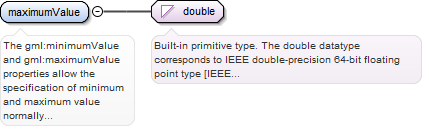
Schema location file:/C:/GaldosOffline/DIGGS_Offline - GMLProfile/Diggs2.0.a/Schemas/gml3.2Profile_diggs.xsd
Attribute Group gml:OwnershipAttributeGroup
Namespace http://www.opengis.net/gml/3.2
Annotations
Encoding a GML property inline vs. by-reference shall not imply anything about
the “ownership” of the contained or referenced GML Object, i.e. the encoding style shall not
imply any “deep-copy” or “deep-delete” semantics. To express ownership over the contained or
referenced GML Object, the gml:OwnershipAttributeGroup attribute group may be added to
object-valued property elements. If the attribute group is not part of the content model of
such a property element, then the value may not be “owned”. When the value of the owns
attribute is "true", the existence of inline or referenced object(s) depends upon the
existence of the parent object.
Diagram
Diagram NO_NAMESPACE.tmp#OwnershipAttributeGroup_owns
Used by
Attributes
QName Type Fixed Default Use Annotation
owns boolean false optional
Source
<attributeGroup name="OwnershipAttributeGroup">
  <annotation>
    <documentation>Encoding a GML property inline vs. by-reference shall not imply anything about the “ownership” of the contained or referenced GML Object, i.e. the encoding style shall not imply any “deep-copy” or “deep-delete” semantics. To express ownership over the contained or referenced GML Object, the gml:OwnershipAttributeGroup attribute group may be added to object-valued property elements. If the attribute group is not part of the content model of such a property element, then the value may not be “owned”. When the value of the owns attribute is "true", the existence of inline or referenced object(s) depends upon the existence of the parent object.</documentation>
  </annotation>
  <attribute name="owns" type="boolean" default="false"/>
</attributeGroup>
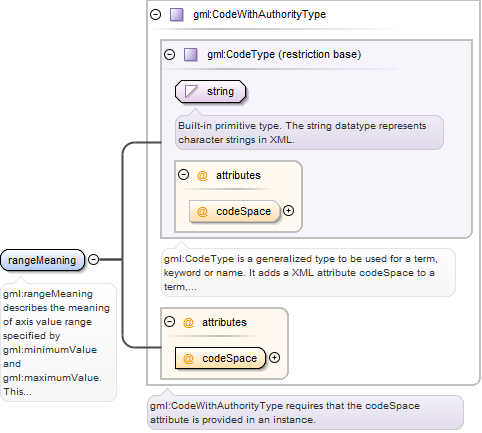
Schema location file:/C:/GaldosOffline/DIGGS_Offline - GMLProfile/Diggs2.0.a/Schemas/gml3.2Profile_diggs.xsd
Attribute Group gml:SRSReferenceGroup
Namespace http://www.opengis.net/gml/3.2
Annotations
The attribute group SRSReferenceGroup is an optional reference to the CRS used
by this geometry, with optional additional information to simplify the processing of the
coordinates when a more complete definition of the CRS is not needed. In general the
attribute srsName points to a CRS instance of gml:AbstractCoordinateReferenceSystem. For
well-known references it is not required that the CRS description exists at the location the
URI points to. If no srsName attribute is given, the CRS shall be specified as part of the
larger context this geometry element is part of.
Diagram
Diagram NO_NAMESPACE.tmp#SRSReferenceGroup_srsName NO_NAMESPACE.tmp#SRSReferenceGroup_srsDimension NO_NAMESPACE.tmp#SRSInformationGroup_axisLabels NO_NAMESPACE.tmp#SRSInformationGroup_uomLabels 3_2.tmp#SRSInformationGroup
Used by
Attributes
QName Type Fixed Default Use Annotation
axisLabels gml:NCNameList optional
srsDimension positiveInteger optional
srsName anyURI optional
uomLabels gml:NCNameList optional
Source
<attributeGroup name="SRSReferenceGroup">
  <annotation>
    <documentation>The attribute group SRSReferenceGroup is an optional reference to the CRS used by this geometry, with optional additional information to simplify the processing of the coordinates when a more complete definition of the CRS is not needed. In general the attribute srsName points to a CRS instance of gml:AbstractCoordinateReferenceSystem. For well-known references it is not required that the CRS description exists at the location the URI points to. If no srsName attribute is given, the CRS shall be specified as part of the larger context this geometry element is part of.</documentation>
  </annotation>
  <attribute name="srsName" type="anyURI"/>
  <attribute name="srsDimension" type="positiveInteger"/>
  <attributeGroup ref="gml:SRSInformationGroup"/>
</attributeGroup>
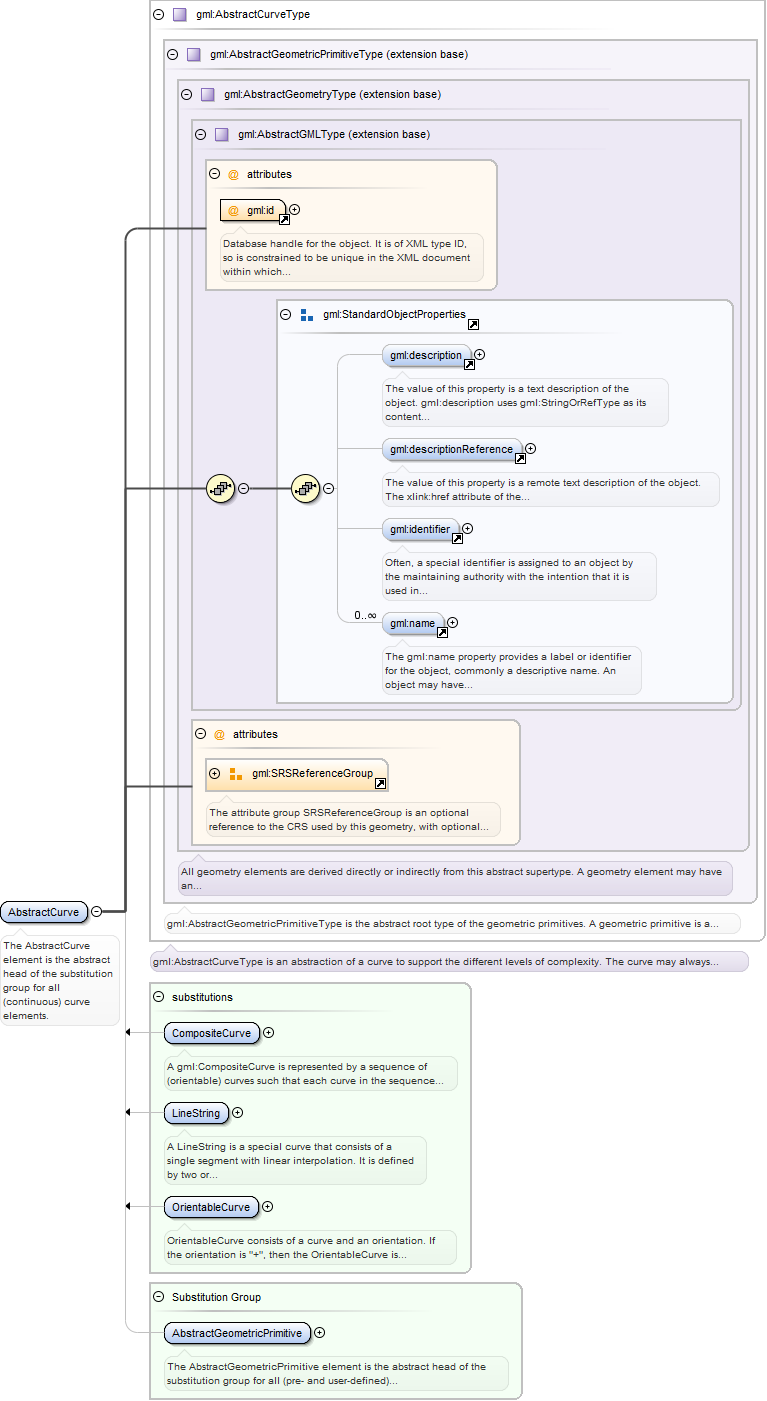
Schema location file:/C:/GaldosOffline/DIGGS_Offline - GMLProfile/Diggs2.0.a/Schemas/gml3.2Profile_diggs.xsd
Attribute Group gml:SRSInformationGroup
Namespace http://www.opengis.net/gml/3.2
Annotations
The attributes uomLabels and axisLabels, defined in the SRSInformationGroup
attribute group, are optional additional and redundant information for a CRS to simplify the
processing of the coordinate values when a more complete definition of the CRS is not
needed. This information shall be the same as included in the complete definition of the
CRS, referenced by the srsName attribute. When the srsName attribute is included, either
both or neither of the axisLabels and uomLabels attributes shall be included. When the
srsName attribute is omitted, both of these attributes shall be omitted. The attribute
axisLabels is an ordered list of labels for all the axes of this CRS. The gml:axisAbbrev
value should be used for these axis labels, after spaces and forbidden characters are
removed. When the srsName attribute is included, this attribute is optional. When the
srsName attribute is omitted, this attribute shall also be omitted. The attribute uomLabels
is an ordered list of unit of measure (uom) labels for all the axes of this CRS. The value
of the string in the gml:catalogSymbol should be used for this uom labels, after spaces and
forbidden characters are removed. When the axisLabels attribute is included, this attribute
shall also be included. When the axisLabels attribute is omitted, this attribute shall also
be omitted.
Diagram
Diagram NO_NAMESPACE.tmp#SRSInformationGroup_axisLabels NO_NAMESPACE.tmp#SRSInformationGroup_uomLabels
Used by
Attribute Group gml:SRSReferenceGroup
Attributes
QName Type Fixed Default Use Annotation
axisLabels gml:NCNameList optional
uomLabels gml:NCNameList optional
Source
<attributeGroup name="SRSInformationGroup">
  <annotation>
    <documentation>The attributes uomLabels and axisLabels, defined in the SRSInformationGroup attribute group, are optional additional and redundant information for a CRS to simplify the processing of the coordinate values when a more complete definition of the CRS is not needed. This information shall be the same as included in the complete definition of the CRS, referenced by the srsName attribute. When the srsName attribute is included, either both or neither of the axisLabels and uomLabels attributes shall be included. When the srsName attribute is omitted, both of these attributes shall be omitted. The attribute axisLabels is an ordered list of labels for all the axes of this CRS. The gml:axisAbbrev value should be used for these axis labels, after spaces and forbidden characters are removed. When the srsName attribute is included, this attribute is optional. When the srsName attribute is omitted, this attribute shall also be omitted. The attribute uomLabels is an ordered list of unit of measure (uom) labels for all the axes of this CRS. The value of the string in the gml:catalogSymbol should be used for this uom labels, after spaces and forbidden characters are removed. When the axisLabels attribute is included, this attribute shall also be included. When the axisLabels attribute is omitted, this attribute shall also be omitted.</documentation>
  </annotation>
  <attribute name="axisLabels" type="gml:NCNameList"/>
  <attribute name="uomLabels" type="gml:NCNameList"/>
</attributeGroup>
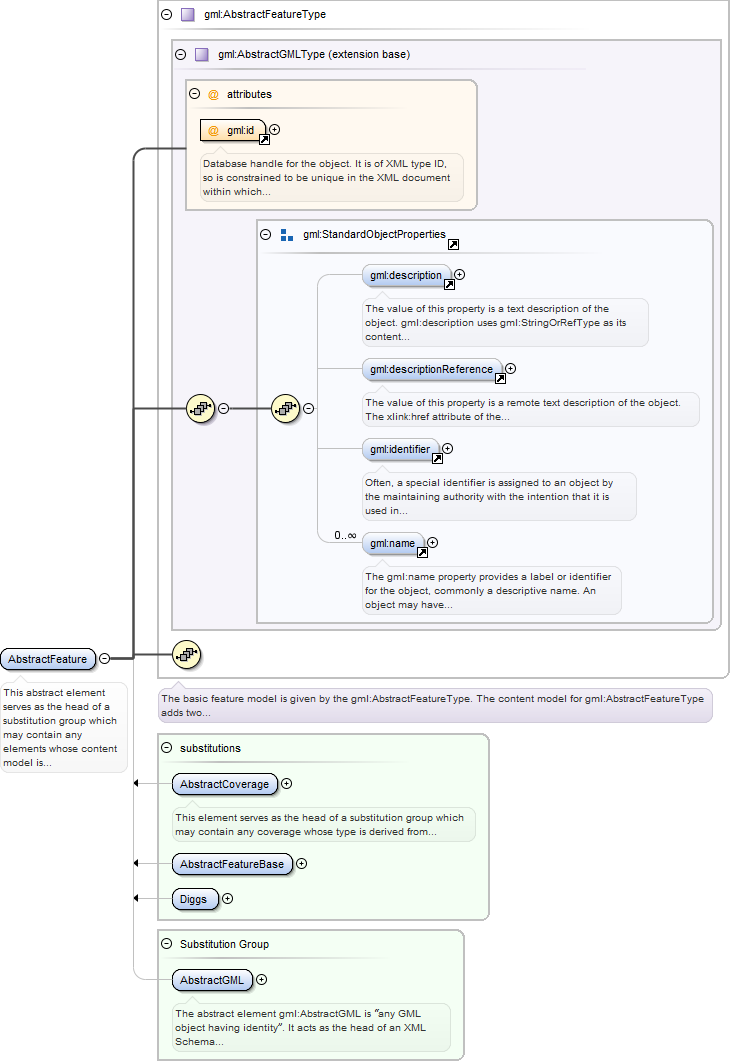
Schema location file:/C:/GaldosOffline/DIGGS_Offline - GMLProfile/Diggs2.0.a/Schemas/gml3.2Profile_diggs.xsd
Attribute Group gml:AggregationAttributeGroup
Namespace http://www.opengis.net/gml/3.2
Annotations
A GML Object Collection is any GML Object with a property element in its
content model whose content model is derived by extension from gml:AbstractMemberType. In
addition, the complex type describing the content model of the GML Object Collection may
also include a reference to the attribute group gml:AggregationAttributeGroup to provide
additional information about the semantics of the object collection. This information may be
used by applications to group GML objects, and optionally to order and index them. The
allowed values for the aggregationType attribute are defined by gml:AggregationType. See 8.4
of ISO/IEC 11404:1996 for the meaning of the values in the enumeration.
Diagram
Diagram NO_NAMESPACE.tmp#AggregationAttributeGroup_aggregationType
Used by
Attributes
QName Type Fixed Default Use Annotation
aggregationType gml:AggregationType optional
Source
<attributeGroup name="AggregationAttributeGroup">
  <annotation>
    <documentation>A GML Object Collection is any GML Object with a property element in its content model whose content model is derived by extension from gml:AbstractMemberType. In addition, the complex type describing the content model of the GML Object Collection may also include a reference to the attribute group gml:AggregationAttributeGroup to provide additional information about the semantics of the object collection. This information may be used by applications to group GML objects, and optionally to order and index them. The allowed values for the aggregationType attribute are defined by gml:AggregationType. See 8.4 of ISO/IEC 11404:1996 for the meaning of the values in the enumeration.</documentation>
  </annotation>
  <attribute name="aggregationType" type="gml:AggregationType"/>
</attributeGroup>
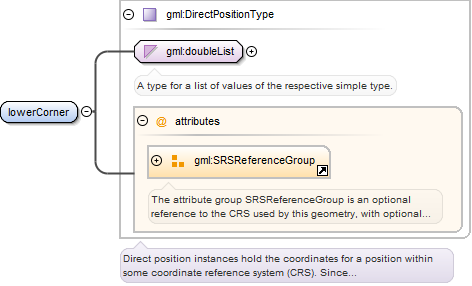
Schema location file:/C:/GaldosOffline/DIGGS_Offline - GMLProfile/Diggs2.0.a/Schemas/gml3.2Profile_diggs.xsd