Showing:

Annotations
Attributes
Diagrams
Instances
Model
Properties
Source
Element gml:AbstractDiscreteCoverage
Namespace http://www.opengis.net/gml/3.2
Annotations
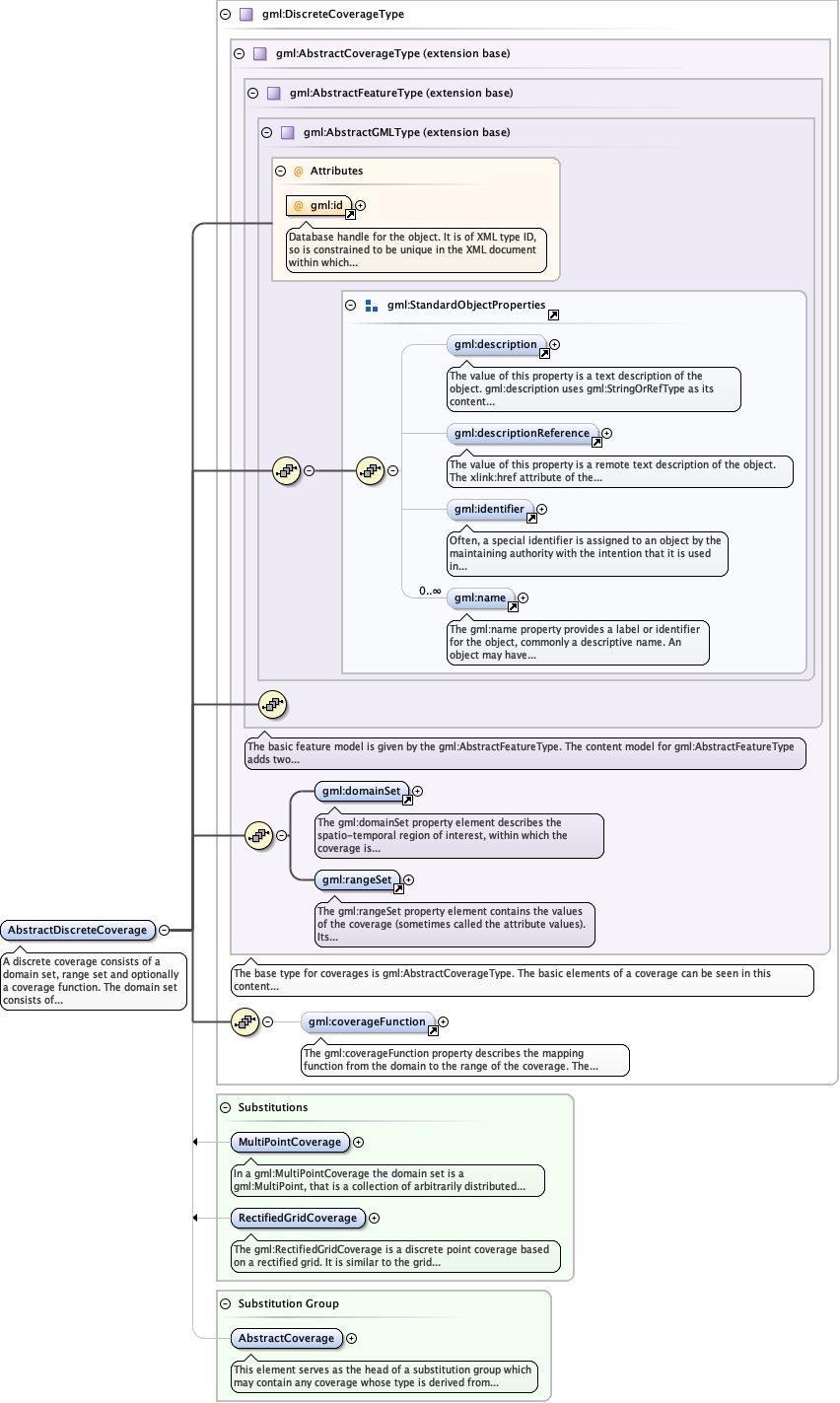
A discrete coverage consists of a domain set, range set and optionally a
coverage function. The domain set consists of either spatial or temporal geometry objects,
finite in number. The range set is comprised of a finite number of attribute values each of
which is associated to every direct position within any single spatiotemporal object in the
domain. In other words, the range values are constant on each spatiotemporal object in the
domain. This coverage function maps each element from the coverage domain to an element in
its range. The coverageFunction element describes the mapping function. This element serves
as the head of a substitution group which may contain any discrete coverage whose type is
derived from gml:DiscreteCoverageType.
Diagram
Diagramgml3_2Profile_diggs_xsd_Attribute_gml_id.tmp#idgml3_2Profile_diggs_xsd_Element_gml_description.tmp#descriptiongml3_2Profile_diggs_xsd_Element_gml_descriptionReference.tmp#descriptionReferencegml3_2Profile_diggs_xsd_Element_gml_identifier.tmp#identifiergml3_2Profile_diggs_xsd_Element_gml_name.tmp#namegml3_2Profile_diggs_xsd_Element_Group_gml_StandardObjectProperties.tmp#StandardObjectPropertiesgml3_2Profile_diggs_xsd_Complex_Type_gml_AbstractGMLType.tmp#AbstractGMLTypegml3_2Profile_diggs_xsd_Complex_Type_gml_AbstractFeatureType.tmp#http___www.opengis.net_gml_3.2_AbstractFeatureTypegml3_2Profile_diggs_xsd_Element_gml_domainSet.tmp#domainSetgml3_2Profile_diggs_xsd_Element_gml_rangeSet.tmp#rangeSetgml3_2Profile_diggs_xsd_Complex_Type_gml_AbstractCoverageType.tmp#AbstractCoverageTypegml3_2Profile_diggs_xsd_Element_gml_coverageFunction.tmp#coverageFunctiongml3_2Profile_diggs_xsd_Complex_Type_gml_DiscreteCoverageType.tmp#DiscreteCoverageTypegml3_2Profile_diggs_xsd_Element_gml_MultiPointCoverage.tmp#MultiPointCoveragegml3_2Profile_diggs_xsd_Element_gml_RectifiedGridCoverage.tmp#RectifiedGridCoveragegml3_2Profile_diggs_xsd_Element_gml_AbstractCoverage.tmp#AbstractCoverage
Type gml:DiscreteCoverageType
Type hierarchy
Properties
content complex
abstract true
Substitution Group
Substitution Group Affiliation
Model
Children gml:coverageFunction, gml:description, gml:descriptionReference, gml:domainSet, gml:identifier, gml:name, gml:rangeSet
Instance
<gml:AbstractDiscreteCoverage gml:id="" xmlns:gml="http://www.opengis.net/gml/3.2">
  <gml:description xlink:actuate="" xlink:arcrole="" xlink:href="" nilReason="" xlink:role="" xlink:show="" xlink:title="" xlink:type="simple">{0,1}</gml:description>
  <gml:descriptionReference xlink:actuate="" xlink:arcrole="" xlink:href="" nilReason="" owns="false" xlink:role="" xlink:show="" xlink:title="" xlink:type="simple">{0,1}</gml:descriptionReference>
  <gml:identifier codeSpace="">{0,1}</gml:identifier>
  <gml:name codeSpace="">{0,unbounded}</gml:name>
  <gml:domainSet xlink:actuate="" xlink:arcrole="" xlink:href="" nilReason="" owns="false" xlink:role="" xlink:show="" xlink:title="" xlink:type="simple">{1,1}</gml:domainSet>
  <gml:rangeSet>{1,1}</gml:rangeSet>
  <gml:coverageFunction>{0,1}</gml:coverageFunction>
</gml:AbstractDiscreteCoverage>
Attributes
QName Type Use Annotation
gml:id ID required
Database handle for the object. It is of XML type ID, so is constrained to be
unique in the XML document within which it occurs. An external identifier for the object in
the form of a URI may be constructed using standard XML and XPointer methods. This is done
by concatenating the URI for the document, a fragment separator, and the value of the id
attribute.
Source
<element name="AbstractDiscreteCoverage" type="gml:DiscreteCoverageType" abstract="true" substitutionGroup="gml:AbstractCoverage">
  <annotation>
    <documentation>A discrete coverage consists of a domain set, range set and optionally a coverage function. The domain set consists of either spatial or temporal geometry objects, finite in number. The range set is comprised of a finite number of attribute values each of which is associated to every direct position within any single spatiotemporal object in the domain. In other words, the range values are constant on each spatiotemporal object in the domain. This coverage function maps each element from the coverage domain to an element in its range. The coverageFunction element describes the mapping function. This element serves as the head of a substitution group which may contain any discrete coverage whose type is derived from gml:DiscreteCoverageType.</documentation>
  </annotation>
</element>