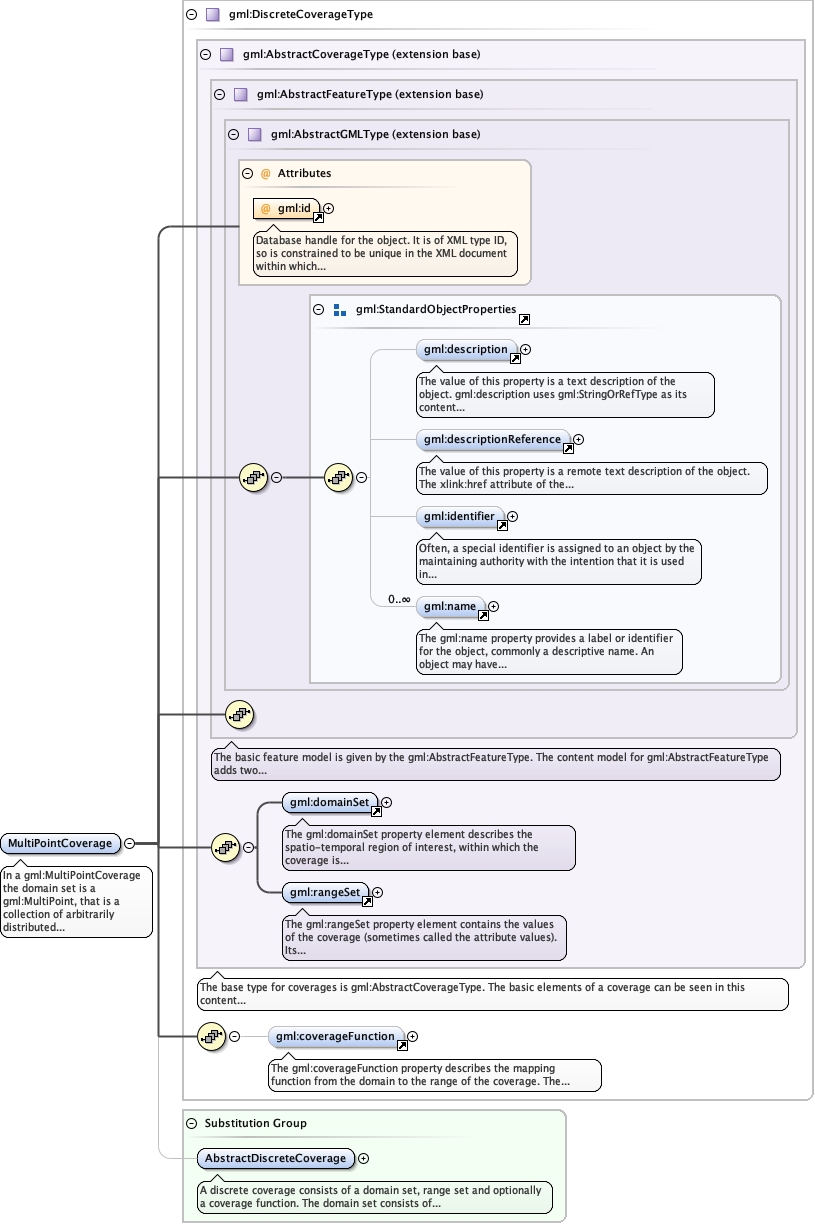
In a gml:MultiPointCoverage the domain set is a gml:MultiPoint, that is acollection of arbitrarily distributed geometric points. The content model is identical withgml:DiscreteCoverageType, but that gml:domainSet shall have values gml:MultiPoint. In agml:MultiPointCoverage the mapping from the domain to the range is straightforward. - Forgml:DataBlock encodings the points of the gml:MultiPoint are mapped in document order to thetuples of the data block. - For gml:CompositeValue encodings the points of thegml:MultiPoint are mapped to the members of the composite value in document order. - Forgml:File encodings the points of the gml:MultiPoint are mapped to the records of the file insequential order.
Database handle for the object. It is of XML type ID, so is constrained to beunique in the XML document within which it occurs. An external identifier for the object inthe form of a URI may be constructed using standard XML and XPointer methods. This is doneby concatenating the URI for the document, a fragment separator, and the value of the idattribute.
Source
<element name="MultiPointCoverage" type="gml:DiscreteCoverageType" substitutionGroup="gml:AbstractDiscreteCoverage"><annotation><documentation>In a gml:MultiPointCoverage the domain set is a gml:MultiPoint, that is a collection of arbitrarily distributed geometric points. The content model is identical with gml:DiscreteCoverageType, but that gml:domainSet shall have values gml:MultiPoint. In a gml:MultiPointCoverage the mapping from the domain to the range is straightforward. - For gml:DataBlock encodings the points of the gml:MultiPoint are mapped in document order to the tuples of the data block. - For gml:CompositeValue encodings the points of the gml:MultiPoint are mapped to the members of the composite value in document order. - For gml:File encodings the points of the gml:MultiPoint are mapped to the records of the file in sequential order.</documentation></annotation></element>