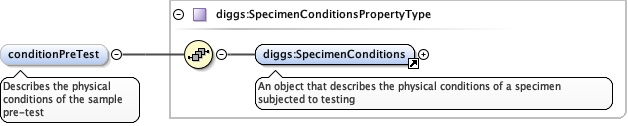
<element minOccurs="0" name="conditionPreTest" type="diggs:SpecimenConditionsPropertyType"><annotation><documentation>Describes the physical conditions of the sample pre-test</documentation></annotation></element>
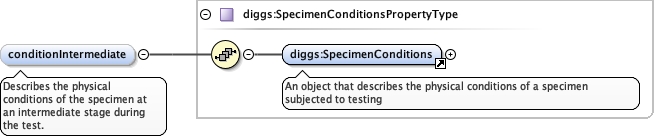
<element minOccurs="0" name="conditionIntermediate" type="diggs:SpecimenConditionsPropertyType" maxOccurs="unbounded"><annotation><documentation>Describes the physical conditions of the specimen at an intermediate stage during the test.</documentation></annotation></element>
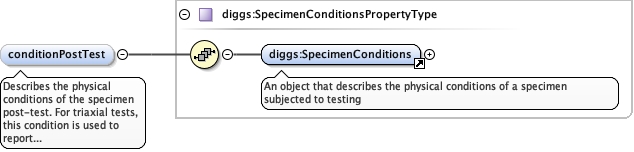
Describes the physical conditions of the specimenpost-test. For triaxial tests, this condition is used to reportspecimen conditions following consolidation stage.
<element minOccurs="0" name="conditionPostTest" type="diggs:SpecimenConditionsPropertyType"><annotation><documentation>Describes the physical conditions of the specimen post-test. For triaxial tests, this condition is used to report specimen conditions following consolidation stage.</documentation></annotation></element>
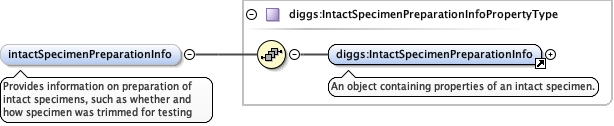
<element minOccurs="0" name="intactSpecimenPreparationInfo" type="diggs:IntactSpecimenPreparationInfoPropertyType"><annotation><documentation>Provides information on preparation of intact specimens, such as whether and how specimen was trimmed for testing</documentation></annotation></element>
<element minOccurs="0" name="reconstitutedSpecimenPreparationInfo" type="diggs:ReconstitutedSpecimenPreparationInfoPropertyType"><annotation><documentation>Provides information on the preparation of reconstituted samples (eg. number of lifts, compactor type, etc.)</documentation></annotation></element>
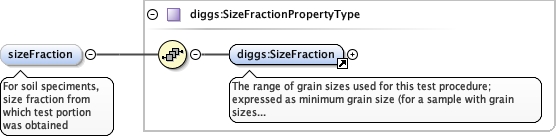
<element minOccurs="0" name="sizeFraction" type="diggs:SizeFractionPropertyType"><annotation><documentation>For soil speciments, size fraction from which test portion was obtained</documentation></annotation></element>
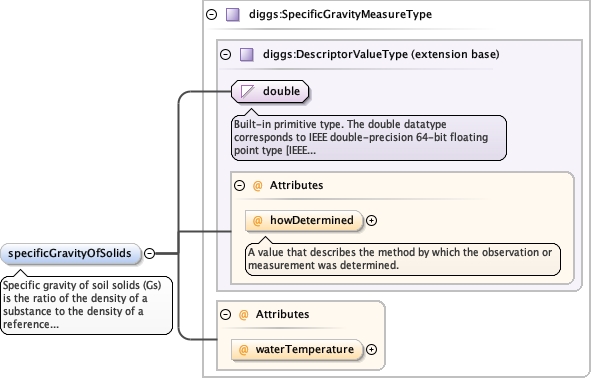
Specific gravity of soil solids (Gs) is the ratio of thedensity of a substance to the density of a reference substance,usually water at 4 deg C; equivalently, it is the ratio of the massof a substance to the mass of a reference substance for the samegiven volume.
<element minOccurs="0" name="specificGravityOfSolids" type="diggs:SpecificGravityMeasureType"><annotation><documentation>Specific gravity of soil solids (Gs) is the ratio of the density of a substance to the density of a reference substance, usually water at 4 deg C; equivalently, it is the ratio of the mass of a substance to the mass of a reference substance for the same given volume.</documentation></annotation></element>
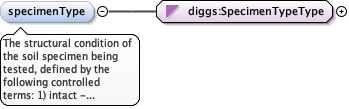
The structural condition of the soil specimen beingtested, defined by the following controlled terms: 1) intact -specimen prepared without disturbance from an "undisturbed" sample(eg. thin-walled sampler); 2) disturbed - specimen prepared from adisturbed sample (eg. thick walled sampler; 3) remolded - specimenprepared from a failed or otherwise disturbed intact specimen; 4)reconstituted - specimen prepared to a predetermined water contentand density
<element minOccurs="0" name="specimenType" type="diggs:SpecimenTypeType"><annotation><documentation>The structural condition of the soil specimen being tested, defined by the following controlled terms: 1) intact - specimen prepared without disturbance from an "undisturbed" sample (eg. thin-walled sampler); 2) disturbed - specimen prepared from a disturbed sample (eg. thick walled sampler; 3) remolded - specimen prepared from a failed or otherwise disturbed intact specimen; 4) reconstituted - specimen prepared to a predetermined water content and density</documentation></annotation></element>
Database handle for the object. It is of XML type ID, so is constrained to beunique in the XML document within which it occurs. An external identifier for the object inthe form of a URI may be constructed using standard XML and XPointer methods. This is doneby concatenating the URI for the document, a fragment separator, and the value of the idattribute.
<div><h3>lang (as an attribute name)</h3><p>denotes an attribute whose value is a language code for the natural language of the content of any element; its value is inherited. This name is reserved by virtue of its definition in the XML specification.</p></div><div><h4>Notes</h4><p>Attempting to install the relevant ISO 2- and 3-letter codes as the enumerated possible values is probably never going to be a realistic possibility.</p><p>See BCP 47 at<a href="http://www.rfc-editor.org/rfc/bcp/bcp47.txt">http://www.rfc-editor.org/rfc/bcp/bcp47.txt</a>and the IANA language subtag registry at<a href="http://www.iana.org/assignments/language-subtag-registry">http://www.iana.org/assignments/language-subtag-registry</a>for further information.</p><p>The union allows for the 'un-declaration' of xml:lang with the empty string.</p></div>
Source
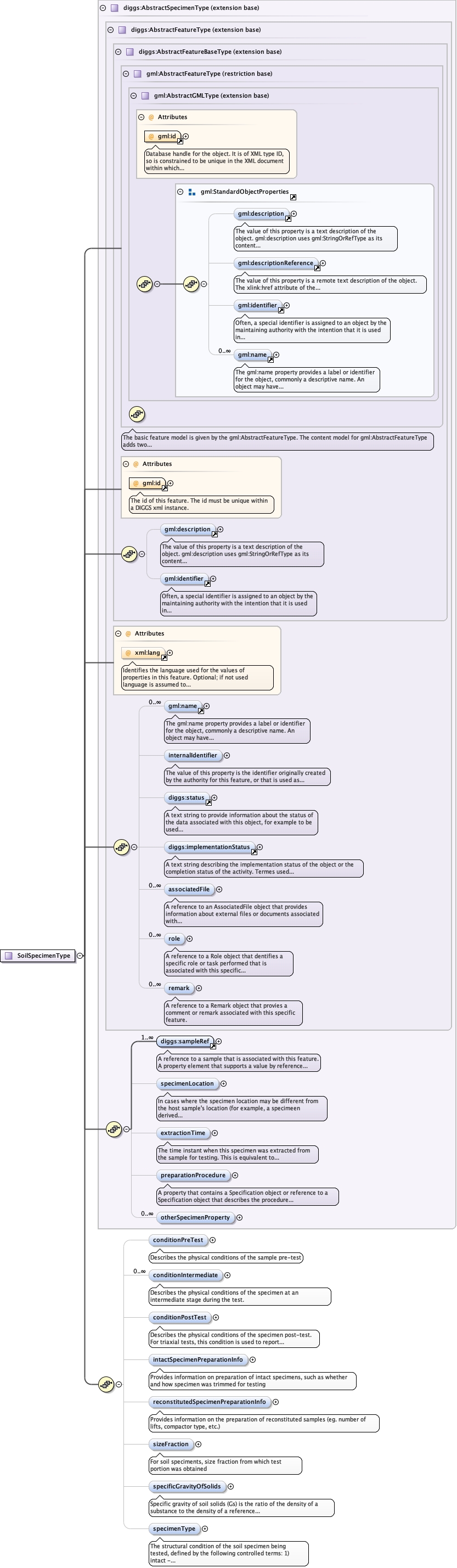
<complexType name="SoilSpecimenType"><complexContent><extension base="diggs:AbstractSpecimenType"><sequence><element minOccurs="0" name="conditionPreTest" type="diggs:SpecimenConditionsPropertyType"><annotation><documentation>Describes the physical conditions of the sample pre-test</documentation></annotation></element><element minOccurs="0" name="conditionIntermediate" type="diggs:SpecimenConditionsPropertyType" maxOccurs="unbounded"><annotation><documentation>Describes the physical conditions of the specimen at an intermediate stage during the test.</documentation></annotation></element><element minOccurs="0" name="conditionPostTest" type="diggs:SpecimenConditionsPropertyType"><annotation><documentation>Describes the physical conditions of the specimen post-test. For triaxial tests, this condition is used to report specimen conditions following consolidation stage.</documentation></annotation></element><element minOccurs="0" name="intactSpecimenPreparationInfo" type="diggs:IntactSpecimenPreparationInfoPropertyType"><annotation><documentation>Provides information on preparation of intact specimens, such as whether and how specimen was trimmed for testing</documentation></annotation></element><element minOccurs="0" name="reconstitutedSpecimenPreparationInfo" type="diggs:ReconstitutedSpecimenPreparationInfoPropertyType"><annotation><documentation>Provides information on the preparation of reconstituted samples (eg. number of lifts, compactor type, etc.)</documentation></annotation></element><element minOccurs="0" name="sizeFraction" type="diggs:SizeFractionPropertyType"><annotation><documentation>For soil speciments, size fraction from which test portion was obtained</documentation></annotation></element><element minOccurs="0" name="specificGravityOfSolids" type="diggs:SpecificGravityMeasureType"><annotation><documentation>Specific gravity of soil solids (Gs) is the ratio of the density of a substance to the density of a reference substance, usually water at 4 deg C; equivalently, it is the ratio of the mass of a substance to the mass of a reference substance for the same given volume.</documentation></annotation></element><element minOccurs="0" name="specimenType" type="diggs:SpecimenTypeType"><annotation><documentation>The structural condition of the soil specimen being tested, defined by the following controlled terms: 1) intact - specimen prepared without disturbance from an "undisturbed" sample (eg. thin-walled sampler); 2) disturbed - specimen prepared from a disturbed sample (eg. thick walled sampler; 3) remolded - specimen prepared from a failed or otherwise disturbed intact specimen; 4) reconstituted - specimen prepared to a predetermined water content and density</documentation></annotation></element></sequence></extension></complexContent></complexType>