<div><h3>lang (as an attribute name)</h3><p>denotes an attribute whose value is a language code for the natural language of the content of any element; its value is inherited. This name is reserved by virtue of its definition in the XML specification.</p></div><div><h4>Notes</h4><p>Attempting to install the relevant ISO 2- and 3-letter codes as the enumerated possible values is probably never going to be a realistic possibility.</p><p>See BCP 47 at<a href="http://www.rfc-editor.org/rfc/bcp/bcp47.txt">http://www.rfc-editor.org/rfc/bcp/bcp47.txt</a>and the IANA language subtag registry at<a href="http://www.iana.org/assignments/language-subtag-registry">http://www.iana.org/assignments/language-subtag-registry</a>for further information.</p><p>The union allows for the 'un-declaration' of xml:lang with the empty string.</p></div>
Source
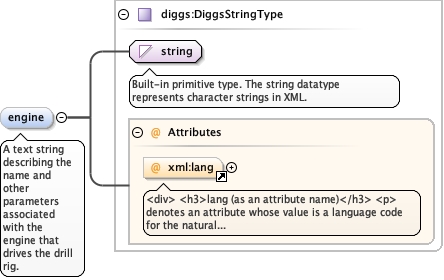
<element minOccurs="0" name="engine" type="diggs:DiggsStringType"><annotation><documentation>A text string describing the name and other parameters associated with the engine that drives the drill rig.</documentation></annotation></element>
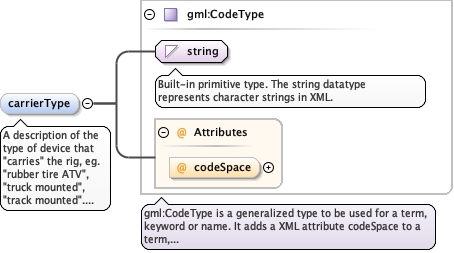
A description of the type of device that "carries" therig, eg. "rubber tire ATV", "truck mounted", "track mounted".Intended to come from a controled list of terms.
<element minOccurs="0" name="carrierType" type="gml:CodeType"><annotation><documentation>A description of the type of device that "carries" the rig, eg. "rubber tire ATV", "truck mounted", "track mounted". Intended to come from a controled list of terms.</documentation></annotation></element>
<div><h3>lang (as an attribute name)</h3><p>denotes an attribute whose value is a language code for the natural language of the content of any element; its value is inherited. This name is reserved by virtue of its definition in the XML specification.</p></div><div><h4>Notes</h4><p>Attempting to install the relevant ISO 2- and 3-letter codes as the enumerated possible values is probably never going to be a realistic possibility.</p><p>See BCP 47 at<a href="http://www.rfc-editor.org/rfc/bcp/bcp47.txt">http://www.rfc-editor.org/rfc/bcp/bcp47.txt</a>and the IANA language subtag registry at<a href="http://www.iana.org/assignments/language-subtag-registry">http://www.iana.org/assignments/language-subtag-registry</a>for further information.</p><p>The union allows for the 'un-declaration' of xml:lang with the empty string.</p></div>
Source
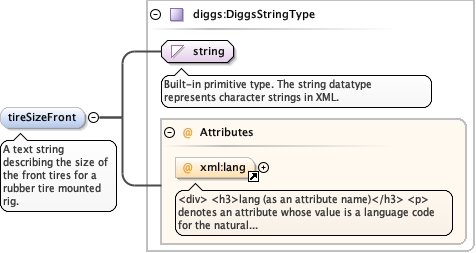
<element minOccurs="0" name="tireSizeFront" type="diggs:DiggsStringType"><annotation><documentation>A text string describing the size of the front tires for a rubber tire mounted rig.</documentation></annotation></element>
<div><h3>lang (as an attribute name)</h3><p>denotes an attribute whose value is a language code for the natural language of the content of any element; its value is inherited. This name is reserved by virtue of its definition in the XML specification.</p></div><div><h4>Notes</h4><p>Attempting to install the relevant ISO 2- and 3-letter codes as the enumerated possible values is probably never going to be a realistic possibility.</p><p>See BCP 47 at<a href="http://www.rfc-editor.org/rfc/bcp/bcp47.txt">http://www.rfc-editor.org/rfc/bcp/bcp47.txt</a>and the IANA language subtag registry at<a href="http://www.iana.org/assignments/language-subtag-registry">http://www.iana.org/assignments/language-subtag-registry</a>for further information.</p><p>The union allows for the 'un-declaration' of xml:lang with the empty string.</p></div>
Source
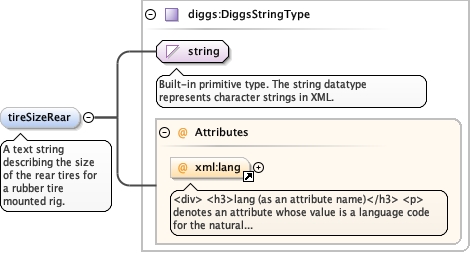
<element minOccurs="0" name="tireSizeRear" type="diggs:DiggsStringType"><annotation><documentation>A text string describing the size of the rear tires for a rubber tire mounted rig.</documentation></annotation></element>
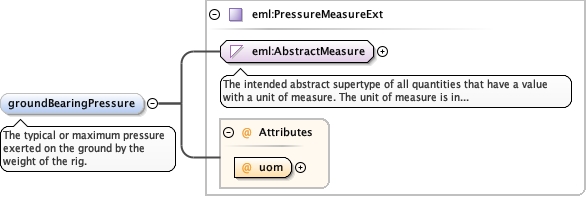
<element minOccurs="0" name="groundBearingPressure" type="eml:PressureMeasureExt"><annotation><documentation>The typical or maximum pressure exerted on the ground by the weight of the rig.</documentation></annotation></element>
<element minOccurs="0" name="numberForwardGears" type="positiveInteger"><annotation><documentation>The number of forward gears in the transmission.</documentation></annotation></element>
<element minOccurs="0" name="numberReverseGears" type="positiveInteger"><annotation><documentation>The number of reverse gears in the transmission.</documentation></annotation></element>
<div><h3>lang (as an attribute name)</h3><p>denotes an attribute whose value is a language code for the natural language of the content of any element; its value is inherited. This name is reserved by virtue of its definition in the XML specification.</p></div><div><h4>Notes</h4><p>Attempting to install the relevant ISO 2- and 3-letter codes as the enumerated possible values is probably never going to be a realistic possibility.</p><p>See BCP 47 at<a href="http://www.rfc-editor.org/rfc/bcp/bcp47.txt">http://www.rfc-editor.org/rfc/bcp/bcp47.txt</a>and the IANA language subtag registry at<a href="http://www.iana.org/assignments/language-subtag-registry">http://www.iana.org/assignments/language-subtag-registry</a>for further information.</p><p>The union allows for the 'un-declaration' of xml:lang with the empty string.</p></div>
Source
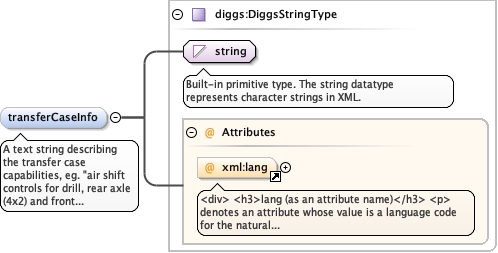
<element minOccurs="0" name="transferCaseInfo" type="diggs:DiggsStringType"><annotation><documentation>A text string describing the transfer case capabilities, eg. "air shift controls for drill, rear axle (4x2) and front axle (4x4)"</documentation></annotation></element>
<div><h3>lang (as an attribute name)</h3><p>denotes an attribute whose value is a language code for the natural language of the content of any element; its value is inherited. This name is reserved by virtue of its definition in the XML specification.</p></div><div><h4>Notes</h4><p>Attempting to install the relevant ISO 2- and 3-letter codes as the enumerated possible values is probably never going to be a realistic possibility.</p><p>See BCP 47 at<a href="http://www.rfc-editor.org/rfc/bcp/bcp47.txt">http://www.rfc-editor.org/rfc/bcp/bcp47.txt</a>and the IANA language subtag registry at<a href="http://www.iana.org/assignments/language-subtag-registry">http://www.iana.org/assignments/language-subtag-registry</a>for further information.</p><p>The union allows for the 'un-declaration' of xml:lang with the empty string.</p></div>
Source
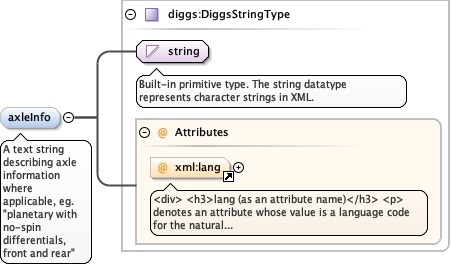
<element minOccurs="0" name="axleInfo" type="diggs:DiggsStringType"><annotation><documentation>A text string describing axle information where applicable, eg. "planetary with no-spin differentials, front and rear"</documentation></annotation></element>
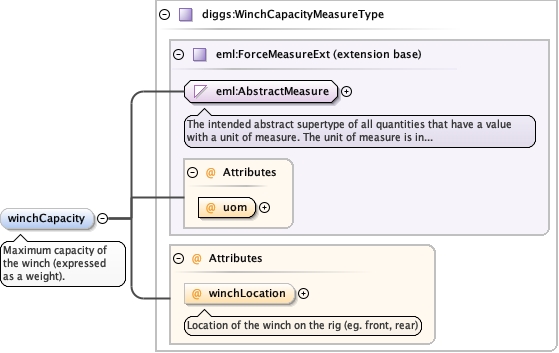
<element minOccurs="0" name="winchCapacity" type="diggs:WinchCapacityMeasureType"><annotation><documentation>Maximum capacity of the winch (expressed as a weight).</documentation></annotation></element>
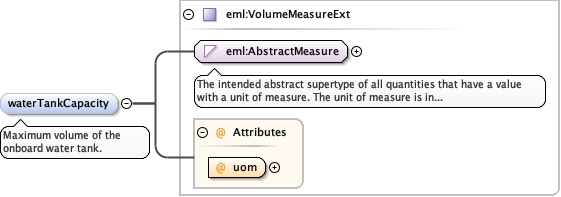
<element minOccurs="0" name="waterTankCapacity" type="eml:VolumeMeasureExt"><annotation><documentation>Maximum volume of the onboard water tank.</documentation></annotation></element>
<div><h3>lang (as an attribute name)</h3><p>denotes an attribute whose value is a language code for the natural language of the content of any element; its value is inherited. This name is reserved by virtue of its definition in the XML specification.</p></div><div><h4>Notes</h4><p>Attempting to install the relevant ISO 2- and 3-letter codes as the enumerated possible values is probably never going to be a realistic possibility.</p><p>See BCP 47 at<a href="http://www.rfc-editor.org/rfc/bcp/bcp47.txt">http://www.rfc-editor.org/rfc/bcp/bcp47.txt</a>and the IANA language subtag registry at<a href="http://www.iana.org/assignments/language-subtag-registry">http://www.iana.org/assignments/language-subtag-registry</a>for further information.</p><p>The union allows for the 'un-declaration' of xml:lang with the empty string.</p></div>
Source
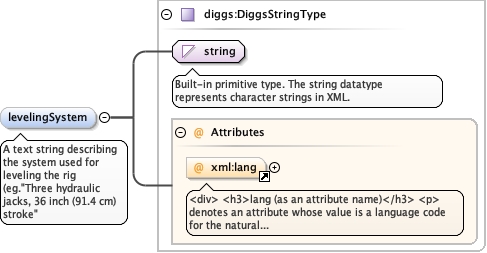
<element minOccurs="0" name="levelingSystem" type="diggs:DiggsStringType"><annotation><documentation>A text string describing the system used for leveling the rig (eg."Three hydraulic jacks, 36 inch (91.4 cm) stroke"</documentation></annotation></element>
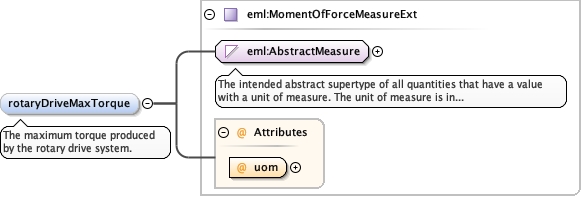
<element minOccurs="0" name="rotaryDriveMaxTorque" type="eml:MomentOfForceMeasureExt"><annotation><documentation>The maximum torque produced by the rotary drive system.</documentation></annotation></element>
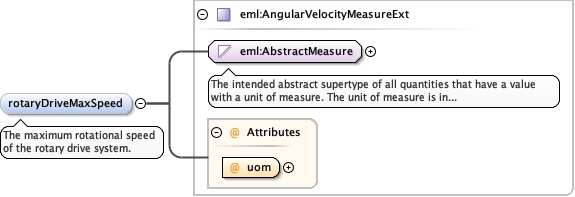
<element minOccurs="0" name="rotaryDriveMaxSpeed" type="eml:AngularVelocityMeasureExt"><annotation><documentation>The maximum rotational speed of the rotary drive system.</documentation></annotation></element>
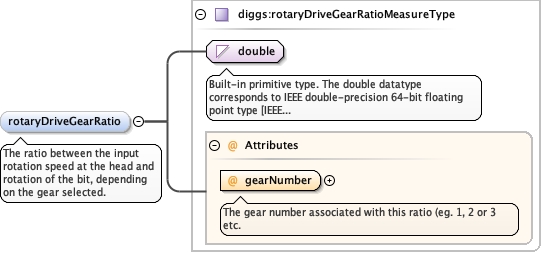
The gear number associated with this ratio (eg. 1, 2 or 3etc.
Source
<element maxOccurs="unbounded" minOccurs="0" name="rotaryDriveGearRatio" type="diggs:rotaryDriveGearRatioMeasureType"><annotation><documentation>The ratio between the input rotation speed at the head and rotation of the bit, depending on the gear selected.</documentation></annotation></element>
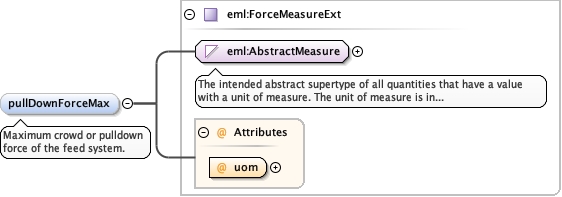
<element minOccurs="0" name="pullDownForceMax" type="eml:ForceMeasureExt"><annotation><documentation>Maximum crowd or pulldown force of the feed system.</documentation></annotation></element>
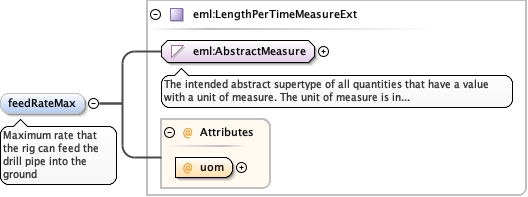
<element minOccurs="0" name="feedRateMax" type="eml:LengthPerTimeMeasureExt"><annotation><documentation>Maximum rate that the rig can feed the drill pipe into the ground</documentation></annotation></element>
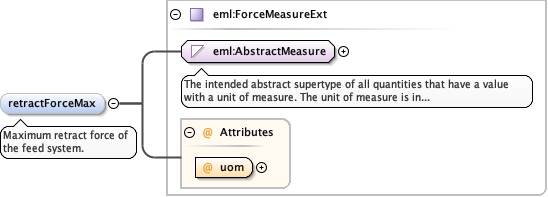
<element minOccurs="0" name="retractForceMax" type="eml:ForceMeasureExt"><annotation><documentation>Maximum retract force of the feed system.</documentation></annotation></element>
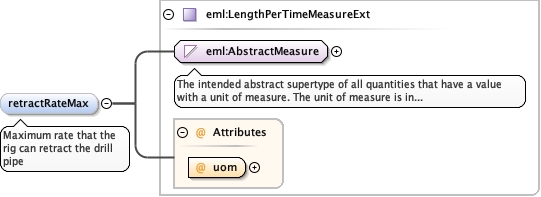
<element minOccurs="0" name="retractRateMax" type="eml:LengthPerTimeMeasureExt"><annotation><documentation>Maximum rate that the rig can retract the drill pipe</documentation></annotation></element>
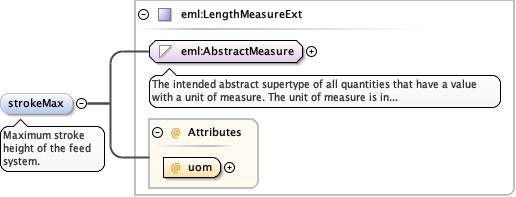
<element minOccurs="0" name="strokeMax" type="eml:LengthMeasureExt"><annotation><documentation>Maximum stroke height of the feed system.</documentation></annotation></element>
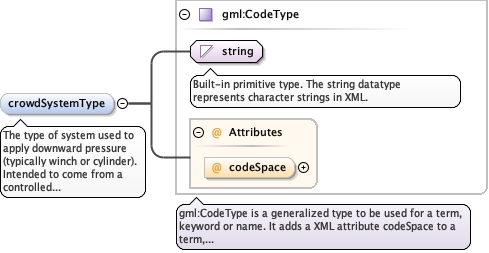
<element minOccurs="0" name="crowdSystemType" type="gml:CodeType"><annotation><documentation>The type of system used to apply downward pressure (typically winch or cylinder). Intended to come from a controlled list of terms.</documentation></annotation></element>
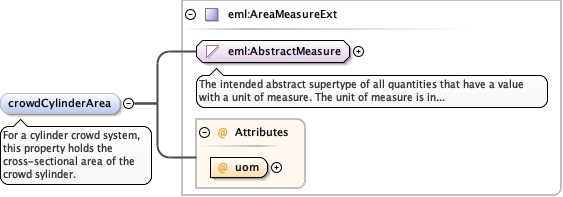
<element minOccurs="0" name="crowdCylinderArea" type="eml:AreaMeasureExt"><annotation><documentation>For a cylinder crowd system, this property holds the cross-sectional area of the crowd sylinder.</documentation></annotation></element>
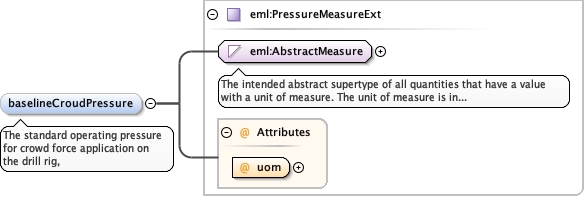
<element minOccurs="0" name="baselineCroudPressure" type="eml:PressureMeasureExt"><annotation><documentation>The standard operating pressure for crowd force application on the drill rig,</documentation></annotation></element>
The ratio of crowd force to the pressure applied(force/pressure) to convert crowd pressure to force.
Diagram
Type
double
Properties
content
simple
minOccurs
0
Source
<element minOccurs="0" name="crowdConversionCoeff" type="double"><annotation><documentation>The ratio of crowd force to the pressure applied (force/pressure) to convert crowd pressure to force.</documentation></annotation></element>
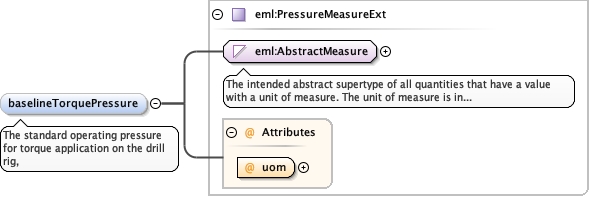
<element minOccurs="0" name="baselineTorquePressure" type="eml:PressureMeasureExt"><annotation><documentation>The standard operating pressure for torque application on the drill rig,</documentation></annotation></element>
The count of hydraulic motors used in the drillingsetup.
Diagram
Type
integer
Properties
content
simple
minOccurs
0
Source
<element minOccurs="0" name="noHydraulicMotors" type="integer"><annotation><documentation>The count of hydraulic motors used in the drilling setup.</documentation></annotation></element>
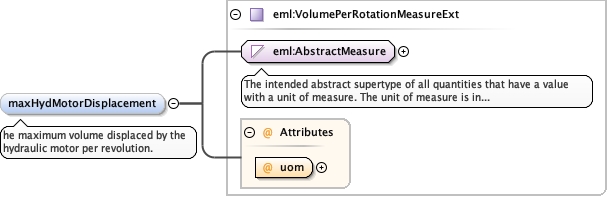
<element minOccurs="0" name="maxHydMotorDisplacement" type="eml:VolumePerRotationMeasureExt"><annotation><documentation>he maximum volume displaced by the hydraulic motor per revolution.</documentation></annotation></element>
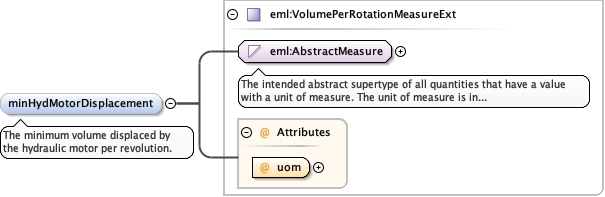
<element minOccurs="0" name="minHydMotorDisplacement" type="eml:VolumePerRotationMeasureExt"><annotation><documentation>The minimum volume displaced by the hydraulic motor per revolution.</documentation></annotation></element>
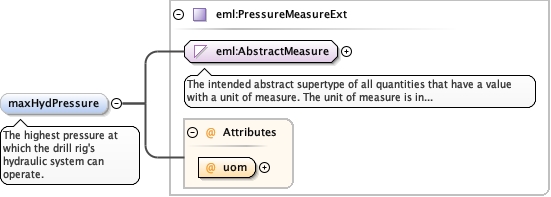
<element minOccurs="0" name="maxHydPressure" type="eml:PressureMeasureExt"><annotation><documentation>The highest pressure at which the drill rig's hydraulic system can operate.</documentation></annotation></element>
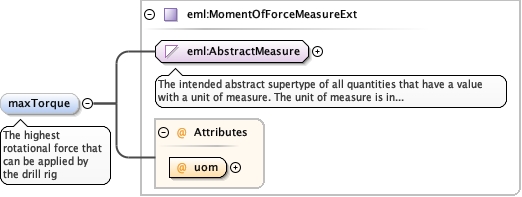
<element minOccurs="0" name="maxTorque" type="eml:MomentOfForceMeasureExt"><annotation><documentation>The highest rotational force that can be applied by the drill rig</documentation></annotation></element>
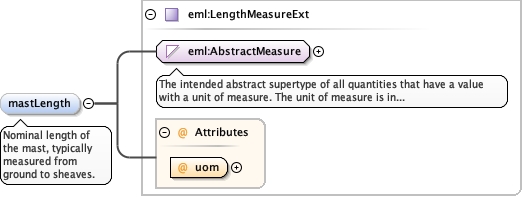
<element minOccurs="0" name="mastLength" type="eml:LengthMeasureExt"><annotation><documentation>Nominal length of the mast, typically measured from ground to sheaves.</documentation></annotation></element>
Database handle for the object. It is of XML type ID, so is constrained to beunique in the XML document within which it occurs. An external identifier for the object inthe form of a URI may be constructed using standard XML and XPointer methods. This is doneby concatenating the URI for the document, a fragment separator, and the value of the idattribute.
<div><h3>lang (as an attribute name)</h3><p>denotes an attribute whose value is a language code for the natural language of the content of any element; its value is inherited. This name is reserved by virtue of its definition in the XML specification.</p></div><div><h4>Notes</h4><p>Attempting to install the relevant ISO 2- and 3-letter codes as the enumerated possible values is probably never going to be a realistic possibility.</p><p>See BCP 47 at<a href="http://www.rfc-editor.org/rfc/bcp/bcp47.txt">http://www.rfc-editor.org/rfc/bcp/bcp47.txt</a>and the IANA language subtag registry at<a href="http://www.iana.org/assignments/language-subtag-registry">http://www.iana.org/assignments/language-subtag-registry</a>for further information.</p><p>The union allows for the 'un-declaration' of xml:lang with the empty string.</p></div>
Source
<complexType name="DrillRigType"><complexContent><extension base="diggs:AbstractEquipmentType"><sequence><element minOccurs="0" name="engine" type="diggs:DiggsStringType"><annotation><documentation>A text string describing the name and other parameters associated with the engine that drives the drill rig.</documentation></annotation></element><element minOccurs="0" name="carrierType" type="gml:CodeType"><annotation><documentation>A description of the type of device that "carries" the rig, eg. "rubber tire ATV", "truck mounted", "track mounted". Intended to come from a controled list of terms.</documentation></annotation></element><element minOccurs="0" name="tireSizeFront" type="diggs:DiggsStringType"><annotation><documentation>A text string describing the size of the front tires for a rubber tire mounted rig.</documentation></annotation></element><element minOccurs="0" name="tireSizeRear" type="diggs:DiggsStringType"><annotation><documentation>A text string describing the size of the rear tires for a rubber tire mounted rig.</documentation></annotation></element><element minOccurs="0" name="groundBearingPressure" type="eml:PressureMeasureExt"><annotation><documentation>The typical or maximum pressure exerted on the ground by the weight of the rig.</documentation></annotation></element><element minOccurs="0" name="numberForwardGears" type="positiveInteger"><annotation><documentation>The number of forward gears in the transmission.</documentation></annotation></element><element minOccurs="0" name="numberReverseGears" type="positiveInteger"><annotation><documentation>The number of reverse gears in the transmission.</documentation></annotation></element><element minOccurs="0" name="transferCaseInfo" type="diggs:DiggsStringType"><annotation><documentation>A text string describing the transfer case capabilities, eg. "air shift controls for drill, rear axle (4x2) and front axle (4x4)"</documentation></annotation></element><element minOccurs="0" name="axleInfo" type="diggs:DiggsStringType"><annotation><documentation>A text string describing axle information where applicable, eg. "planetary with no-spin differentials, front and rear"</documentation></annotation></element><element minOccurs="0" name="winchCapacity" type="diggs:WinchCapacityMeasureType"><annotation><documentation>Maximum capacity of the winch (expressed as a weight).</documentation></annotation></element><element minOccurs="0" name="waterTankCapacity" type="eml:VolumeMeasureExt"><annotation><documentation>Maximum volume of the onboard water tank.</documentation></annotation></element><element minOccurs="0" name="levelingSystem" type="diggs:DiggsStringType"><annotation><documentation>A text string describing the system used for leveling the rig (eg."Three hydraulic jacks, 36 inch (91.4 cm) stroke"</documentation></annotation></element><element minOccurs="0" name="rotaryDriveMaxTorque" type="eml:MomentOfForceMeasureExt"><annotation><documentation>The maximum torque produced by the rotary drive system.</documentation></annotation></element><element minOccurs="0" name="rotaryDriveMaxSpeed" type="eml:AngularVelocityMeasureExt"><annotation><documentation>The maximum rotational speed of the rotary drive system.</documentation></annotation></element><element maxOccurs="unbounded" minOccurs="0" name="rotaryDriveGearRatio" type="diggs:rotaryDriveGearRatioMeasureType"><annotation><documentation>The ratio between the input rotation speed at the head and rotation of the bit, depending on the gear selected.</documentation></annotation></element><element minOccurs="0" name="pullDownForceMax" type="eml:ForceMeasureExt"><annotation><documentation>Maximum crowd or pulldown force of the feed system.</documentation></annotation></element><element minOccurs="0" name="feedRateMax" type="eml:LengthPerTimeMeasureExt"><annotation><documentation>Maximum rate that the rig can feed the drill pipe into the ground</documentation></annotation></element><element minOccurs="0" name="retractForceMax" type="eml:ForceMeasureExt"><annotation><documentation>Maximum retract force of the feed system.</documentation></annotation></element><element minOccurs="0" name="retractRateMax" type="eml:LengthPerTimeMeasureExt"><annotation><documentation>Maximum rate that the rig can retract the drill pipe</documentation></annotation></element><element minOccurs="0" name="strokeMax" type="eml:LengthMeasureExt"><annotation><documentation>Maximum stroke height of the feed system.</documentation></annotation></element><element minOccurs="0" name="crowdSystemType" type="gml:CodeType"><annotation><documentation>The type of system used to apply downward pressure (typically winch or cylinder). Intended to come from a controlled list of terms.</documentation></annotation></element><element minOccurs="0" name="crowdCylinderArea" type="eml:AreaMeasureExt"><annotation><documentation>For a cylinder crowd system, this property holds the cross-sectional area of the crowd sylinder.</documentation></annotation></element><element minOccurs="0" name="baselineCroudPressure" type="eml:PressureMeasureExt"><annotation><documentation>The standard operating pressure for crowd force application on the drill rig,</documentation></annotation></element><element minOccurs="0" name="crowdConversionCoeff" type="double"><annotation><documentation>The ratio of crowd force to the pressure applied (force/pressure) to convert crowd pressure to force.</documentation></annotation></element><element minOccurs="0" name="baselineTorquePressure" type="eml:PressureMeasureExt"><annotation><documentation>The standard operating pressure for torque application on the drill rig,</documentation></annotation></element><element minOccurs="0" name="noHydraulicMotors" type="integer"><annotation><documentation>The count of hydraulic motors used in the drilling setup.</documentation></annotation></element><element minOccurs="0" name="maxHydMotorDisplacement" type="eml:VolumePerRotationMeasureExt"><annotation><documentation>he maximum volume displaced by the hydraulic motor per revolution.</documentation></annotation></element><element minOccurs="0" name="minHydMotorDisplacement" type="eml:VolumePerRotationMeasureExt"><annotation><documentation>The minimum volume displaced by the hydraulic motor per revolution.</documentation></annotation></element><element minOccurs="0" name="maxHydPressure" type="eml:PressureMeasureExt"><annotation><documentation>The highest pressure at which the drill rig's hydraulic system can operate.</documentation></annotation></element><element minOccurs="0" name="maxTorque" type="eml:MomentOfForceMeasureExt"><annotation><documentation>The highest rotational force that can be applied by the drill rig</documentation></annotation></element><element minOccurs="0" name="mastLength" type="eml:LengthMeasureExt"><annotation><documentation>Nominal length of the mast, typically measured from ground to sheaves.</documentation></annotation></element></sequence></extension></complexContent></complexType>