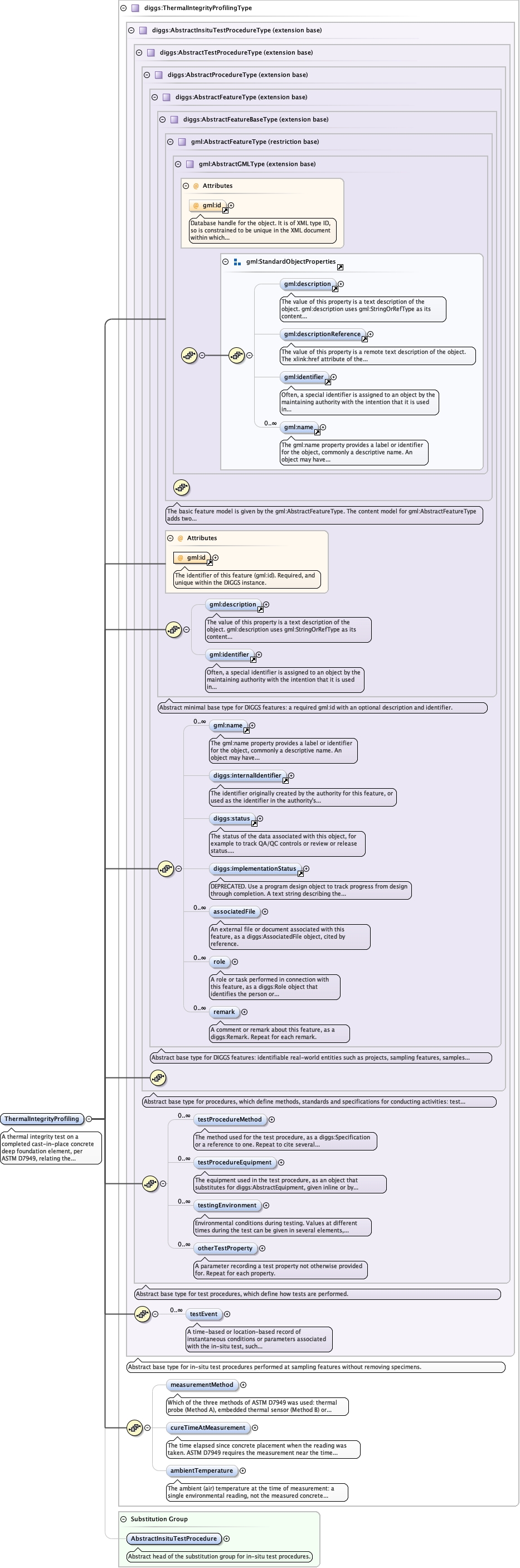
A thermal integrity test on a completed cast-in-place concrete deep foundationelement, per ASTM D7949, relating the heat of hydration generated by the curingconcrete along the element to its as-built cross-section and continuity. Itcharacterizes as-built shape (necking, bulging, cage eccentricity) from a heatsignature captured once during curing, where diggs:LowStrainIntegrityTestcharacterizes discontinuity from a stress-wave reflection captured any time aftercuring. It substitutes diggs:AbstractInsituTestProcedure directly, notdiggs:AbstractLoadTestProcedure, because no load is applied. The name keeps "ThermalIntegrity Profiling" (commercially, TIP) although ASTM D7949 was withdrawn in 2023and reinstated in 2025 as D7949-25 under the broader title "Standard Test Methodsfor Integrity Testing of Concrete Deep Foundations by Thermal Methods"; cite ASTMD7949 as the governing standard whichever edition's title is quoted. The 2025edition has three methods, all in the enumeration of measurementMethod: Method A, athermal probe lowered into access ducts in the element; Method B, multiple embeddedthermal sensors (thermistors) attached to the reinforcing cage; Method C, anembedded fiber-optic cable attached to the cage, which gives effectively continuouscoverage along the length. No European or ISO standard defines a competing method:EN 1536 (bored piles) and EN 1538 (diaphragm walls) accept thermal integrity testingwithout defining one, and European practice runs the ASTM D7949 methodology. Eachphysical sensor is its own Equipment/Sensor object under the inheritedtestProcedureEquipment, classified with equipmentClass.xml#thermal_integrity_probe(Method A), equipmentClass.xml#thermistor (Method B) orequipmentClass.xml#embedded_fiber_optic_cable (Method C); their count and positionfollow from how many are cited. The measured temperature profile and the interpretedeffective-radius profile are results: give the temperature per depth on theResultSet of Test/outcome with properties.xml#temperature, and the effective radiuswith properties.xml#effective_radius. A profile is one Test, becausemeasurementMethod, cureTimeAtMeasurement and ambientTemperature are fixed for onepass along the element: one Test has a diggs:MultiPointLocation with every depthstation and one ResultSet with a temperature and effective radius tuple per station,as for diggs:StaticConePenetrationTest and unlike a Standard Penetration Test, whichis one Test per depth.
Database handle for the object. It is of XML type ID, so is constrained to beunique in the XML document within which it occurs. An external identifier for the object inthe form of a URI may be constructed using standard XML and XPointer methods. This is doneby concatenating the URI for the document, a fragment separator, and the value of the idattribute.
Source
<element name="ThermalIntegrityProfiling" type="diggs:ThermalIntegrityProfilingType" abstract="false" substitutionGroup="diggs:AbstractInsituTestProcedure"><annotation><documentation>A thermal integrity test on a completed cast-in-place concrete deep foundation element, per ASTM D7949, relating the heat of hydration generated by the curing concrete along the element to its as-built cross-section and continuity. It characterizes as-built shape (necking, bulging, cage eccentricity) from a heat signature captured once during curing, where diggs:LowStrainIntegrityTest characterizes discontinuity from a stress-wave reflection captured any time after curing. It substitutes diggs:AbstractInsituTestProcedure directly, not diggs:AbstractLoadTestProcedure, because no load is applied. The name keeps "Thermal Integrity Profiling" (commercially, TIP) although ASTM D7949 was withdrawn in 2023 and reinstated in 2025 as D7949-25 under the broader title "Standard Test Methods for Integrity Testing of Concrete Deep Foundations by Thermal Methods"; cite ASTM D7949 as the governing standard whichever edition's title is quoted. The 2025 edition has three methods, all in the enumeration of measurementMethod: Method A, a thermal probe lowered into access ducts in the element; Method B, multiple embedded thermal sensors (thermistors) attached to the reinforcing cage; Method C, an embedded fiber-optic cable attached to the cage, which gives effectively continuous coverage along the length. No European or ISO standard defines a competing method: EN 1536 (bored piles) and EN 1538 (diaphragm walls) accept thermal integrity testing without defining one, and European practice runs the ASTM D7949 methodology. Each physical sensor is its own Equipment/Sensor object under the inherited testProcedureEquipment, classified with equipmentClass.xml#thermal_integrity_probe (Method A), equipmentClass.xml#thermistor (Method B) or equipmentClass.xml#embedded_fiber_optic_cable (Method C); their count and position follow from how many are cited. The measured temperature profile and the interpreted effective-radius profile are results: give the temperature per depth on the ResultSet of Test/outcome with properties.xml#temperature, and the effective radius with properties.xml#effective_radius. A profile is one Test, because measurementMethod, cureTimeAtMeasurement and ambientTemperature are fixed for one pass along the element: one Test has a diggs:MultiPointLocation with every depth station and one ResultSet with a temperature and effective radius tuple per station, as for diggs:StaticConePenetrationTest and unlike a Standard Penetration Test, which is one Test per depth.</documentation></annotation></element>