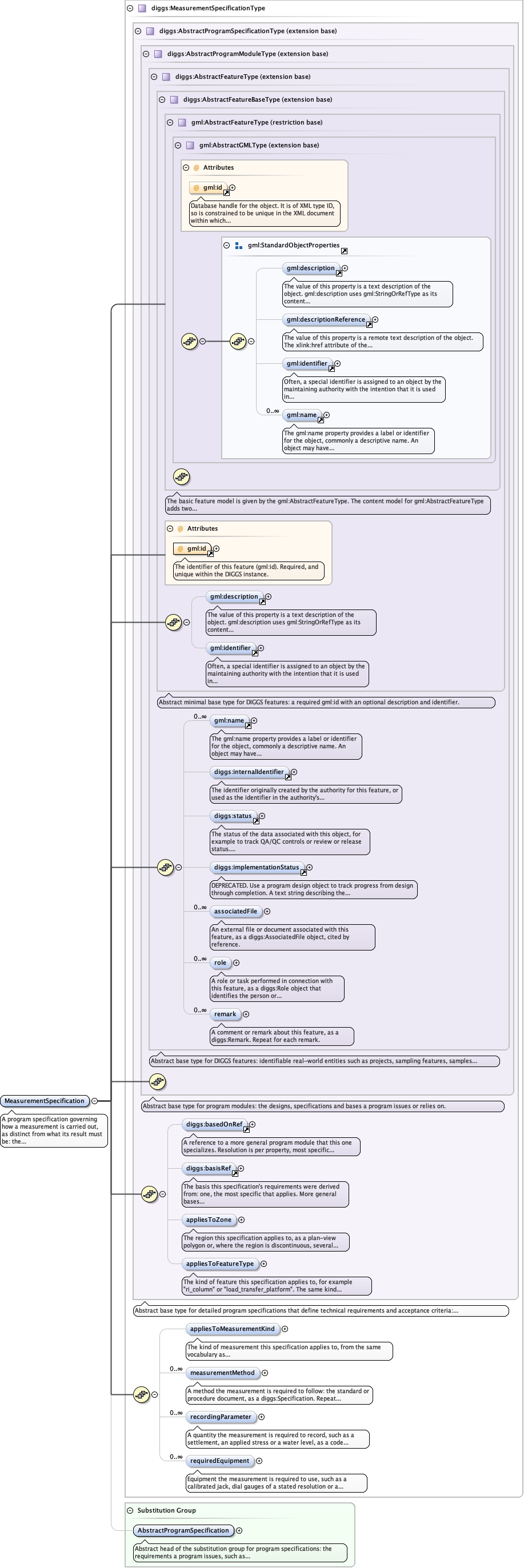
A program specification governing how a measurement is carried out, as distinct fromwhat its result must be: the method to follow, the quantities to record and theequipment to use. It applies to any kind of measurement, such as an in-situ test, alaboratory test or a monitoring campaign. Requirements the measurement must meet,such as a minimum number of load increments, a maximum test stress or a hold time,are criteria that name this specification through partOfSpecificationRef, and theplanned measurement cites the specification through programSpecificationRef.Criteria on the measured result are performance criteria and are stated separately.
Database handle for the object. It is of XML type ID, so is constrained to beunique in the XML document within which it occurs. An external identifier for the object inthe form of a URI may be constructed using standard XML and XPointer methods. This is doneby concatenating the URI for the document, a fragment separator, and the value of the idattribute.
Source
<element name="MeasurementSpecification" type="diggs:MeasurementSpecificationType" substitutionGroup="diggs:AbstractProgramSpecification"><annotation><documentation>A program specification governing how a measurement is carried out, as distinct from what its result must be: the method to follow, the quantities to record and the equipment to use. It applies to any kind of measurement, such as an in-situ test, a laboratory test or a monitoring campaign. Requirements the measurement must meet, such as a minimum number of load increments, a maximum test stress or a hold time, are criteria that name this specification through partOfSpecificationRef, and the planned measurement cites the specification through programSpecificationRef. Criteria on the measured result are performance criteria and are stated separately.</documentation></annotation></element>