Showing:

Annotations
Attributes
Diagrams
Instances
Model
Properties
Source
Element diggs:DesignProductionSequence
Namespace http://diggsml.org/schemas/3
Annotations
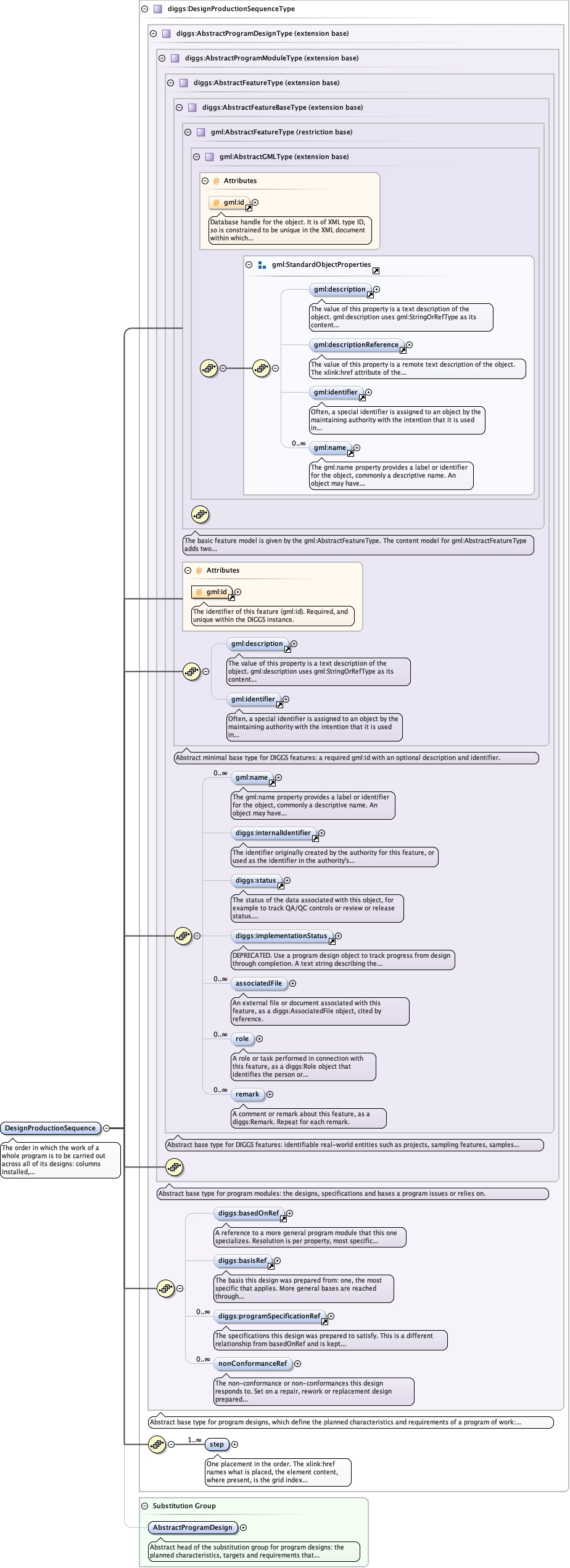
The order in which the work of a whole program is to be carried out across all of
its designs: columns installed, boreholes drilled, samples taken, measurements made.
One object holds one order, so whether one feature is produced after a second and
before a third is answered from a single series of numbers, wherever the three are
designed. Declare it in the program's design slot, after the designs it orders. A
diggs:ClearanceConstraint on the program (a minimum spacing to fresh work, a minimum
age before adjacent work) attaches through programSpecificationRef.
Diagram
Diagramgml3_2Profile_diggs_xsd_Attribute_gml_id.tmp#idgml3_2Profile_diggs_xsd_Element_gml_description.tmp#descriptiongml3_2Profile_diggs_xsd_Element_gml_descriptionReference.tmp#descriptionReferencegml3_2Profile_diggs_xsd_Element_gml_identifier.tmp#identifiergml3_2Profile_diggs_xsd_Element_gml_name.tmp#namegml3_2Profile_diggs_xsd_Element_Group_gml_StandardObjectProperties.tmp#StandardObjectPropertiesgml3_2Profile_diggs_xsd_Complex_Type_gml_AbstractGMLType.tmp#AbstractGMLTypegml3_2Profile_diggs_xsd_Complex_Type_gml_AbstractFeatureType.tmp#AbstractFeatureTypegml3_2Profile_diggs_xsd_Attribute_gml_id.tmp#idgml3_2Profile_diggs_xsd_Element_gml_description.tmp#descriptiongml3_2Profile_diggs_xsd_Element_gml_identifier.tmp#identifierAbstractTypes_xsd_Complex_Type_diggs_AbstractFeatureBaseType.tmp#AbstractFeatureBaseTypegml3_2Profile_diggs_xsd_Element_gml_name.tmp#nameCommon_xsd_Element_diggs_internalIdentifier.tmp#internalIdentifierCommon_xsd_Element_diggs_status.tmp#statusCommon_xsd_Element_diggs_implementationStatus.tmp#implementationStatusAbstractTypes_xsd_Complex_Type_diggs_AbstractFeatureType.tmp#http___diggsml.org_schemas_3_AbstractFeatureType_associatedFileAbstractTypes_xsd_Complex_Type_diggs_AbstractFeatureType.tmp#http___diggsml.org_schemas_3_AbstractFeatureType_roleAbstractTypes_xsd_Complex_Type_diggs_AbstractFeatureType.tmp#http___diggsml.org_schemas_3_AbstractFeatureType_remarkAbstractTypes_xsd_Complex_Type_diggs_AbstractFeatureType.tmp#http___diggsml.org_schemas_3_AbstractFeatureTypeAbstractTypes_xsd_Complex_Type_diggs_AbstractProgramModuleType.tmp#AbstractProgramModuleTypeCommon_xsd_Element_diggs_basedOnRef.tmp#basedOnRefCommon_xsd_Element_diggs_basisRef.tmp#basisRefCommon_xsd_Element_diggs_programSpecificationRef.tmp#programSpecificationRefAbstractTypes_xsd_Complex_Type_diggs_AbstractProgramDesignType.tmp#AbstractProgramDesignType_nonConformanceRefAbstractTypes_xsd_Complex_Type_diggs_AbstractProgramDesignType.tmp#AbstractProgramDesignTypeCore_xsd_Complex_Type_diggs_DesignProductionSequenceType.tmp#DesignProductionSequenceType_stepCore_xsd_Complex_Type_diggs_DesignProductionSequenceType.tmp#DesignProductionSequenceTypeAbstractTypes_xsd_Element_diggs_AbstractProgramDesign.tmp#AbstractProgramDesign
Type diggs:DesignProductionSequenceType
Type hierarchy
Properties
content complex
Substitution Group Affiliation
Model
Children diggs:associatedFile, diggs:basedOnRef, diggs:basisRef, diggs:implementationStatus, diggs:internalIdentifier, diggs:nonConformanceRef, diggs:programSpecificationRef, diggs:remark, diggs:role, diggs:status, diggs:step, gml:description, gml:identifier, gml:name
Instance
<diggs:DesignProductionSequence gml:id="" xmlns:diggs="http://diggsml.org/schemas/3" xmlns:gml="http://www.opengis.net/gml/3.2">
  <gml:description xlink:href="" nilReason="">{0,1}</gml:description>
  <gml:identifier codeSpace="">{0,1}</gml:identifier>
  <gml:name codeSpace="">{0,unbounded}</gml:name>
  <diggs:internalIdentifier codeSpace="">{0,1}</diggs:internalIdentifier>
  <diggs:status codeSpace="">{0,1}</diggs:status>
  <diggs:implementationStatus codeSpace="">{0,1}</diggs:implementationStatus>
  <diggs:associatedFile xlink:href="" nilReason="" owns="false">{0,unbounded}</diggs:associatedFile>
  <diggs:role>{0,unbounded}</diggs:role>
  <diggs:remark>{0,unbounded}</diggs:remark>
  <diggs:basedOnRef xlink:href="" identifierRef="" nilReason="" owns="false">{0,1}</diggs:basedOnRef>
  <diggs:basisRef xlink:href="" identifierRef="" nilReason="" owns="false">{0,1}</diggs:basisRef>
  <diggs:programSpecificationRef xlink:href="" identifierRef="" nilReason="" owns="false">{0,unbounded}</diggs:programSpecificationRef>
  <diggs:nonConformanceRef xlink:href="" identifierRef="" nilReason="" owns="false">{0,unbounded}</diggs:nonConformanceRef>
  <diggs:step dimension="2" xlink:href="" sequenceNumber="">{1,unbounded}</diggs:step>
</diggs:DesignProductionSequence>
Attributes
QName Type Use Annotation
gml:id ID required
Database handle for the object. It is of XML type ID, so is constrained to be
unique in the XML document within which it occurs. An external identifier for the object in
the form of a URI may be constructed using standard XML and XPointer methods. This is done
by concatenating the URI for the document, a fragment separator, and the value of the id
attribute.
Source
<element name="DesignProductionSequence" type="diggs:DesignProductionSequenceType" substitutionGroup="diggs:AbstractProgramDesign">
  <annotation>
    <documentation>The order in which the work of a whole program is to be carried out across all of its designs: columns installed, boreholes drilled, samples taken, measurements made. One object holds one order, so whether one feature is produced after a second and before a third is answered from a single series of numbers, wherever the three are designed. Declare it in the program's design slot, after the designs it orders. A diggs:ClearanceConstraint on the program (a minimum spacing to fresh work, a minimum age before adjacent work) attaches through programSpecificationRef.</documentation>
  </annotation>
</element>