| Namespace | http://diggsml.org/schemas/3 | |||||||||
|
Annotations
|
|
|||||||||
|
Diagram
|
 |
|||||||||
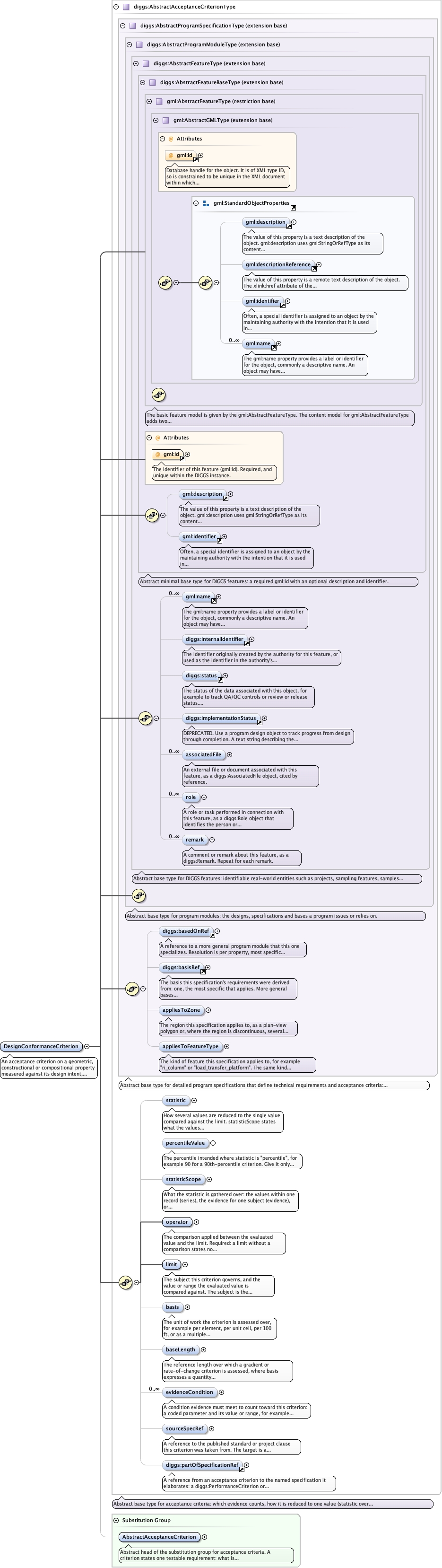
| Type | diggs:AbstractAcceptanceCriterionType | |||||||||
| Type hierarchy | ||||||||||
|
Properties
|
|
|||||||||
| Substitution Group Affiliation | ||||||||||
| Model |
gml:description{0,1} , gml:identifier{0,1} , gml:name* , diggs:internalIdentifier{0,1} , diggs:status{0,1} , diggs:implementationStatus{0,1} , diggs:associatedFile* , diggs:role* , diggs:remark* , diggs:basedOnRef{0,1} , diggs:basisRef{0,1} , diggs:appliesToZone{0,1} , diggs:appliesToFeatureType{0,1} , diggs:statistic{0,1} , diggs:percentileValue{0,1} , diggs:statisticScope{0,1} , diggs:operator , diggs:limit , diggs:basis{0,1} , diggs:baseLength{0,1} , diggs:evidenceCondition* , diggs:sourceSpecRef{0,1} , diggs:partOfSpecificationRef{0,1}
|
|||||||||
| Children | diggs:appliesToFeatureType, diggs:appliesToZone, diggs:associatedFile, diggs:baseLength, diggs:basedOnRef, diggs:basis, diggs:basisRef, diggs:evidenceCondition, diggs:implementationStatus, diggs:internalIdentifier, diggs:limit, diggs:operator, diggs:partOfSpecificationRef, diggs:percentileValue, diggs:remark, diggs:role, diggs:sourceSpecRef, diggs:statistic, diggs:statisticScope, diggs:status, gml:description, gml:identifier, gml:name | |||||||||
|
Instance
|
|
|||||||||
|
Attributes
|
|
|||||||||
|
Source
|
|