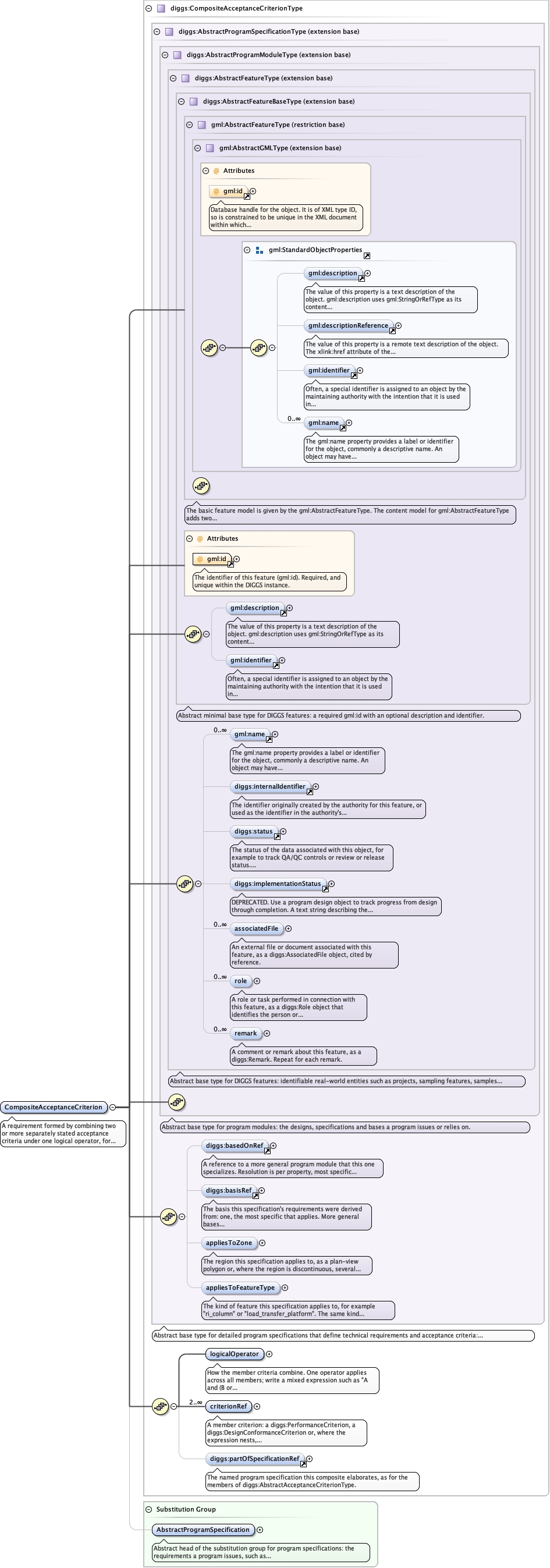
A requirement formed by combining two or more separately stated acceptance criteriaunder one logical operator, for example the drilling refusal rule "penetration ratebelow X and torque above Y". Each member is a normally declared criterion with itsown subject, statistic, operator, limit, basis and evaluated-against references,evaluated on its own terms; the composite combines their verdicts and has nostatistic, basis or base length of its own. A member may have a different kind ofsubject from the composite: a requirement about the act of construction, such as arefusal rule, is judged on the construction activity cited throughconstructionActivityRef, while the composite is judged on the feature. Aconstruction activity member applies to the feature named by that activity'ssamplingFeatureRef; where several activities act on the feature, the latest byactivityDateTime counts. The composite substitutesdiggs:AbstractProgramSpecification, so it is accepted wherever adiggs:PerformanceCriterion is.
Database handle for the object. It is of XML type ID, so is constrained to beunique in the XML document within which it occurs. An external identifier for the object inthe form of a URI may be constructed using standard XML and XPointer methods. This is doneby concatenating the URI for the document, a fragment separator, and the value of the idattribute.
Source
<element name="CompositeAcceptanceCriterion" type="diggs:CompositeAcceptanceCriterionType" substitutionGroup="diggs:AbstractProgramSpecification"><annotation><documentation>A requirement formed by combining two or more separately stated acceptance criteria under one logical operator, for example the drilling refusal rule "penetration rate below X and torque above Y". Each member is a normally declared criterion with its own subject, statistic, operator, limit, basis and evaluated-against references, evaluated on its own terms; the composite combines their verdicts and has no statistic, basis or base length of its own. A member may have a different kind of subject from the composite: a requirement about the act of construction, such as a refusal rule, is judged on the construction activity cited through constructionActivityRef, while the composite is judged on the feature. A construction activity member applies to the feature named by that activity's samplingFeatureRef; where several activities act on the feature, the latest by activityDateTime counts. The composite substitutes diggs:AbstractProgramSpecification, so it is accepted wherever a diggs:PerformanceCriterion is.</documentation></annotation></element>