Showing:

Annotations
Attributes
Diagrams
Instances
Model
Properties
Source
Element diggs:ClearanceConstraint
Namespace http://diggsml.org/schemas/3
Annotations
A requirement that two activities or features keep a minimum separation distance, a
minimum elapsed time between them, or both together as a conditional rule:
"installations within 3 m of each other must be at least 24 h apart". It is generic
across domains: adjacent columns protecting fresh grout from vibration,
grout-injection stages avoiding hydraulic fracture of a neighbor still curing, a new
borehole standing off from a utility, a pile sequenced away from a monitored
structure. It states a relation between two features, or two members of a
population, over a length and a duration, which the single operator and limit of a
criterion cannot combine; it therefore substitutes
diggs:AbstractProgramSpecification directly. appliesToFeatureType (inherited) names
the population the constraint governs, the subject; referenceFeatureType names what
the subject must keep clear of. If referenceFeatureType is absent, every member of
the subject population clears every other member. If it names a different type, the
constraint relates the subject population to that other one, typically a
pre-existing feature the program did not install and cannot date, in which case
minimumElapsedTime does not apply on that side. minimumSeparation and
minimumElapsedTime are independently optional. Both present is the conditional case:
within minimumSeparation, the two governing timestamps must be at least
minimumElapsedTime apart. minimumSeparation alone is an unconditional exclusion
zone. minimumElapsedTime alone is an unconditional sequencing gap for every pair the
scope selects. At least one of the two is expected; the validation chain checks it.
The object records the rule, not the check: evaluating it means finding, for every
pair of features the scope selects, the separation between their locations (per
separationBasis) and the elapsed time between their governing timestamps (per
elapsedTimeBasis, typically each feature's installing
diggs:AbstractConstructionActivity/activityDateTime), and comparing each against its
threshold.
Diagram
Diagramgml3_2Profile_diggs_xsd_Attribute_gml_id.tmp#idgml3_2Profile_diggs_xsd_Element_gml_description.tmp#descriptiongml3_2Profile_diggs_xsd_Element_gml_descriptionReference.tmp#descriptionReferencegml3_2Profile_diggs_xsd_Element_gml_identifier.tmp#identifiergml3_2Profile_diggs_xsd_Element_gml_name.tmp#namegml3_2Profile_diggs_xsd_Element_Group_gml_StandardObjectProperties.tmp#StandardObjectPropertiesgml3_2Profile_diggs_xsd_Complex_Type_gml_AbstractGMLType.tmp#AbstractGMLTypegml3_2Profile_diggs_xsd_Complex_Type_gml_AbstractFeatureType.tmp#AbstractFeatureTypegml3_2Profile_diggs_xsd_Attribute_gml_id.tmp#idgml3_2Profile_diggs_xsd_Element_gml_description.tmp#descriptiongml3_2Profile_diggs_xsd_Element_gml_identifier.tmp#identifierAbstractTypes_xsd_Complex_Type_diggs_AbstractFeatureBaseType.tmp#AbstractFeatureBaseTypegml3_2Profile_diggs_xsd_Element_gml_name.tmp#nameCommon_xsd_Element_diggs_internalIdentifier.tmp#internalIdentifierCommon_xsd_Element_diggs_status.tmp#statusCommon_xsd_Element_diggs_implementationStatus.tmp#implementationStatusAbstractTypes_xsd_Complex_Type_diggs_AbstractFeatureType.tmp#http___diggsml.org_schemas_3_AbstractFeatureType_associatedFileAbstractTypes_xsd_Complex_Type_diggs_AbstractFeatureType.tmp#http___diggsml.org_schemas_3_AbstractFeatureType_roleAbstractTypes_xsd_Complex_Type_diggs_AbstractFeatureType.tmp#http___diggsml.org_schemas_3_AbstractFeatureType_remarkAbstractTypes_xsd_Complex_Type_diggs_AbstractFeatureType.tmp#http___diggsml.org_schemas_3_AbstractFeatureTypeAbstractTypes_xsd_Complex_Type_diggs_AbstractProgramModuleType.tmp#AbstractProgramModuleTypeCommon_xsd_Element_diggs_basedOnRef.tmp#basedOnRefCommon_xsd_Element_diggs_basisRef.tmp#basisRefAbstractTypes_xsd_Complex_Type_diggs_AbstractProgramSpecificationType.tmp#AbstractProgramSpecificationType_appliesToZoneAbstractTypes_xsd_Complex_Type_diggs_AbstractProgramSpecificationType.tmp#AbstractProgramSpecificationType_appliesToFeatureTypeAbstractTypes_xsd_Complex_Type_diggs_AbstractProgramSpecificationType.tmp#AbstractProgramSpecificationTypeCore_xsd_Complex_Type_diggs_ClearanceConstraintType.tmp#ClearanceConstraintType_referenceFeatureTypeCore_xsd_Complex_Type_diggs_ClearanceConstraintType.tmp#ClearanceConstraintType_minimumSeparationCore_xsd_Complex_Type_diggs_ClearanceConstraintType.tmp#ClearanceConstraintType_separationBasisCore_xsd_Complex_Type_diggs_ClearanceConstraintType.tmp#ClearanceConstraintType_minimumElapsedTimeCore_xsd_Complex_Type_diggs_ClearanceConstraintType.tmp#ClearanceConstraintType_elapsedTimeBasisCore_xsd_Complex_Type_diggs_ClearanceConstraintType.tmp#ClearanceConstraintType_temporalOrderCore_xsd_Complex_Type_diggs_ClearanceConstraintType.tmp#ClearanceConstraintType_constraintRationaleCore_xsd_Complex_Type_diggs_ClearanceConstraintType.tmp#ClearanceConstraintTypeAbstractTypes_xsd_Element_diggs_AbstractProgramSpecification.tmp#AbstractProgramSpecification
Type diggs:ClearanceConstraintType
Type hierarchy
Properties
content complex
Substitution Group Affiliation
Model
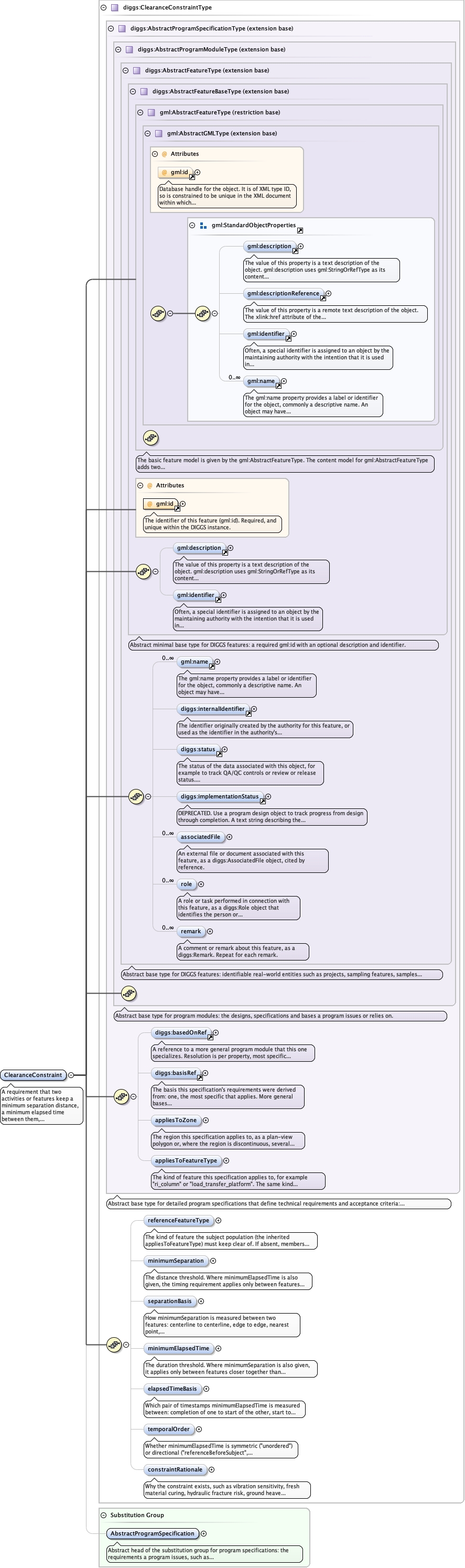
Children diggs:appliesToFeatureType, diggs:appliesToZone, diggs:associatedFile, diggs:basedOnRef, diggs:basisRef, diggs:constraintRationale, diggs:elapsedTimeBasis, diggs:implementationStatus, diggs:internalIdentifier, diggs:minimumElapsedTime, diggs:minimumSeparation, diggs:referenceFeatureType, diggs:remark, diggs:role, diggs:separationBasis, diggs:status, diggs:temporalOrder, gml:description, gml:identifier, gml:name
Instance
<diggs:ClearanceConstraint gml:id="" xmlns:diggs="http://diggsml.org/schemas/3" xmlns:gml="http://www.opengis.net/gml/3.2">
  <gml:description xlink:href="" nilReason="">{0,1}</gml:description>
  <gml:identifier codeSpace="">{0,1}</gml:identifier>
  <gml:name codeSpace="">{0,unbounded}</gml:name>
  <diggs:internalIdentifier codeSpace="">{0,1}</diggs:internalIdentifier>
  <diggs:status codeSpace="">{0,1}</diggs:status>
  <diggs:implementationStatus codeSpace="">{0,1}</diggs:implementationStatus>
  <diggs:associatedFile xlink:href="" nilReason="" owns="false">{0,unbounded}</diggs:associatedFile>
  <diggs:role>{0,unbounded}</diggs:role>
  <diggs:remark>{0,unbounded}</diggs:remark>
  <diggs:basedOnRef xlink:href="" identifierRef="" nilReason="" owns="false">{0,1}</diggs:basedOnRef>
  <diggs:basisRef xlink:href="" identifierRef="" nilReason="" owns="false">{0,1}</diggs:basisRef>
  <diggs:appliesToZone xlink:href="" nilReason="" owns="false">{0,1}</diggs:appliesToZone>
  <diggs:appliesToFeatureType codeSpace="">{0,1}</diggs:appliesToFeatureType>
  <diggs:referenceFeatureType codeSpace="">{0,1}</diggs:referenceFeatureType>
  <diggs:minimumSeparation howDetermined="" qualifier="" uom="">{0,1}</diggs:minimumSeparation>
  <diggs:separationBasis codeSpace="">{0,1}</diggs:separationBasis>
  <diggs:minimumElapsedTime howDetermined="" qualifier="" uom="">{0,1}</diggs:minimumElapsedTime>
  <diggs:elapsedTimeBasis>{0,1}</diggs:elapsedTimeBasis>
  <diggs:temporalOrder>{0,1}</diggs:temporalOrder>
  <diggs:constraintRationale codeSpace="">{0,1}</diggs:constraintRationale>
</diggs:ClearanceConstraint>
Attributes
QName Type Use Annotation
gml:id ID required
Database handle for the object. It is of XML type ID, so is constrained to be
unique in the XML document within which it occurs. An external identifier for the object in
the form of a URI may be constructed using standard XML and XPointer methods. This is done
by concatenating the URI for the document, a fragment separator, and the value of the id
attribute.
Source
<element name="ClearanceConstraint" type="diggs:ClearanceConstraintType" substitutionGroup="diggs:AbstractProgramSpecification">
  <annotation>
    <documentation>A requirement that two activities or features keep a minimum separation distance, a minimum elapsed time between them, or both together as a conditional rule: "installations within 3 m of each other must be at least 24 h apart". It is generic across domains: adjacent columns protecting fresh grout from vibration, grout-injection stages avoiding hydraulic fracture of a neighbor still curing, a new borehole standing off from a utility, a pile sequenced away from a monitored structure. It states a relation between two features, or two members of a population, over a length and a duration, which the single operator and limit of a criterion cannot combine; it therefore substitutes diggs:AbstractProgramSpecification directly. appliesToFeatureType (inherited) names the population the constraint governs, the subject; referenceFeatureType names what the subject must keep clear of. If referenceFeatureType is absent, every member of the subject population clears every other member. If it names a different type, the constraint relates the subject population to that other one, typically a pre-existing feature the program did not install and cannot date, in which case minimumElapsedTime does not apply on that side. minimumSeparation and minimumElapsedTime are independently optional. Both present is the conditional case: within minimumSeparation, the two governing timestamps must be at least minimumElapsedTime apart. minimumSeparation alone is an unconditional exclusion zone. minimumElapsedTime alone is an unconditional sequencing gap for every pair the scope selects. At least one of the two is expected; the validation chain checks it. The object records the rule, not the check: evaluating it means finding, for every pair of features the scope selects, the separation between their locations (per separationBasis) and the elapsed time between their governing timestamps (per elapsedTimeBasis, typically each feature's installing diggs:AbstractConstructionActivity/activityDateTime), and comparing each against its threshold.</documentation>
  </annotation>
</element>