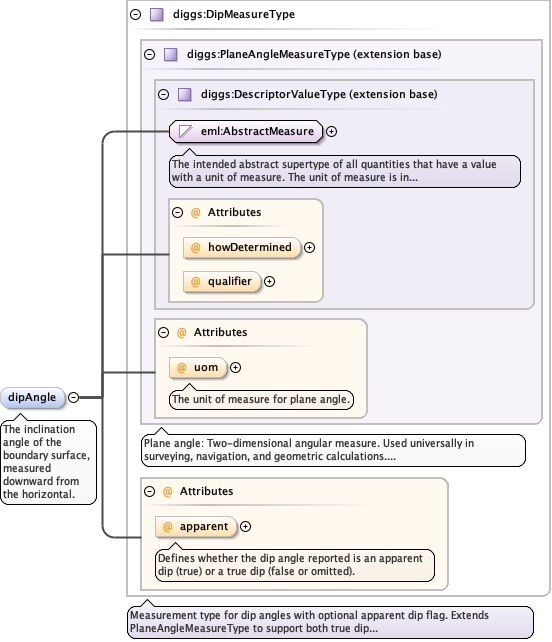
<element minOccurs="0" name="dipAngle" type="diggs:DipMeasureType"><annotation><documentation>The inclination angle of the boundary surface, measured downward from the horizontal.</documentation></annotation></element>
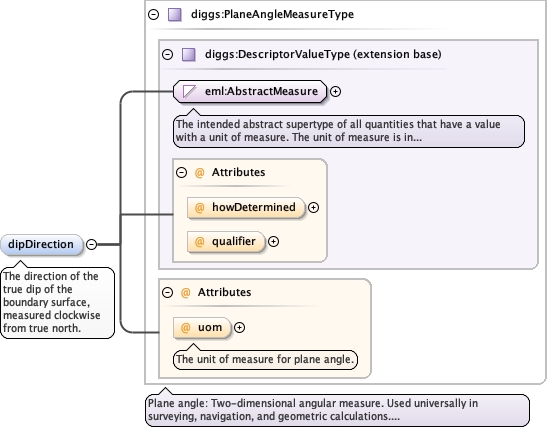
<element minOccurs="0" name="dipDirection" type="diggs:PlaneAngleMeasureType"><annotation><documentation>The direction of the true dip of the boundary surface, measured clockwise from true north.</documentation></annotation></element>
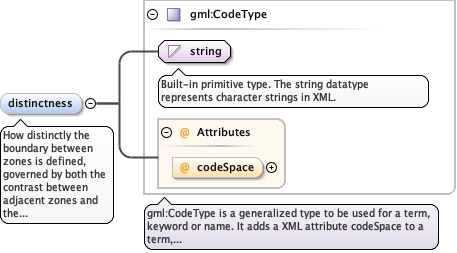
How distinctly the boundary between zones is defined, governed byboth the contrast between adjacent zones and the width of theboundary, for example sharp or gradational. A controlled term ispreferred. No DIGGS-authored dictionary currently exists for thiselement.
<element minOccurs="0" name="distinctness" type="gml:CodeType"><annotation><documentation>How distinctly the boundary between zones is defined, governed by both the contrast between adjacent zones and the width of the boundary, for example sharp or gradational. A controlled term is preferred. No DIGGS-authored dictionary currently exists for this element.</documentation></annotation></element>
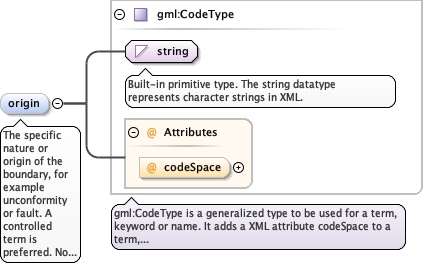
The specific nature or origin of the boundary, for exampleunconformity or fault. A controlled term is preferred. NoDIGGS-authored dictionary currently exists for this element.
<element minOccurs="0" name="origin" type="gml:CodeType"><annotation><documentation>The specific nature or origin of the boundary, for example unconformity or fault. A controlled term is preferred. No DIGGS-authored dictionary currently exists for this element.</documentation></annotation></element>
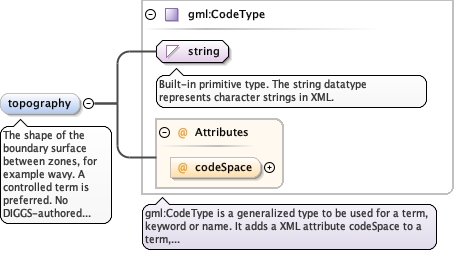
The shape of the boundary surface between zones, for example wavy. Acontrolled term is preferred. No DIGGS-authored dictionary currentlyexists for this element.
<element minOccurs="0" name="topography" type="gml:CodeType"><annotation><documentation>The shape of the boundary surface between zones, for example wavy. A controlled term is preferred. No DIGGS-authored dictionary currently exists for this element.</documentation></annotation></element>
Database handle for the object. It is of XML type ID, so is constrained to beunique in the XML document within which it occurs. An external identifier for the object inthe form of a URI may be constructed using standard XML and XPointer methods. This is doneby concatenating the URI for the document, a fragment separator, and the value of the idattribute.
The method by which the boundary was determined. Values come from theenumerated list.
Source
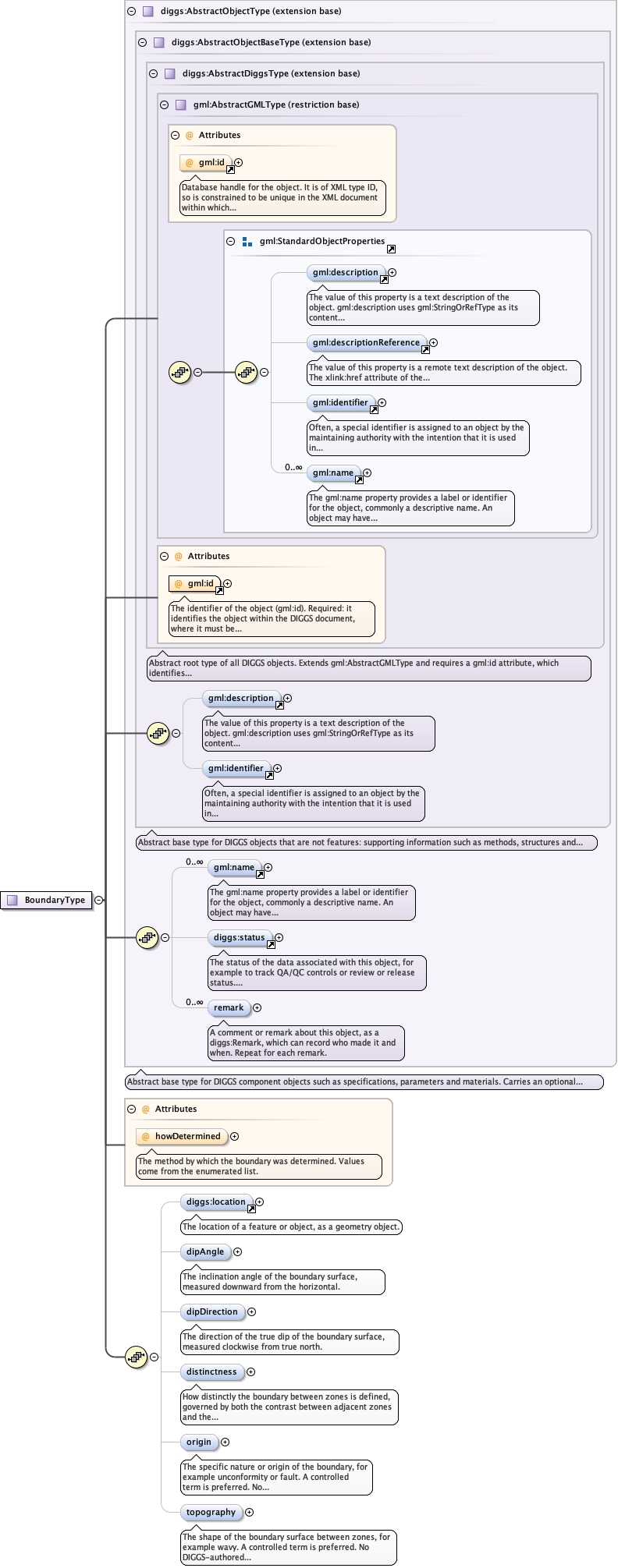
<complexType name="BoundaryType"><complexContent><extension base="diggs:AbstractObjectType"><sequence><element minOccurs="0" ref="diggs:location"/><element minOccurs="0" name="dipAngle" type="diggs:DipMeasureType"><annotation><documentation>The inclination angle of the boundary surface, measured downward from the horizontal.</documentation></annotation></element><element minOccurs="0" name="dipDirection" type="diggs:PlaneAngleMeasureType"><annotation><documentation>The direction of the true dip of the boundary surface, measured clockwise from true north.</documentation></annotation></element><element minOccurs="0" name="distinctness" type="gml:CodeType"><annotation><documentation>How distinctly the boundary between zones is defined, governed by both the contrast between adjacent zones and the width of the boundary, for example sharp or gradational. A controlled term is preferred. No DIGGS-authored dictionary currently exists for this element.</documentation></annotation></element><element minOccurs="0" name="origin" type="gml:CodeType"><annotation><documentation>The specific nature or origin of the boundary, for example unconformity or fault. A controlled term is preferred. No DIGGS-authored dictionary currently exists for this element.</documentation></annotation></element><element minOccurs="0" name="topography" type="gml:CodeType"><annotation><documentation>The shape of the boundary surface between zones, for example wavy. A controlled term is preferred. No DIGGS-authored dictionary currently exists for this element.</documentation></annotation></element></sequence><attribute name="howDetermined" type="diggs:DescriptorMethodEnumType"><annotation><documentation>The method by which the boundary was determined. Values come from the enumerated list.</documentation></annotation></attribute></extension></complexContent></complexType>
<attribute name="howDetermined" type="diggs:DescriptorMethodEnumType"><annotation><documentation>The method by which the boundary was determined. Values come from the enumerated list.</documentation></annotation></attribute>