Showing:

Annotations
Attributes
Diagrams
Facets
Instances
Model
Properties
Source
Used by
Element diggs:AbstractSamplingActivityType / diggs:samplingLocation
Namespace http://diggsml.org/schemas/3
Annotations
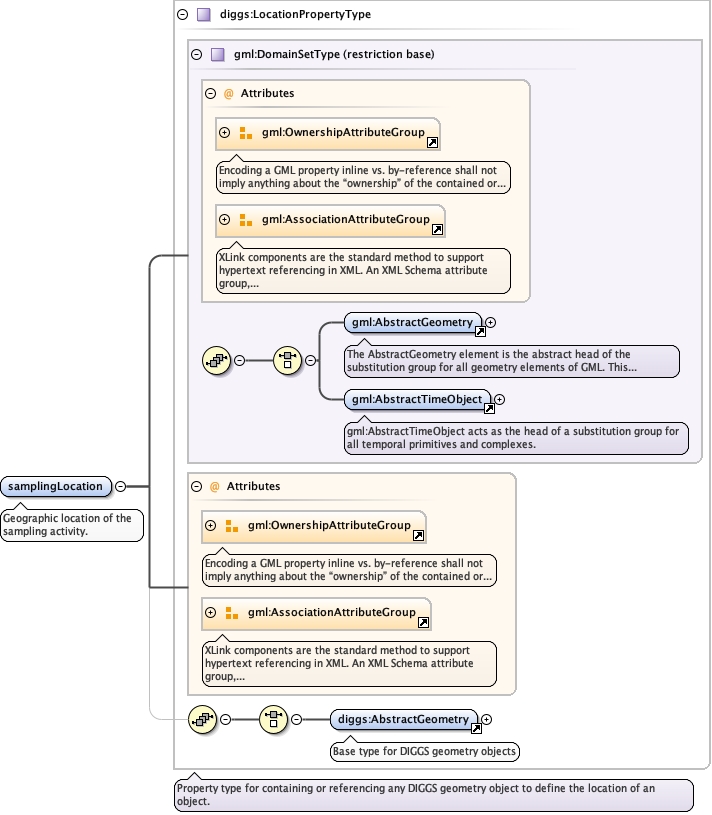
Geographic location of the sampling
activity.
Diagram
Diagramgml3_2Profile_diggs_xsd_Attribute_Group_gml_OwnershipAttributeGroup.tmp#OwnershipAttributeGroupgml3_2Profile_diggs_xsd_Attribute_Group_gml_AssociationAttributeGroup.tmp#AssociationAttributeGroupgml3_2Profile_diggs_xsd_Element_gml_AbstractGeometry.tmp#AbstractGeometrygml3_2Profile_diggs_xsd_Element_gml_AbstractTimeObject.tmp#AbstractTimeObjectgml3_2Profile_diggs_xsd_Complex_Type_gml_DomainSetType.tmp#DomainSetTypegml3_2Profile_diggs_xsd_Attribute_Group_gml_OwnershipAttributeGroup.tmp#OwnershipAttributeGroupgml3_2Profile_diggs_xsd_Attribute_Group_gml_AssociationAttributeGroup.tmp#AssociationAttributeGroupCore_xsd_Element_diggs_AbstractGeometry.tmp#http___diggsml.org_schemas_3_AbstractGeometryCommon_xsd_Complex_Type_diggs_LocationPropertyType.tmp#LocationPropertyType
Type diggs:LocationPropertyType
Type hierarchy
Properties
content complex
minOccurs 1
Model
Children diggs:AbstractGeometry
Instance
<diggs:samplingLocation xlink:actuate="" xlink:role="" xlink:arcrole="" xlink:show="" xlink:title="" xlink:href="" xlink:type="simple" nilReason="" owns="false" xmlns:diggs="http://diggsml.org/schemas/3">
  <diggs:AbstractGeometry axisLabels="" gml:id="" srsDimension="" srsName="" uomLabels="">{1,1}</diggs:AbstractGeometry>
</diggs:samplingLocation>
Attributes
QName Type Fixed Default Use Annotation
nilReason gml:NilReasonType optional
owns boolean false optional
xlink:actuate restriction of string optional
The 'actuate' attribute is used to communicate the desired timing 
of traversal from the starting resource to the ending resource; 
it's value should be treated as follows:
onLoad - traverse to the ending resource immediately on loading 
         the starting resource 
onRequest - traverse from the starting resource to the ending 
            resource only on a post-loading event triggered for 
            this purpose 
other - behavior is unconstrained; examine other markup in link 
        for hints 
none - behavior is unconstrained
xlink:arcrole anyURI optional
xlink:href anyURI optional
xlink:role anyURI optional
xlink:show restriction of string optional
The 'show' attribute is used to communicate the desired presentation 
of the ending resource on traversal from the starting resource; it's 
value should be treated as follows: 
new - load ending resource in a new window, frame, pane, or other 
      presentation context
replace - load the resource in the same window, frame, pane, or 
          other presentation context
embed - load ending resource in place of the presentation of the 
        starting resource
other - behavior is unconstrained; examine other markup in the 
        link for hints 
none - behavior is unconstrained
xlink:title string optional
xlink:type string simple optional
Source
<element name="samplingLocation" type="diggs:LocationPropertyType" minOccurs="1">
  <annotation>
    <documentation>Geographic location of the sampling activity.</documentation>
  </annotation>
</element>
Element diggs:AbstractSamplingActivityType / diggs:sourceSampleRef
Namespace http://diggsml.org/schemas/3
Annotations
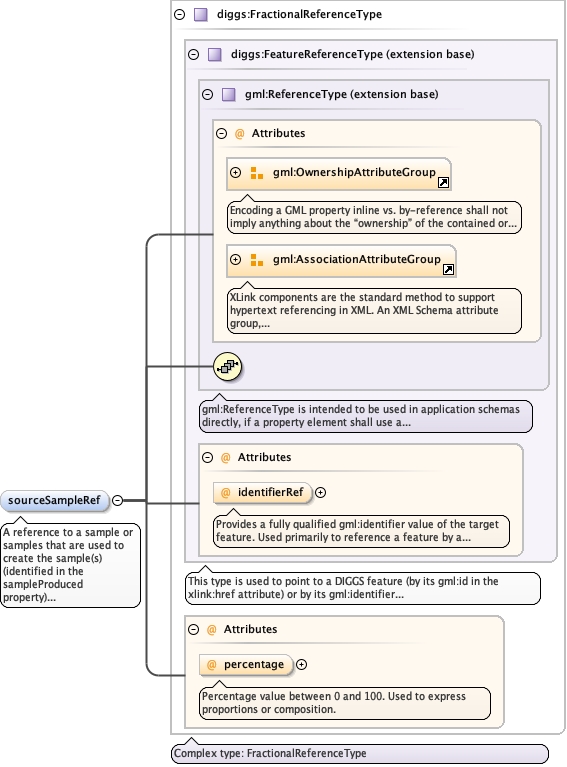
A reference to a sample or samples that are used to
create the sample(s) (identified in the sampleProduced property)
produced by this activity. This element is only used for activities
that subsample or aggregate samples from other samples. For
aggregate samples, the percentage attribute optionally defines how
much of the total new sample is composed from the source
sample.
Diagram
Diagramgml3_2Profile_diggs_xsd_Attribute_Group_gml_OwnershipAttributeGroup.tmp#OwnershipAttributeGroupgml3_2Profile_diggs_xsd_Attribute_Group_gml_AssociationAttributeGroup.tmp#AssociationAttributeGroupgml3_2Profile_diggs_xsd_Complex_Type_gml_ReferenceType.tmp#ReferenceTypeCommon_xsd_Complex_Type_diggs_FeatureReferenceType.tmp#FeatureReferenceType_identifierRefCommon_xsd_Complex_Type_diggs_FeatureReferenceType.tmp#FeatureReferenceTypeCommon_xsd_Complex_Type_diggs_FractionalReferenceType.tmp#FractionalReferenceType_percentageCommon_xsd_Complex_Type_diggs_FractionalReferenceType.tmp#FractionalReferenceType
Type diggs:FractionalReferenceType
Type hierarchy
Properties
content complex
minOccurs 0
maxOccurs unbounded
Model
Attributes
QName Type Fixed Default Use Annotation
identifierRef diggs:IdentifierReferenceType optional
Provides a fully qualified gml:identifier value of the target
feature. Used primarily to reference a feature by a globally unique
identifier as opposed to the gml:id
nilReason gml:NilReasonType optional
owns boolean false optional
percentage diggs:Val0-100Type optional
Percentage value between 0 and 100. Used to express
proportions or composition.
xlink:actuate restriction of string optional
The 'actuate' attribute is used to communicate the desired timing 
of traversal from the starting resource to the ending resource; 
it's value should be treated as follows:
onLoad - traverse to the ending resource immediately on loading 
         the starting resource 
onRequest - traverse from the starting resource to the ending 
            resource only on a post-loading event triggered for 
            this purpose 
other - behavior is unconstrained; examine other markup in link 
        for hints 
none - behavior is unconstrained
xlink:arcrole anyURI optional
xlink:href anyURI optional
xlink:role anyURI optional
xlink:show restriction of string optional
The 'show' attribute is used to communicate the desired presentation 
of the ending resource on traversal from the starting resource; it's 
value should be treated as follows: 
new - load ending resource in a new window, frame, pane, or other 
      presentation context
replace - load the resource in the same window, frame, pane, or 
          other presentation context
embed - load ending resource in place of the presentation of the 
        starting resource
other - behavior is unconstrained; examine other markup in the 
        link for hints 
none - behavior is unconstrained
xlink:title string optional
xlink:type string simple optional
Source
<element minOccurs="0" name="sourceSampleRef" maxOccurs="unbounded" type="diggs:FractionalReferenceType">
  <annotation>
    <appinfo source="urn:x-gml:targetElement">diggs:Sample/@gml:id</appinfo>
    <documentation>A reference to a sample or samples that are used to create the sample(s) (identified in the sampleProduced property) produced by this activity. This element is only used for activities that subsample or aggregate samples from other samples. For aggregate samples, the percentage attribute optionally defines how much of the total new sample is composed from the source sample.</documentation>
  </annotation>
</element>
Element diggs:AbstractSamplingActivityType / diggs:activityType
Namespace http://diggsml.org/schemas/3
Annotations
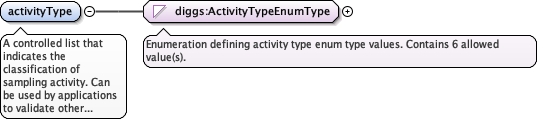
A controlled list that indicates the classification of
sampling activity. Can be used by applications to validate other
activity info. One of the following strings must be used: collect -
activity created a sample or samples by collection from a sampling
feature; aggregate - activity created a sample or samples by
aggregating existing samples; the associated Sample(s) should
contain more than one sourceSampleRef; subsample - activity created
a sample or samples by subsampling an existing sample; only one
sourceSampleRef should be specified for the related Sample(s); test
- activity produced a test, standard or blank sample that does not
relate to any field sample or sampling feature; activity will point
to a project but no sourceSampleRef nor samplingFeatureRef should be
specified for the associated Sample(s). none - the sample activity
failed to produce any physical sample; unknown - used where no
information about the sampling activity exists (eg. for legacy data
where only sample name or label and location (depth) exists).
Diagram
DiagramCore_xsd_Simple_Type_diggs_ActivityTypeEnumType.tmp#ActivityTypeEnumType
Type diggs:ActivityTypeEnumType
Properties
content simple
Facets
enumeration aggregate
aggregate - aggregate value.
enumeration collect
collect - collect value.
enumeration none
none - none value.
enumeration subsample
subsample - subsample value.
enumeration test
test - test value.
enumeration unknown
unknown - unknown value.
Source
<element name="activityType" type="diggs:ActivityTypeEnumType">
  <annotation>
    <documentation>A controlled list that indicates the classification of sampling activity. Can be used by applications to validate other activity info. One of the following strings must be used: collect - activity created a sample or samples by collection from a sampling feature; aggregate - activity created a sample or samples by aggregating existing samples; the associated Sample(s) should contain more than one sourceSampleRef; subsample - activity created a sample or samples by subsampling an existing sample; only one sourceSampleRef should be specified for the related Sample(s); test - activity produced a test, standard or blank sample that does not relate to any field sample or sampling feature; activity will point to a project but no sourceSampleRef nor samplingFeatureRef should be specified for the associated Sample(s). none - the sample activity failed to produce any physical sample; unknown - used where no information about the sampling activity exists (eg. for legacy data where only sample name or label and location (depth) exists).</documentation>
  </annotation>
</element>
Element diggs:AbstractSamplingActivityType / diggs:lengthLongestPortion
Namespace http://diggsml.org/schemas/3
Annotations
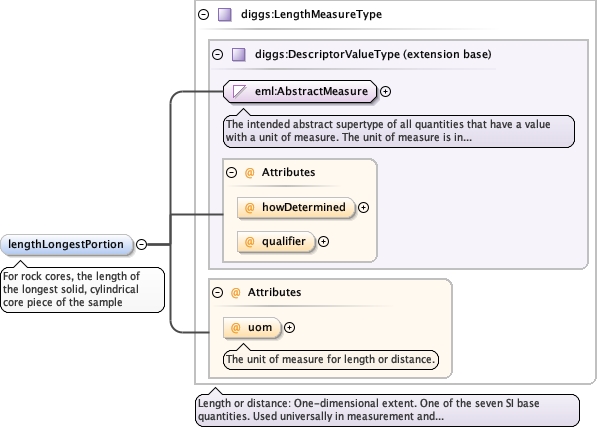
For rock cores, the length of the longest solid,
cylindrical core piece of the sample
Diagram
DiagramEmlAllObjects_xsd_Simple_Type_eml_AbstractMeasure.tmp#AbstractMeasureMeasureTypes_xsd_Complex_Type_diggs_DescriptorValueType.tmp#DescriptorValueType_howDeterminedMeasureTypes_xsd_Complex_Type_diggs_DescriptorValueType.tmp#DescriptorValueType_qualifierMeasureTypes_xsd_Complex_Type_diggs_DescriptorValueType.tmp#DescriptorValueTypeMeasureTypes_xsd_Complex_Type_diggs_LengthMeasureType.tmp#LengthMeasureType_uomMeasureTypes_xsd_Complex_Type_diggs_LengthMeasureType.tmp#LengthMeasureType
Type diggs:LengthMeasureType
Type hierarchy
Properties
content complex
minOccurs 0
Attributes
QName Type Use Annotation
howDetermined diggs:DescriptorMethodEnumType optional
qualifier diggs:QualifierEnumExtType optional
uom diggs:LengthUomEnumType optional
The unit of measure for length or distance.
Source
<element minOccurs="0" name="lengthLongestPortion" type="diggs:LengthMeasureType">
  <annotation>
    <documentation>For rock cores, the length of the longest solid, cylindrical core piece of the sample</documentation>
  </annotation>
</element>
Element diggs:AbstractSamplingActivityType / diggs:purpose
Namespace http://diggsml.org/schemas/3
Annotations
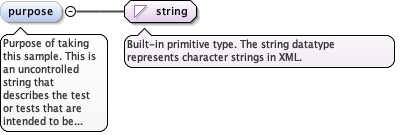
Purpose of taking this sample. This is an uncontrolled
string that describes the test or tests that are intended to be run
on the sample(s) generated from this activity.
Diagram
Diagram
Type string
Properties
content simple
minOccurs 0
Source
<element minOccurs="0" name="purpose" type="string">
  <annotation>
    <documentation>Purpose of taking this sample. This is an uncontrolled string that describes the test or tests that are intended to be run on the sample(s) generated from this activity.</documentation>
  </annotation>
</element>
Element diggs:AbstractSamplingActivityType / diggs:rockQualityDesignationLength
Namespace http://diggsml.org/schemas/3
Annotations
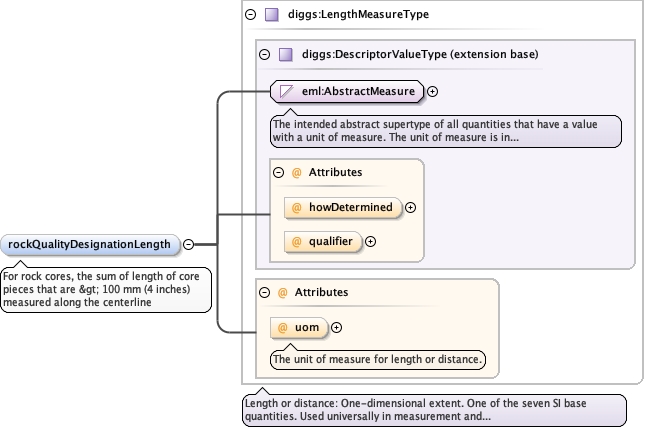
For rock cores, the sum of length of core pieces that are
> 100 mm (4 inches) measured along the centerline
Diagram
DiagramEmlAllObjects_xsd_Simple_Type_eml_AbstractMeasure.tmp#AbstractMeasureMeasureTypes_xsd_Complex_Type_diggs_DescriptorValueType.tmp#DescriptorValueType_howDeterminedMeasureTypes_xsd_Complex_Type_diggs_DescriptorValueType.tmp#DescriptorValueType_qualifierMeasureTypes_xsd_Complex_Type_diggs_DescriptorValueType.tmp#DescriptorValueTypeMeasureTypes_xsd_Complex_Type_diggs_LengthMeasureType.tmp#LengthMeasureType_uomMeasureTypes_xsd_Complex_Type_diggs_LengthMeasureType.tmp#LengthMeasureType
Type diggs:LengthMeasureType
Type hierarchy
Properties
content complex
minOccurs 0
Attributes
QName Type Use Annotation
howDetermined diggs:DescriptorMethodEnumType optional
qualifier diggs:QualifierEnumExtType optional
uom diggs:LengthUomEnumType optional
The unit of measure for length or distance.
Source
<element minOccurs="0" name="rockQualityDesignationLength" type="diggs:LengthMeasureType">
  <annotation>
    <documentation>For rock cores, the sum of length of core pieces that are > 100 mm (4 inches) measured along the centerline</documentation>
  </annotation>
</element>
Element diggs:AbstractSamplingActivityType / diggs:samplingActivityRQD
Namespace http://diggsml.org/schemas/3
Annotations
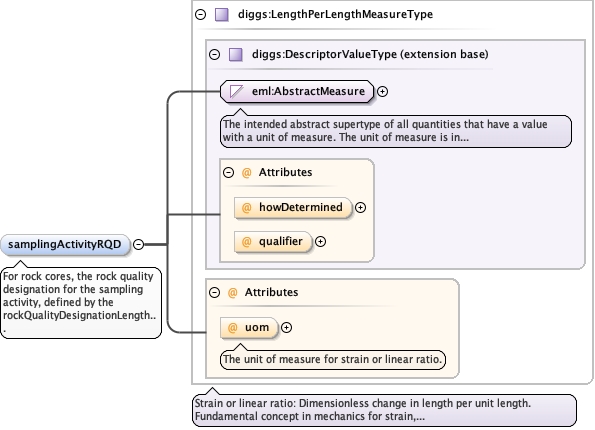
For rock cores, the rock quality designation for the
sampling activity, defined by the rockQualityDesignationLength
divided by the core run (length of sampling activity
interval)
Diagram
DiagramEmlAllObjects_xsd_Simple_Type_eml_AbstractMeasure.tmp#AbstractMeasureMeasureTypes_xsd_Complex_Type_diggs_DescriptorValueType.tmp#DescriptorValueType_howDeterminedMeasureTypes_xsd_Complex_Type_diggs_DescriptorValueType.tmp#DescriptorValueType_qualifierMeasureTypes_xsd_Complex_Type_diggs_DescriptorValueType.tmp#DescriptorValueTypeMeasureTypes_xsd_Complex_Type_diggs_LengthPerLengthMeasureType.tmp#LengthPerLengthMeasureType_uomMeasureTypes_xsd_Complex_Type_diggs_LengthPerLengthMeasureType.tmp#LengthPerLengthMeasureType
Type diggs:LengthPerLengthMeasureType
Type hierarchy
Properties
content complex
minOccurs 0
Attributes
QName Type Use Annotation
howDetermined diggs:DescriptorMethodEnumType optional
qualifier diggs:QualifierEnumExtType optional
uom diggs:LengthPerLengthUomEnumType optional
The unit of measure for strain or linear ratio.
Source
<element minOccurs="0" name="samplingActivityRQD" type="diggs:LengthPerLengthMeasureType">
  <annotation>
    <documentation>For rock cores, the rock quality designation for the sampling activity, defined by the rockQualityDesignationLength divided by the core run (length of sampling activity interval)</documentation>
  </annotation>
</element>
Element diggs:AbstractSamplingActivityType / diggs:sampleProduced
Namespace http://diggsml.org/schemas/3
Annotations
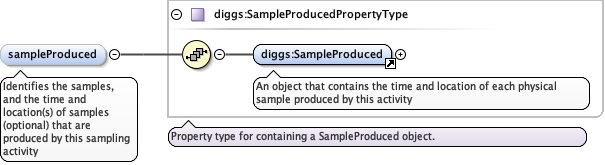
Identifies the samples, and the time and location(s) of
samples (optional) that are produced by this sampling
activity
Diagram
DiagramCommon_xsd_Element_diggs_SampleProduced.tmp#SampleProducedCommon_xsd_Complex_Type_diggs_SampleProducedPropertyType.tmp#SampleProducedPropertyType
Type diggs:SampleProducedPropertyType
Properties
content complex
minOccurs 0
maxOccurs unbounded
Model
Children diggs:SampleProduced
Instance
<diggs:sampleProduced xmlns:diggs="http://diggsml.org/schemas/3">
  <diggs:SampleProduced gml:id="">{1,1}</diggs:SampleProduced>
</diggs:sampleProduced>
Source
<element maxOccurs="unbounded" minOccurs="0" name="sampleProduced" type="diggs:SampleProducedPropertyType">
  <annotation>
    <documentation>Identifies the samples, and the time and location(s) of samples (optional) that are produced by this sampling activity</documentation>
  </annotation>
</element>
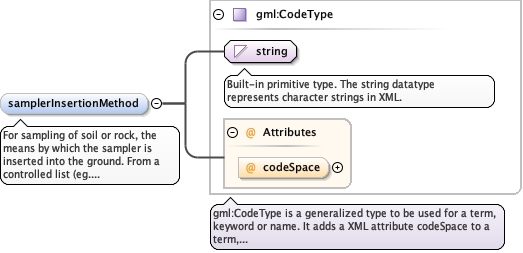
Element diggs:AbstractSamplingActivityType / diggs:samplerInsertionMethod
Namespace http://diggsml.org/schemas/3
Annotations
For sampling of soil or rock, the means by which the
sampler is inserted into the ground. From a controlled list (eg.
pushed, driven, etc.
Diagram
Diagramgml3_2Profile_diggs_xsd_Complex_Type_gml_CodeType.tmp#CodeType_codeSpacegml3_2Profile_diggs_xsd_Complex_Type_gml_CodeType.tmp#CodeType
Type gml:CodeType
Properties
content complex
minOccurs 0
Attributes
QName Type Use
codeSpace anyURI optional
Source
<element minOccurs="0" name="samplerInsertionMethod" type="gml:CodeType">
  <annotation>
    <documentation>For sampling of soil or rock, the means by which the sampler is inserted into the ground. From a controlled list (eg. pushed, driven, etc.</documentation>
  </annotation>
</element>
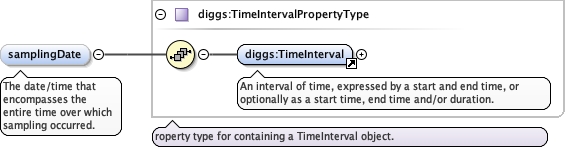
Element diggs:AbstractSamplingActivityType / diggs:samplingDate
Namespace http://diggsml.org/schemas/3
Annotations
The date/time that encompasses the entire time over which
sampling occurred.
Diagram
DiagramCommon_xsd_Element_diggs_TimeInterval.tmp#TimeIntervalCommon_xsd_Complex_Type_diggs_TimeIntervalPropertyType.tmp#TimeIntervalPropertyType
Type diggs:TimeIntervalPropertyType
Properties
content complex
minOccurs 0
Model
Children diggs:TimeInterval
Instance
<diggs:samplingDate xmlns:diggs="http://diggsml.org/schemas/3">
  <diggs:TimeInterval gml:id="">{1,1}</diggs:TimeInterval>
</diggs:samplingDate>
Source
<element minOccurs="0" name="samplingDate" type="diggs:TimeIntervalPropertyType">
  <annotation>
    <documentation>The date/time that encompasses the entire time over which sampling occurred.</documentation>
  </annotation>
</element>
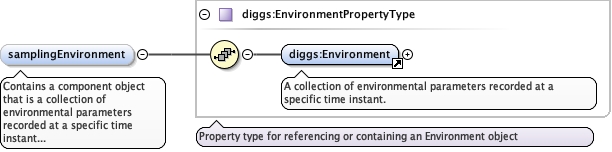
Element diggs:AbstractSamplingActivityType / diggs:samplingEnvironment
Namespace http://diggsml.org/schemas/3
Annotations
Contains a component object that is a collection of
environmental parameters recorded at a specific time instant dureing
the sampling.
Diagram
DiagramCommon_xsd_Element_diggs_Environment.tmp#EnvironmentCommon_xsd_Complex_Type_diggs_EnvironmentPropertyType.tmp#EnvironmentPropertyType
Type diggs:EnvironmentPropertyType
Properties
content complex
minOccurs 0
maxOccurs unbounded
Model
Children diggs:Environment
Instance
<diggs:samplingEnvironment xmlns:diggs="http://diggsml.org/schemas/3">
  <diggs:Environment gml:id="">{1,1}</diggs:Environment>
</diggs:samplingEnvironment>
Source
<element minOccurs="0" name="samplingEnvironment" type="diggs:EnvironmentPropertyType" maxOccurs="unbounded">
  <annotation>
    <documentation>Contains a component object that is a collection of environmental parameters recorded at a specific time instant dureing the sampling.</documentation>
  </annotation>
</element>
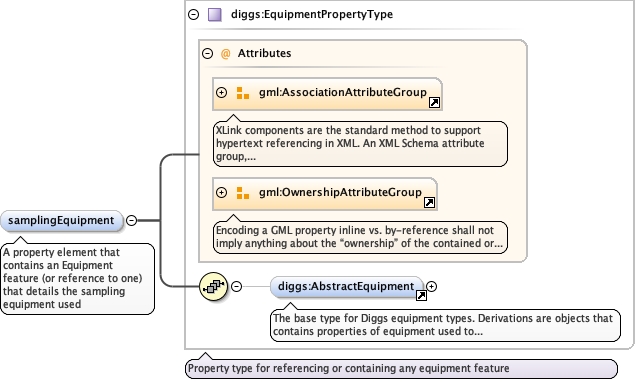
Element diggs:AbstractSamplingActivityType / diggs:samplingEquipment
Namespace http://diggsml.org/schemas/3
Annotations
A property element that contains an Equipment feature (or
reference to one) that details the sampling equipment
used
Diagram
Diagramgml3_2Profile_diggs_xsd_Attribute_Group_gml_AssociationAttributeGroup.tmp#AssociationAttributeGroupgml3_2Profile_diggs_xsd_Attribute_Group_gml_OwnershipAttributeGroup.tmp#OwnershipAttributeGroupAbstractTypes_xsd_Element_diggs_AbstractEquipment.tmp#AbstractEquipmentCommon_xsd_Complex_Type_diggs_EquipmentPropertyType.tmp#EquipmentPropertyType
Type diggs:EquipmentPropertyType
Properties
content complex
minOccurs 0
maxOccurs unbounded
Model
Children diggs:AbstractEquipment
Instance
<diggs:samplingEquipment xlink:actuate="" xlink:arcrole="" xlink:href="" nilReason="" owns="false" xlink:role="" xlink:show="" xlink:title="" xlink:type="simple" xmlns:diggs="http://diggsml.org/schemas/3">
  <diggs:AbstractEquipment gml:id="">{0,1}</diggs:AbstractEquipment>
</diggs:samplingEquipment>
Attributes
QName Type Fixed Default Use Annotation
nilReason gml:NilReasonType optional
owns boolean false optional
xlink:actuate restriction of string optional
The 'actuate' attribute is used to communicate the desired timing 
of traversal from the starting resource to the ending resource; 
it's value should be treated as follows:
onLoad - traverse to the ending resource immediately on loading 
         the starting resource 
onRequest - traverse from the starting resource to the ending 
            resource only on a post-loading event triggered for 
            this purpose 
other - behavior is unconstrained; examine other markup in link 
        for hints 
none - behavior is unconstrained
xlink:arcrole anyURI optional
xlink:href anyURI optional
xlink:role anyURI optional
xlink:show restriction of string optional
The 'show' attribute is used to communicate the desired presentation 
of the ending resource on traversal from the starting resource; it's 
value should be treated as follows: 
new - load ending resource in a new window, frame, pane, or other 
      presentation context
replace - load the resource in the same window, frame, pane, or 
          other presentation context
embed - load ending resource in place of the presentation of the 
        starting resource
other - behavior is unconstrained; examine other markup in the 
        link for hints 
none - behavior is unconstrained
xlink:title string optional
xlink:type string simple optional
Source
<element name="samplingEquipment" type="diggs:EquipmentPropertyType" maxOccurs="unbounded" minOccurs="0">
  <annotation>
    <appinfo>diggs:AbstractEquipment</appinfo>
    <documentation>A property element that contains an Equipment feature (or reference to one) that details the sampling equipment used</documentation>
  </annotation>
</element>
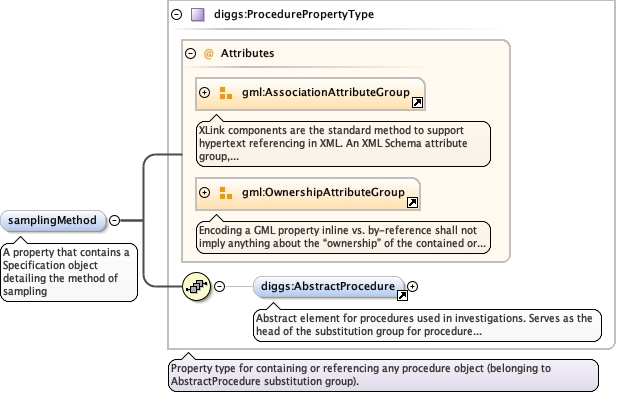
Element diggs:AbstractSamplingActivityType / diggs:samplingMethod
Namespace http://diggsml.org/schemas/3
Annotations
A property that contains a Specification object detailing
the method of sampling
Diagram
Diagramgml3_2Profile_diggs_xsd_Attribute_Group_gml_AssociationAttributeGroup.tmp#AssociationAttributeGroupgml3_2Profile_diggs_xsd_Attribute_Group_gml_OwnershipAttributeGroup.tmp#OwnershipAttributeGroupAbstractTypes_xsd_Element_diggs_AbstractProcedure.tmp#AbstractProcedureCommon_xsd_Complex_Type_diggs_ProcedurePropertyType.tmp#ProcedurePropertyType
Type diggs:ProcedurePropertyType
Properties
content complex
minOccurs 0
maxOccurs unbounded
Model
Children diggs:AbstractProcedure
Instance
<diggs:samplingMethod xlink:actuate="" xlink:arcrole="" xlink:href="" nilReason="" owns="false" xlink:role="" xlink:show="" xlink:title="" xlink:type="simple" xmlns:diggs="http://diggsml.org/schemas/3">
  <diggs:AbstractProcedure gml:id="">{0,1}</diggs:AbstractProcedure>
</diggs:samplingMethod>
Attributes
QName Type Fixed Default Use Annotation
nilReason gml:NilReasonType optional
owns boolean false optional
xlink:actuate restriction of string optional
The 'actuate' attribute is used to communicate the desired timing 
of traversal from the starting resource to the ending resource; 
it's value should be treated as follows:
onLoad - traverse to the ending resource immediately on loading 
         the starting resource 
onRequest - traverse from the starting resource to the ending 
            resource only on a post-loading event triggered for 
            this purpose 
other - behavior is unconstrained; examine other markup in link 
        for hints 
none - behavior is unconstrained
xlink:arcrole anyURI optional
xlink:href anyURI optional
xlink:role anyURI optional
xlink:show restriction of string optional
The 'show' attribute is used to communicate the desired presentation 
of the ending resource on traversal from the starting resource; it's 
value should be treated as follows: 
new - load ending resource in a new window, frame, pane, or other 
      presentation context
replace - load the resource in the same window, frame, pane, or 
          other presentation context
embed - load ending resource in place of the presentation of the 
        starting resource
other - behavior is unconstrained; examine other markup in the 
        link for hints 
none - behavior is unconstrained
xlink:title string optional
xlink:type string simple optional
Source
<element name="samplingMethod" type="diggs:ProcedurePropertyType" maxOccurs="unbounded" minOccurs="0">
  <annotation>
    <documentation>A property that contains a Specification object detailing the method of sampling</documentation>
  </annotation>
</element>
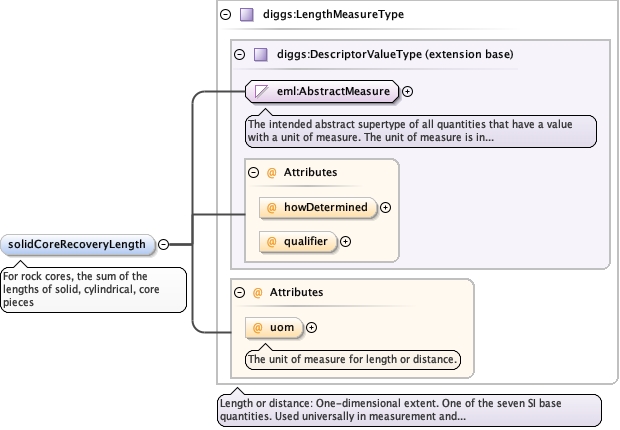
Element diggs:AbstractSamplingActivityType / diggs:solidCoreRecoveryLength
Namespace http://diggsml.org/schemas/3
Annotations
For rock cores, the sum of the lengths of solid,
cylindrical, core pieces
Diagram
DiagramEmlAllObjects_xsd_Simple_Type_eml_AbstractMeasure.tmp#AbstractMeasureMeasureTypes_xsd_Complex_Type_diggs_DescriptorValueType.tmp#DescriptorValueType_howDeterminedMeasureTypes_xsd_Complex_Type_diggs_DescriptorValueType.tmp#DescriptorValueType_qualifierMeasureTypes_xsd_Complex_Type_diggs_DescriptorValueType.tmp#DescriptorValueTypeMeasureTypes_xsd_Complex_Type_diggs_LengthMeasureType.tmp#LengthMeasureType_uomMeasureTypes_xsd_Complex_Type_diggs_LengthMeasureType.tmp#LengthMeasureType
Type diggs:LengthMeasureType
Type hierarchy
Properties
content complex
minOccurs 0
Attributes
QName Type Use Annotation
howDetermined diggs:DescriptorMethodEnumType optional
qualifier diggs:QualifierEnumExtType optional
uom diggs:LengthUomEnumType optional
The unit of measure for length or distance.
Source
<element minOccurs="0" name="solidCoreRecoveryLength" type="diggs:LengthMeasureType">
  <annotation>
    <documentation>For rock cores, the sum of the lengths of solid, cylindrical, core pieces</documentation>
  </annotation>
</element>
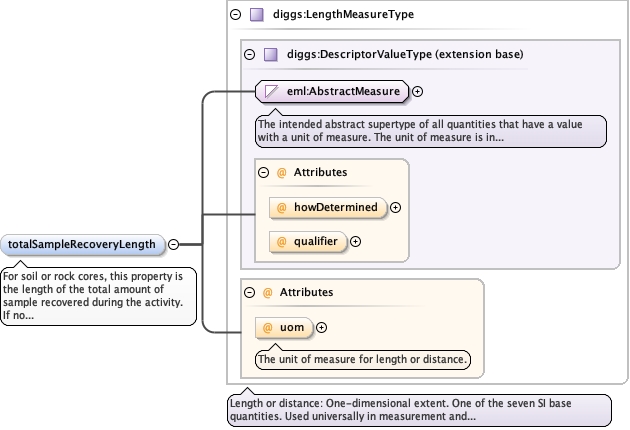
Element diggs:AbstractSamplingActivityType / diggs:totalSampleRecoveryLength
Namespace http://diggsml.org/schemas/3
Annotations
For soil or rock cores, this property is the length of
the total amount of sample recovered during the activity. If no
sample is recovered, this value is 0. This value can also be derived
if totalSampleRecovery is reported.
Diagram
DiagramEmlAllObjects_xsd_Simple_Type_eml_AbstractMeasure.tmp#AbstractMeasureMeasureTypes_xsd_Complex_Type_diggs_DescriptorValueType.tmp#DescriptorValueType_howDeterminedMeasureTypes_xsd_Complex_Type_diggs_DescriptorValueType.tmp#DescriptorValueType_qualifierMeasureTypes_xsd_Complex_Type_diggs_DescriptorValueType.tmp#DescriptorValueTypeMeasureTypes_xsd_Complex_Type_diggs_LengthMeasureType.tmp#LengthMeasureType_uomMeasureTypes_xsd_Complex_Type_diggs_LengthMeasureType.tmp#LengthMeasureType
Type diggs:LengthMeasureType
Type hierarchy
Properties
content complex
minOccurs 0
Attributes
QName Type Use Annotation
howDetermined diggs:DescriptorMethodEnumType optional
qualifier diggs:QualifierEnumExtType optional
uom diggs:LengthUomEnumType optional
The unit of measure for length or distance.
Source
<element minOccurs="0" name="totalSampleRecoveryLength" type="diggs:LengthMeasureType">
  <annotation>
    <documentation>For soil or rock cores, this property is the length of the total amount of sample recovered during the activity. If no sample is recovered, this value is 0. This value can also be derived if totalSampleRecovery is reported.</documentation>
  </annotation>
</element>
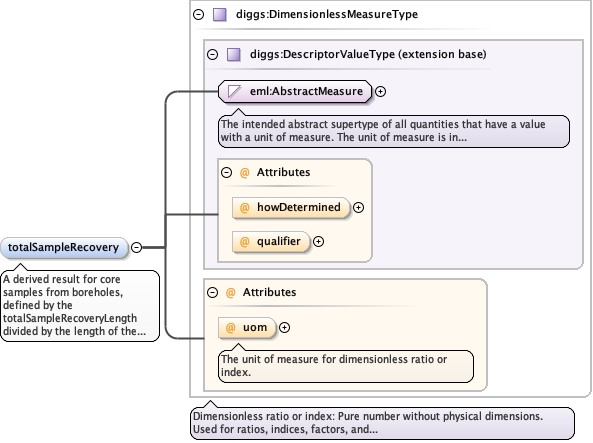
Element diggs:AbstractSamplingActivityType / diggs:totalSampleRecovery
Namespace http://diggsml.org/schemas/3
Annotations
A derived result for core samples from boreholes, defined
by the totalSampleRecoveryLength divided by the length of the
samplingActivity intervsl, typically reported as a
percent.
Diagram
DiagramEmlAllObjects_xsd_Simple_Type_eml_AbstractMeasure.tmp#AbstractMeasureMeasureTypes_xsd_Complex_Type_diggs_DescriptorValueType.tmp#DescriptorValueType_howDeterminedMeasureTypes_xsd_Complex_Type_diggs_DescriptorValueType.tmp#DescriptorValueType_qualifierMeasureTypes_xsd_Complex_Type_diggs_DescriptorValueType.tmp#DescriptorValueTypeMeasureTypes_xsd_Complex_Type_diggs_DimensionlessMeasureType.tmp#DimensionlessMeasureType_uomMeasureTypes_xsd_Complex_Type_diggs_DimensionlessMeasureType.tmp#DimensionlessMeasureType
Type diggs:DimensionlessMeasureType
Type hierarchy
Properties
content complex
minOccurs 0
Attributes
QName Type Use Annotation
howDetermined diggs:DescriptorMethodEnumType optional
qualifier diggs:QualifierEnumExtType optional
uom diggs:DimensionlessUomEnumType optional
The unit of measure for dimensionless ratio or index.
Source
<element minOccurs="0" name="totalSampleRecovery" type="diggs:DimensionlessMeasureType">
  <annotation>
    <documentation>A derived result for core samples from boreholes, defined by the totalSampleRecoveryLength divided by the length of the samplingActivity intervsl, typically reported as a percent.</documentation>
  </annotation>
</element>
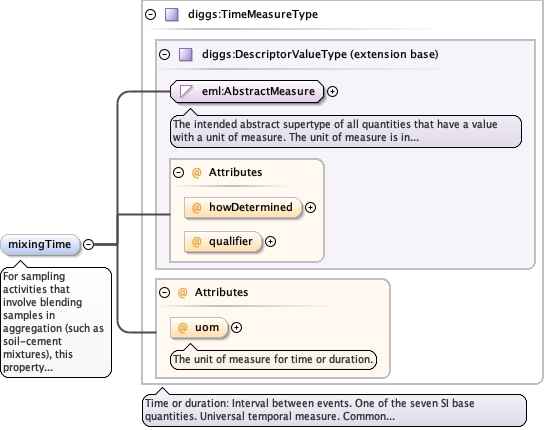
Element diggs:AbstractSamplingActivityType / diggs:mixingTime
Namespace http://diggsml.org/schemas/3
Annotations
For sampling activities that involve blending samples in
aggregation (such as soil-cement mixtures), this property carries
the time duration to mix the sample together.
Diagram
DiagramEmlAllObjects_xsd_Simple_Type_eml_AbstractMeasure.tmp#AbstractMeasureMeasureTypes_xsd_Complex_Type_diggs_DescriptorValueType.tmp#DescriptorValueType_howDeterminedMeasureTypes_xsd_Complex_Type_diggs_DescriptorValueType.tmp#DescriptorValueType_qualifierMeasureTypes_xsd_Complex_Type_diggs_DescriptorValueType.tmp#DescriptorValueTypeMeasureTypes_xsd_Complex_Type_diggs_TimeMeasureType.tmp#TimeMeasureType_uomMeasureTypes_xsd_Complex_Type_diggs_TimeMeasureType.tmp#TimeMeasureType
Type diggs:TimeMeasureType
Type hierarchy
Properties
content complex
minOccurs 0
Attributes
QName Type Use Annotation
howDetermined diggs:DescriptorMethodEnumType optional
qualifier diggs:QualifierEnumExtType optional
uom diggs:TimeUomEnumType optional
The unit of measure for time or duration.
Source
<element minOccurs="0" name="mixingTime" type="diggs:TimeMeasureType">
  <annotation>
    <documentation>For sampling activities that involve blending samples in aggregation (such as soil-cement mixtures), this property carries the time duration to mix the sample together.</documentation>
  </annotation>
</element>
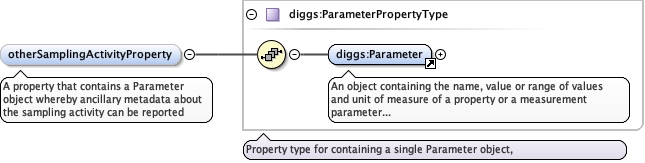
Element diggs:AbstractSamplingActivityType / diggs:otherSamplingActivityProperty
Namespace http://diggsml.org/schemas/3
Annotations
A property that contains a Parameter object whereby
ancillary metadata about the sampling activity can be
reported
Diagram
DiagramCommon_xsd_Element_diggs_Parameter.tmp#ParameterCommon_xsd_Complex_Type_diggs_ParameterPropertyType.tmp#ParameterPropertyType
Type diggs:ParameterPropertyType
Properties
content complex
minOccurs 0
maxOccurs unbounded
Model
Children diggs:Parameter
Instance
<diggs:otherSamplingActivityProperty xmlns:diggs="http://diggsml.org/schemas/3">
  <diggs:Parameter gml:id="" index="">{1,1}</diggs:Parameter>
</diggs:otherSamplingActivityProperty>
Source
<element maxOccurs="unbounded" minOccurs="0" name="otherSamplingActivityProperty" type="diggs:ParameterPropertyType">
  <annotation>
    <documentation>A property that contains a Parameter object whereby ancillary metadata about the sampling activity can be reported</documentation>
  </annotation>
</element>
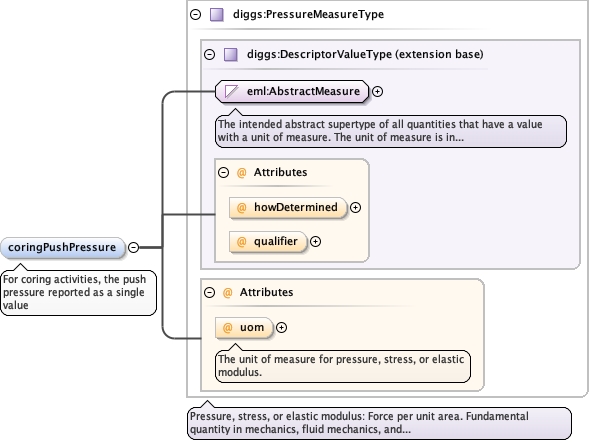
Element diggs:AbstractSamplingActivityType / diggs:coringPushPressure
Namespace http://diggsml.org/schemas/3
Annotations
For coring activities, the push pressure reported as
a single value
Diagram
DiagramEmlAllObjects_xsd_Simple_Type_eml_AbstractMeasure.tmp#AbstractMeasureMeasureTypes_xsd_Complex_Type_diggs_DescriptorValueType.tmp#DescriptorValueType_howDeterminedMeasureTypes_xsd_Complex_Type_diggs_DescriptorValueType.tmp#DescriptorValueType_qualifierMeasureTypes_xsd_Complex_Type_diggs_DescriptorValueType.tmp#DescriptorValueTypeMeasureTypes_xsd_Complex_Type_diggs_PressureMeasureType.tmp#PressureMeasureType_uomMeasureTypes_xsd_Complex_Type_diggs_PressureMeasureType.tmp#PressureMeasureType
Type diggs:PressureMeasureType
Type hierarchy
Properties
content complex
minOccurs 0
maxOccurs 1
Attributes
QName Type Use Annotation
howDetermined diggs:DescriptorMethodEnumType optional
qualifier diggs:QualifierEnumExtType optional
uom diggs:PressureUomEnumType optional
The unit of measure for pressure, stress, or elastic modulus.
Source
<element maxOccurs="1" minOccurs="0" name="coringPushPressure" type="diggs:PressureMeasureType">
  <annotation>
    <documentation>For coring activities, the push pressure reported as a single value</documentation>
  </annotation>
</element>
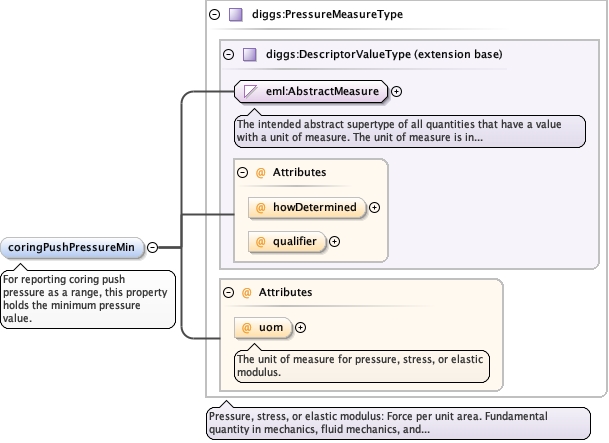
Element diggs:AbstractSamplingActivityType / diggs:coringPushPressureMin
Namespace http://diggsml.org/schemas/3
Annotations
For reporting coring push pressure as a range,
this property holds the minimum pressure
value.
Diagram
DiagramEmlAllObjects_xsd_Simple_Type_eml_AbstractMeasure.tmp#AbstractMeasureMeasureTypes_xsd_Complex_Type_diggs_DescriptorValueType.tmp#DescriptorValueType_howDeterminedMeasureTypes_xsd_Complex_Type_diggs_DescriptorValueType.tmp#DescriptorValueType_qualifierMeasureTypes_xsd_Complex_Type_diggs_DescriptorValueType.tmp#DescriptorValueTypeMeasureTypes_xsd_Complex_Type_diggs_PressureMeasureType.tmp#PressureMeasureType_uomMeasureTypes_xsd_Complex_Type_diggs_PressureMeasureType.tmp#PressureMeasureType
Type diggs:PressureMeasureType
Type hierarchy
Properties
content complex
minOccurs 0
maxOccurs 1
Attributes
QName Type Use Annotation
howDetermined diggs:DescriptorMethodEnumType optional
qualifier diggs:QualifierEnumExtType optional
uom diggs:PressureUomEnumType optional
The unit of measure for pressure, stress, or elastic modulus.
Source
<element maxOccurs="1" minOccurs="0" name="coringPushPressureMin" type="diggs:PressureMeasureType">
  <annotation>
    <documentation>For reporting coring push pressure as a range, this property holds the minimum pressure value.</documentation>
  </annotation>
</element>
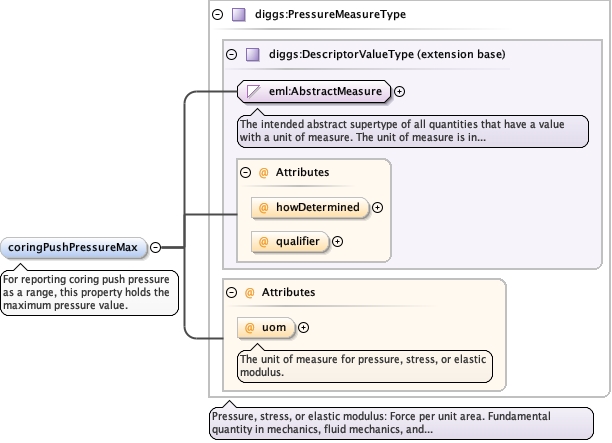
Element diggs:AbstractSamplingActivityType / diggs:coringPushPressureMax
Namespace http://diggsml.org/schemas/3
Annotations
For reporting coring push pressure as a range,
this property holds the maximum pressure
value.
Diagram
DiagramEmlAllObjects_xsd_Simple_Type_eml_AbstractMeasure.tmp#AbstractMeasureMeasureTypes_xsd_Complex_Type_diggs_DescriptorValueType.tmp#DescriptorValueType_howDeterminedMeasureTypes_xsd_Complex_Type_diggs_DescriptorValueType.tmp#DescriptorValueType_qualifierMeasureTypes_xsd_Complex_Type_diggs_DescriptorValueType.tmp#DescriptorValueTypeMeasureTypes_xsd_Complex_Type_diggs_PressureMeasureType.tmp#PressureMeasureType_uomMeasureTypes_xsd_Complex_Type_diggs_PressureMeasureType.tmp#PressureMeasureType
Type diggs:PressureMeasureType
Type hierarchy
Properties
content complex
minOccurs 0
maxOccurs 1
Attributes
QName Type Use Annotation
howDetermined diggs:DescriptorMethodEnumType optional
qualifier diggs:QualifierEnumExtType optional
uom diggs:PressureUomEnumType optional
The unit of measure for pressure, stress, or elastic modulus.
Source
<element maxOccurs="1" minOccurs="0" name="coringPushPressureMax" type="diggs:PressureMeasureType">
  <annotation>
    <documentation>For reporting coring push pressure as a range, this property holds the maximum pressure value.</documentation>
  </annotation>
</element>
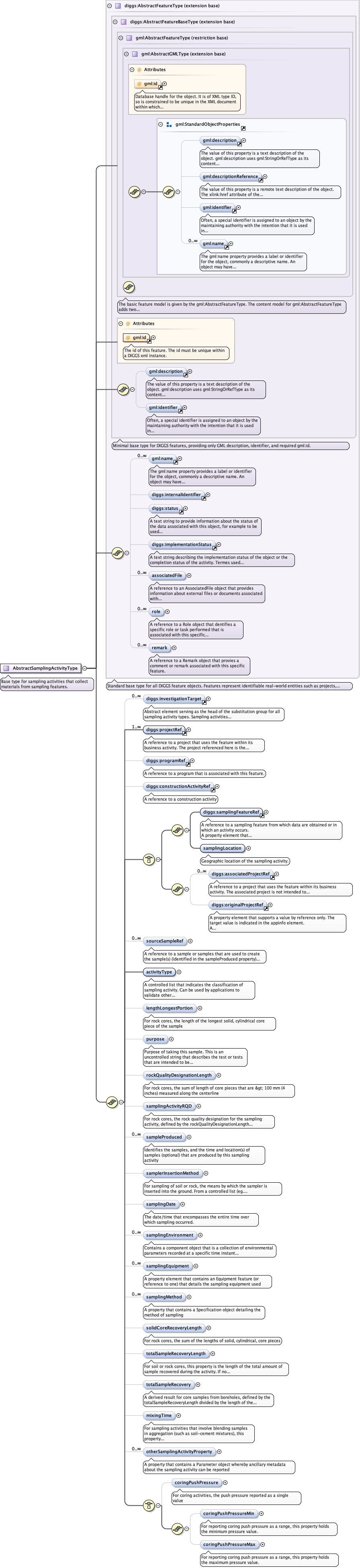
Complex Type diggs:AbstractSamplingActivityType
Namespace http://diggsml.org/schemas/3
Annotations
Base type for sampling activities that collect materials from sampling features.
Diagram
Diagramgml3_2Profile_diggs_xsd_Attribute_gml_id.tmp#idgml3_2Profile_diggs_xsd_Element_gml_description.tmp#descriptiongml3_2Profile_diggs_xsd_Element_gml_descriptionReference.tmp#descriptionReferencegml3_2Profile_diggs_xsd_Element_gml_identifier.tmp#identifiergml3_2Profile_diggs_xsd_Element_gml_name.tmp#namegml3_2Profile_diggs_xsd_Element_Group_gml_StandardObjectProperties.tmp#StandardObjectPropertiesgml3_2Profile_diggs_xsd_Complex_Type_gml_AbstractGMLType.tmp#AbstractGMLTypegml3_2Profile_diggs_xsd_Complex_Type_gml_AbstractFeatureType.tmp#AbstractFeatureTypegml3_2Profile_diggs_xsd_Attribute_gml_id.tmp#idgml3_2Profile_diggs_xsd_Element_gml_description.tmp#descriptiongml3_2Profile_diggs_xsd_Element_gml_identifier.tmp#identifierAbstractTypes_xsd_Complex_Type_diggs_AbstractFeatureBaseType.tmp#AbstractFeatureBaseTypegml3_2Profile_diggs_xsd_Element_gml_name.tmp#nameCommon_xsd_Element_diggs_internalIdentifier.tmp#internalIdentifierCommon_xsd_Element_diggs_status.tmp#statusCommon_xsd_Element_diggs_implementationStatus.tmp#implementationStatusAbstractTypes_xsd_Complex_Type_diggs_AbstractFeatureType.tmp#http___diggsml.org_schemas_3_AbstractFeatureType_associatedFileAbstractTypes_xsd_Complex_Type_diggs_AbstractFeatureType.tmp#http___diggsml.org_schemas_3_AbstractFeatureType_roleAbstractTypes_xsd_Complex_Type_diggs_AbstractFeatureType.tmp#http___diggsml.org_schemas_3_AbstractFeatureType_remarkAbstractTypes_xsd_Complex_Type_diggs_AbstractFeatureType.tmp#http___diggsml.org_schemas_3_AbstractFeatureTypeCommon_xsd_Element_diggs_investigationTarget.tmp#investigationTargetCommon_xsd_Element_diggs_projectRef.tmp#projectRefCommon_xsd_Element_diggs_programRef.tmp#programRefCommon_xsd_Element_diggs_constructionActivityRef.tmp#constructionActivityRefCommon_xsd_Element_diggs_samplingFeatureRef.tmp#samplingFeatureRefAbstractTypes_xsd_Complex_Type_diggs_AbstractSamplingActivityType.tmp#AbstractSamplingActivityType_samplingLocationCommon_xsd_Element_diggs_associatedProjectRef.tmp#associatedProjectRefCommon_xsd_Element_diggs_originalProjectRef.tmp#originalProjectRefAbstractTypes_xsd_Complex_Type_diggs_AbstractSamplingActivityType.tmp#AbstractSamplingActivityType_sourceSampleRefAbstractTypes_xsd_Complex_Type_diggs_AbstractSamplingActivityType.tmp#AbstractSamplingActivityType_activityTypeAbstractTypes_xsd_Complex_Type_diggs_AbstractSamplingActivityType.tmp#AbstractSamplingActivityType_lengthLongestPortionAbstractTypes_xsd_Complex_Type_diggs_AbstractSamplingActivityType.tmp#AbstractSamplingActivityType_purposeAbstractTypes_xsd_Complex_Type_diggs_AbstractSamplingActivityType.tmp#AbstractSamplingActivityType_rockQualityDesignationLengthAbstractTypes_xsd_Complex_Type_diggs_AbstractSamplingActivityType.tmp#AbstractSamplingActivityType_samplingActivityRQDAbstractTypes_xsd_Complex_Type_diggs_AbstractSamplingActivityType.tmp#AbstractSamplingActivityType_sampleProducedAbstractTypes_xsd_Complex_Type_diggs_AbstractSamplingActivityType.tmp#AbstractSamplingActivityType_samplerInsertionMethodAbstractTypes_xsd_Complex_Type_diggs_AbstractSamplingActivityType.tmp#AbstractSamplingActivityType_samplingDateAbstractTypes_xsd_Complex_Type_diggs_AbstractSamplingActivityType.tmp#AbstractSamplingActivityType_samplingEnvironmentAbstractTypes_xsd_Complex_Type_diggs_AbstractSamplingActivityType.tmp#AbstractSamplingActivityType_samplingEquipmentAbstractTypes_xsd_Complex_Type_diggs_AbstractSamplingActivityType.tmp#AbstractSamplingActivityType_samplingMethodAbstractTypes_xsd_Complex_Type_diggs_AbstractSamplingActivityType.tmp#AbstractSamplingActivityType_solidCoreRecoveryLengthAbstractTypes_xsd_Complex_Type_diggs_AbstractSamplingActivityType.tmp#AbstractSamplingActivityType_totalSampleRecoveryLengthAbstractTypes_xsd_Complex_Type_diggs_AbstractSamplingActivityType.tmp#AbstractSamplingActivityType_totalSampleRecoveryAbstractTypes_xsd_Complex_Type_diggs_AbstractSamplingActivityType.tmp#AbstractSamplingActivityType_mixingTimeAbstractTypes_xsd_Complex_Type_diggs_AbstractSamplingActivityType.tmp#AbstractSamplingActivityType_otherSamplingActivityPropertyAbstractTypes_xsd_Complex_Type_diggs_AbstractSamplingActivityType.tmp#AbstractSamplingActivityType_coringPushPressureAbstractTypes_xsd_Complex_Type_diggs_AbstractSamplingActivityType.tmp#AbstractSamplingActivityType_coringPushPressureMinAbstractTypes_xsd_Complex_Type_diggs_AbstractSamplingActivityType.tmp#AbstractSamplingActivityType_coringPushPressureMax
Type extension of diggs:AbstractFeatureType
Type hierarchy
Properties
abstract true
Used by
Model
Children diggs:activityType, diggs:associatedFile, diggs:associatedProjectRef, diggs:constructionActivityRef, diggs:coringPushPressure, diggs:coringPushPressureMax, diggs:coringPushPressureMin, diggs:implementationStatus, diggs:internalIdentifier, diggs:investigationTarget, diggs:lengthLongestPortion, diggs:mixingTime, diggs:originalProjectRef, diggs:otherSamplingActivityProperty, diggs:programRef, diggs:projectRef, diggs:purpose, diggs:remark, diggs:rockQualityDesignationLength, diggs:role, diggs:sampleProduced, diggs:samplerInsertionMethod, diggs:samplingActivityRQD, diggs:samplingDate, diggs:samplingEnvironment, diggs:samplingEquipment, diggs:samplingFeatureRef, diggs:samplingLocation, diggs:samplingMethod, diggs:solidCoreRecoveryLength, diggs:sourceSampleRef, diggs:status, diggs:totalSampleRecovery, diggs:totalSampleRecoveryLength, gml:description, gml:identifier, gml:name
Attributes
QName Type Use Annotation
gml:id ID required
Database handle for the object. It is of XML type ID, so is constrained to be
unique in the XML document within which it occurs. An external identifier for the object in
the form of a URI may be constructed using standard XML and XPointer methods. This is done
by concatenating the URI for the document, a fragment separator, and the value of the id
attribute.
Source
<complexType name="AbstractSamplingActivityType" abstract="true">
  <annotation>
    <documentation>Base type for sampling activities that collect materials from sampling features.</documentation>
  </annotation>
  <complexContent>
    <extension base="diggs:AbstractFeatureType">
      <sequence>
        <element ref="diggs:investigationTarget" maxOccurs="unbounded" minOccurs="0">
          <annotation>
            <documentation>Abstract element serving as the head of the substitution group for all sampling activity types. Sampling activities represent the actions taken to collect samples from sampling features. Activities include drilling, coring, excavation, grab sampling, and other collection methods. Each activity records the who, what, when, where, and how of sample collection, including equipment used, environmental conditions, and recovery information.</documentation>
          </annotation>
        </element>
        <element ref="diggs:projectRef" maxOccurs="unbounded"/>
        <element minOccurs="0" ref="diggs:programRef"/>
        <element minOccurs="0" ref="diggs:constructionActivityRef"/>
        <choice>
          <sequence>
            <element ref="diggs:samplingFeatureRef" minOccurs="1" maxOccurs="1"/>
            <element name="samplingLocation" type="diggs:LocationPropertyType" minOccurs="1">
              <annotation>
                <documentation>Geographic location of the sampling activity.</documentation>
              </annotation>
            </element>
          </sequence>
          <sequence>
            <element maxOccurs="unbounded" minOccurs="0" ref="diggs:associatedProjectRef"/>
            <element minOccurs="0" ref="diggs:originalProjectRef"/>
          </sequence>
        </choice>
        <element minOccurs="0" name="sourceSampleRef" maxOccurs="unbounded" type="diggs:FractionalReferenceType">
          <annotation>
            <appinfo source="urn:x-gml:targetElement">diggs:Sample/@gml:id</appinfo>
            <documentation>A reference to a sample or samples that are used to create the sample(s) (identified in the sampleProduced property) produced by this activity. This element is only used for activities that subsample or aggregate samples from other samples. For aggregate samples, the percentage attribute optionally defines how much of the total new sample is composed from the source sample.</documentation>
          </annotation>
        </element>
        <element name="activityType" type="diggs:ActivityTypeEnumType">
          <annotation>
            <documentation>A controlled list that indicates the classification of sampling activity. Can be used by applications to validate other activity info. One of the following strings must be used: collect - activity created a sample or samples by collection from a sampling feature; aggregate - activity created a sample or samples by aggregating existing samples; the associated Sample(s) should contain more than one sourceSampleRef; subsample - activity created a sample or samples by subsampling an existing sample; only one sourceSampleRef should be specified for the related Sample(s); test - activity produced a test, standard or blank sample that does not relate to any field sample or sampling feature; activity will point to a project but no sourceSampleRef nor samplingFeatureRef should be specified for the associated Sample(s). none - the sample activity failed to produce any physical sample; unknown - used where no information about the sampling activity exists (eg. for legacy data where only sample name or label and location (depth) exists).</documentation>
          </annotation>
        </element>
        <element minOccurs="0" name="lengthLongestPortion" type="diggs:LengthMeasureType">
          <annotation>
            <documentation>For rock cores, the length of the longest solid, cylindrical core piece of the sample</documentation>
          </annotation>
        </element>
        <element minOccurs="0" name="purpose" type="string">
          <annotation>
            <documentation>Purpose of taking this sample. This is an uncontrolled string that describes the test or tests that are intended to be run on the sample(s) generated from this activity.</documentation>
          </annotation>
        </element>
        <element minOccurs="0" name="rockQualityDesignationLength" type="diggs:LengthMeasureType">
          <annotation>
            <documentation>For rock cores, the sum of length of core pieces that are > 100 mm (4 inches) measured along the centerline</documentation>
          </annotation>
        </element>
        <element minOccurs="0" name="samplingActivityRQD" type="diggs:LengthPerLengthMeasureType">
          <annotation>
            <documentation>For rock cores, the rock quality designation for the sampling activity, defined by the rockQualityDesignationLength divided by the core run (length of sampling activity interval)</documentation>
          </annotation>
        </element>
        <element maxOccurs="unbounded" minOccurs="0" name="sampleProduced" type="diggs:SampleProducedPropertyType">
          <annotation>
            <documentation>Identifies the samples, and the time and location(s) of samples (optional) that are produced by this sampling activity</documentation>
          </annotation>
        </element>
        <element minOccurs="0" name="samplerInsertionMethod" type="gml:CodeType">
          <annotation>
            <documentation>For sampling of soil or rock, the means by which the sampler is inserted into the ground. From a controlled list (eg. pushed, driven, etc.</documentation>
          </annotation>
        </element>
        <element minOccurs="0" name="samplingDate" type="diggs:TimeIntervalPropertyType">
          <annotation>
            <documentation>The date/time that encompasses the entire time over which sampling occurred.</documentation>
          </annotation>
        </element>
        <element minOccurs="0" name="samplingEnvironment" type="diggs:EnvironmentPropertyType" maxOccurs="unbounded">
          <annotation>
            <documentation>Contains a component object that is a collection of environmental parameters recorded at a specific time instant dureing the sampling.</documentation>
          </annotation>
        </element>
        <element name="samplingEquipment" type="diggs:EquipmentPropertyType" maxOccurs="unbounded" minOccurs="0">
          <annotation>
            <appinfo>diggs:AbstractEquipment</appinfo>
            <documentation>A property element that contains an Equipment feature (or reference to one) that details the sampling equipment used</documentation>
          </annotation>
        </element>
        <element name="samplingMethod" type="diggs:ProcedurePropertyType" maxOccurs="unbounded" minOccurs="0">
          <annotation>
            <documentation>A property that contains a Specification object detailing the method of sampling</documentation>
          </annotation>
        </element>
        <element minOccurs="0" name="solidCoreRecoveryLength" type="diggs:LengthMeasureType">
          <annotation>
            <documentation>For rock cores, the sum of the lengths of solid, cylindrical, core pieces</documentation>
          </annotation>
        </element>
        <element minOccurs="0" name="totalSampleRecoveryLength" type="diggs:LengthMeasureType">
          <annotation>
            <documentation>For soil or rock cores, this property is the length of the total amount of sample recovered during the activity. If no sample is recovered, this value is 0. This value can also be derived if totalSampleRecovery is reported.</documentation>
          </annotation>
        </element>
        <element minOccurs="0" name="totalSampleRecovery" type="diggs:DimensionlessMeasureType">
          <annotation>
            <documentation>A derived result for core samples from boreholes, defined by the totalSampleRecoveryLength divided by the length of the samplingActivity intervsl, typically reported as a percent.</documentation>
          </annotation>
        </element>
        <element minOccurs="0" name="mixingTime" type="diggs:TimeMeasureType">
          <annotation>
            <documentation>For sampling activities that involve blending samples in aggregation (such as soil-cement mixtures), this property carries the time duration to mix the sample together.</documentation>
          </annotation>
        </element>
        <element maxOccurs="unbounded" minOccurs="0" name="otherSamplingActivityProperty" type="diggs:ParameterPropertyType">
          <annotation>
            <documentation>A property that contains a Parameter object whereby ancillary metadata about the sampling activity can be reported</documentation>
          </annotation>
        </element>
        <choice>
          <element maxOccurs="1" minOccurs="0" name="coringPushPressure" type="diggs:PressureMeasureType">
            <annotation>
              <documentation>For coring activities, the push pressure reported as a single value</documentation>
            </annotation>
          </element>
          <sequence>
            <element maxOccurs="1" minOccurs="0" name="coringPushPressureMin" type="diggs:PressureMeasureType">
              <annotation>
                <documentation>For reporting coring push pressure as a range, this property holds the minimum pressure value.</documentation>
              </annotation>
            </element>
            <element maxOccurs="1" minOccurs="0" name="coringPushPressureMax" type="diggs:PressureMeasureType">
              <annotation>
                <documentation>For reporting coring push pressure as a range, this property holds the maximum pressure value.</documentation>
              </annotation>
            </element>
          </sequence>
        </choice>
      </sequence>
    </extension>
  </complexContent>
</complexType>