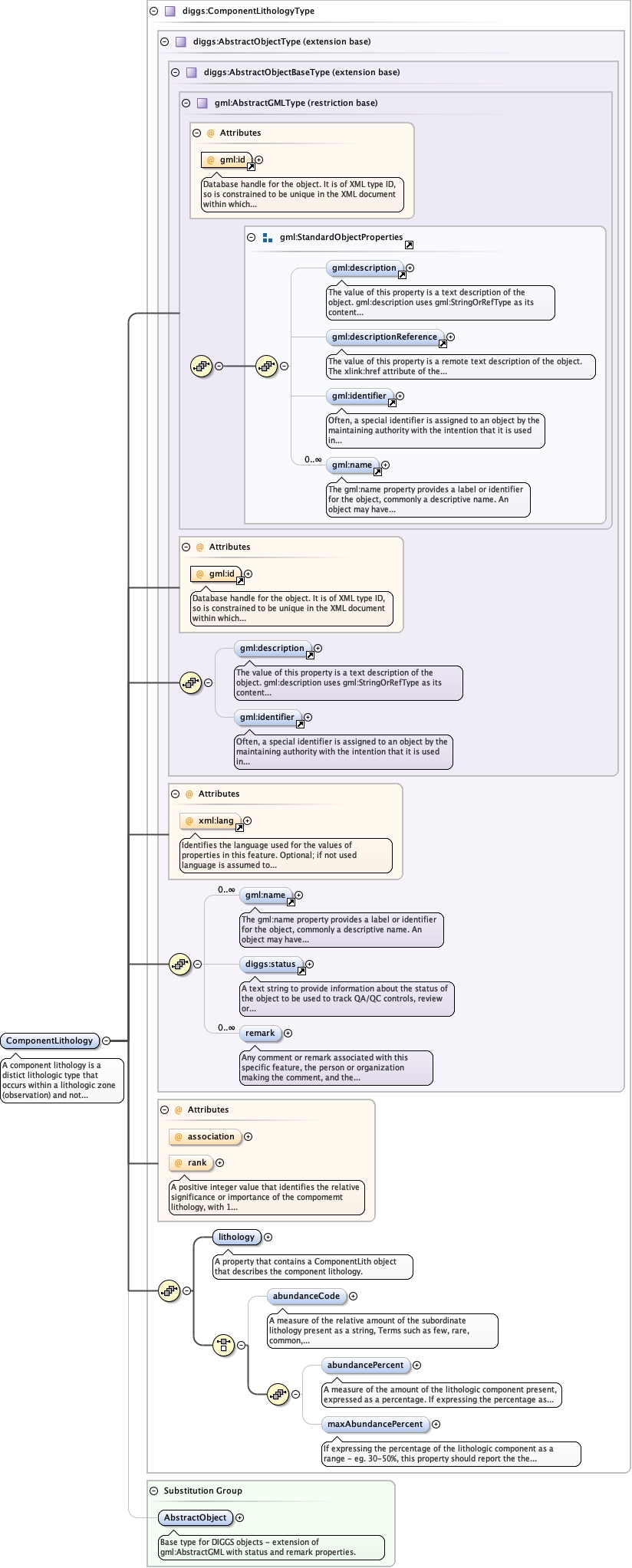
A component lithology is a distict lithologic type that occurs within a lithologic zone (observation) and not descxribed as part of the primary lithology. This primarily occurs in situations where the zone is interbedded and complex enough that separating out each lithologic layer is not practical, or where one lithology occurs as inclusion within another.
Database handle for the object. It is of XML type ID, so is constrained to beunique in the XML document within which it occurs. An external identifier for the object inthe form of a URI may be constructed using standard XML and XPointer methods. This is doneby concatenating the URI for the document, a fragment separator, and the value of the idattribute.
A positive integer value that identifies the relative significance or importance of the compomemt lithology, with 1 signifying the highest rank. Using this attribute eliminates possible ambiguity when using abundanceCode to infer significance.
<div><h3>lang (as an attribute name)</h3><p>denotes an attribute whose value is a language code for the natural language of the content of any element; its value is inherited. This name is reserved by virtue of its definition in the XML specification.</p></div><div><h4>Notes</h4><p>Attempting to install the relevant ISO 2- and 3-letter codes as the enumerated possible values is probably never going to be a realistic possibility.</p><p>See BCP 47 at<a href="http://www.rfc-editor.org/rfc/bcp/bcp47.txt">http://www.rfc-editor.org/rfc/bcp/bcp47.txt</a>and the IANA language subtag registry at<a href="http://www.iana.org/assignments/language-subtag-registry">http://www.iana.org/assignments/language-subtag-registry</a>for further information.</p><p>The union allows for the 'un-declaration' of xml:lang with the empty string.</p></div>
Source
<element name="ComponentLithology" substitutionGroup="diggs:AbstractObject" type="diggs:ComponentLithologyType"><annotation><documentation>A component lithology is a distict lithologic type that occurs within a lithologic zone (observation) and not descxribed as part of the primary lithology. This primarily occurs in situations where the zone is interbedded and complex enough that separating out each lithologic layer is not practical, or where one lithology occurs as inclusion within another.</documentation></annotation></element>