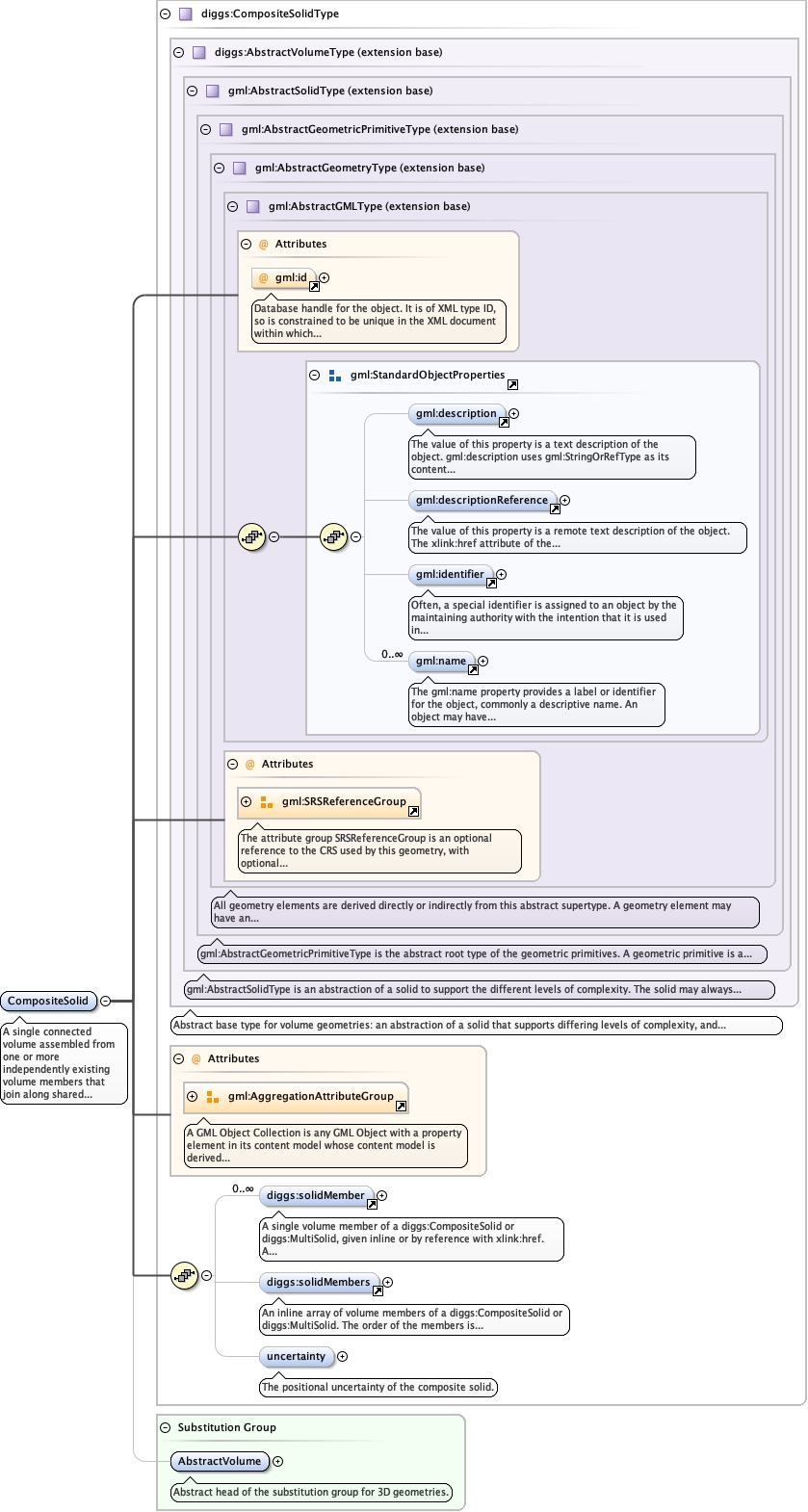
A single connected volume assembled from one or more independently existing volumemembers that join along shared boundary faces (ISO 19107 GM_CompositeSolid): onebody, tiled into cells that between them cover it exactly once, with no gaps and nooverlaps. Because it is a volume, it substitutes diggs:AbstractVolume and is legalwherever diggs:Solid or diggs:SurfaceBoundedSolid is, including diggs:featureExtent.The no-gap, no-overlap condition is not machine-enforced, as elsewhere in thisgeometry family. It is intended for a body divided into cells that carry differentproperty values (a fault-block model, a block model in the mining sense) while stillbehaving as one connected volume, for example for a total-volume computation or asthe single subject of one observation. When the members are not asserted to tile oneconnected body, use diggs:MultiSolid.
Database handle for the object. It is of XML type ID, so is constrained to beunique in the XML document within which it occurs. An external identifier for the object inthe form of a URI may be constructed using standard XML and XPointer methods. This is doneby concatenating the URI for the document, a fragment separator, and the value of the idattribute.
<element name="CompositeSolid" substitutionGroup="diggs:AbstractVolume" type="diggs:CompositeSolidType"><annotation><documentation>A single connected volume assembled from one or more independently existing volume members that join along shared boundary faces (ISO 19107 GM_CompositeSolid): one body, tiled into cells that between them cover it exactly once, with no gaps and no overlaps. Because it is a volume, it substitutes diggs:AbstractVolume and is legal wherever diggs:Solid or diggs:SurfaceBoundedSolid is, including diggs:featureExtent. The no-gap, no-overlap condition is not machine-enforced, as elsewhere in this geometry family. It is intended for a body divided into cells that carry different property values (a fault-block model, a block model in the mining sense) while still behaving as one connected volume, for example for a total-volume computation or as the single subject of one observation. When the members are not asserted to tile one connected body, use diggs:MultiSolid.</documentation></annotation></element>