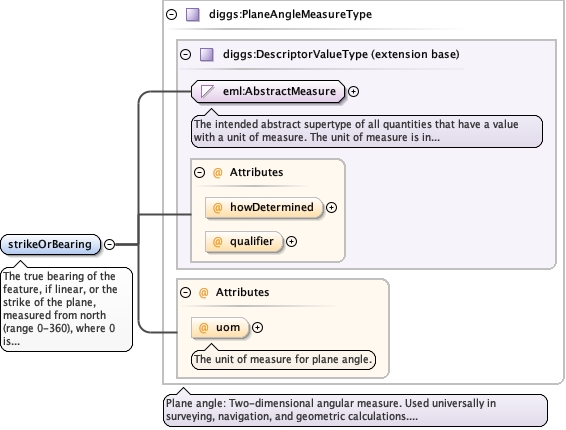
<element name="strikeOrBearing" type="diggs:PlaneAngleMeasureType"><annotation><documentation>The true bearing of the feature, if linear, or the strike of the plane, measured from north (range 0-360), where 0 is north and 90 is east.</documentation></annotation></element>
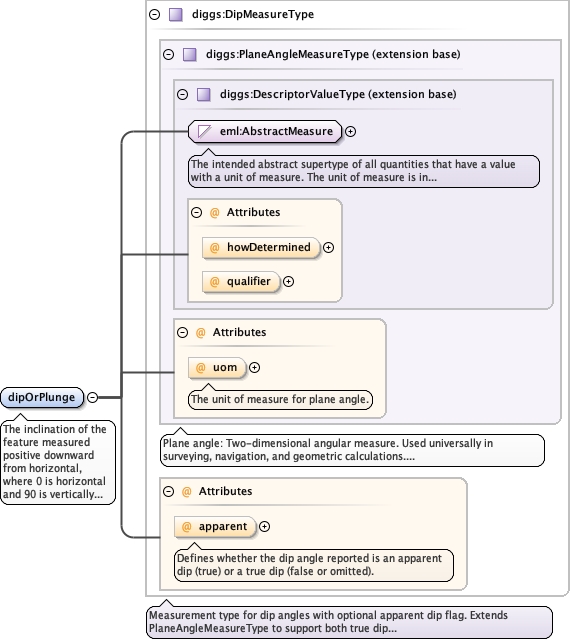
The inclination of the feature measured positive downward fromhorizontal, where 0 is horizontal and 90 is vertically down. Set theapparent attribute to true if the value is an apparent dip ratherthan a true dip.
<element name="dipOrPlunge" type="diggs:DipMeasureType"><annotation><documentation>The inclination of the feature measured positive downward from horizontal, where 0 is horizontal and 90 is vertically down. Set the apparent attribute to true if the value is an apparent dip rather than a true dip.</documentation></annotation></element>
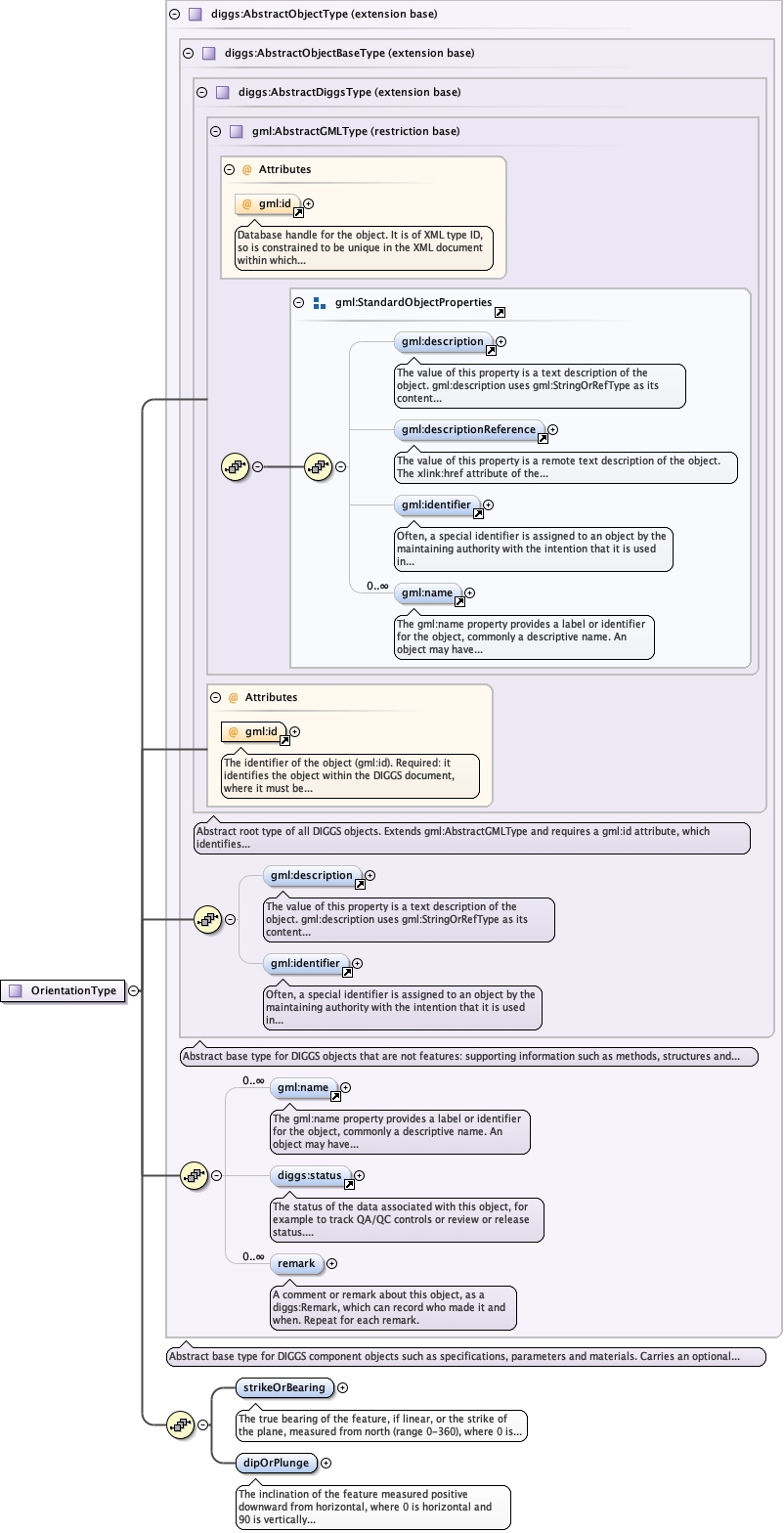
Database handle for the object. It is of XML type ID, so is constrained to beunique in the XML document within which it occurs. An external identifier for the object inthe form of a URI may be constructed using standard XML and XPointer methods. This is doneby concatenating the URI for the document, a fragment separator, and the value of the idattribute.
Source
<complexType name="OrientationType"><complexContent><extension base="diggs:AbstractObjectType"><sequence><element name="strikeOrBearing" type="diggs:PlaneAngleMeasureType"><annotation><documentation>The true bearing of the feature, if linear, or the strike of the plane, measured from north (range 0-360), where 0 is north and 90 is east.</documentation></annotation></element><element name="dipOrPlunge" type="diggs:DipMeasureType"><annotation><documentation>The inclination of the feature measured positive downward from horizontal, where 0 is horizontal and 90 is vertically down. Set the apparent attribute to true if the value is an apparent dip rather than a true dip.</documentation></annotation></element></sequence></extension></complexContent></complexType>