<element minOccurs="0" name="specimenCondition" type="diggs:GroutSpecimenConditionsPropertyType"><annotation><documentation>Describes the physical conditions of the sample pre-test</documentation></annotation></element>
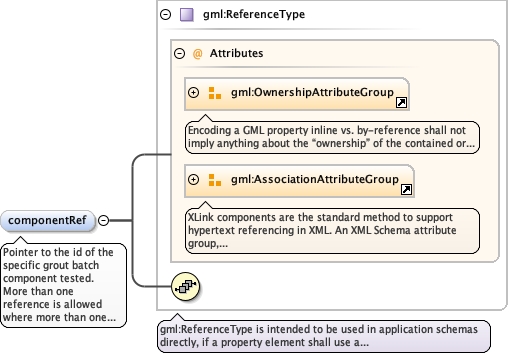
Pointer to the id of the specific grout batch componenttested. More than one reference is allowed where more than onecomponent of a specific type is included together in the specimentested. In this case each componentRef will point to the componentsused.
The 'actuate' attribute is used to communicate the desired timing of traversal from the starting resource to the ending resource; it's value should be treated as follows:onLoad - traverse to the ending resource immediately on loading the starting resource onRequest - traverse from the starting resource to the ending resource only on a post-loading event triggered for this purpose other - behavior is unconstrained; examine other markup in link for hints none - behavior is unconstrained
The 'show' attribute is used to communicate the desired presentation of the ending resource on traversal from the starting resource; it's value should be treated as follows: new - load ending resource in a new window, frame, pane, or other presentation contextreplace - load the resource in the same window, frame, pane, or other presentation contextembed - load ending resource in place of the presentation of the starting resourceother - behavior is unconstrained; examine other markup in the link for hints none - behavior is unconstrained
<element maxOccurs="unbounded" minOccurs="0" name="componentRef" type="gml:ReferenceType"><annotation><appinfo>diggs:Admixture or diggs:Binder or diggs:Cement or diggs:Chemical or diggs:Filler</appinfo><documentation>Pointer to the id of the specific grout batch component tested. More than one reference is allowed where more than one component of a specific type is included together in the specimen tested. In this case each componentRef will point to the components used.</documentation></annotation></element>
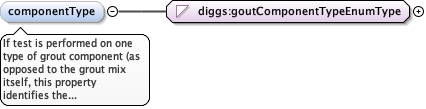
If test is performed on one type of grout component (asopposed to the grout mix itself, this property identifies thespecific grout component type tested. From an emumerated list: 1)Admixture 2) Binder 3) Cement 4) Chemical 5) Filler See GroutBatchobject for definition of these components
<element minOccurs="0" name="componentType" type="diggs:goutComponentTypeEnumType"><annotation><documentation>If test is performed on one type of grout component (as opposed to the grout mix itself, this property identifies the specific grout component type tested. From an emumerated list: 1) Admixture 2) Binder 3) Cement 4) Chemical 5) Filler See GroutBatch object for definition of these components</documentation></annotation></element>
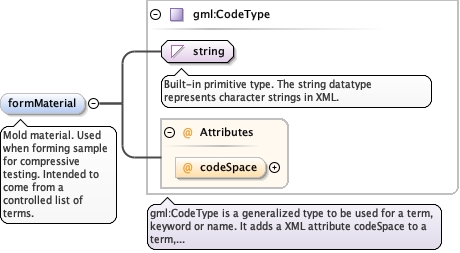
<element minOccurs="0" name="formMaterial" type="gml:CodeType"><annotation><documentation>Mold material. Used when forming sample for compressive testing. Intended to come from a controlled list of terms.</documentation></annotation></element>
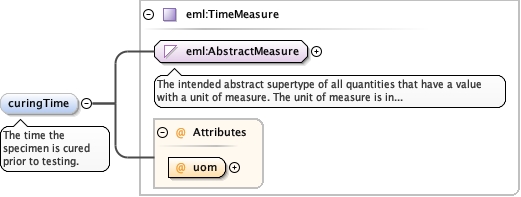
<element minOccurs="0" name="curingTime" type="eml:TimeMeasure"><annotation><documentation>The time the specimen is cured prior to testing.</documentation></annotation></element>
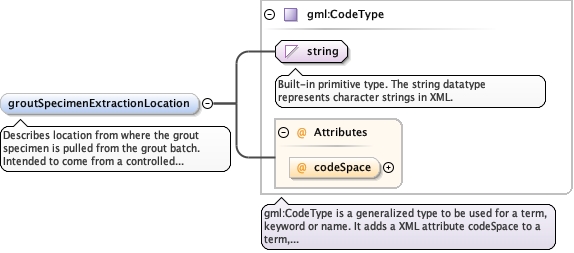
<element minOccurs="0" name="groutSpecimenExtractionLocation" type="gml:CodeType"><annotation><documentation>Describes location from where the grout specimen is pulled from the grout batch. Intended to come from a controlled list of terms.</documentation></annotation></element>
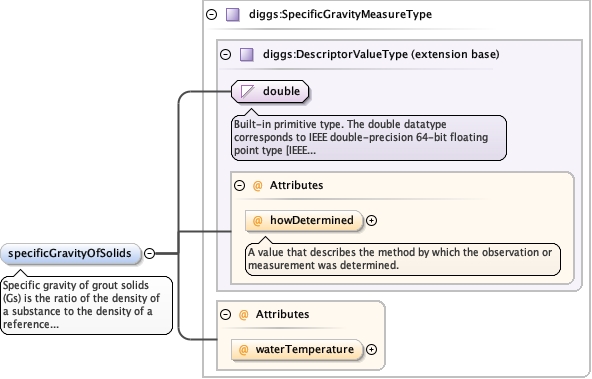
Specific gravity of grout solids (Gs) is the ratio of thedensity of a substance to the density of a reference substance,usually water at 4 deg C; equivalently, it is the ratio of the massof a substance to the mass of a reference substance for the samegiven volume.
<element minOccurs="0" name="specificGravityOfSolids" type="diggs:SpecificGravityMeasureType"><annotation><documentation>Specific gravity of grout solids (Gs) is the ratio of the density of a substance to the density of a reference substance, usually water at 4 deg C; equivalently, it is the ratio of the mass of a substance to the mass of a reference substance for the same given volume.</documentation></annotation></element>
Database handle for the object. It is of XML type ID, so is constrained to beunique in the XML document within which it occurs. An external identifier for the object inthe form of a URI may be constructed using standard XML and XPointer methods. This is doneby concatenating the URI for the document, a fragment separator, and the value of the idattribute.
<div><h3>lang (as an attribute name)</h3><p>denotes an attribute whose value is a language code for the natural language of the content of any element; its value is inherited. This name is reserved by virtue of its definition in the XML specification.</p></div><div><h4>Notes</h4><p>Attempting to install the relevant ISO 2- and 3-letter codes as the enumerated possible values is probably never going to be a realistic possibility.</p><p>See BCP 47 at<a href="http://www.rfc-editor.org/rfc/bcp/bcp47.txt">http://www.rfc-editor.org/rfc/bcp/bcp47.txt</a>and the IANA language subtag registry at<a href="http://www.iana.org/assignments/language-subtag-registry">http://www.iana.org/assignments/language-subtag-registry</a>for further information.</p><p>The union allows for the 'un-declaration' of xml:lang with the empty string.</p></div>
Source
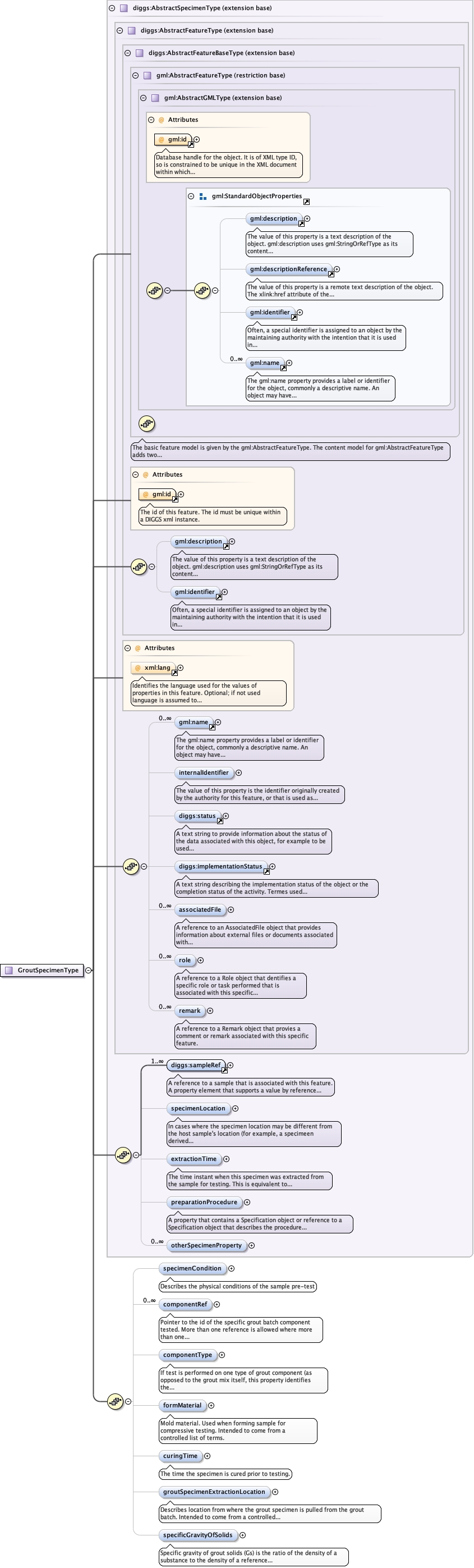
<complexType name="GroutSpecimenType"><complexContent><extension base="diggs:AbstractSpecimenType"><sequence><element minOccurs="0" name="specimenCondition" type="diggs:GroutSpecimenConditionsPropertyType"><annotation><documentation>Describes the physical conditions of the sample pre-test</documentation></annotation></element><element maxOccurs="unbounded" minOccurs="0" name="componentRef" type="gml:ReferenceType"><annotation><appinfo>diggs:Admixture or diggs:Binder or diggs:Cement or diggs:Chemical or diggs:Filler</appinfo><documentation>Pointer to the id of the specific grout batch component tested. More than one reference is allowed where more than one component of a specific type is included together in the specimen tested. In this case each componentRef will point to the components used.</documentation></annotation></element><element minOccurs="0" name="componentType" type="diggs:goutComponentTypeEnumType"><annotation><documentation>If test is performed on one type of grout component (as opposed to the grout mix itself, this property identifies the specific grout component type tested. From an emumerated list: 1) Admixture 2) Binder 3) Cement 4) Chemical 5) Filler See GroutBatch object for definition of these components</documentation></annotation></element><element minOccurs="0" name="formMaterial" type="gml:CodeType"><annotation><documentation>Mold material. Used when forming sample for compressive testing. Intended to come from a controlled list of terms.</documentation></annotation></element><element minOccurs="0" name="curingTime" type="eml:TimeMeasure"><annotation><documentation>The time the specimen is cured prior to testing.</documentation></annotation></element><element minOccurs="0" name="groutSpecimenExtractionLocation" type="gml:CodeType"><annotation><documentation>Describes location from where the grout specimen is pulled from the grout batch. Intended to come from a controlled list of terms.</documentation></annotation></element><element minOccurs="0" name="specificGravityOfSolids" type="diggs:SpecificGravityMeasureType"><annotation><documentation>Specific gravity of grout solids (Gs) is the ratio of the density of a substance to the density of a reference substance, usually water at 4 deg C; equivalently, it is the ratio of the mass of a substance to the mass of a reference substance for the same given volume.</documentation></annotation></element></sequence></extension></complexContent></complexType>