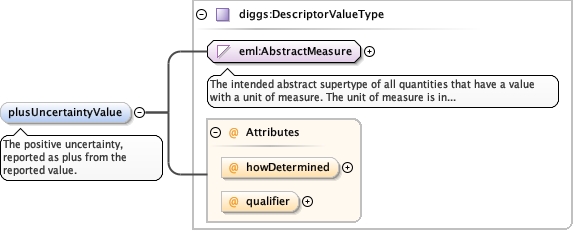
<element minOccurs="0" name="plusUncertaintyValue" type="diggs:DescriptorValueType"><annotation><documentation>The positive uncertainty, reported as plus from the reported value.</documentation></annotation></element>
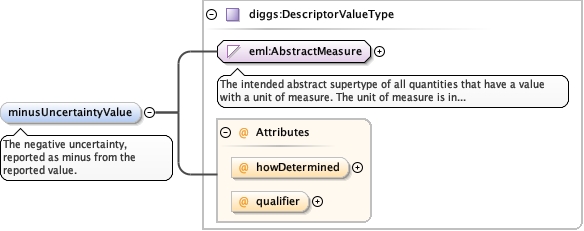
<element minOccurs="0" name="minusUncertaintyValue" type="diggs:DescriptorValueType"><annotation><documentation>The negative uncertainty, reported as minus from the reported value.</documentation></annotation></element>
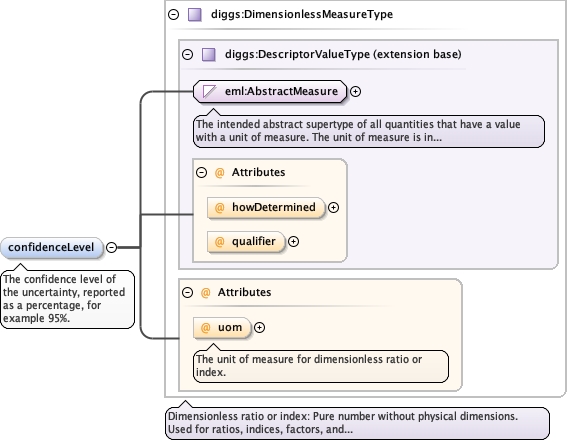
The unit of measure for dimensionless ratio or index.
Source
<element minOccurs="0" name="confidenceLevel" type="diggs:DimensionlessMeasureType"><annotation><documentation>The confidence level of the uncertainty, reported as a percentage, for example 95%.</documentation></annotation></element>
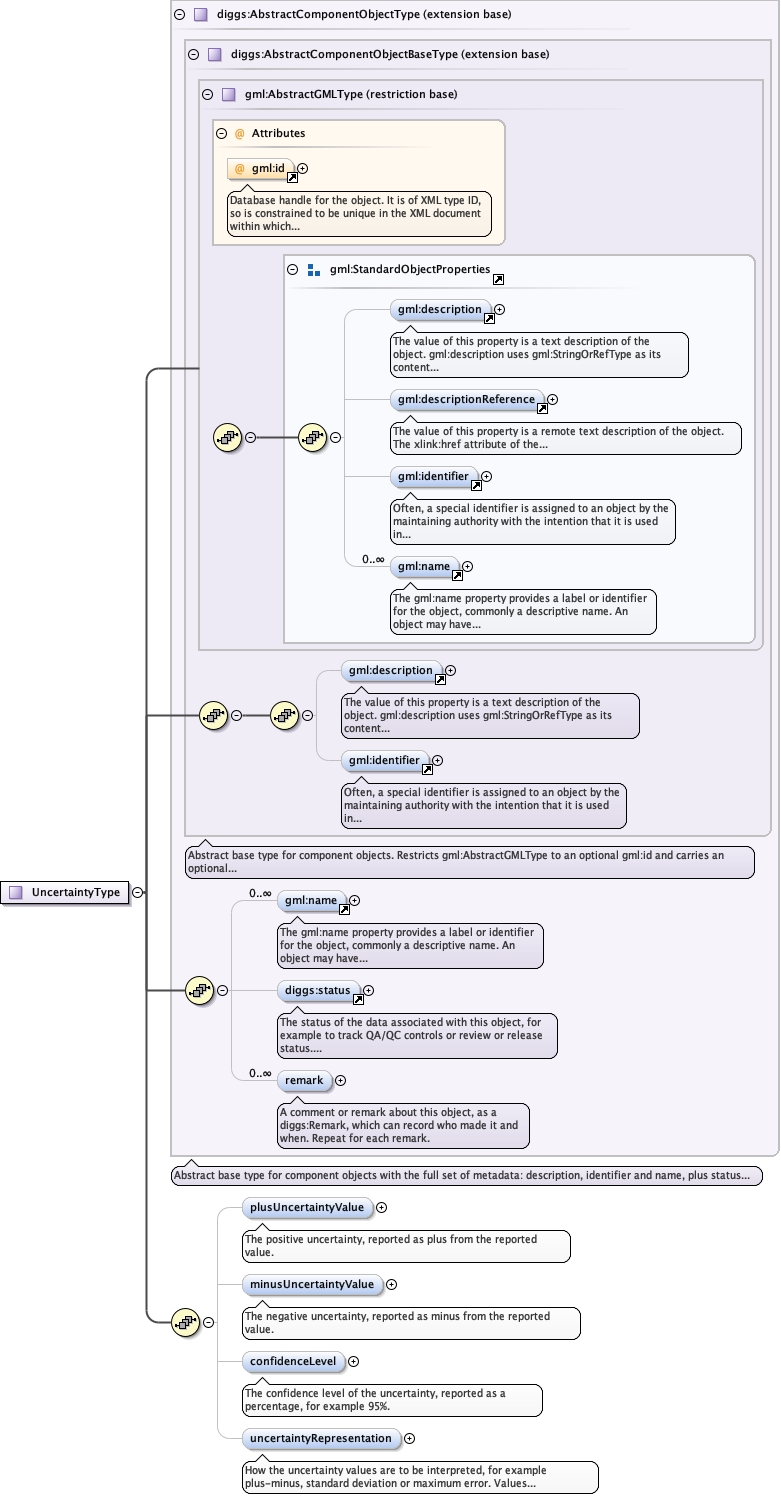
How the uncertainty values are to be interpreted, for exampleplus-minus, standard deviation or maximum error. Values come fromthe enumerated list, or "Other: xx", where xx is a user-defined termwhose meaning differs from every listed value (not a synonym ofone).
<element minOccurs="0" name="uncertaintyRepresentation" type="diggs:UncertaintyRepresentationEnumExtType"><annotation><documentation>How the uncertainty values are to be interpreted, for example plus-minus, standard deviation or maximum error. Values come from the enumerated list, or "Other: xx", where xx is a user-defined term whose meaning differs from every listed value (not a synonym of one).</documentation></annotation></element>
Database handle for the object. It is of XML type ID, so is constrained to beunique in the XML document within which it occurs. An external identifier for the object inthe form of a URI may be constructed using standard XML and XPointer methods. This is doneby concatenating the URI for the document, a fragment separator, and the value of the idattribute.
Source
<complexType name="UncertaintyType"><complexContent><extension base="diggs:AbstractComponentObjectType"><sequence><element minOccurs="0" name="plusUncertaintyValue" type="diggs:DescriptorValueType"><annotation><documentation>The positive uncertainty, reported as plus from the reported value.</documentation></annotation></element><element minOccurs="0" name="minusUncertaintyValue" type="diggs:DescriptorValueType"><annotation><documentation>The negative uncertainty, reported as minus from the reported value.</documentation></annotation></element><element minOccurs="0" name="confidenceLevel" type="diggs:DimensionlessMeasureType"><annotation><documentation>The confidence level of the uncertainty, reported as a percentage, for example 95%.</documentation></annotation></element><element minOccurs="0" name="uncertaintyRepresentation" type="diggs:UncertaintyRepresentationEnumExtType"><annotation><documentation>How the uncertainty values are to be interpreted, for example plus-minus, standard deviation or maximum error. Values come from the enumerated list, or "Other: xx", where xx is a user-defined term whose meaning differs from every listed value (not a synonym of one).</documentation></annotation></element></sequence></extension></complexContent></complexType>