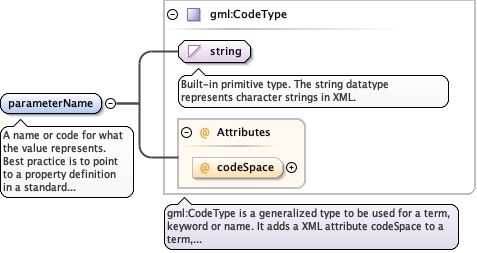
A name or code for what the value represents. Best practice is topoint to a property definition in a standard properties dictionarythrough the codeSpace attribute (the dictionary's URI with the entryid, for example the liquid_limit entry of properties.xml). Use theDIGGS dictionary that serves the host element: properties.xml,ri_design_properties.xml, design_basis_properties.xml,design_factor_properties.xml, designProperty.xml,evidenceCondition.xml or gp_properties.xml.
<element minOccurs="1" name="parameterName" type="gml:CodeType"><annotation><documentation>A name or code for what the value represents. Best practice is to point to a property definition in a standard properties dictionary through the codeSpace attribute (the dictionary's URI with the entry id, for example the liquid_limit entry of properties.xml). Use the DIGGS dictionary that serves the host element: properties.xml, ri_design_properties.xml, design_basis_properties.xml, design_factor_properties.xml, designProperty.xml, evidenceCondition.xml or gp_properties.xml.</documentation></annotation></element>
For numeric parameter values expressed as a range rather than afixed value, the minimum of the range.
Diagram
Type
string
Properties
content
simple
minOccurs
0
Source
<element name="parameterMinValue" type="string" minOccurs="0"><annotation><documentation>For numeric parameter values expressed as a range rather than a fixed value, the minimum of the range.</documentation></annotation></element>
<element minOccurs="0" name="parameterValue" type="string"><annotation><documentation>The value of the parameter.</documentation></annotation></element>
For numeric parameter values expressed as a range rather than afixed value, the maximum of the range.
Diagram
Type
string
Properties
content
simple
minOccurs
0
Source
<element name="parameterMaxValue" type="string" minOccurs="0"><annotation><documentation>For numeric parameter values expressed as a range rather than a fixed value, the maximum of the range.</documentation></annotation></element>
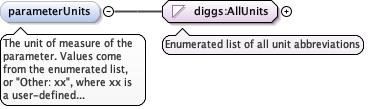
The unit of measure of the parameter. Values come from theenumerated list, or "Other: xx", where xx is a user-defined termwhose meaning differs from every listed value (not a synonym ofone).
<element name="parameterUnits" type="diggs:AllUnits" minOccurs="0"><annotation><documentation>The unit of measure of the parameter. Values come from the enumerated list, or "Other: xx", where xx is a user-defined term whose meaning differs from every listed value (not a synonym of one).</documentation></annotation></element>
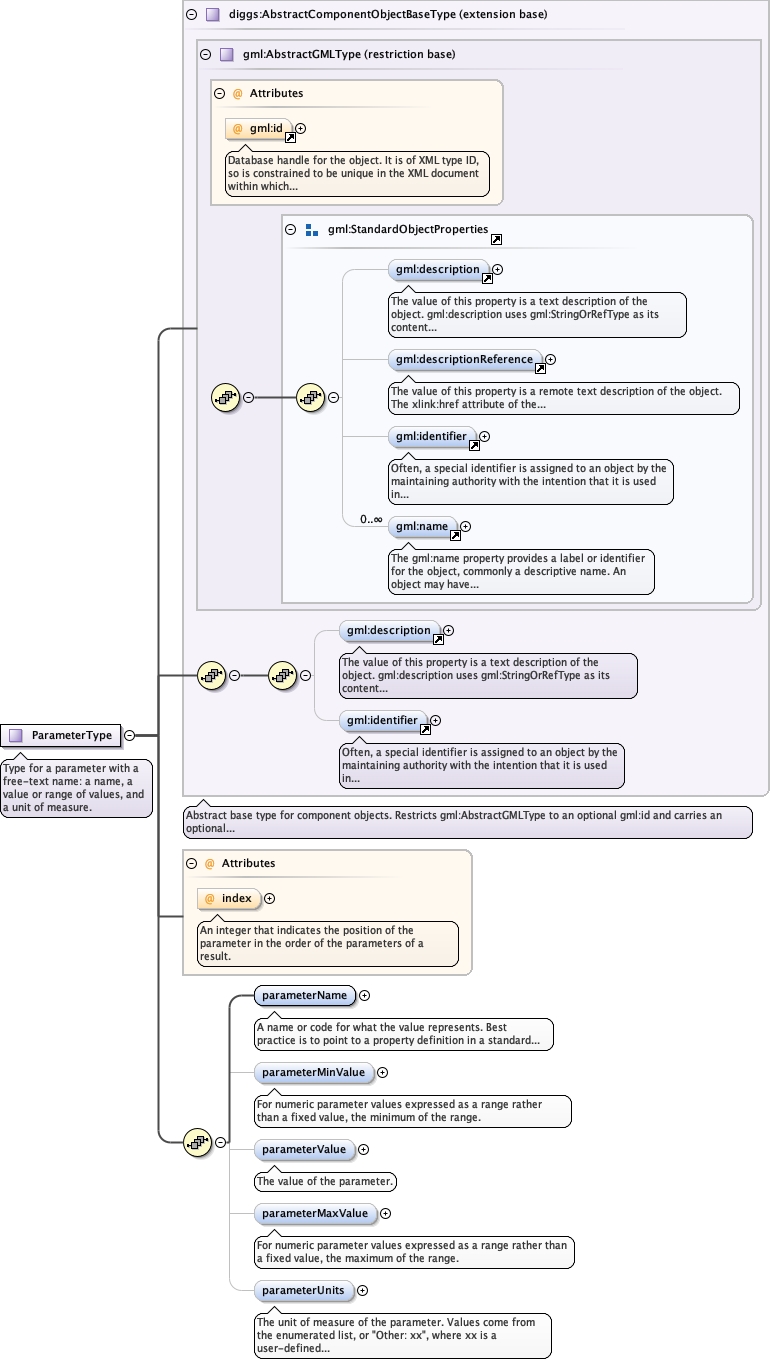
Complex Type diggs:ParameterType
Namespace
http://diggsml.org/schemas/3
Annotations
Type for a parameter with a free-text name: a name, a value or range of values, anda unit of measure.
Database handle for the object. It is of XML type ID, so is constrained to beunique in the XML document within which it occurs. An external identifier for the object inthe form of a URI may be constructed using standard XML and XPointer methods. This is doneby concatenating the URI for the document, a fragment separator, and the value of the idattribute.
An integer that indicates the position of the parameter in the order ofthe parameters of a result.
Source
<complexType name="ParameterType"><annotation><documentation>Type for a parameter with a free-text name: a name, a value or range of values, and a unit of measure.</documentation></annotation><complexContent><extension base="diggs:AbstractComponentObjectBaseType"><sequence><element minOccurs="1" name="parameterName" type="gml:CodeType"><annotation><documentation>A name or code for what the value represents. Best practice is to point to a property definition in a standard properties dictionary through the codeSpace attribute (the dictionary's URI with the entry id, for example the liquid_limit entry of properties.xml). Use the DIGGS dictionary that serves the host element: properties.xml, ri_design_properties.xml, design_basis_properties.xml, design_factor_properties.xml, designProperty.xml, evidenceCondition.xml or gp_properties.xml.</documentation></annotation></element><element name="parameterMinValue" type="string" minOccurs="0"><annotation><documentation>For numeric parameter values expressed as a range rather than a fixed value, the minimum of the range.</documentation></annotation></element><element minOccurs="0" name="parameterValue" type="string"><annotation><documentation>The value of the parameter.</documentation></annotation></element><element name="parameterMaxValue" type="string" minOccurs="0"><annotation><documentation>For numeric parameter values expressed as a range rather than a fixed value, the maximum of the range.</documentation></annotation></element><element name="parameterUnits" type="diggs:AllUnits" minOccurs="0"><annotation><documentation>The unit of measure of the parameter. Values come from the enumerated list, or "Other: xx", where xx is a user-defined term whose meaning differs from every listed value (not a synonym of one).</documentation></annotation></element></sequence><attribute name="index" type="positiveInteger" use="optional"><annotation><documentation>An integer that indicates the position of the parameter in the order of the parameters of a result.</documentation></annotation></attribute></extension></complexContent></complexType>
<attribute name="index" type="positiveInteger" use="optional"><annotation><documentation>An integer that indicates the position of the parameter in the order of the parameters of a result.</documentation></annotation></attribute>