Showing:

Annotations
Attributes
Diagrams
Instances
Model
Properties
Source
Used by
Element diggs:AbstractTestProcedureType / diggs:testProcedureMethod
Namespace http://diggsml.org/schemas/3
Annotations
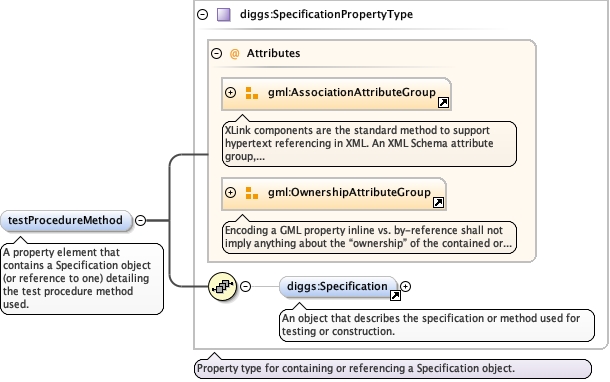
A property element that contains a Specification object
(or reference to one) detailing the test procedure method
used.
Diagram
Diagramgml3_2Profile_diggs_xsd_Attribute_Group_gml_AssociationAttributeGroup.tmp#AssociationAttributeGroupgml3_2Profile_diggs_xsd_Attribute_Group_gml_OwnershipAttributeGroup.tmp#OwnershipAttributeGroupCommon_xsd_Element_diggs_Specification.tmp#SpecificationCommon_xsd_Complex_Type_diggs_SpecificationPropertyType.tmp#SpecificationPropertyType
Type diggs:SpecificationPropertyType
Properties
content complex
minOccurs 0
maxOccurs unbounded
Model
Children diggs:Specification
Instance
<diggs:testProcedureMethod xlink:actuate="" xlink:arcrole="" xlink:href="" nilReason="" owns="false" xlink:role="" xlink:show="" xlink:title="" xlink:type="simple" xmlns:diggs="http://diggsml.org/schemas/3">
  <diggs:Specification gml:id="">{0,1}</diggs:Specification>
</diggs:testProcedureMethod>
Attributes
QName Type Fixed Default Use Annotation
nilReason gml:NilReasonType optional
owns boolean false optional
xlink:actuate restriction of string optional
The 'actuate' attribute is used to communicate the desired timing 
of traversal from the starting resource to the ending resource; 
it's value should be treated as follows:
onLoad - traverse to the ending resource immediately on loading 
         the starting resource 
onRequest - traverse from the starting resource to the ending 
            resource only on a post-loading event triggered for 
            this purpose 
other - behavior is unconstrained; examine other markup in link 
        for hints 
none - behavior is unconstrained
xlink:arcrole anyURI optional
xlink:href anyURI optional
xlink:role anyURI optional
xlink:show restriction of string optional
The 'show' attribute is used to communicate the desired presentation 
of the ending resource on traversal from the starting resource; it's 
value should be treated as follows: 
new - load ending resource in a new window, frame, pane, or other 
      presentation context
replace - load the resource in the same window, frame, pane, or 
          other presentation context
embed - load ending resource in place of the presentation of the 
        starting resource
other - behavior is unconstrained; examine other markup in the 
        link for hints 
none - behavior is unconstrained
xlink:title string optional
xlink:type string simple optional
Source
<element name="testProcedureMethod" type="diggs:SpecificationPropertyType" maxOccurs="unbounded" minOccurs="0">
  <annotation>
    <documentation>A property element that contains a Specification object (or reference to one) detailing the test procedure method used.</documentation>
  </annotation>
</element>
Element diggs:AbstractTestProcedureType / diggs:testProcedureEquipment
Namespace http://diggsml.org/schemas/3
Annotations
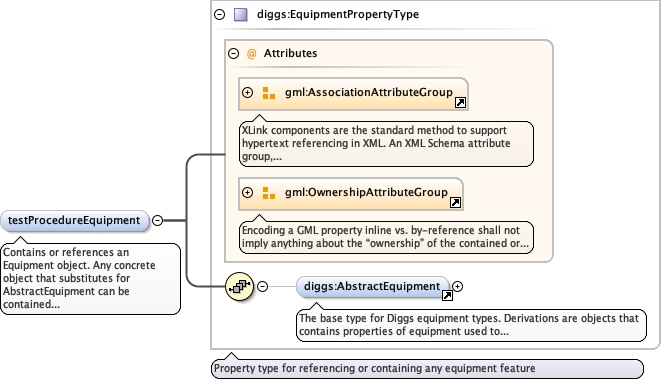
Contains or references an Equipment object. Any concrete
object that substitutes for AbstractEquipment can be contained or
referenced by this property.
Diagram
Diagramgml3_2Profile_diggs_xsd_Attribute_Group_gml_AssociationAttributeGroup.tmp#AssociationAttributeGroupgml3_2Profile_diggs_xsd_Attribute_Group_gml_OwnershipAttributeGroup.tmp#OwnershipAttributeGroupAbstractTypes_xsd_Element_diggs_AbstractEquipment.tmp#AbstractEquipmentCommon_xsd_Complex_Type_diggs_EquipmentPropertyType.tmp#EquipmentPropertyType
Type diggs:EquipmentPropertyType
Properties
content complex
minOccurs 0
maxOccurs unbounded
Model
Children diggs:AbstractEquipment
Instance
<diggs:testProcedureEquipment xlink:actuate="" xlink:arcrole="" xlink:href="" nilReason="" owns="false" xlink:role="" xlink:show="" xlink:title="" xlink:type="simple" xmlns:diggs="http://diggsml.org/schemas/3">
  <diggs:AbstractEquipment gml:id="">{0,1}</diggs:AbstractEquipment>
</diggs:testProcedureEquipment>
Attributes
QName Type Fixed Default Use Annotation
nilReason gml:NilReasonType optional
owns boolean false optional
xlink:actuate restriction of string optional
The 'actuate' attribute is used to communicate the desired timing 
of traversal from the starting resource to the ending resource; 
it's value should be treated as follows:
onLoad - traverse to the ending resource immediately on loading 
         the starting resource 
onRequest - traverse from the starting resource to the ending 
            resource only on a post-loading event triggered for 
            this purpose 
other - behavior is unconstrained; examine other markup in link 
        for hints 
none - behavior is unconstrained
xlink:arcrole anyURI optional
xlink:href anyURI optional
xlink:role anyURI optional
xlink:show restriction of string optional
The 'show' attribute is used to communicate the desired presentation 
of the ending resource on traversal from the starting resource; it's 
value should be treated as follows: 
new - load ending resource in a new window, frame, pane, or other 
      presentation context
replace - load the resource in the same window, frame, pane, or 
          other presentation context
embed - load ending resource in place of the presentation of the 
        starting resource
other - behavior is unconstrained; examine other markup in the 
        link for hints 
none - behavior is unconstrained
xlink:title string optional
xlink:type string simple optional
Source
<element name="testProcedureEquipment" type="diggs:EquipmentPropertyType" maxOccurs="unbounded" minOccurs="0">
  <annotation>
    <appinfo>diggs:AbstractEquipment</appinfo>
    <documentation>Contains or references an Equipment object. Any concrete object that substitutes for AbstractEquipment can be contained or referenced by this property.</documentation>
  </annotation>
</element>
Element diggs:AbstractTestProcedureType / diggs:testingEnvironment
Namespace http://diggsml.org/schemas/3
Annotations
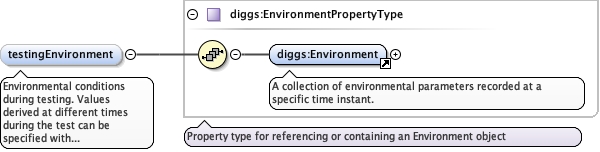
Environmental conditions during testing. Values derived
at different times during the test can be specified with multiple
elements and using the Environment/dateTime
property.
Diagram
DiagramCommon_xsd_Element_diggs_Environment.tmp#EnvironmentCommon_xsd_Complex_Type_diggs_EnvironmentPropertyType.tmp#EnvironmentPropertyType
Type diggs:EnvironmentPropertyType
Properties
content complex
minOccurs 0
maxOccurs unbounded
Model
Children diggs:Environment
Instance
<diggs:testingEnvironment xmlns:diggs="http://diggsml.org/schemas/3">
  <diggs:Environment gml:id="">{1,1}</diggs:Environment>
</diggs:testingEnvironment>
Source
<element minOccurs="0" name="testingEnvironment" type="diggs:EnvironmentPropertyType" maxOccurs="unbounded">
  <annotation>
    <documentation>Environmental conditions during testing. Values derived at different times during the test can be specified with multiple elements and using the Environment/dateTime property.</documentation>
  </annotation>
</element>
Element diggs:AbstractTestProcedureType / diggs:otherTestProperty
Namespace http://diggsml.org/schemas/3
Diagram
DiagramCommon_xsd_Element_diggs_Parameter.tmp#ParameterCommon_xsd_Complex_Type_diggs_ParameterPropertyType.tmp#ParameterPropertyType
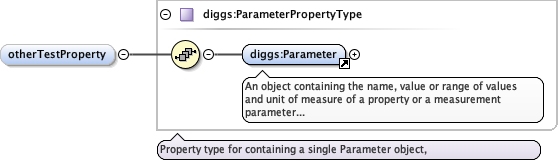
Type diggs:ParameterPropertyType
Properties
content complex
minOccurs 0
maxOccurs unbounded
Model
Children diggs:Parameter
Instance
<diggs:otherTestProperty xmlns:diggs="http://diggsml.org/schemas/3">
  <diggs:Parameter gml:id="" index="">{1,1}</diggs:Parameter>
</diggs:otherTestProperty>
Source
<element maxOccurs="unbounded" minOccurs="0" name="otherTestProperty" type="diggs:ParameterPropertyType"/>
Complex Type diggs:AbstractTestProcedureType
Namespace http://diggsml.org/schemas/3
Annotations
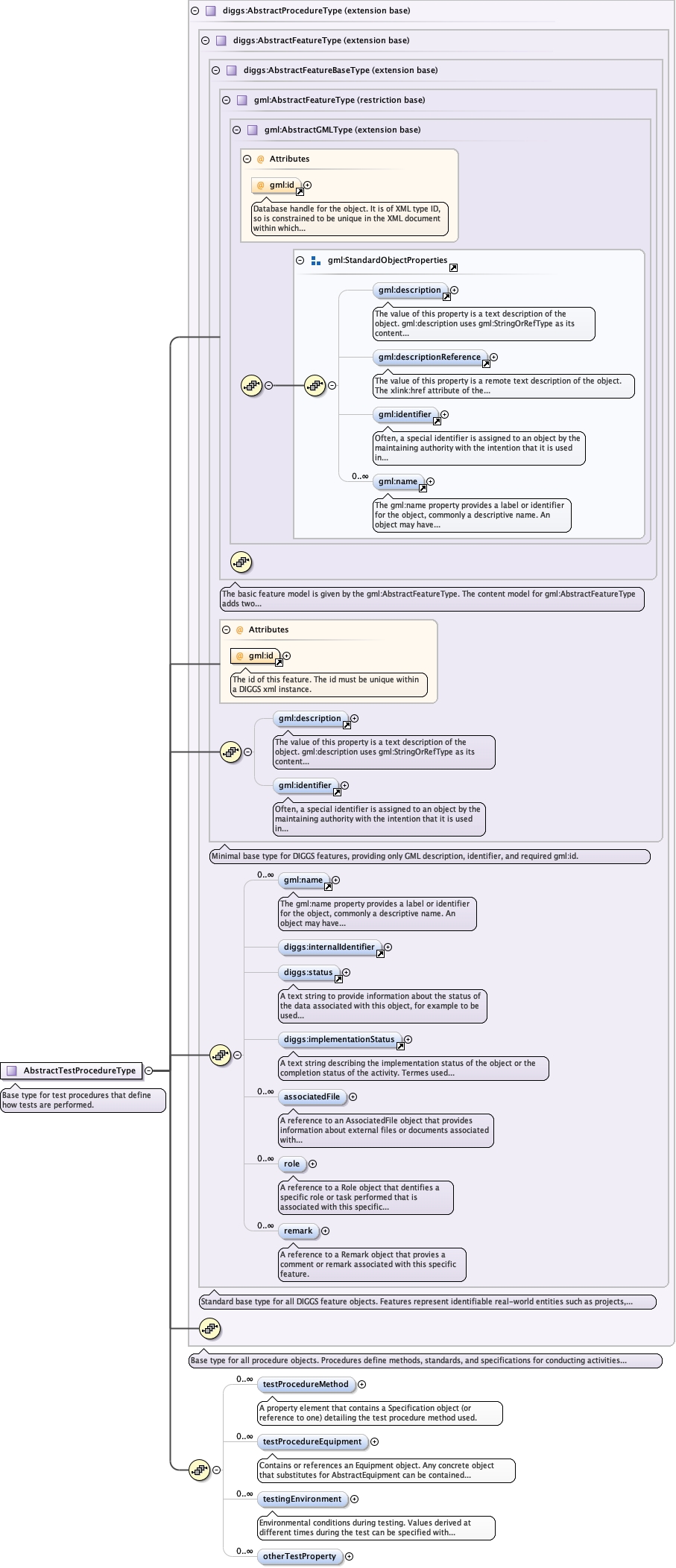
Base type for test procedures that define how tests are performed.
Diagram
Diagramgml3_2Profile_diggs_xsd_Attribute_gml_id.tmp#idgml3_2Profile_diggs_xsd_Element_gml_description.tmp#descriptiongml3_2Profile_diggs_xsd_Element_gml_descriptionReference.tmp#descriptionReferencegml3_2Profile_diggs_xsd_Element_gml_identifier.tmp#identifiergml3_2Profile_diggs_xsd_Element_gml_name.tmp#namegml3_2Profile_diggs_xsd_Element_Group_gml_StandardObjectProperties.tmp#StandardObjectPropertiesgml3_2Profile_diggs_xsd_Complex_Type_gml_AbstractGMLType.tmp#AbstractGMLTypegml3_2Profile_diggs_xsd_Complex_Type_gml_AbstractFeatureType.tmp#AbstractFeatureTypegml3_2Profile_diggs_xsd_Attribute_gml_id.tmp#idgml3_2Profile_diggs_xsd_Element_gml_description.tmp#descriptiongml3_2Profile_diggs_xsd_Element_gml_identifier.tmp#identifierAbstractTypes_xsd_Complex_Type_diggs_AbstractFeatureBaseType.tmp#AbstractFeatureBaseTypegml3_2Profile_diggs_xsd_Element_gml_name.tmp#nameCommon_xsd_Element_diggs_internalIdentifier.tmp#internalIdentifierCommon_xsd_Element_diggs_status.tmp#statusCommon_xsd_Element_diggs_implementationStatus.tmp#implementationStatusAbstractTypes_xsd_Complex_Type_diggs_AbstractFeatureType.tmp#http___diggsml.org_schemas_3_AbstractFeatureType_associatedFileAbstractTypes_xsd_Complex_Type_diggs_AbstractFeatureType.tmp#http___diggsml.org_schemas_3_AbstractFeatureType_roleAbstractTypes_xsd_Complex_Type_diggs_AbstractFeatureType.tmp#http___diggsml.org_schemas_3_AbstractFeatureType_remarkAbstractTypes_xsd_Complex_Type_diggs_AbstractFeatureType.tmp#http___diggsml.org_schemas_3_AbstractFeatureTypeAbstractTypes_xsd_Complex_Type_diggs_AbstractProcedureType.tmp#AbstractProcedureTypeAbstractTypes_xsd_Complex_Type_diggs_AbstractTestProcedureType.tmp#AbstractTestProcedureType_testProcedureMethodAbstractTypes_xsd_Complex_Type_diggs_AbstractTestProcedureType.tmp#AbstractTestProcedureType_testProcedureEquipmentAbstractTypes_xsd_Complex_Type_diggs_AbstractTestProcedureType.tmp#AbstractTestProcedureType_testingEnvironmentAbstractTypes_xsd_Complex_Type_diggs_AbstractTestProcedureType.tmp#AbstractTestProcedureType_otherTestProperty
Type extension of diggs:AbstractProcedureType
Type hierarchy
Used by
Model
Children diggs:associatedFile, diggs:implementationStatus, diggs:internalIdentifier, diggs:otherTestProperty, diggs:remark, diggs:role, diggs:status, diggs:testProcedureEquipment, diggs:testProcedureMethod, diggs:testingEnvironment, gml:description, gml:identifier, gml:name
Attributes
QName Type Use Annotation
gml:id ID required
Database handle for the object. It is of XML type ID, so is constrained to be
unique in the XML document within which it occurs. An external identifier for the object in
the form of a URI may be constructed using standard XML and XPointer methods. This is done
by concatenating the URI for the document, a fragment separator, and the value of the id
attribute.
Source
<complexType name="AbstractTestProcedureType">
  <annotation>
    <documentation>Base type for test procedures that define how tests are performed.</documentation>
  </annotation>
  <complexContent>
    <extension base="diggs:AbstractProcedureType">
      <sequence>
        <element name="testProcedureMethod" type="diggs:SpecificationPropertyType" maxOccurs="unbounded" minOccurs="0">
          <annotation>
            <documentation>A property element that contains a Specification object (or reference to one) detailing the test procedure method used.</documentation>
          </annotation>
        </element>
        <element name="testProcedureEquipment" type="diggs:EquipmentPropertyType" maxOccurs="unbounded" minOccurs="0">
          <annotation>
            <appinfo>diggs:AbstractEquipment</appinfo>
            <documentation>Contains or references an Equipment object. Any concrete object that substitutes for AbstractEquipment can be contained or referenced by this property.</documentation>
          </annotation>
        </element>
        <element minOccurs="0" name="testingEnvironment" type="diggs:EnvironmentPropertyType" maxOccurs="unbounded">
          <annotation>
            <documentation>Environmental conditions during testing. Values derived at different times during the test can be specified with multiple elements and using the Environment/dateTime property.</documentation>
          </annotation>
        </element>
        <element maxOccurs="unbounded" minOccurs="0" name="otherTestProperty" type="diggs:ParameterPropertyType"/>
      </sequence>
    </extension>
  </complexContent>
</complexType>