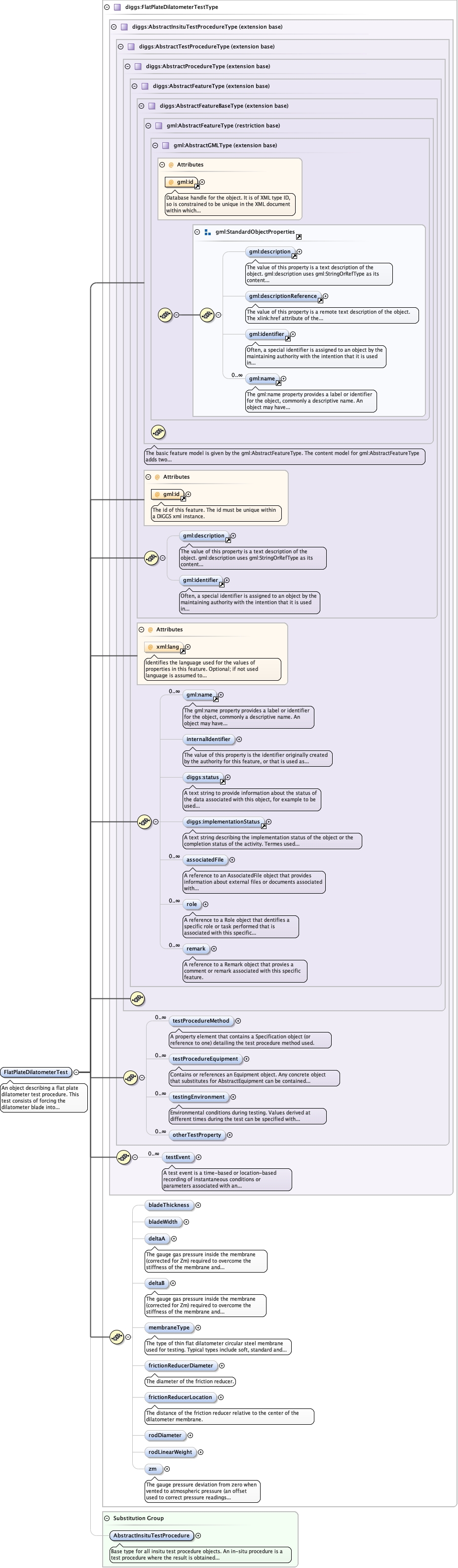
An object describing a flat plate dilatometer test procedure. This test consists of forcing the dilatometer blade into the soil, withthe membrane facing the horizontal direction, to a desired test penetration,measuring the thrust to accomplish this penetration and then using gas pressure toexpand a circular steel membrane located on one side of the blade. The operatormeasures and records the pressure required to produce expansion of the membrane intothe soil at two preset deflections. The operator then deflates the membrane,possibly recording an optional third measurement, advances the blade the desiredpenetration increment and repeats the test.
Database handle for the object. It is of XML type ID, so is constrained to beunique in the XML document within which it occurs. An external identifier for the object inthe form of a URI may be constructed using standard XML and XPointer methods. This is doneby concatenating the URI for the document, a fragment separator, and the value of the idattribute.
<div><h3>lang (as an attribute name)</h3><p>denotes an attribute whose value is a language code for the natural language of the content of any element; its value is inherited. This name is reserved by virtue of its definition in the XML specification.</p></div><div><h4>Notes</h4><p>Attempting to install the relevant ISO 2- and 3-letter codes as the enumerated possible values is probably never going to be a realistic possibility.</p><p>See BCP 47 at<a href="http://www.rfc-editor.org/rfc/bcp/bcp47.txt">http://www.rfc-editor.org/rfc/bcp/bcp47.txt</a>and the IANA language subtag registry at<a href="http://www.iana.org/assignments/language-subtag-registry">http://www.iana.org/assignments/language-subtag-registry</a>for further information.</p><p>The union allows for the 'un-declaration' of xml:lang with the empty string.</p></div>
Source
<element name="FlatPlateDilatometerTest" substitutionGroup="diggs:AbstractInsituTestProcedure" type="diggs:FlatPlateDilatometerTestType"><annotation><documentation>An object describing a flat plate dilatometer test procedure. This test consists of forcing the dilatometer blade into the soil, with the membrane facing the horizontal direction, to a desired test penetration, measuring the thrust to accomplish this penetration and then using gas pressure to expand a circular steel membrane located on one side of the blade. The operator measures and records the pressure required to produce expansion of the membrane into the soil at two preset deflections. The operator then deflates the membrane, possibly recording an optional third measurement, advances the blade the desired penetration increment and repeats the test.</documentation></annotation></element>