An index number indicating which heating increment theseparameters are associated with (eg. increment 1, 2,etc.)
Diagram
Type
integer
Properties
content
simple
minOccurs
0
Source
<element minOccurs="0" name="heatingIncrementNumber" type="integer"><annotation><documentation>An index number indicating which heating increment these parameters are associated with (eg. increment 1, 2, etc.)</documentation></annotation></element>
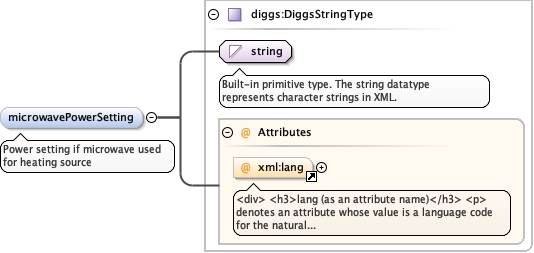
<div><h3>lang (as an attribute name)</h3><p>denotes an attribute whose value is a language code for the natural language of the content of any element; its value is inherited. This name is reserved by virtue of its definition in the XML specification.</p></div><div><h4>Notes</h4><p>Attempting to install the relevant ISO 2- and 3-letter codes as the enumerated possible values is probably never going to be a realistic possibility.</p><p>See BCP 47 at<a href="http://www.rfc-editor.org/rfc/bcp/bcp47.txt">http://www.rfc-editor.org/rfc/bcp/bcp47.txt</a>and the IANA language subtag registry at<a href="http://www.iana.org/assignments/language-subtag-registry">http://www.iana.org/assignments/language-subtag-registry</a>for further information.</p><p>The union allows for the 'un-declaration' of xml:lang with the empty string.</p></div>
Source
<element minOccurs="0" name="microwavePowerSetting" type="diggs:DiggsStringType"><annotation><documentation>Power setting if microwave used for heating source</documentation></annotation></element>
Database handle for the object. It is of XML type ID, so is constrained to beunique in the XML document within which it occurs. An external identifier for the object inthe form of a URI may be constructed using standard XML and XPointer methods. This is doneby concatenating the URI for the document, a fragment separator, and the value of the idattribute.
<div><h3>lang (as an attribute name)</h3><p>denotes an attribute whose value is a language code for the natural language of the content of any element; its value is inherited. This name is reserved by virtue of its definition in the XML specification.</p></div><div><h4>Notes</h4><p>Attempting to install the relevant ISO 2- and 3-letter codes as the enumerated possible values is probably never going to be a realistic possibility.</p><p>See BCP 47 at<a href="http://www.rfc-editor.org/rfc/bcp/bcp47.txt">http://www.rfc-editor.org/rfc/bcp/bcp47.txt</a>and the IANA language subtag registry at<a href="http://www.iana.org/assignments/language-subtag-registry">http://www.iana.org/assignments/language-subtag-registry</a>for further information.</p><p>The union allows for the 'un-declaration' of xml:lang with the empty string.</p></div>
Source
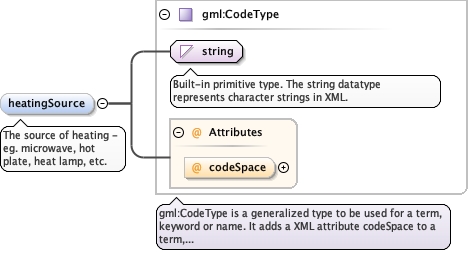
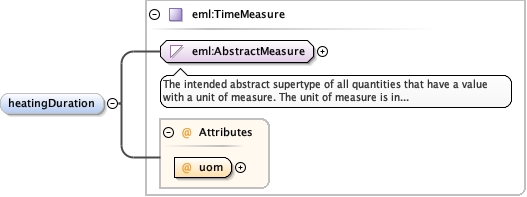
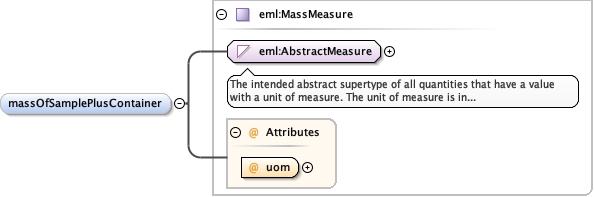
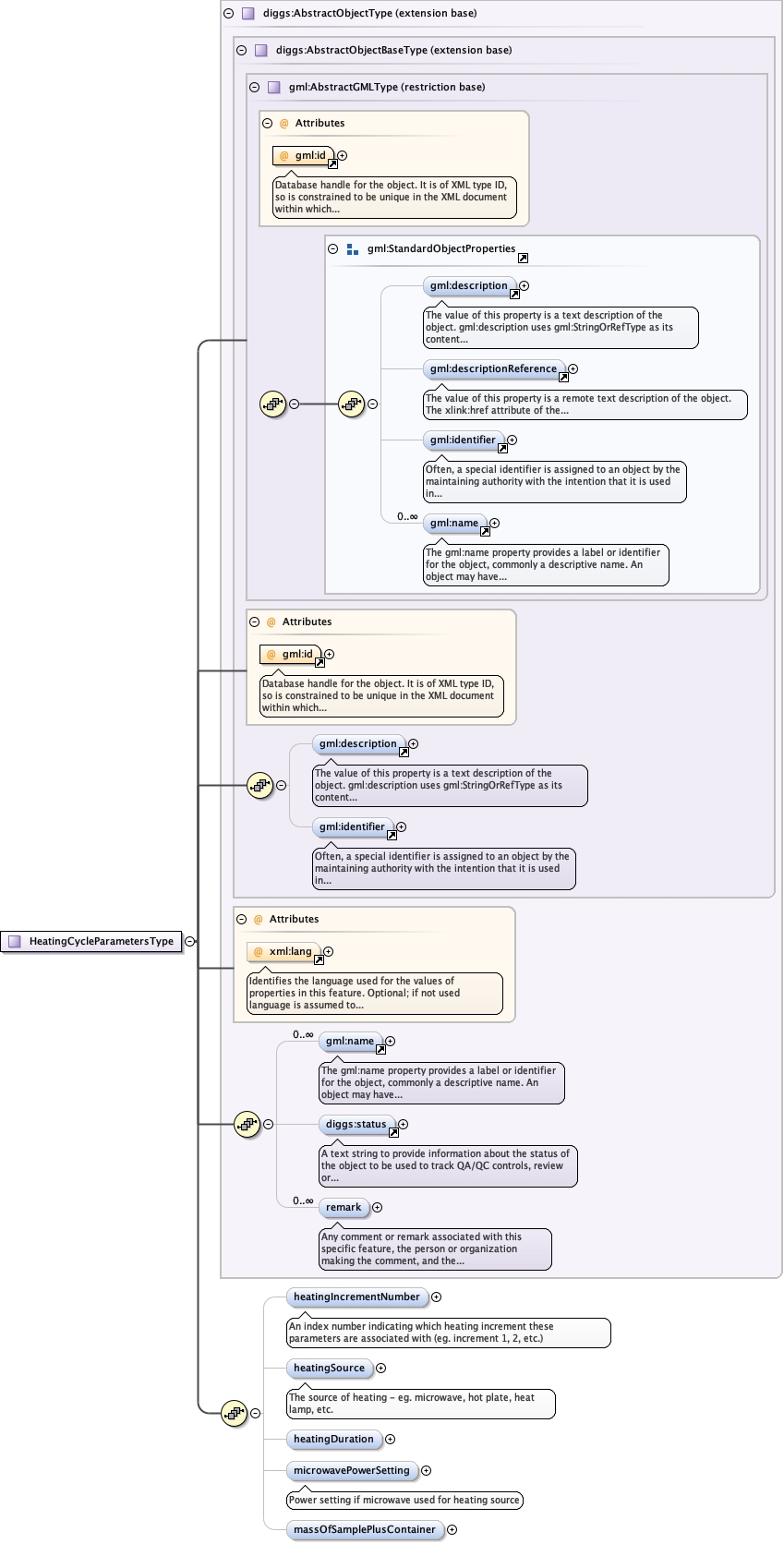
<complexType name="HeatingCycleParametersType"><annotation><documentation/></annotation><complexContent><extension base="diggs:AbstractObjectType"><sequence><element minOccurs="0" name="heatingIncrementNumber" type="integer"><annotation><documentation>An index number indicating which heating increment these parameters are associated with (eg. increment 1, 2, etc.)</documentation></annotation></element><element minOccurs="0" name="heatingSource" type="gml:CodeType"><annotation><documentation>The source of heating - eg. microwave, hot plate, heat lamp, etc.</documentation></annotation></element><element minOccurs="0" name="heatingDuration" type="eml:TimeMeasure"/><element minOccurs="0" name="microwavePowerSetting" type="diggs:DiggsStringType"><annotation><documentation>Power setting if microwave used for heating source</documentation></annotation></element><element minOccurs="0" name="massOfSamplePlusContainer" type="eml:MassMeasure"/></sequence></extension></complexContent></complexType>