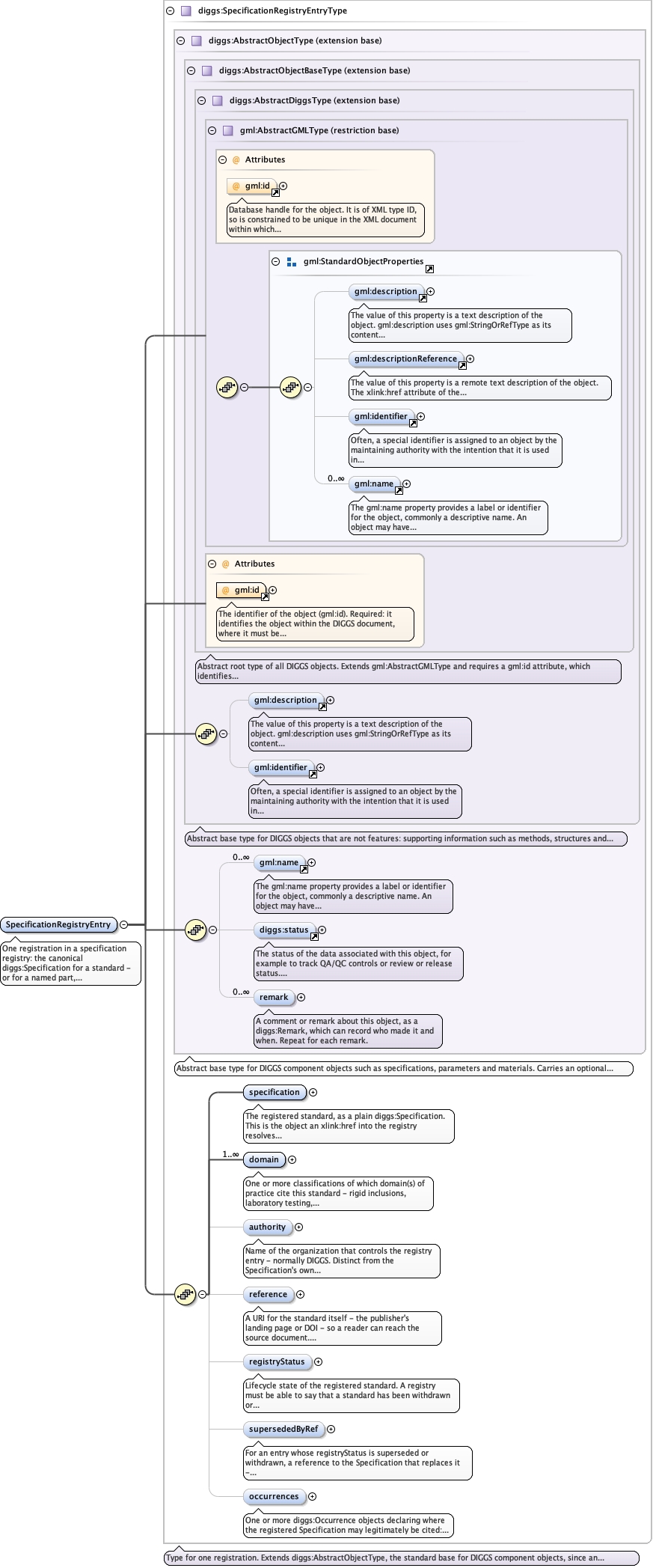
One registration in a specification registry: the canonical
                diggs:Specification for a standard - or for a named part, clause or procedure of a
                standard - together with the metadata that governs how it may be cited.

                This object exists so that the registered diggs:Specification can stay exactly what
                it always was. It substitutes nothing and appears nowhere except inside a registry,
                so no consuming application ever meets it where it expected a Specification. A
                reference into a registry resolves to the contained Specification, not to this
                entry.

                CHOOSING gml:id ON THE CONTAINED SPECIFICATION. The Specification's gml:id is the
                citation token - it is what appears after the '#' in every xlink:href - so it should
                track the standard's own identifier as closely as XML permits. gml:id is an XML ID
                and therefore an NCName: it may not begin with a digit and may not contain a space,
                a slash or a colon. So "ASTM D1143" becomes astm_d1143 and "BS 8006-1:2010" becomes
                bs_8006_1_2010. Use lower snake case throughout, and keep the token stable forever
                once published - a registry whose identifiers churn is worse than no registry,
                because existing citations silently break.

                SUBMETHODS. A named procedure within a standard is its own entry, not a variant of
                one: ASTM D1143 Procedure A gets its own SpecificationRegistryEntry whose
                Specification carries its own gml:id (astm_d1143_proc_a), repeats the parent's
                standardReferenceNumber, and is distinguished by standardClause, standardPart or
                shortMethodName. Because those are structured properties rather than free text, a
                consumer can group every Specification sharing a standardReferenceNumber under its
                parent standard mechanically. That grouping is the only reason to prefer registering
                a submethod over inventing an ad hoc code for it.
Database handle for the object. It is of XML type ID, so is constrained to beunique in the XML document within which it occurs. An external identifier for the object inthe form of a URI may be constructed using standard XML and XPointer methods. This is doneby concatenating the URI for the document, a fragment separator, and the value of the idattribute.
Source
<element name="SpecificationRegistryEntry" type="diggs:SpecificationRegistryEntryType"><annotation><documentation>One registration in a specification registry: the canonical diggs:Specification for a standard - or for a named part, clause or procedure of a standard - together with the metadata that governs how it may be cited. This object exists so that the registered diggs:Specification can stay exactly what it always was. It substitutes nothing and appears nowhere except inside a registry, so no consuming application ever meets it where it expected a Specification. A reference into a registry resolves to the contained Specification, not to this entry. CHOOSING gml:id ON THE CONTAINED SPECIFICATION. The Specification's gml:id is the citation token - it is what appears after the '#' in every xlink:href - so it should track the standard's own identifier as closely as XML permits. gml:id is an XML ID and therefore an NCName: it may not begin with a digit and may not contain a space, a slash or a colon. So "ASTM D1143" becomes astm_d1143 and "BS 8006-1:2010" becomes bs_8006_1_2010. Use lower snake case throughout, and keep the token stable forever once published - a registry whose identifiers churn is worse than no registry, because existing citations silently break. SUBMETHODS. A named procedure within a standard is its own entry, not a variant of one: ASTM D1143 Procedure A gets its own SpecificationRegistryEntry whose Specification carries its own gml:id (astm_d1143_proc_a), repeats the parent's standardReferenceNumber, and is distinguished by standardClause, standardPart or shortMethodName. Because those are structured properties rather than free text, a consumer can group every Specification sharing a standardReferenceNumber under its parent standard mechanically. That grouping is the only reason to prefer registering a submethod over inventing an ad hoc code for it.</documentation></annotation></element>