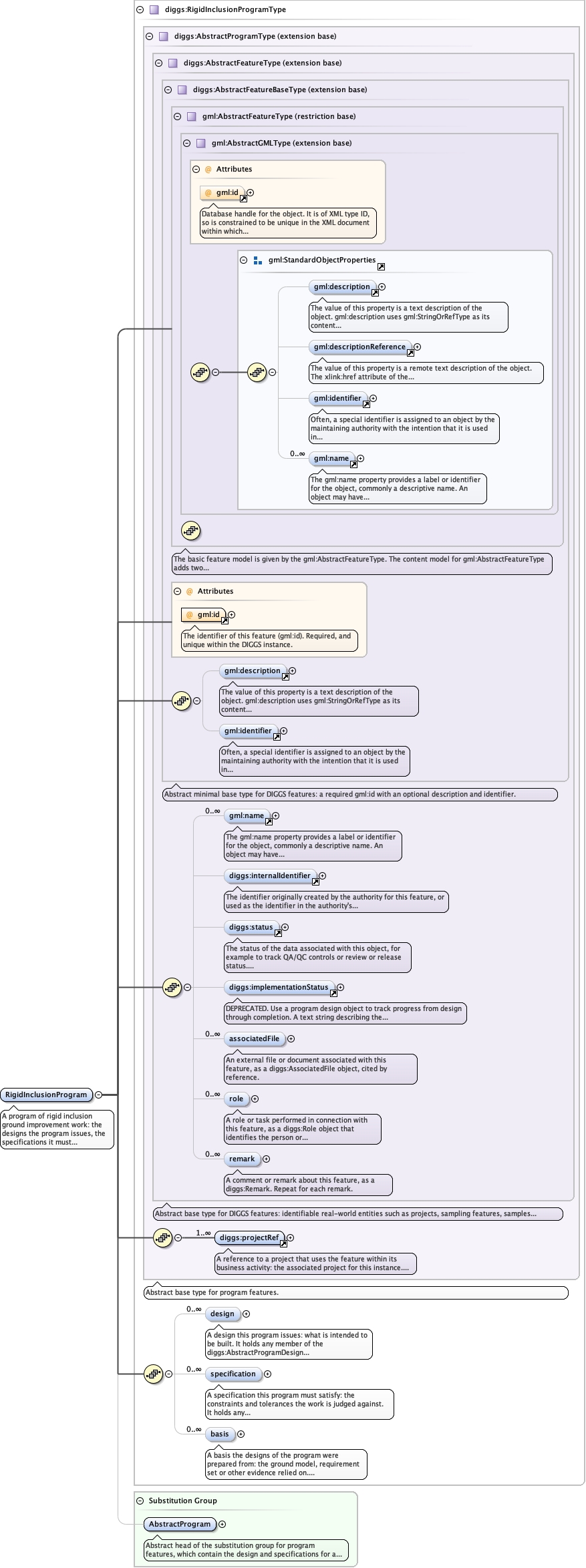
A program of rigid inclusion ground improvement work: the designs the programissues, the specifications it must satisfy, and the bases those were prepared from.It has three generic slots (design, specification, basis) rather than one per kindof design or specification, because the kind of object is carried by its own typeand substitution group. Document order is strictly all design elements, then allspecification elements, then all basis elements, not interleaved. This is an XSDsequence constraint, not a logical one: a design's programSpecificationRef may pointat a specification declared later in the document, but every design element mustprecede every specification element, and every specification element every basiselement, whichever cites which. An instance grouped by narrative instead, such as aDesignMeasurement next to its own criterion, fails validation.
Database handle for the object. It is of XML type ID, so is constrained to beunique in the XML document within which it occurs. An external identifier for the object inthe form of a URI may be constructed using standard XML and XPointer methods. This is doneby concatenating the URI for the document, a fragment separator, and the value of the idattribute.
Source
<element name="RigidInclusionProgram" type="diggs:RigidInclusionProgramType" substitutionGroup="diggs:AbstractProgram"><annotation><documentation>A program of rigid inclusion ground improvement work: the designs the program issues, the specifications it must satisfy, and the bases those were prepared from. It has three generic slots (design, specification, basis) rather than one per kind of design or specification, because the kind of object is carried by its own type and substitution group. Document order is strictly all design elements, then all specification elements, then all basis elements, not interleaved. This is an XSD sequence constraint, not a logical one: a design's programSpecificationRef may point at a specification declared later in the document, but every design element must precede every specification element, and every specification element every basis element, whichever cites which. An instance grouped by narrative instead, such as a DesignMeasurement next to its own criterion, fails validation.</documentation></annotation></element>