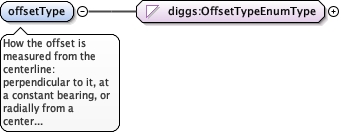
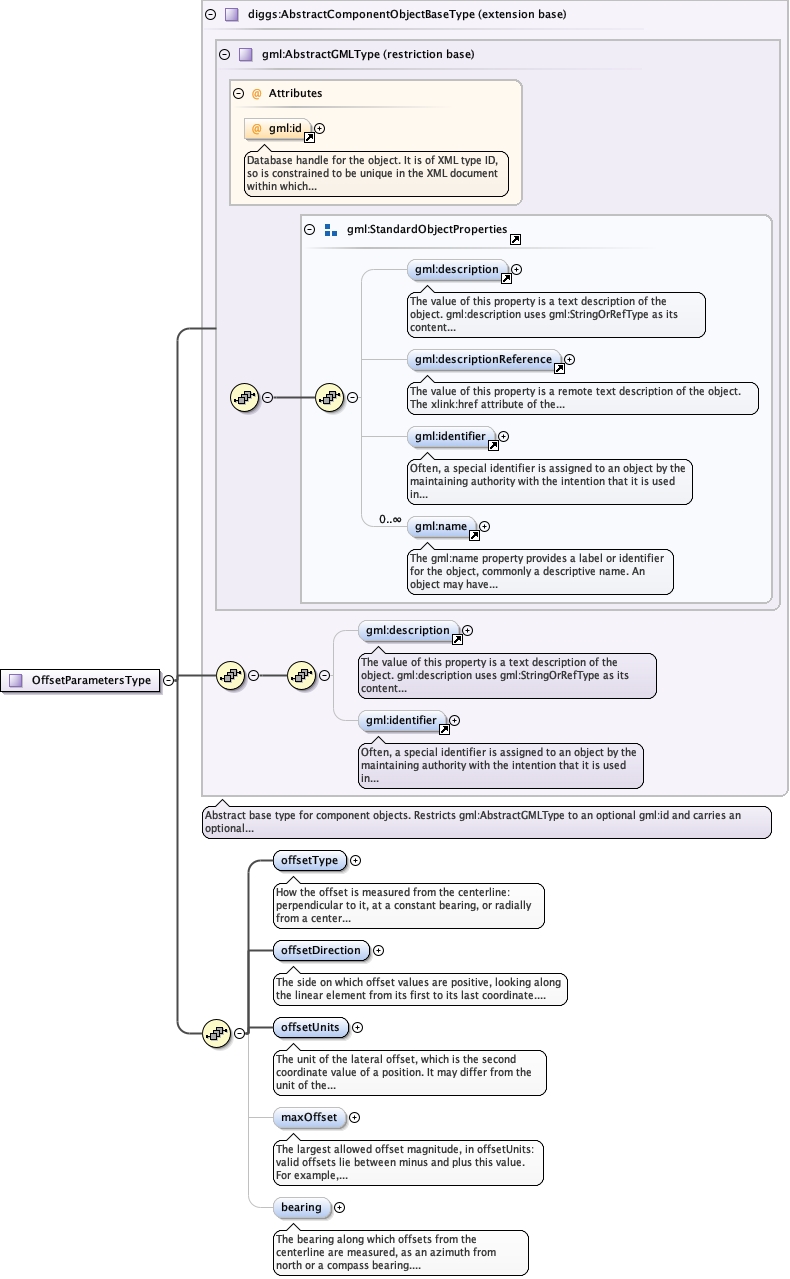
How the offset is measured from the centerline: perpendicular to it,at a constant bearing, or radially from a center point. Values comefrom the enumerated list.
Offset measured perpendicular to the tangent of the centerline at eachpoint. The usual method for straight or gently curved features.
enumeration
constantBearing
Offset measured along a fixed compass bearing from each centerline point,rather than perpendicular to the local tangent. Used in marine surveys withsensor arrays that keep a constant orientation relative to north.
enumeration
radial
Offset measured radially outward from a defined center point, rather thanperpendicular to the centerline. For circular or spiral survey patterns andradial sampling designs.
Source
<element name="offsetType" type="diggs:OffsetTypeEnumType" default="perpendicular"><annotation><documentation>How the offset is measured from the centerline: perpendicular to it, at a constant bearing, or radially from a center point. Values come from the enumerated list.</documentation></annotation></element>
The side on which offset values are positive, looking along thelinear element from its first to its last coordinate. Offsets on theother side are negative, and zero is on the centerline. Values comefrom the enumerated list.
Positive offset is to the right when looking along the linear element.Standard for terrestrial applications such as transects, pipelines and roadalignments.
enumeration
left
Positive offset is to the left when looking along the linear element.
enumeration
starboard
Positive offset is to starboard, the right side when facing the bow. Marineconvention for geophysical tracklines and marine surveys; equivalent toright.
enumeration
port
Positive offset is to port, the left side when facing the bow. Marineconvention for geophysical tracklines; equivalent to left.
Source
<element name="offsetDirection" type="diggs:OffsetDirectionEnumType" default="right"><annotation><documentation>The side on which offset values are positive, looking along the linear element from its first to its last coordinate. Offsets on the other side are negative, and zero is on the centerline. Values come from the enumerated list.</documentation></annotation></element>
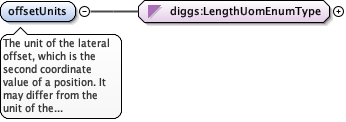
The unit of the lateral offset, which is the second coordinate valueof a position. It may differ from the unit of the distance along,though they are typically the same.
<element name="offsetUnits" type="diggs:LengthUomEnumType"><annotation><documentation>The unit of the lateral offset, which is the second coordinate value of a position. It may differ from the unit of the distance along, though they are typically the same.</documentation></annotation></element>
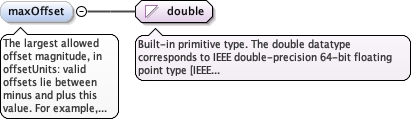
The largest allowed offset magnitude, in offsetUnits: valid offsetslie between minus and plus this value. For example, the swath widthof a geophysical instrument, or the limit of sampling from atransect centerline.
Diagram
Type
double
Properties
content
simple
minOccurs
0
Source
<element name="maxOffset" type="double" minOccurs="0"><annotation><documentation>The largest allowed offset magnitude, in offsetUnits: valid offsets lie between minus and plus this value. For example, the swath width of a geophysical instrument, or the limit of sampling from a transect centerline.</documentation></annotation></element>
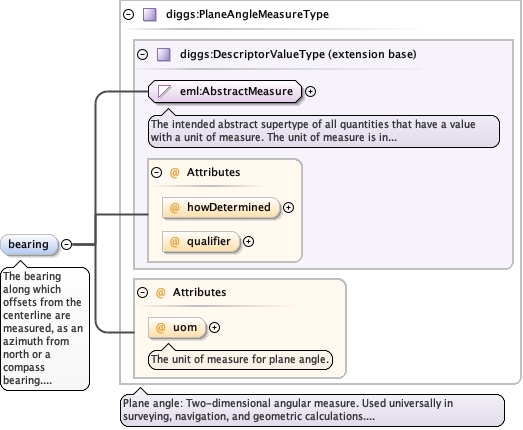
The bearing along which offsets from the centerline are measured, asan azimuth from north or a compass bearing. Required when offsetTypeis constantBearing.
<element minOccurs="0" name="bearing" type="diggs:PlaneAngleMeasureType"><annotation><documentation>The bearing along which offsets from the centerline are measured, as an azimuth from north or a compass bearing. Required when offsetType is constantBearing.</documentation></annotation></element>
Database handle for the object. It is of XML type ID, so is constrained to beunique in the XML document within which it occurs. An external identifier for the object inthe form of a URI may be constructed using standard XML and XPointer methods. This is doneby concatenating the URI for the document, a fragment separator, and the value of the idattribute.
Source
<complexType name="OffsetParametersType"><complexContent><extension base="diggs:AbstractComponentObjectBaseType"><sequence><element name="offsetType" type="diggs:OffsetTypeEnumType" default="perpendicular"><annotation><documentation>How the offset is measured from the centerline: perpendicular to it, at a constant bearing, or radially from a center point. Values come from the enumerated list.</documentation></annotation></element><element name="offsetDirection" type="diggs:OffsetDirectionEnumType" default="right"><annotation><documentation>The side on which offset values are positive, looking along the linear element from its first to its last coordinate. Offsets on the other side are negative, and zero is on the centerline. Values come from the enumerated list.</documentation></annotation></element><element name="offsetUnits" type="diggs:LengthUomEnumType"><annotation><documentation>The unit of the lateral offset, which is the second coordinate value of a position. It may differ from the unit of the distance along, though they are typically the same.</documentation></annotation></element><element name="maxOffset" type="double" minOccurs="0"><annotation><documentation>The largest allowed offset magnitude, in offsetUnits: valid offsets lie between minus and plus this value. For example, the swath width of a geophysical instrument, or the limit of sampling from a transect centerline.</documentation></annotation></element><element minOccurs="0" name="bearing" type="diggs:PlaneAngleMeasureType"><annotation><documentation>The bearing along which offsets from the centerline are measured, as an azimuth from north or a compass bearing. Required when offsetType is constantBearing.</documentation></annotation></element></sequence></extension></complexContent></complexType>