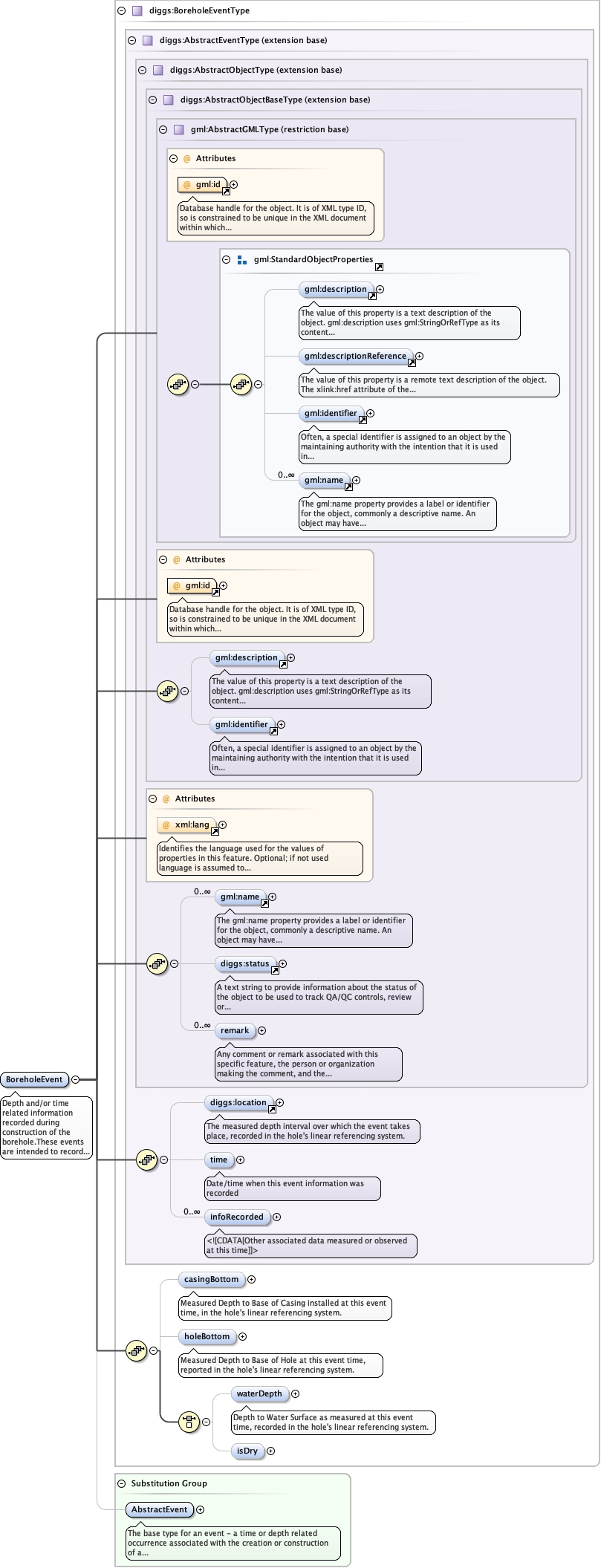
Showing:

Annotations
Attributes
Diagrams
Instances
Model
Properties
Source
Used by
Element diggs:BoreholeEvent
Namespace http://diggsml.org/schema-dev
Annotations
Depth and/or time related information recorded during construction of the
borehole.These events are intended to record information that is non-geological.
Typically this includes drillers comments usually found on the boring or drilling
log, for reporting incidents during drilling (such as "Fishing for broken U100"),
drilling records that don't readily fit in any other groups (such as "Pushing
boulder ahead of casing"), observations that are not strictly geological (such as
"Strong petrol smell").
Diagram
Diagramgml3_2Profile_diggs_xsd_Attribute_gml_id.tmp#idgml3_2Profile_diggs_xsd_Element_gml_description.tmp#descriptiongml3_2Profile_diggs_xsd_Element_gml_descriptionReference.tmp#descriptionReferencegml3_2Profile_diggs_xsd_Element_gml_identifier.tmp#identifiergml3_2Profile_diggs_xsd_Element_gml_name.tmp#namegml3_2Profile_diggs_xsd_Element_Group_gml_StandardObjectProperties.tmp#StandardObjectPropertiesgml3_2Profile_diggs_xsd_Complex_Type_gml_AbstractGMLType.tmp#AbstractGMLTypegml3_2Profile_diggs_xsd_Attribute_gml_id.tmp#idgml3_2Profile_diggs_xsd_Element_gml_description.tmp#descriptiongml3_2Profile_diggs_xsd_Element_gml_identifier.tmp#identifierKernel_xsd_Complex_Type_diggs_AbstractObjectBaseType.tmp#AbstractObjectBaseTypexml_xsd_Attribute_xml_lang.tmp#langgml3_2Profile_diggs_xsd_Element_gml_name.tmp#nameKernel_xsd_Element_diggs_status.tmp#statusKernel_xsd_Complex_Type_diggs_AbstractObjectType.tmp#AbstractObjectType_remarkKernel_xsd_Complex_Type_diggs_AbstractObjectType.tmp#AbstractObjectTypeKernel_xsd_Element_diggs_location.tmp#locationKernel_xsd_Complex_Type_diggs_AbstractEventType.tmp#AbstractEventType_timeKernel_xsd_Complex_Type_diggs_AbstractEventType.tmp#AbstractEventType_infoRecordedKernel_xsd_Complex_Type_diggs_AbstractEventType.tmp#AbstractEventTypeKernel_xsd_Complex_Type_diggs_BoreholeEventType.tmp#BoreholeEventType_casingBottomKernel_xsd_Complex_Type_diggs_BoreholeEventType.tmp#BoreholeEventType_holeBottomKernel_xsd_Complex_Type_diggs_BoreholeEventType.tmp#BoreholeEventType_waterDepthKernel_xsd_Complex_Type_diggs_BoreholeEventType.tmp#BoreholeEventType_isDryKernel_xsd_Complex_Type_diggs_BoreholeEventType.tmp#BoreholeEventTypeKernel_xsd_Element_diggs_AbstractEvent.tmp#AbstractEvent
Type diggs:BoreholeEventType
Type hierarchy
Properties
content complex
Substitution Group Affiliation
Used by
Model
Children diggs:casingBottom, diggs:holeBottom, diggs:infoRecorded, diggs:isDry, diggs:location, diggs:remark, diggs:status, diggs:time, diggs:waterDepth, gml:description, gml:identifier, gml:name
Instance
<diggs:BoreholeEvent gml:id="" xml:lang="" xmlns:diggs="http://diggsml.org/schema-dev" xmlns:gml="http://www.opengis.net/gml/3.2">
  <gml:description xlink:actuate="" xlink:arcrole="" xlink:href="" nilReason="" xlink:role="" xlink:show="" xlink:title="" xlink:type="simple">{0,1}</gml:description>
  <gml:identifier codeSpace="">{0,1}</gml:identifier>
  <gml:name codeSpace="">{0,unbounded}</gml:name>
  <diggs:status codeSpace="">{0,1}</diggs:status>
  <diggs:remark>{0,unbounded}</diggs:remark>
  <diggs:location xlink:actuate="" xlink:role="" xlink:arcrole="" xlink:show="" xlink:title="" xlink:href="" xlink:type="simple" nilReason="" owns="false">{0,1}</diggs:location>
  <diggs:time>{0,1}</diggs:time>
  <diggs:infoRecorded>{0,unbounded}</diggs:infoRecorded>
  <diggs:casingBottom xlink:actuate="" xlink:role="" xlink:arcrole="" xlink:show="" xlink:title="" xlink:href="" xlink:type="simple" nilReason="" owns="false">{0,1}</diggs:casingBottom>
  <diggs:holeBottom xlink:actuate="" xlink:role="" xlink:arcrole="" xlink:show="" xlink:title="" xlink:href="" xlink:type="simple" nilReason="" owns="false">{0,1}</diggs:holeBottom>
  <diggs:waterDepth xlink:actuate="" xlink:role="" xlink:arcrole="" xlink:show="" xlink:title="" xlink:href="" xlink:type="simple" nilReason="" owns="false">{0,1}</diggs:waterDepth>
  <diggs:isDry>{0,1}</diggs:isDry>
</diggs:BoreholeEvent>
Attributes
QName Type Use Annotation
gml:id ID required
Database handle for the object. It is of XML type ID, so is constrained to be
unique in the XML document within which it occurs. An external identifier for the object in
the form of a URI may be constructed using standard XML and XPointer methods. This is done
by concatenating the URI for the document, a fragment separator, and the value of the id
attribute.
xml:lang union of(xs:language, restriction of xs:string) optional
<div>
  <h3>lang (as an attribute name)</h3>
  <p>denotes an attribute whose value is a language code for the natural language of the content of any element; its value is inherited. This name is reserved by virtue of its definition in the XML specification.</p>
</div>
<div>
  <h4>Notes</h4>
  <p>Attempting to install the relevant ISO 2- and 3-letter codes as the enumerated possible values is probably never going to be a realistic possibility.</p>
  <p>See BCP 47 at
    <a href="http://www.rfc-editor.org/rfc/bcp/bcp47.txt">http://www.rfc-editor.org/rfc/bcp/bcp47.txt</a>and the IANA language subtag registry at
    <a href="http://www.iana.org/assignments/language-subtag-registry">http://www.iana.org/assignments/language-subtag-registry</a>for further information.</p>
  <p>The union allows for the 'un-declaration' of xml:lang with the empty string.</p>
</div>
Source
<element name="BoreholeEvent" type="diggs:BoreholeEventType" substitutionGroup="diggs:AbstractEvent">
  <annotation>
    <documentation>Depth and/or time related information recorded during construction of the borehole.These events are intended to record information that is non-geological. Typically this includes drillers comments usually found on the boring or drilling log, for reporting incidents during drilling (such as "Fishing for broken U100"), drilling records that don't readily fit in any other groups (such as "Pushing boulder ahead of casing"), observations that are not strictly geological (such as "Strong petrol smell").</documentation>
  </annotation>
</element>