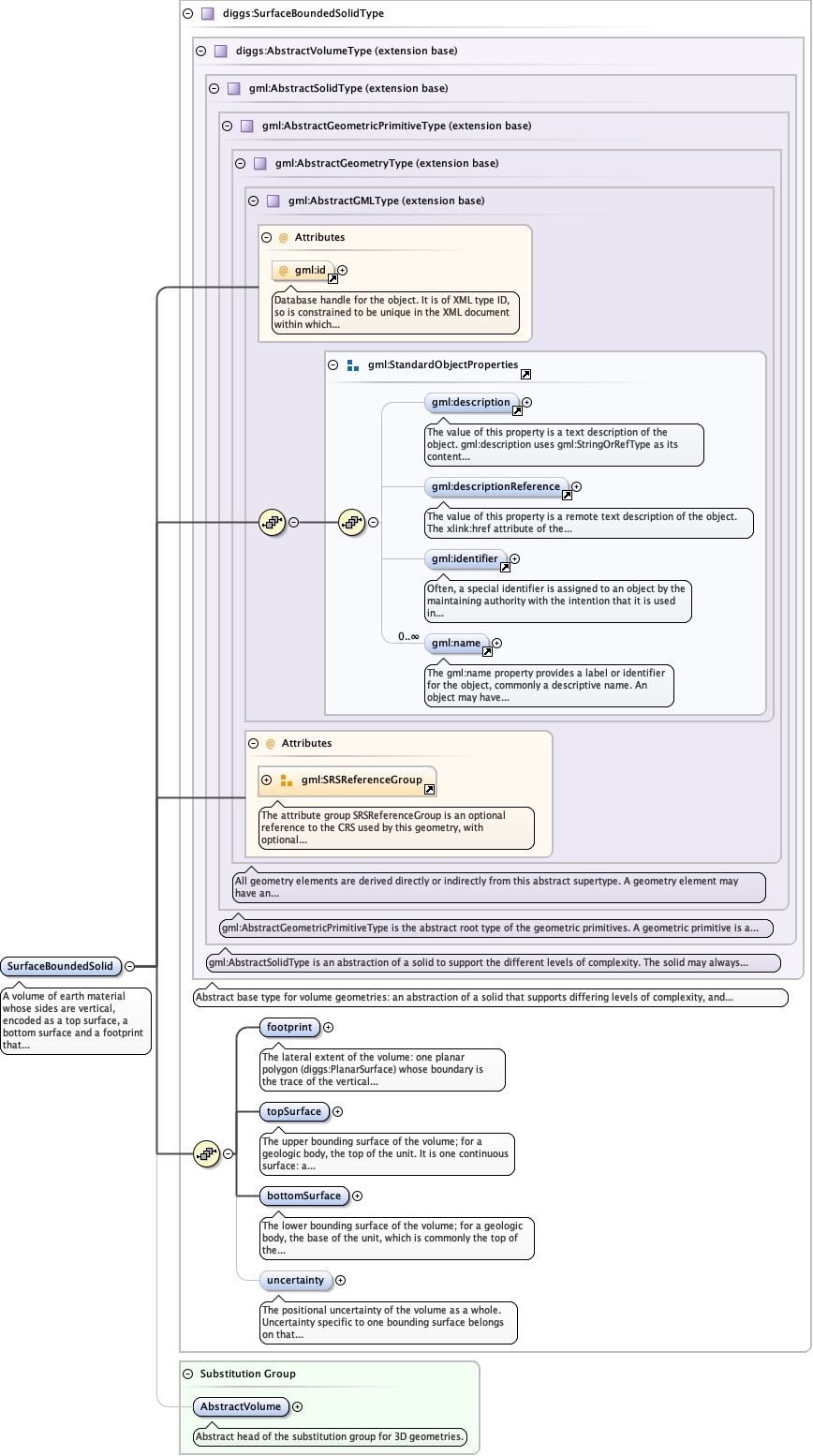
A volume of earth material whose sides are vertical, encoded as a top surface, abottom surface and a footprint that fixes its lateral extent: one planar region, orseveral disjoint planar regions when the plan-view extent is itself disconnected(see diggs:PlanarSurfaceOrMultiSurfacePropertyType). It is intended for geologicbodies, such as a stratigraphic unit, a geotechnical layer or a zone of treatedground, whose top and bottom vary in relief but whose lateral boundary is verticaleverywhere. It states only the independent geometry and leaves the side walls to becomputed, which for a many-vertex footprint or a finely triangulated top surface isa large reduction in instance size compared with a diggs:Solid, which needs adiggs:Shell enumerating every bounding polygon, including one side polygon perfootprint edge. Use diggs:Solid for a volume whose sides are not vertical.Construction: the solid is the region between topSurface and bottomSurface, boundedlaterally by vertical walls on the footprint's boundary or, when the footprint is adiggs:MultiSurface, on the boundary of each member independently, which gives aseparate disjoint body per member; together they make up the oneSurfaceBoundedSolid. The footprint decides only where a wall stands in plan view,never how tall it is. A wall lies in the vertical plane through its footprint edge,and its upper and lower edges follow the profiles of the top and bottom surfacesalong that edge. A wall therefore changes slope wherever a surface does, and where asurface has a vertical member crossing the edge (a step) the wall steps with it, sothat the solid is closed; where a surface is one plane, or linear along the wholeedge, the wall reduces to one planar quadrilateral. The vertices of the top andbottom surfaces need not coincide with each other or with the footprint's. Afootprint interior ring (a hole through the body, or through one member) generatesits own wall. Footprint members shall not overlap in plan view. Coverage: the topand bottom surfaces shall each extend to or beyond the footprint over its entirearea. A body whose surface stops short of its footprint is not a validdiggs:SurfaceBoundedSolid, and no rendering is defined for it. The XSD cannotexpress this geometric condition; check it by instance-level geometry validation ofthe footprint against the extent of each bounding surface. Bounding surfaces:topSurface and bottomSurface are each one continuous surface, a diggs:PlanarSurface,diggs:CompositeSurface, diggs:MultiPlanarSurface or diggs:TriangulatedSurface (seediggs:BoundingSurfacePropertyType), not a diggs:MultiSurface, whose members have noassumed adjacency. A body present as several disjoint pieces is expressed with adiggs:MultiSurface footprint over continuous top and bottom surfaces: each footprintmember is walled and capped independently. The members of a diggs:CompositeSurfaceand the patches of a diggs:MultiPlanarSurface shall share boundaries, adjacentmembers meeting along a common boundary curve in three dimensions, so a step isrepresented by a vertical member or patch, never by a gap. Neither surface need beplanar, single-patch or monotonic. Crossing surfaces: the two surfaces may touch orcross. The solid exists only where topSurface lies above bottomSurface; where thetop is at or below the bottom the body has no thickness and that part of thefootprint is empty. A body may pinch out within its footprint, and the survivingregions are separate parts of the one solid. A consumer should treat the emptyregions as void, with the parts of the walls that would stand on them, rather thanrender an inverted volume. No GML counterpart: GML represents a solid only byexplicit boundary representation (gml:Solid bounded by gml:Shell), so this is aDIGGS construct with nothing in GML to align to. It substitutes diggs:AbstractVolumeand its type derives from diggs:AbstractVolumeType, which derives fromgml:AbstractSolidType, so a schema-aware GML consumer sees a member of the solidfamily, and only a DIGGS-aware consumer needs to know how to expand it.
Database handle for the object. It is of XML type ID, so is constrained to beunique in the XML document within which it occurs. An external identifier for the object inthe form of a URI may be constructed using standard XML and XPointer methods. This is doneby concatenating the URI for the document, a fragment separator, and the value of the idattribute.
<element name="SurfaceBoundedSolid" type="diggs:SurfaceBoundedSolidType" substitutionGroup="diggs:AbstractVolume"><annotation><documentation>A volume of earth material whose sides are vertical, encoded as a top surface, a bottom surface and a footprint that fixes its lateral extent: one planar region, or several disjoint planar regions when the plan-view extent is itself disconnected (see diggs:PlanarSurfaceOrMultiSurfacePropertyType). It is intended for geologic bodies, such as a stratigraphic unit, a geotechnical layer or a zone of treated ground, whose top and bottom vary in relief but whose lateral boundary is vertical everywhere. It states only the independent geometry and leaves the side walls to be computed, which for a many-vertex footprint or a finely triangulated top surface is a large reduction in instance size compared with a diggs:Solid, which needs a diggs:Shell enumerating every bounding polygon, including one side polygon per footprint edge. Use diggs:Solid for a volume whose sides are not vertical. Construction: the solid is the region between topSurface and bottomSurface, bounded laterally by vertical walls on the footprint's boundary or, when the footprint is a diggs:MultiSurface, on the boundary of each member independently, which gives a separate disjoint body per member; together they make up the one SurfaceBoundedSolid. The footprint decides only where a wall stands in plan view, never how tall it is. A wall lies in the vertical plane through its footprint edge, and its upper and lower edges follow the profiles of the top and bottom surfaces along that edge. A wall therefore changes slope wherever a surface does, and where a surface has a vertical member crossing the edge (a step) the wall steps with it, so that the solid is closed; where a surface is one plane, or linear along the whole edge, the wall reduces to one planar quadrilateral. The vertices of the top and bottom surfaces need not coincide with each other or with the footprint's. A footprint interior ring (a hole through the body, or through one member) generates its own wall. Footprint members shall not overlap in plan view. Coverage: the top and bottom surfaces shall each extend to or beyond the footprint over its entire area. A body whose surface stops short of its footprint is not a valid diggs:SurfaceBoundedSolid, and no rendering is defined for it. The XSD cannot express this geometric condition; check it by instance-level geometry validation of the footprint against the extent of each bounding surface. Bounding surfaces: topSurface and bottomSurface are each one continuous surface, a diggs:PlanarSurface, diggs:CompositeSurface, diggs:MultiPlanarSurface or diggs:TriangulatedSurface (see diggs:BoundingSurfacePropertyType), not a diggs:MultiSurface, whose members have no assumed adjacency. A body present as several disjoint pieces is expressed with a diggs:MultiSurface footprint over continuous top and bottom surfaces: each footprint member is walled and capped independently. The members of a diggs:CompositeSurface and the patches of a diggs:MultiPlanarSurface shall share boundaries, adjacent members meeting along a common boundary curve in three dimensions, so a step is represented by a vertical member or patch, never by a gap. Neither surface need be planar, single-patch or monotonic. Crossing surfaces: the two surfaces may touch or cross. The solid exists only where topSurface lies above bottomSurface; where the top is at or below the bottom the body has no thickness and that part of the footprint is empty. A body may pinch out within its footprint, and the surviving regions are separate parts of the one solid. A consumer should treat the empty regions as void, with the parts of the walls that would stand on them, rather than render an inverted volume. No GML counterpart: GML represents a solid only by explicit boundary representation (gml:Solid bounded by gml:Shell), so this is a DIGGS construct with nothing in GML to align to. It substitutes diggs:AbstractVolume and its type derives from diggs:AbstractVolumeType, which derives from gml:AbstractSolidType, so a schema-aware GML consumer sees a member of the solid family, and only a DIGGS-aware consumer needs to know how to expand it.</documentation></annotation></element>