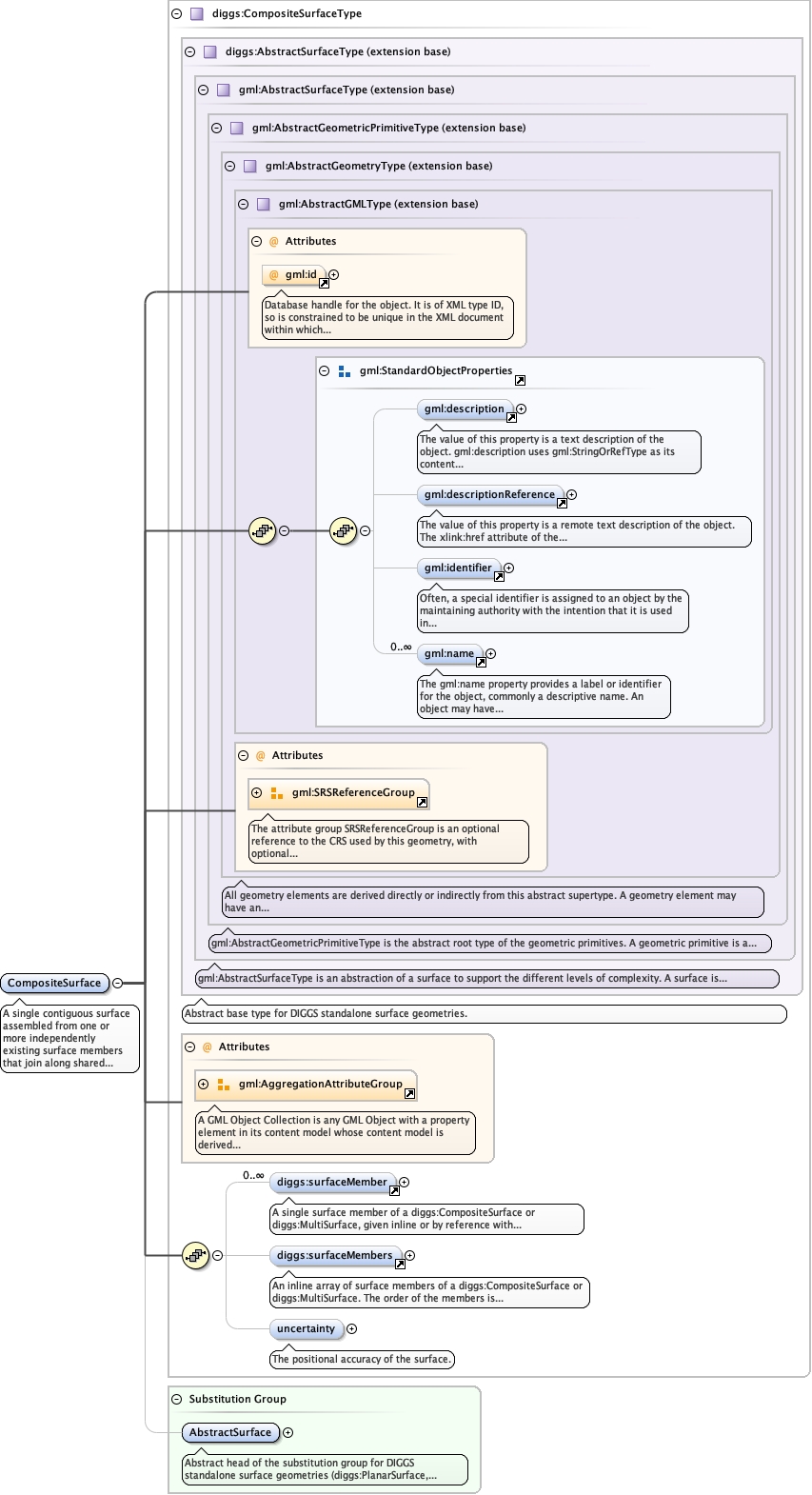
A single contiguous surface assembled from one or more independently existingsurface members that join along shared boundaries (ISO 19107 GM_CompositeSurface).Each member is a complete diggs:AbstractSurface object with its own gml:id andoptional srsName, given inline or by xlink:href to a surface defined elsewhere inthe document. Use it when panels need their own CRS, gml:id or reuse by reference,for example a dog-leg trench wall whose segments were surveyed in different localdatums. Use diggs:MultiPlanarSurface for a single multi-panel surface withnon-addressable panels, and diggs:MultiSurface for a discontinuous collection or acoverage domain needing one value per member.
Database handle for the object. It is of XML type ID, so is constrained to beunique in the XML document within which it occurs. An external identifier for the object inthe form of a URI may be constructed using standard XML and XPointer methods. This is doneby concatenating the URI for the document, a fragment separator, and the value of the idattribute.
<element name="CompositeSurface" substitutionGroup="diggs:AbstractSurface" type="diggs:CompositeSurfaceType"><annotation><documentation>A single contiguous surface assembled from one or more independently existing surface members that join along shared boundaries (ISO 19107 GM_CompositeSurface). Each member is a complete diggs:AbstractSurface object with its own gml:id and optional srsName, given inline or by xlink:href to a surface defined elsewhere in the document. Use it when panels need their own CRS, gml:id or reuse by reference, for example a dog-leg trench wall whose segments were surveyed in different local datums. Use diggs:MultiPlanarSurface for a single multi-panel surface with non-addressable panels, and diggs:MultiSurface for a discontinuous collection or a coverage domain needing one value per member.</documentation></annotation></element>