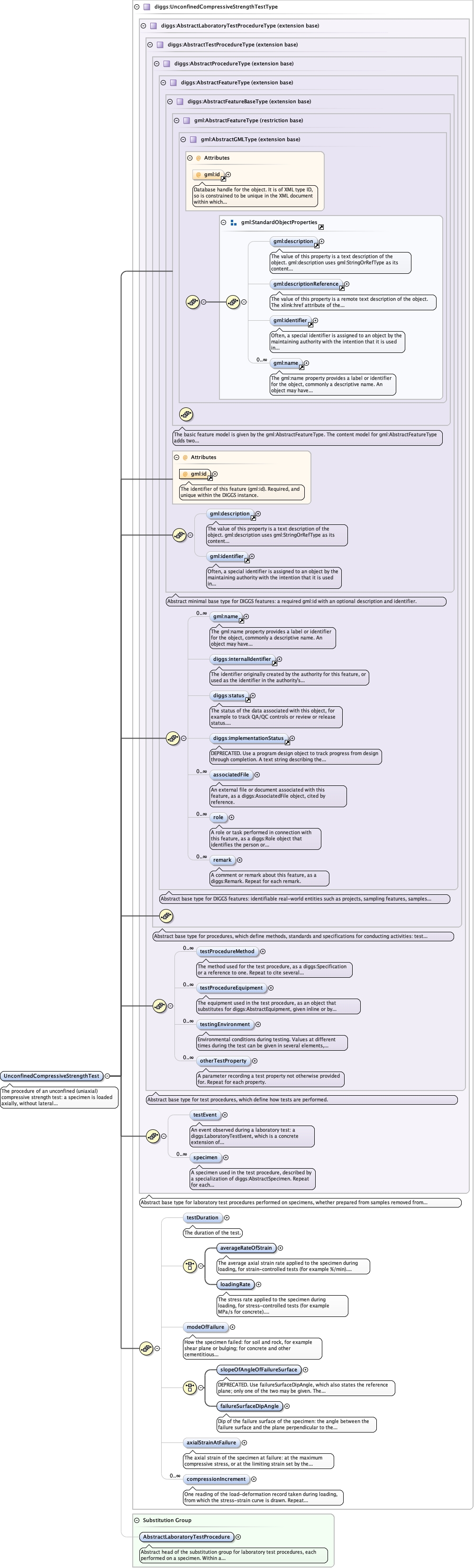
The procedure of an unconfined (uniaxial) compressive strength test: a specimen isloaded axially, without lateral confinement, until it fails, and the maximumcompressive stress it sustains is its unconfined compressive strength. It applies tosoil and rock, and to manufactured cementitious materials such as concrete, grout,mortar and soil-cement. The strength and other measured values are reported in theresults of the diggs:Test or diggs:MaterialTest that carries this procedure; thisobject records how the test was carried out and how the specimen failed. Thegoverning standard is cited by testProcedureMethod and the specimens tested aredescribed by specimen.
Database handle for the object. It is of XML type ID, so is constrained to beunique in the XML document within which it occurs. An external identifier for the object inthe form of a URI may be constructed using standard XML and XPointer methods. This is doneby concatenating the URI for the document, a fragment separator, and the value of the idattribute.
Source
<element abstract="false" name="UnconfinedCompressiveStrengthTest" substitutionGroup="diggs:AbstractLaboratoryTestProcedure" type="diggs:UnconfinedCompressiveStrengthTestType"><annotation><documentation>The procedure of an unconfined (uniaxial) compressive strength test: a specimen is loaded axially, without lateral confinement, until it fails, and the maximum compressive stress it sustains is its unconfined compressive strength. It applies to soil and rock, and to manufactured cementitious materials such as concrete, grout, mortar and soil-cement. The strength and other measured values are reported in the results of the diggs:Test or diggs:MaterialTest that carries this procedure; this object records how the test was carried out and how the specimen failed. The governing standard is cited by testProcedureMethod and the specimens tested are described by specimen.</documentation></annotation></element>