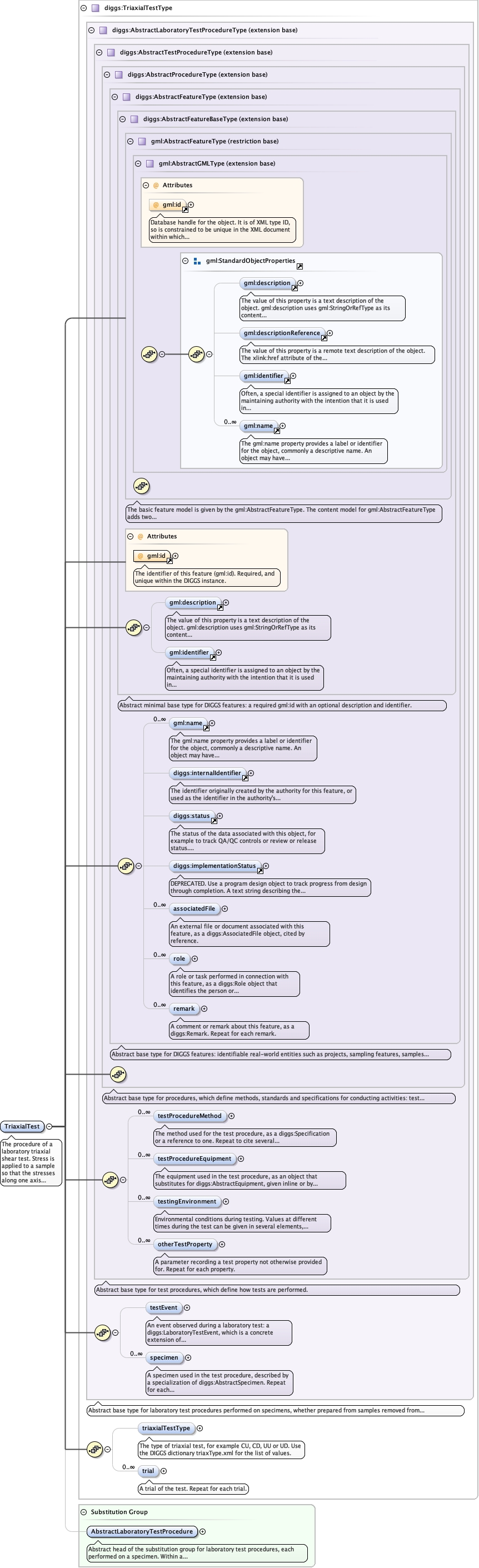
The procedure of a laboratory triaxial shear test. Stress is applied to a sample sothat the stresses along one axis differ from those in perpendicular directions; inconventional triaxial tests a cylindrical soil sample is subjected to radialstresses (confining pressure) and controlled increases in axial stress or axialdisplacement. Depending on loading and drainage conditions there are three maintypes: consolidated drained (CD), consolidated undrained (CU) and unconsolidatedundrained (UU). The results give the shear strength parameters (friction angle,cohesion, dilatancy angle) and other dependent parameters.
Database handle for the object. It is of XML type ID, so is constrained to beunique in the XML document within which it occurs. An external identifier for the object inthe form of a URI may be constructed using standard XML and XPointer methods. This is doneby concatenating the URI for the document, a fragment separator, and the value of the idattribute.
Source
<element abstract="false" name="TriaxialTest" substitutionGroup="diggs:AbstractLaboratoryTestProcedure" type="diggs:TriaxialTestType"><annotation><documentation>The procedure of a laboratory triaxial shear test. Stress is applied to a sample so that the stresses along one axis differ from those in perpendicular directions; in conventional triaxial tests a cylindrical soil sample is subjected to radial stresses (confining pressure) and controlled increases in axial stress or axial displacement. Depending on loading and drainage conditions there are three main types: consolidated drained (CD), consolidated undrained (CU) and unconsolidated undrained (UU). The results give the shear strength parameters (friction angle, cohesion, dilatancy angle) and other dependent parameters.</documentation></annotation></element>