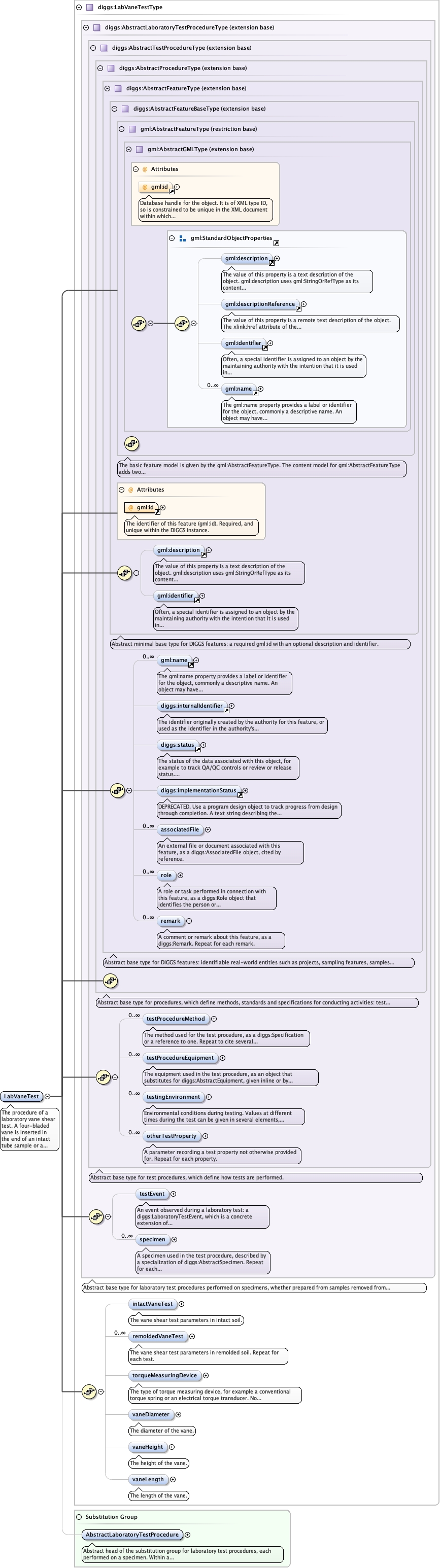
The procedure of a laboratory vane shear test. A four-bladed vane is inserted in theend of an intact tube sample or a remolded sample and rotated at a constant rate todetermine the torque required to shear a cylindrical surface. The torque isconverted to a unit shearing resistance of the cylindrical surface area, and ismeasured by a calibrated torque spring or torque transducer attached directly to thevane.
Database handle for the object. It is of XML type ID, so is constrained to beunique in the XML document within which it occurs. An external identifier for the object inthe form of a URI may be constructed using standard XML and XPointer methods. This is doneby concatenating the URI for the document, a fragment separator, and the value of the idattribute.
Source
<element abstract="false" name="LabVaneTest" substitutionGroup="diggs:AbstractLaboratoryTestProcedure" type="diggs:LabVaneTestType"><annotation><documentation>The procedure of a laboratory vane shear test. A four-bladed vane is inserted in the end of an intact tube sample or a remolded sample and rotated at a constant rate to determine the torque required to shear a cylindrical surface. The torque is converted to a unit shearing resistance of the cylindrical surface area, and is measured by a calibrated torque spring or torque transducer attached directly to the vane.</documentation></annotation></element>