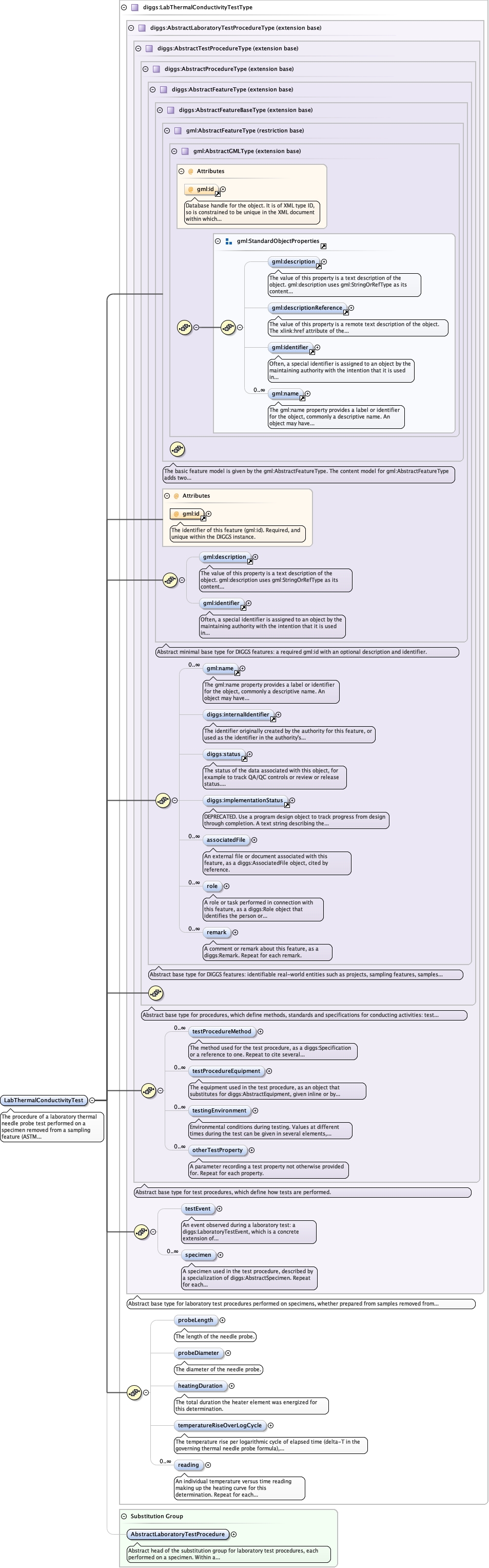
The procedure of a laboratory thermal needle probe test performed on a specimenremoved from a sampling feature (ASTM D5334, IEEE Std 442). A long, small-diameterneedle containing a heating element and a temperature sensor is inserted into thespecimen; a known current is passed through the heater and the resulting temperaturerise is monitored over time. Thermal conductivity and its reciprocal, thermalresistivity, are computed from the rate of temperature rise per logarithmic timecycle and are reported as diggs:Property values (propertyClass thermal_conductivityor thermal_resistivity) in the outcome of the test, not as elements of thisprocedure; one determination results per test. It is not for in-situ measurement:the field-probe variant that ASTM D5334 and IEEE Std 442 also describe is out ofscope. Whether the specimen is undisturbed or remolded is recorded bydiggs:SoilSpecimenType/specimenType.
Database handle for the object. It is of XML type ID, so is constrained to beunique in the XML document within which it occurs. An external identifier for the object inthe form of a URI may be constructed using standard XML and XPointer methods. This is doneby concatenating the URI for the document, a fragment separator, and the value of the idattribute.
Source
<element abstract="false" name="LabThermalConductivityTest" substitutionGroup="diggs:AbstractLaboratoryTestProcedure" type="diggs:LabThermalConductivityTestType"><annotation><documentation>The procedure of a laboratory thermal needle probe test performed on a specimen removed from a sampling feature (ASTM D5334, IEEE Std 442). A long, small-diameter needle containing a heating element and a temperature sensor is inserted into the specimen; a known current is passed through the heater and the resulting temperature rise is monitored over time. Thermal conductivity and its reciprocal, thermal resistivity, are computed from the rate of temperature rise per logarithmic time cycle and are reported as diggs:Property values (propertyClass thermal_conductivity or thermal_resistivity) in the outcome of the test, not as elements of this procedure; one determination results per test. It is not for in-situ measurement: the field-probe variant that ASTM D5334 and IEEE Std 442 also describe is out of scope. Whether the specimen is undisturbed or remolded is recorded by diggs:SoilSpecimenType/specimenType.</documentation></annotation></element>