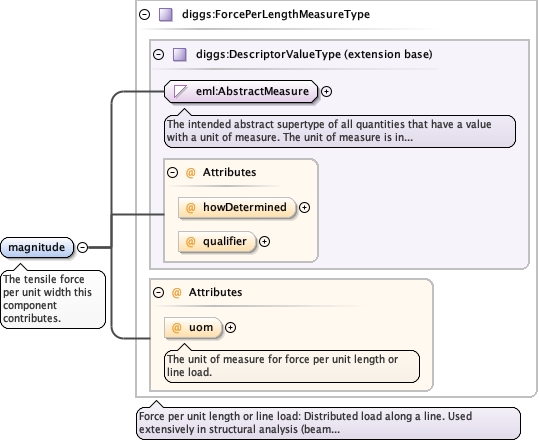
The unit of measure for force per unit length or line load.
Source
<element name="magnitude" type="diggs:ForcePerLengthMeasureType"><annotation><documentation>The tensile force per unit width this component contributes.</documentation></annotation></element>
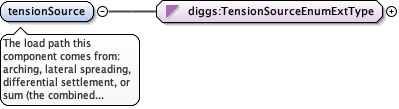
The load path this component comes from: arching, lateral spreading,differential settlement, or sum (the combined design tension). Thelateral-spreading demand on the reinforcement is the lateralspreading value of this code. Values come from the enumerated list,or "Other: xx", where xx is a user-defined term whose meaningdiffers from every listed value (not a synonym of one).
<element name="tensionSource" type="diggs:TensionSourceEnumExtType"><annotation><documentation>The load path this component comes from: arching, lateral spreading, differential settlement, or sum (the combined design tension). The lateral-spreading demand on the reinforcement is the lateral spreading value of this code. Values come from the enumerated list, or "Other: xx", where xx is a user-defined term whose meaning differs from every listed value (not a synonym of one).</documentation></annotation></element>
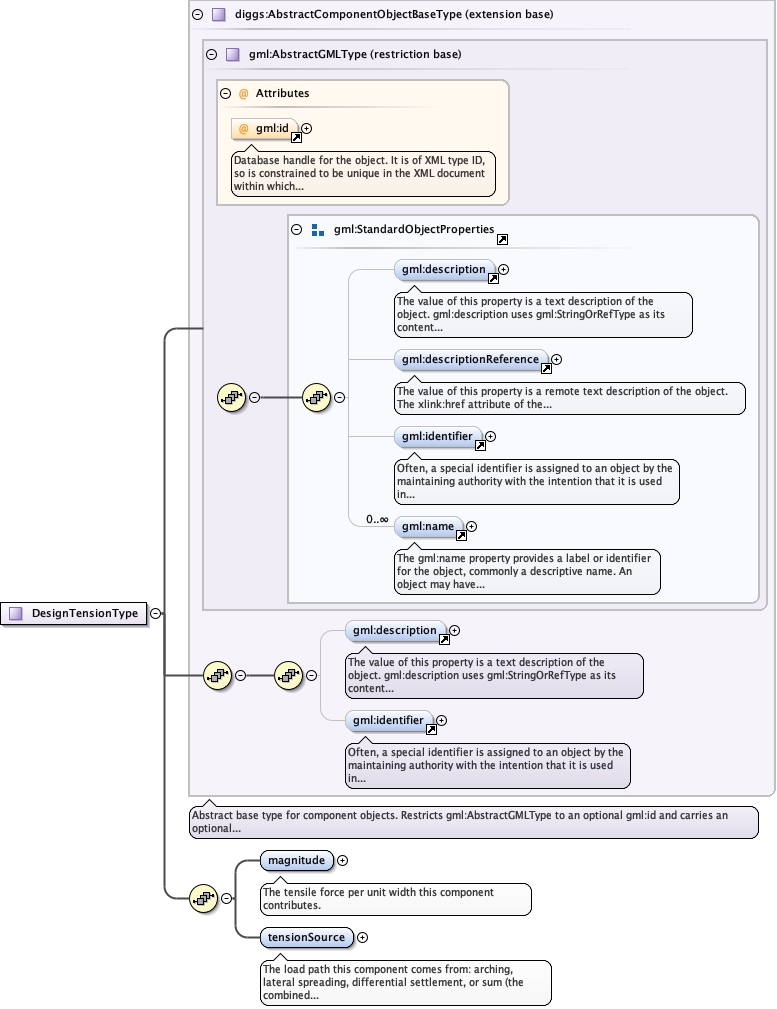
Database handle for the object. It is of XML type ID, so is constrained to beunique in the XML document within which it occurs. An external identifier for the object inthe form of a URI may be constructed using standard XML and XPointer methods. This is doneby concatenating the URI for the document, a fragment separator, and the value of the idattribute.
Source
<complexType name="DesignTensionType"><complexContent><extension base="diggs:AbstractComponentObjectBaseType"><sequence><element name="magnitude" type="diggs:ForcePerLengthMeasureType"><annotation><documentation>The tensile force per unit width this component contributes.</documentation></annotation></element><element name="tensionSource" type="diggs:TensionSourceEnumExtType"><annotation><documentation>The load path this component comes from: arching, lateral spreading, differential settlement, or sum (the combined design tension). The lateral-spreading demand on the reinforcement is the lateral spreading value of this code. Values come from the enumerated list, or "Other: xx", where xx is a user-defined term whose meaning differs from every listed value (not a synonym of one).</documentation></annotation></element></sequence></extension></complexContent></complexType>