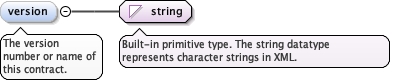
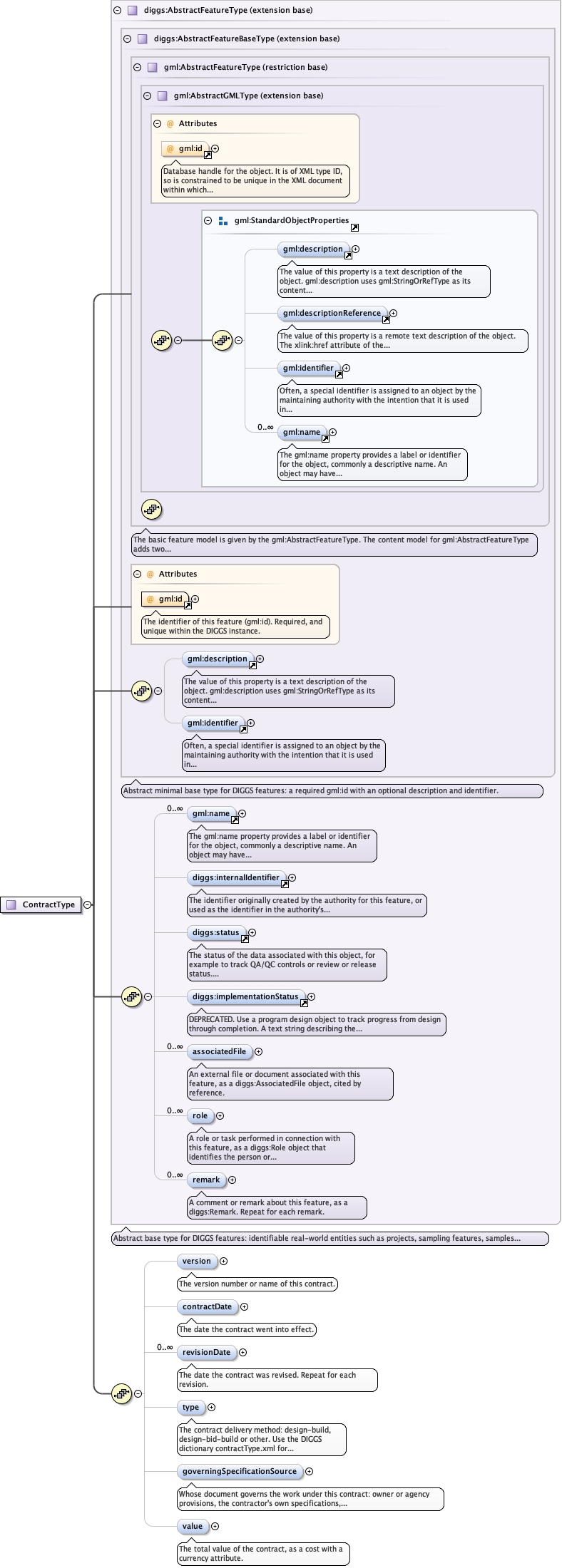
<element name="version" type="string" minOccurs="0" maxOccurs="1"><annotation><documentation>The version number or name of this contract.</documentation></annotation></element>
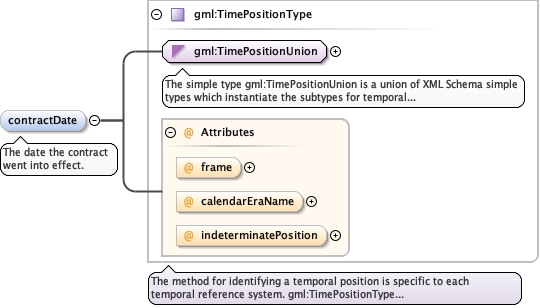
<element minOccurs="0" name="contractDate" type="gml:TimePositionType"><annotation><documentation>The date the contract went into effect.</documentation></annotation></element>
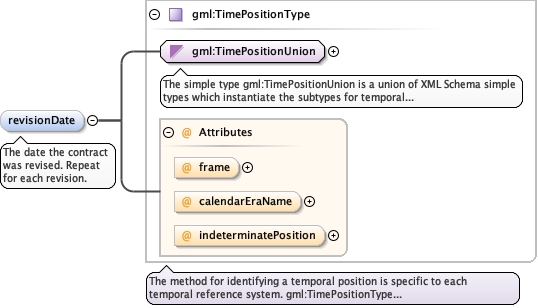
<element minOccurs="0" name="revisionDate" type="gml:TimePositionType" maxOccurs="unbounded"><annotation><documentation>The date the contract was revised. Repeat for each revision.</documentation></annotation></element>
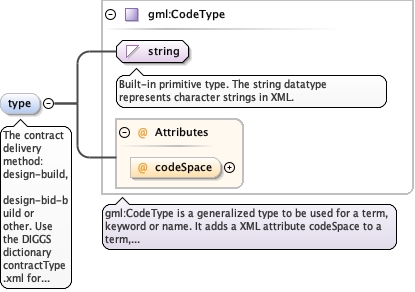
<element name="type" type="gml:CodeType" minOccurs="0" maxOccurs="1"><annotation><documentation>The contract delivery method: design-build, design-bid-build or other. Use the DIGGS dictionary contractType.xml for the list of values.</documentation></annotation></element>
Whose document governs the work under this contract: owner or agencyprovisions, the contractor's own specifications, or none. This is acontracting fact, not a design-basis fact; it differs fromdiggs:RIProgramBasisType/governingStandard, which states whichpublished document governs. The two are complementary: a contractcan name owner or agency provisions here while the basis cites thespecific standard those provisions invoke. It is stated on thecontract, reached through the project's contract property, and notper program: the source applies to everything executed under thecontract, which may span more than one specialty's program on thesame project. The party concerned is stated through the inheritedrole of the contract (for example owner, client,specialty_contractor or main_contractor, from roles.xml) with theresponsible business associate, on this same object. Values comefrom the enumerated list, or "Other: xx", where xx is a user-definedterm whose meaning differs from every listed value (not a synonym ofone).
<element name="governingSpecificationSource" type="diggs:GoverningSpecificationSourceEnumExtType" minOccurs="0" maxOccurs="1"><annotation><documentation>Whose document governs the work under this contract: owner or agency provisions, the contractor's own specifications, or none. This is a contracting fact, not a design-basis fact; it differs from diggs:RIProgramBasisType/governingStandard, which states which published document governs. The two are complementary: a contract can name owner or agency provisions here while the basis cites the specific standard those provisions invoke. It is stated on the contract, reached through the project's contract property, and not per program: the source applies to everything executed under the contract, which may span more than one specialty's program on the same project. The party concerned is stated through the inherited role of the contract (for example owner, client, specialty_contractor or main_contractor, from roles.xml) with the responsible business associate, on this same object. Values come from the enumerated list, or "Other: xx", where xx is a user-defined term whose meaning differs from every listed value (not a synonym of one).</documentation></annotation></element>
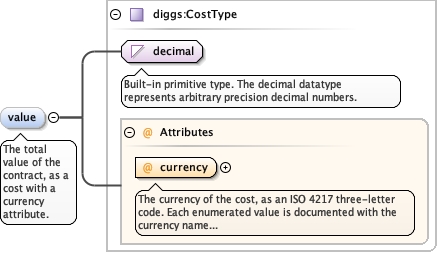
The currency of the cost, as an ISO 4217 three-letter code. Eachenumerated value is documented with the currency name and the country orterritory where it is used. Values come from the enumerated list.
Source
<element name="value" type="diggs:CostType" minOccurs="0" maxOccurs="1"><annotation><documentation>The total value of the contract, as a cost with a currency attribute.</documentation></annotation></element>
Database handle for the object. It is of XML type ID, so is constrained to beunique in the XML document within which it occurs. An external identifier for the object inthe form of a URI may be constructed using standard XML and XPointer methods. This is doneby concatenating the URI for the document, a fragment separator, and the value of the idattribute.
Source
<complexType name="ContractType"><complexContent><extension base="diggs:AbstractFeatureType"><sequence><element name="version" type="string" minOccurs="0" maxOccurs="1"><annotation><documentation>The version number or name of this contract.</documentation></annotation></element><element minOccurs="0" name="contractDate" type="gml:TimePositionType"><annotation><documentation>The date the contract went into effect.</documentation></annotation></element><element minOccurs="0" name="revisionDate" type="gml:TimePositionType" maxOccurs="unbounded"><annotation><documentation>The date the contract was revised. Repeat for each revision.</documentation></annotation></element><element name="type" type="gml:CodeType" minOccurs="0" maxOccurs="1"><annotation><documentation>The contract delivery method: design-build, design-bid-build or other. Use the DIGGS dictionary contractType.xml for the list of values.</documentation></annotation></element><element name="governingSpecificationSource" type="diggs:GoverningSpecificationSourceEnumExtType" minOccurs="0" maxOccurs="1"><annotation><documentation>Whose document governs the work under this contract: owner or agency provisions, the contractor's own specifications, or none. This is a contracting fact, not a design-basis fact; it differs from diggs:RIProgramBasisType/governingStandard, which states which published document governs. The two are complementary: a contract can name owner or agency provisions here while the basis cites the specific standard those provisions invoke. It is stated on the contract, reached through the project's contract property, and not per program: the source applies to everything executed under the contract, which may span more than one specialty's program on the same project. The party concerned is stated through the inherited role of the contract (for example owner, client, specialty_contractor or main_contractor, from roles.xml) with the responsible business associate, on this same object. Values come from the enumerated list, or "Other: xx", where xx is a user-defined term whose meaning differs from every listed value (not a synonym of one).</documentation></annotation></element><element name="value" type="diggs:CostType" minOccurs="0" maxOccurs="1"><annotation><documentation>The total value of the contract, as a cost with a currency attribute.</documentation></annotation></element></sequence></extension></complexContent></complexType>