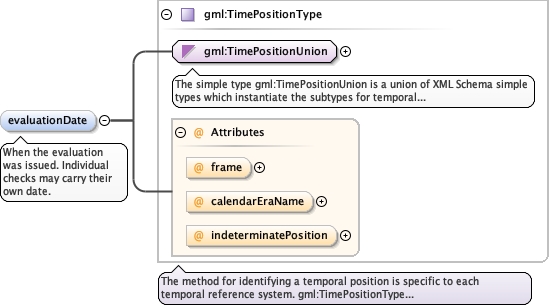
<element minOccurs="0" name="evaluationDate" type="gml:TimePositionType"><annotation><documentation>When the evaluation was issued. Individual checks may carry their own date.</documentation></annotation></element>
Complex Type diggs:AbstractEvaluationType
Namespace
http://diggsml.org/schemas/3
Annotations
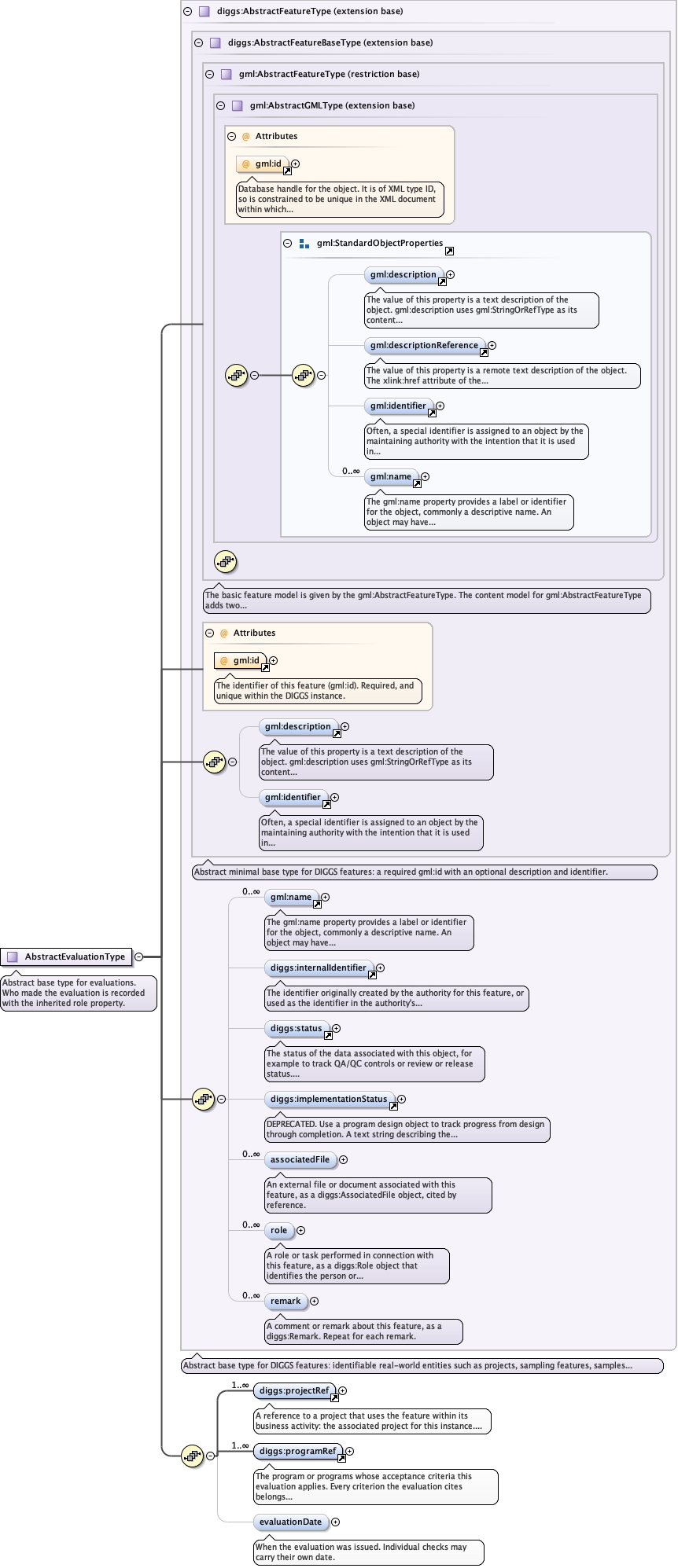
Abstract base type for evaluations. Who made the evaluation is recorded with theinherited role property.
Database handle for the object. It is of XML type ID, so is constrained to beunique in the XML document within which it occurs. An external identifier for the object inthe form of a URI may be constructed using standard XML and XPointer methods. This is doneby concatenating the URI for the document, a fragment separator, and the value of the idattribute.
Source
<complexType abstract="true" name="AbstractEvaluationType"><annotation><documentation>Abstract base type for evaluations. Who made the evaluation is recorded with the inherited role property.</documentation></annotation><complexContent><extension base="diggs:AbstractFeatureType"><sequence><element ref="diggs:projectRef" maxOccurs="unbounded"/><element maxOccurs="unbounded" ref="diggs:programRef"><annotation><documentation>The program or programs whose acceptance criteria this evaluation applies. Every criterion the evaluation cites belongs to one of them. More than one where an evaluation spans programs, for example the results of a testing program judged against the criteria of a ground improvement program.</documentation></annotation></element><element minOccurs="0" name="evaluationDate" type="gml:TimePositionType"><annotation><documentation>When the evaluation was issued. Individual checks may carry their own date.</documentation></annotation></element></sequence></extension></complexContent></complexType>