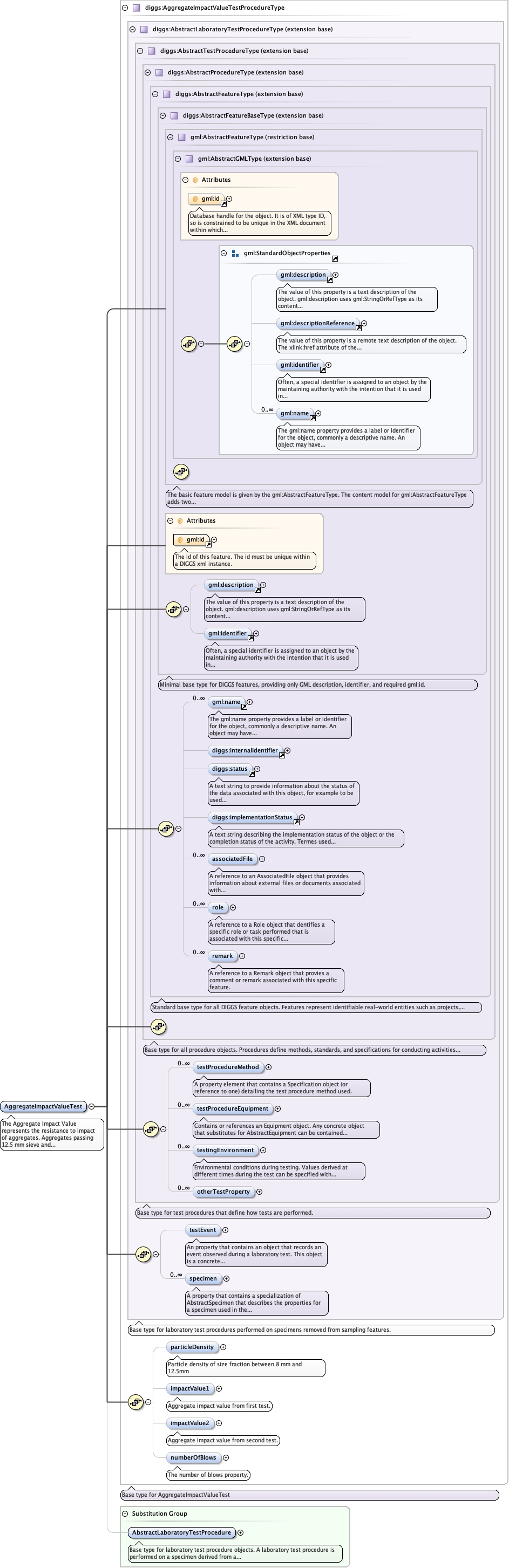
The Aggregate Impact Value represents the resistance to impact ofaggregates. Aggregates passing 12.5 mm sieve and retained on 10 mm sieve is filledin a cylindrical steel cup of internal dia 10.2 mm and depth 5 cm which is attachedto a metal base of impact testing machine. The material is filled in 3 layers whereeach layer is tamped for 25 number of blows. Metal hammer of weight 13.5 to 14 Kg isarranged to drop with a free fall of 38.0 cm by vertical guides and the testspecimen is subjected to 15 number of blows. The crushed aggregate is allowed topass through the 2.36 sieve. And the impact value is measured as percentage ofaggregates passing to the total weight of the sample.
Database handle for the object. It is of XML type ID, so is constrained to beunique in the XML document within which it occurs. An external identifier for the object inthe form of a URI may be constructed using standard XML and XPointer methods. This is doneby concatenating the URI for the document, a fragment separator, and the value of the idattribute.
Source
<element name="AggregateImpactValueTest" type="diggs:AggregateImpactValueTestProcedureType" abstract="false" substitutionGroup="diggs:AbstractLaboratoryTestProcedure"><annotation><documentation>The Aggregate Impact Value represents the resistance to impact of aggregates. Aggregates passing 12.5 mm sieve and retained on 10 mm sieve is filled in a cylindrical steel cup of internal dia 10.2 mm and depth 5 cm which is attached to a metal base of impact testing machine. The material is filled in 3 layers where each layer is tamped for 25 number of blows. Metal hammer of weight 13.5 to 14 Kg is arranged to drop with a free fall of 38.0 cm by vertical guides and the test specimen is subjected to 15 number of blows. The crushed aggregate is allowed to pass through the 2.36 sieve. And the impact value is measured as percentage of aggregates passing to the total weight of the sample.</documentation></annotation></element>