Showing:

Annotations
Attributes
Diagrams
Instances
Model
Properties
Source
Used by
Element diggs:ConstituentSystemType / diggs:constituentType
Namespace http://diggsml.org/schemas/3
Annotations
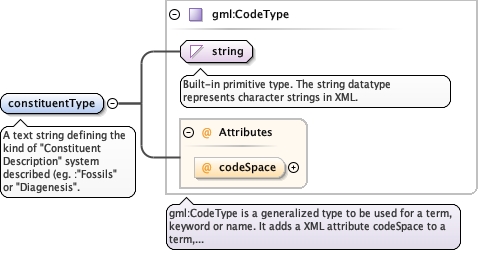
A text string defining the kind of "Constituent
Description" system described (eg. :"Fossils" or "Diagenesis".
Diagram
Diagramgml3_2Profile_diggs_xsd_Complex_Type_gml_CodeType.tmp#CodeType_codeSpacegml3_2Profile_diggs_xsd_Complex_Type_gml_CodeType.tmp#CodeType
Type gml:CodeType
Properties
content complex
Attributes
QName Type Use
codeSpace anyURI optional
Source
<element name="constituentType" type="gml:CodeType">
  <annotation>
    <documentation>A text string defining the kind of "Constituent Description" system described (eg. :"Fossils" or "Diagenesis".</documentation>
  </annotation>
</element>
Element diggs:ConstituentSystemType / diggs:constituentObservation
Namespace http://diggsml.org/schemas/3
Annotations
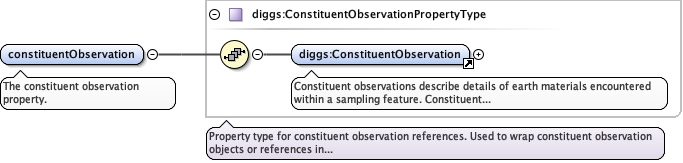
The constituent observation property.
Diagram
DiagramExtObservation_xsd_Element_diggs_ConstituentObservation.tmp#ConstituentObservationExtObservation_xsd_Complex_Type_diggs_ConstituentObservationPropertyType.tmp#ConstituentObservationPropertyType
Type diggs:ConstituentObservationPropertyType
Properties
content complex
maxOccurs unbounded
Model
Children diggs:ConstituentObservation
Instance
<diggs:constituentObservation xmlns:diggs="http://diggsml.org/schemas/3">
  <diggs:ConstituentObservation howDetermined="" gml:id="" stratumCode="">{1,1}</diggs:ConstituentObservation>
</diggs:constituentObservation>
Source
<element maxOccurs="unbounded" name="constituentObservation" type="diggs:ConstituentObservationPropertyType">
  <annotation>
    <documentation>The constituent observation property.</documentation>
  </annotation>
</element>
Complex Type diggs:ConstituentSystemType
Namespace http://diggsml.org/schemas/3
Annotations
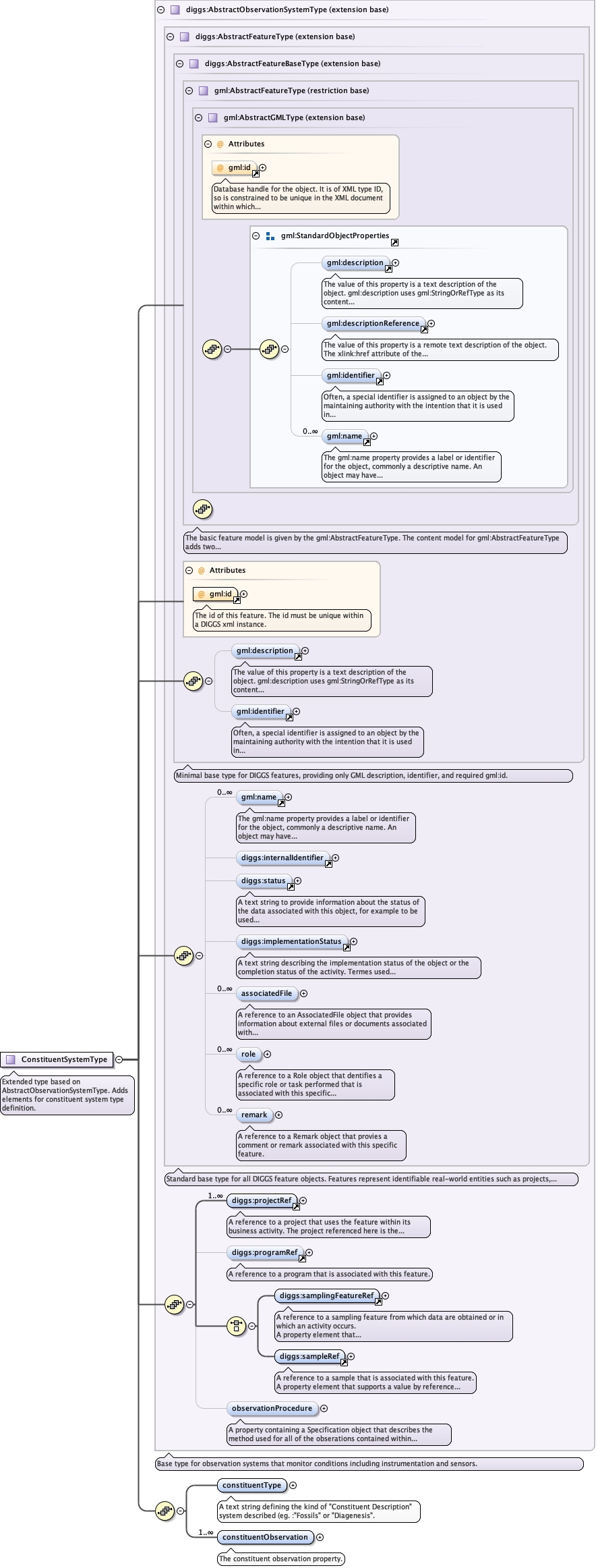
Extended type based on AbstractObservationSystemType. Adds elements for constituent system type definition.
Diagram
Diagramgml3_2Profile_diggs_xsd_Attribute_gml_id.tmp#idgml3_2Profile_diggs_xsd_Element_gml_description.tmp#descriptiongml3_2Profile_diggs_xsd_Element_gml_descriptionReference.tmp#descriptionReferencegml3_2Profile_diggs_xsd_Element_gml_identifier.tmp#identifiergml3_2Profile_diggs_xsd_Element_gml_name.tmp#namegml3_2Profile_diggs_xsd_Element_Group_gml_StandardObjectProperties.tmp#StandardObjectPropertiesgml3_2Profile_diggs_xsd_Complex_Type_gml_AbstractGMLType.tmp#AbstractGMLTypegml3_2Profile_diggs_xsd_Complex_Type_gml_AbstractFeatureType.tmp#AbstractFeatureTypegml3_2Profile_diggs_xsd_Attribute_gml_id.tmp#idgml3_2Profile_diggs_xsd_Element_gml_description.tmp#descriptiongml3_2Profile_diggs_xsd_Element_gml_identifier.tmp#identifierAbstractTypes_xsd_Complex_Type_diggs_AbstractFeatureBaseType.tmp#AbstractFeatureBaseTypegml3_2Profile_diggs_xsd_Element_gml_name.tmp#nameCommon_xsd_Element_diggs_internalIdentifier.tmp#internalIdentifierCommon_xsd_Element_diggs_status.tmp#statusCommon_xsd_Element_diggs_implementationStatus.tmp#implementationStatusAbstractTypes_xsd_Complex_Type_diggs_AbstractFeatureType.tmp#http___diggsml.org_schemas_3_AbstractFeatureType_associatedFileAbstractTypes_xsd_Complex_Type_diggs_AbstractFeatureType.tmp#http___diggsml.org_schemas_3_AbstractFeatureType_roleAbstractTypes_xsd_Complex_Type_diggs_AbstractFeatureType.tmp#http___diggsml.org_schemas_3_AbstractFeatureType_remarkAbstractTypes_xsd_Complex_Type_diggs_AbstractFeatureType.tmp#http___diggsml.org_schemas_3_AbstractFeatureTypeCommon_xsd_Element_diggs_projectRef.tmp#projectRefCommon_xsd_Element_diggs_programRef.tmp#programRefCommon_xsd_Element_diggs_samplingFeatureRef.tmp#samplingFeatureRefCommon_xsd_Element_diggs_sampleRef.tmp#sampleRefAbstractTypes_xsd_Complex_Type_diggs_AbstractObservationSystemType.tmp#AbstractObservationSystemType_observationProcedureAbstractTypes_xsd_Complex_Type_diggs_AbstractObservationSystemType.tmp#AbstractObservationSystemTypeExtObservation_xsd_Complex_Type_diggs_ConstituentSystemType.tmp#ConstituentSystemType_constituentTypeExtObservation_xsd_Complex_Type_diggs_ConstituentSystemType.tmp#ConstituentSystemType_constituentObservation
Type extension of diggs:AbstractObservationSystemType
Type hierarchy
Used by
Model
Children diggs:associatedFile, diggs:constituentObservation, diggs:constituentType, diggs:implementationStatus, diggs:internalIdentifier, diggs:observationProcedure, diggs:programRef, diggs:projectRef, diggs:remark, diggs:role, diggs:sampleRef, diggs:samplingFeatureRef, diggs:status, gml:description, gml:identifier, gml:name
Attributes
QName Type Use Annotation
gml:id ID required
Database handle for the object. It is of XML type ID, so is constrained to be
unique in the XML document within which it occurs. An external identifier for the object in
the form of a URI may be constructed using standard XML and XPointer methods. This is done
by concatenating the URI for the document, a fragment separator, and the value of the id
attribute.
Source
<complexType name="ConstituentSystemType">
  <annotation>
    <documentation>Extended type based on AbstractObservationSystemType. Adds elements for constituent system type definition.</documentation>
  </annotation>
  <complexContent>
    <extension base="diggs:AbstractObservationSystemType">
      <sequence>
        <element name="constituentType" type="gml:CodeType">
          <annotation>
            <documentation>A text string defining the kind of "Constituent Description" system described (eg. :"Fossils" or "Diagenesis".</documentation>
          </annotation>
        </element>
        <element maxOccurs="unbounded" name="constituentObservation" type="diggs:ConstituentObservationPropertyType">
          <annotation>
            <documentation>The constituent observation property.</documentation>
          </annotation>
        </element>
      </sequence>
    </extension>
  </complexContent>
</complexType>