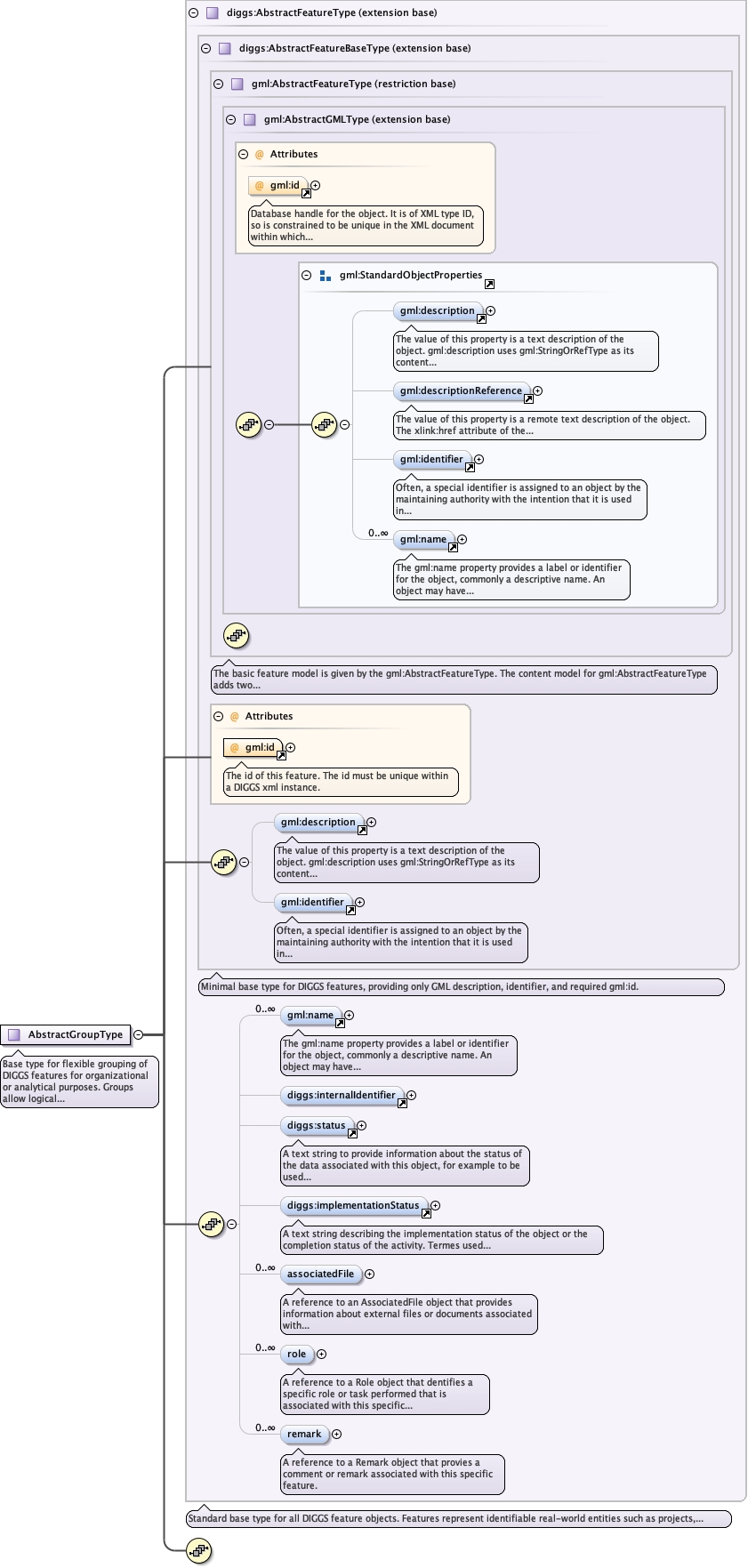
Base type for flexible grouping of DIGGS features for organizational or analytical purposes. Groups allow logical associations of projects, sampling features, samples, or other features without establishing strict hierarchical relationships. Groups can be used to organize features by geographic area, time period, purpose, contractor, or any other organizational principle. Groups can contain mixed feature types and features can belong to multiple groups.
Database handle for the object. It is of XML type ID, so is constrained to beunique in the XML document within which it occurs. An external identifier for the object inthe form of a URI may be constructed using standard XML and XPointer methods. This is doneby concatenating the URI for the document, a fragment separator, and the value of the idattribute.
Source
<complexType name="AbstractGroupType" abstract="true"><annotation><documentation>Base type for flexible grouping of DIGGS features for organizational or analytical purposes. Groups allow logical associations of projects, sampling features, samples, or other features without establishing strict hierarchical relationships. Groups can be used to organize features by geographic area, time period, purpose, contractor, or any other organizational principle. Groups can contain mixed feature types and features can belong to multiple groups.</documentation></annotation><complexContent><extension base="diggs:AbstractFeatureType"><sequence/></extension></complexContent></complexType>