Showing:

Annotations
Attributes
Diagrams
Instances
Model
Properties
Source
Element gml:ValueArray
Namespace http://www.opengis.net/gml/3.2
Annotations
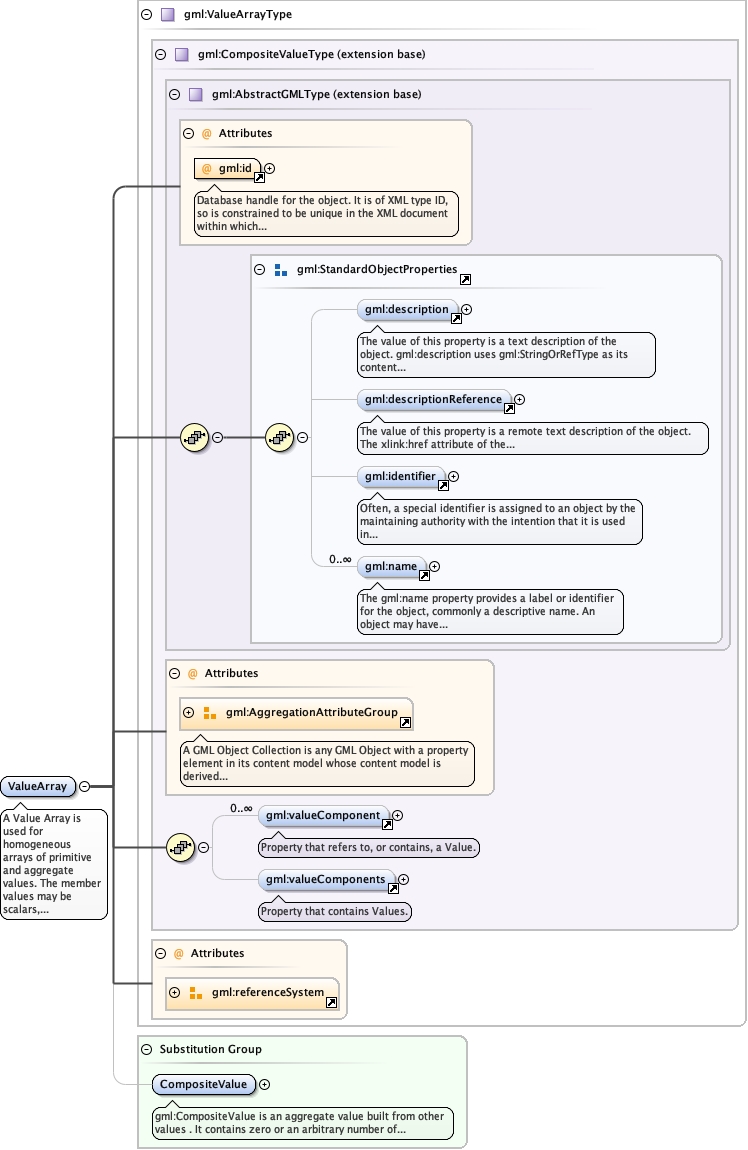
A Value Array is used for homogeneous arrays of primitive and aggregate values.
The member values may be scalars, composites, arrays or lists. ValueArray has the same
content model as CompositeValue, but the member values shall be homogeneous. The element
declaration contains a Schematron constraint which expresses this restriction precisely.
Since the members are homogeneous, the gml:referenceSystem (uom, codeSpace) may be specified
on the gml:ValueArray itself and inherited by all the members if desired.
Diagram
Diagramgml3_2Profile_diggs_xsd_Attribute_gml_id.tmp#idgml3_2Profile_diggs_xsd_Element_gml_description.tmp#descriptiongml3_2Profile_diggs_xsd_Element_gml_descriptionReference.tmp#descriptionReferencegml3_2Profile_diggs_xsd_Element_gml_identifier.tmp#identifiergml3_2Profile_diggs_xsd_Element_gml_name.tmp#namegml3_2Profile_diggs_xsd_Element_Group_gml_StandardObjectProperties.tmp#StandardObjectPropertiesgml3_2Profile_diggs_xsd_Complex_Type_gml_AbstractGMLType.tmp#AbstractGMLTypegml3_2Profile_diggs_xsd_Attribute_Group_gml_AggregationAttributeGroup.tmp#AggregationAttributeGroupgml3_2Profile_diggs_xsd_Element_gml_valueComponent.tmp#valueComponentgml3_2Profile_diggs_xsd_Element_gml_valueComponents.tmp#valueComponentsgml3_2Profile_diggs_xsd_Complex_Type_gml_CompositeValueType.tmp#CompositeValueTypegml3_2Profile_diggs_xsd_Attribute_Group_gml_referenceSystem.tmp#referenceSystemgml3_2Profile_diggs_xsd_Complex_Type_gml_ValueArrayType.tmp#ValueArrayTypegml3_2Profile_diggs_xsd_Element_gml_CompositeValue.tmp#CompositeValue
Type gml:ValueArrayType
Type hierarchy
Properties
content complex
Substitution Group Affiliation
Model
Children gml:description, gml:descriptionReference, gml:identifier, gml:name, gml:valueComponent, gml:valueComponents
Instance
<gml:ValueArray aggregationType="" codeSpace="" gml:id="" uom="" xmlns:gml="http://www.opengis.net/gml/3.2">
  <gml:description xlink:actuate="" xlink:arcrole="" xlink:href="" nilReason="" xlink:role="" xlink:show="" xlink:title="" xlink:type="simple">{0,1}</gml:description>
  <gml:descriptionReference xlink:actuate="" xlink:arcrole="" xlink:href="" nilReason="" owns="false" xlink:role="" xlink:show="" xlink:title="" xlink:type="simple">{0,1}</gml:descriptionReference>
  <gml:identifier codeSpace="">{0,1}</gml:identifier>
  <gml:name codeSpace="">{0,unbounded}</gml:name>
  <gml:valueComponent xlink:actuate="" xlink:arcrole="" xlink:href="" nilReason="" owns="false" xlink:role="" xlink:show="" xlink:title="" xlink:type="simple">{0,unbounded}</gml:valueComponent>
  <gml:valueComponents owns="false">{0,1}</gml:valueComponents>
</gml:ValueArray>
Attributes
QName Type Use Annotation
aggregationType gml:AggregationType optional
codeSpace anyURI optional
gml:id ID required
Database handle for the object. It is of XML type ID, so is constrained to be
unique in the XML document within which it occurs. An external identifier for the object in
the form of a URI may be constructed using standard XML and XPointer methods. This is done
by concatenating the URI for the document, a fragment separator, and the value of the id
attribute.
uom gml:UomIdentifier optional
Source
<element name="ValueArray" type="gml:ValueArrayType" substitutionGroup="gml:CompositeValue">
  <annotation>
    <documentation>A Value Array is used for homogeneous arrays of primitive and aggregate values. The member values may be scalars, composites, arrays or lists. ValueArray has the same content model as CompositeValue, but the member values shall be homogeneous. The element declaration contains a Schematron constraint which expresses this restriction precisely. Since the members are homogeneous, the gml:referenceSystem (uom, codeSpace) may be specified on the gml:ValueArray itself and inherited by all the members if desired.</documentation>
  </annotation>
</element>