Showing:

Annotations
Attributes
Diagrams
Instances
Model
Properties
Source
Used by
Element gml:TimePeriod
Namespace http://www.opengis.net/gml/3.2
Annotations
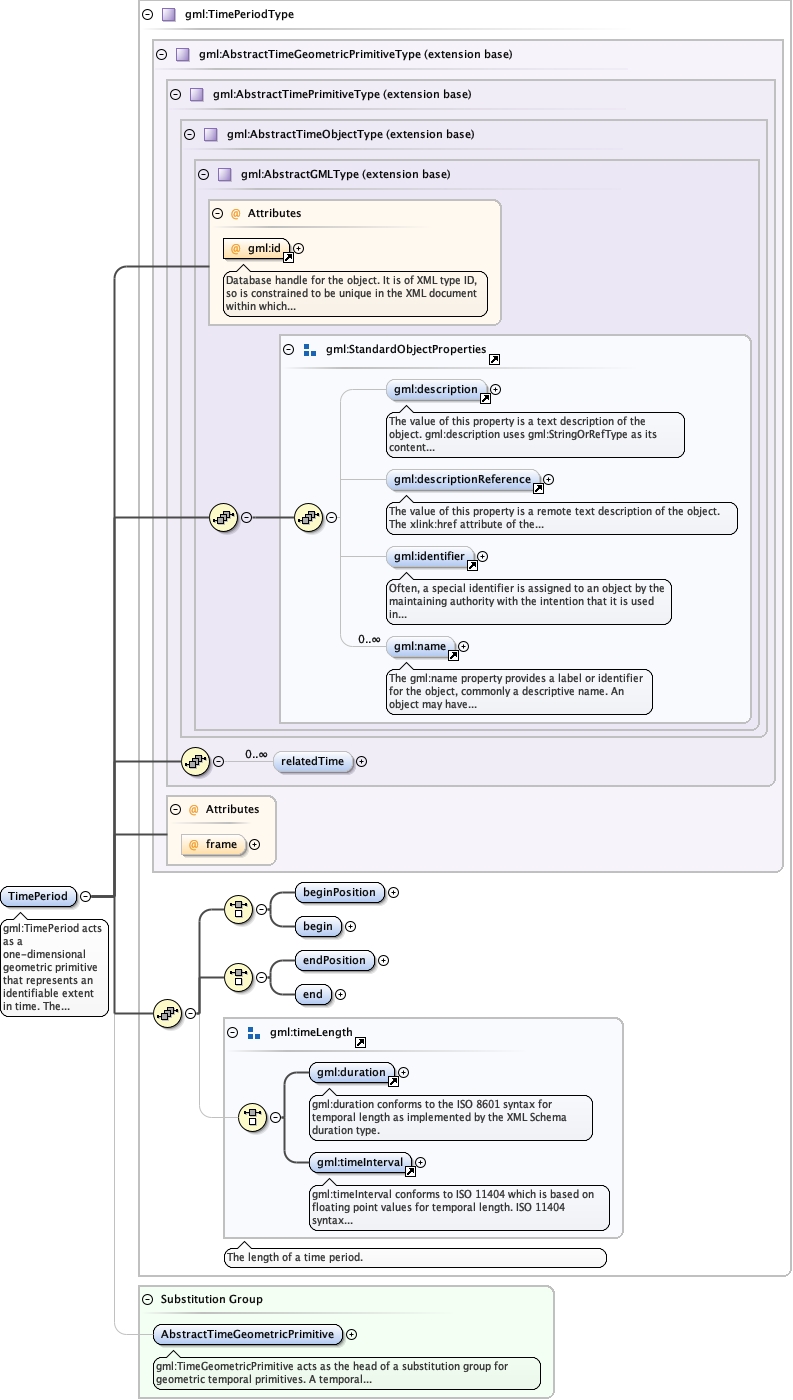
gml:TimePeriod acts as a one-dimensional geometric primitive that represents an
identifiable extent in time. The location in of a gml:TimePeriod is described by the
temporal positions of the instants at which it begins and ends. The length of the period is
equal to the temporal distance between the two bounding temporal positions. Both beginning
and end may be described in terms of their direct position using gml:TimePositionType which
is an XML Schema simple content type, or by reference to an indentifiable time instant using
gml:TimeInstantPropertyType. Alternatively a limit of a gml:TimePeriod may use the
conventional GML property model to make a reference to a time instant described elsewhere,
or a limit may be indicated as a direct position.
Diagram
Diagramgml3_2Profile_diggs_xsd_Attribute_gml_id.tmp#idgml3_2Profile_diggs_xsd_Element_gml_description.tmp#descriptiongml3_2Profile_diggs_xsd_Element_gml_descriptionReference.tmp#descriptionReferencegml3_2Profile_diggs_xsd_Element_gml_identifier.tmp#identifiergml3_2Profile_diggs_xsd_Element_gml_name.tmp#namegml3_2Profile_diggs_xsd_Element_Group_gml_StandardObjectProperties.tmp#StandardObjectPropertiesgml3_2Profile_diggs_xsd_Complex_Type_gml_AbstractGMLType.tmp#AbstractGMLTypegml3_2Profile_diggs_xsd_Complex_Type_gml_AbstractTimeObjectType.tmp#AbstractTimeObjectTypegml3_2Profile_diggs_xsd_Complex_Type_gml_AbstractTimePrimitiveType.tmp#AbstractTimePrimitiveType_relatedTimegml3_2Profile_diggs_xsd_Complex_Type_gml_AbstractTimePrimitiveType.tmp#AbstractTimePrimitiveTypegml3_2Profile_diggs_xsd_Complex_Type_gml_AbstractTimeGeometricPrimitiveType.tmp#AbstractTimeGeometricPrimitiveType_framegml3_2Profile_diggs_xsd_Complex_Type_gml_AbstractTimeGeometricPrimitiveType.tmp#AbstractTimeGeometricPrimitiveTypegml3_2Profile_diggs_xsd_Complex_Type_gml_TimePeriodType.tmp#TimePeriodType_beginPositiongml3_2Profile_diggs_xsd_Complex_Type_gml_TimePeriodType.tmp#TimePeriodType_begingml3_2Profile_diggs_xsd_Complex_Type_gml_TimePeriodType.tmp#TimePeriodType_endPositiongml3_2Profile_diggs_xsd_Complex_Type_gml_TimePeriodType.tmp#TimePeriodType_endgml3_2Profile_diggs_xsd_Element_gml_duration.tmp#durationgml3_2Profile_diggs_xsd_Element_gml_timeInterval.tmp#http___www.opengis.net_gml_3.2_timeIntervalgml3_2Profile_diggs_xsd_Element_Group_gml_timeLength.tmp#timeLengthgml3_2Profile_diggs_xsd_Complex_Type_gml_TimePeriodType.tmp#TimePeriodTypegml3_2Profile_diggs_xsd_Element_gml_AbstractTimeGeometricPrimitive.tmp#AbstractTimeGeometricPrimitive
Type gml:TimePeriodType
Type hierarchy
Properties
content complex
Substitution Group Affiliation
Used by
Model
Children gml:begin, gml:beginPosition, gml:description, gml:descriptionReference, gml:duration, gml:end, gml:endPosition, gml:identifier, gml:name, gml:relatedTime, gml:timeInterval
Instance
<gml:TimePeriod frame="#ISO-8601" gml:id="" xmlns:gml="http://www.opengis.net/gml/3.2">
  <gml:description xlink:actuate="" xlink:arcrole="" xlink:href="" nilReason="" xlink:role="" xlink:show="" xlink:title="" xlink:type="simple">{0,1}</gml:description>
  <gml:descriptionReference xlink:actuate="" xlink:arcrole="" xlink:href="" nilReason="" owns="false" xlink:role="" xlink:show="" xlink:title="" xlink:type="simple">{0,1}</gml:descriptionReference>
  <gml:identifier codeSpace="">{0,1}</gml:identifier>
  <gml:name codeSpace="">{0,unbounded}</gml:name>
  <gml:relatedTime xlink:actuate="" xlink:arcrole="" xlink:href="" nilReason="" owns="false" relativePosition="" xlink:role="" xlink:show="" xlink:title="" xlink:type="simple">{0,unbounded}</gml:relatedTime>
  <gml:beginPosition calendarEraName="" frame="#ISO-8601" indeterminatePosition="">{1,1}</gml:beginPosition>
  <gml:begin xlink:actuate="" xlink:arcrole="" xlink:href="" nilReason="" owns="false" xlink:role="" xlink:show="" xlink:title="" xlink:type="simple">{1,1}</gml:begin>
  <gml:endPosition calendarEraName="" frame="#ISO-8601" indeterminatePosition="">{1,1}</gml:endPosition>
  <gml:end xlink:actuate="" xlink:arcrole="" xlink:href="" nilReason="" owns="false" xlink:role="" xlink:show="" xlink:title="" xlink:type="simple">{1,1}</gml:end>
  <gml:duration>{1,1}</gml:duration>
  <gml:timeInterval factor="" radix="" unit="">{1,1}</gml:timeInterval>
</gml:TimePeriod>
Attributes
QName Type Default Use Annotation
frame anyURI #ISO-8601 optional
gml:id ID required
Database handle for the object. It is of XML type ID, so is constrained to be
unique in the XML document within which it occurs. An external identifier for the object in
the form of a URI may be constructed using standard XML and XPointer methods. This is done
by concatenating the URI for the document, a fragment separator, and the value of the id
attribute.
Source
<element name="TimePeriod" type="gml:TimePeriodType" substitutionGroup="gml:AbstractTimeGeometricPrimitive">
  <annotation>
    <documentation>gml:TimePeriod acts as a one-dimensional geometric primitive that represents an identifiable extent in time. The location in of a gml:TimePeriod is described by the temporal positions of the instants at which it begins and ends. The length of the period is equal to the temporal distance between the two bounding temporal positions. Both beginning and end may be described in terms of their direct position using gml:TimePositionType which is an XML Schema simple content type, or by reference to an indentifiable time instant using gml:TimeInstantPropertyType. Alternatively a limit of a gml:TimePeriod may use the conventional GML property model to make a reference to a time instant described elsewhere, or a limit may be indicated as a direct position.</documentation>
  </annotation>
</element>