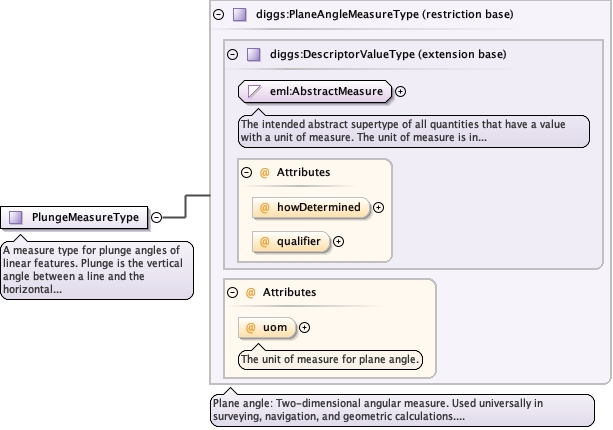
A measure type for plunge angles of linear features. Plunge is the vertical angle between a line and the horizontal plane, measured POSITIVE UP. The angle is negative for features dipping below horizontal and positive for features pointing upward above horizontal. Values are constrained to the range -90° to +90° (or equivalent in other angular units), where 0° represents horizontal, -90° represents vertically downward, and +90° represents vertically upward. A vertical borehole therefore plunges -90°. THIS REVERSES THE CONVENTION THIS TYPE PREVIOUSLY DOCUMENTED, which described plunge as positive downward following structural-geology usage. That statement was wrong for DIGGS on two counts: it contradicted the plunge property on diggs:AbstractLinearSamplingFeatureType, which has always said "positive up", and it contradicted actual practice - released DIGGS instances record downward holes as negative, for example a plunge of -88.5 dega on a near-vertical borehole, which the old wording would have read as a hole pointing almost straight UP. The element documentation and the instance data agree with each other, so the type text has been corrected to match them rather than the other way round. Plunge is used extensively in structural geology to describe the orientation of fold axes, lineations, drill holes, mineral elongations, and other linear features. When combined with trend (the horizontal direction), plunge provides complete three-dimensional orientation of a line in space.
<complexType name="PlungeMeasureType"><annotation><documentation>A measure type for plunge angles of linear features. Plunge is the vertical angle between a line and the horizontal plane, measured POSITIVE UP. The angle is negative for features dipping below horizontal and positive for features pointing upward above horizontal. Values are constrained to the range -90° to +90° (or equivalent in other angular units), where 0° represents horizontal, -90° represents vertically downward, and +90° represents vertically upward. A vertical borehole therefore plunges -90°. THIS REVERSES THE CONVENTION THIS TYPE PREVIOUSLY DOCUMENTED, which described plunge as positive downward following structural-geology usage. That statement was wrong for DIGGS on two counts: it contradicted the plunge property on diggs:AbstractLinearSamplingFeatureType, which has always said "positive up", and it contradicted actual practice - released DIGGS instances record downward holes as negative, for example a plunge of -88.5 dega on a near-vertical borehole, which the old wording would have read as a hole pointing almost straight UP. The element documentation and the instance data agree with each other, so the type text has been corrected to match them rather than the other way round. Plunge is used extensively in structural geology to describe the orientation of fold axes, lineations, drill holes, mineral elongations, and other linear features. When combined with trend (the horizontal direction), plunge provides complete three-dimensional orientation of a line in space.</documentation></annotation><simpleContent><restriction base="diggs:PlaneAngleMeasureType"><minInclusive value="-90"><annotation><documentation>Minimum plunge value (-90 degrees or equivalent): vertically DOWNWARD orientation, the value a vertical borehole takes</documentation></annotation></minInclusive><maxInclusive value="90"><annotation><documentation>Maximum plunge value (+90 degrees or equivalent): vertically UPWARD orientation</documentation></annotation></maxInclusive></restriction></simpleContent></complexType>