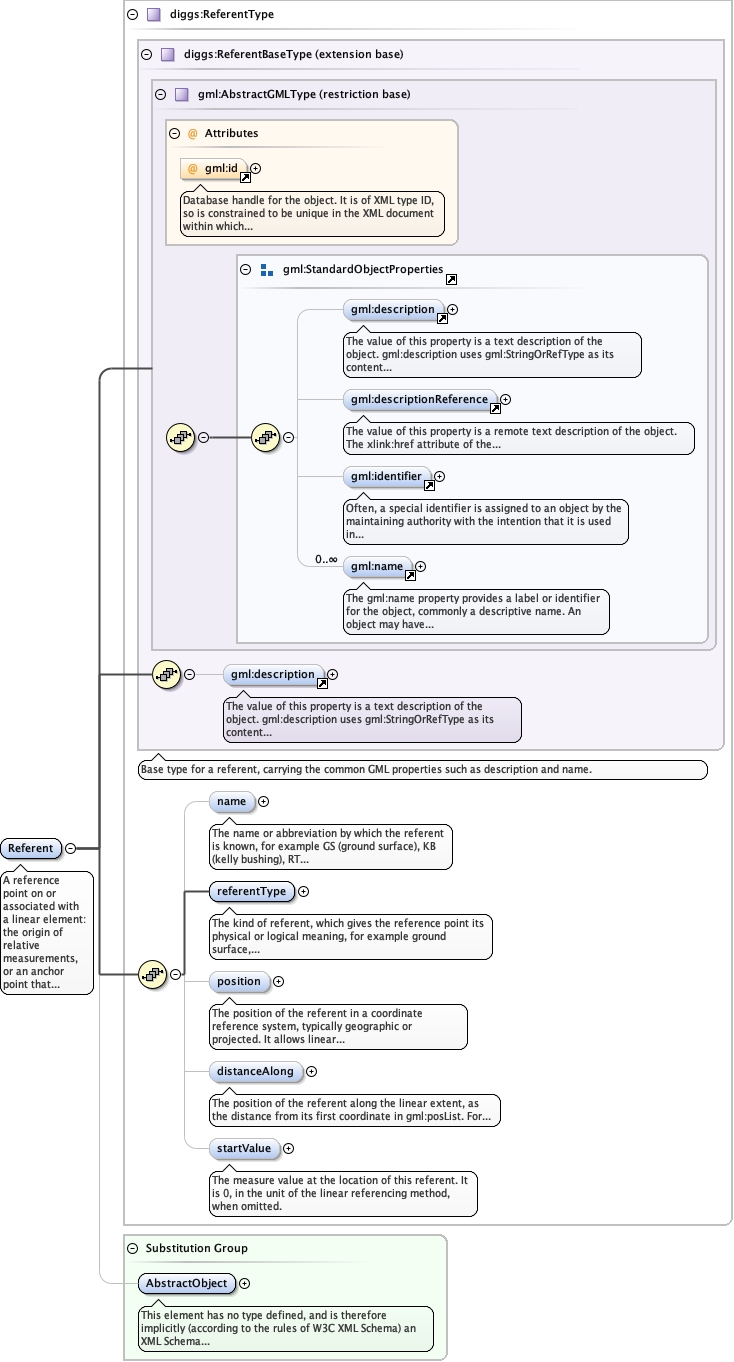
A reference point on or associated with a linear element: the origin of relativemeasurements, or an anchor point that calibrates an interpolative method. Examplesare the ground surface, kelly bushing or rotary table for drilling, the sea floor ormudline for marine work, the start or end of a geophysical trackline, a kickoffpoint for wells, and the top or bottom of a core. When a linear spatial referencesystem uses a relative method, the referent is the zero point of its measurements.
Database handle for the object. It is of XML type ID, so is constrained to beunique in the XML document within which it occurs. An external identifier for the object inthe form of a URI may be constructed using standard XML and XPointer methods. This is doneby concatenating the URI for the document, a fragment separator, and the value of the idattribute.
Source
<element name="Referent" type="diggs:ReferentType" substitutionGroup="gml:AbstractObject"><annotation><documentation>A reference point on or associated with a linear element: the origin of relative measurements, or an anchor point that calibrates an interpolative method. Examples are the ground surface, kelly bushing or rotary table for drilling, the sea floor or mudline for marine work, the start or end of a geophysical trackline, a kickoff point for wells, and the top or bottom of a core. When a linear spatial reference system uses a relative method, the referent is the zero point of its measurements.</documentation></annotation></element>